Google's March 2026 spam update is live - what changed and why it matters
Google released the March 2026 spam update on March 24 at 12:18 PDT, targeting global search spam across all languages. Rollout may take days.


Google released the March 2026 spam update on March 24 at 12:18 PDT, targeting global search spam across all languages. Rollout may take days.
Google today began rolling out the March 2026 spam update to its search rankings worldwide, marking the first confirmed spam enforcement action of the year and the first major algorithmic intervention since the December 2025 core update concluded nearly three months ago.
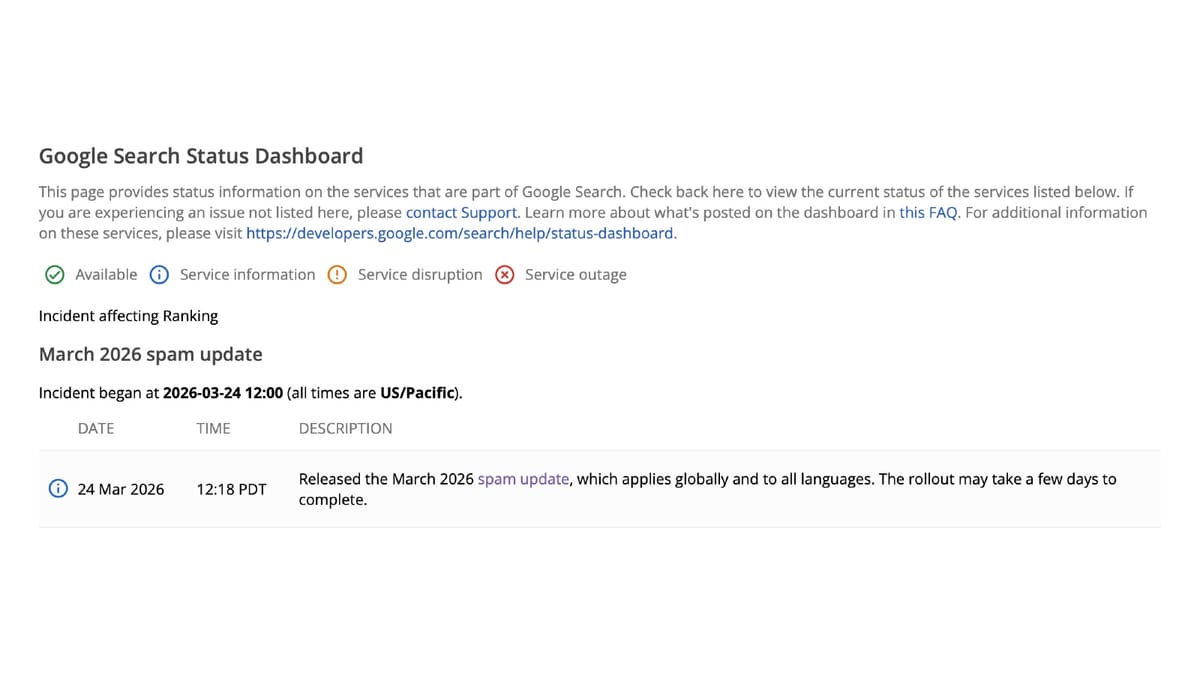
According to the Google Search Status Dashboard, the update was released on March 24, 2026, at 12:18 PDT - with the incident formally logged as beginning at 12:00 PDT the same day. The dashboard entry, classified under "Incident affecting Ranking," carries a brief but sweeping description: "Released the March 2026 spam update, which applies globally and to all languages. The rollout may take a few days to complete."
The announcement came simultaneously through Google Search Central's LinkedIn page, which has 125,863 followers. The post, published approximately two hours after the dashboard entry, reads: "Today we released the March 2026 spam update to Google Search. This is a normal spam update, and it will roll out for all languages and locations. The rollout may take a few days to complete." The post had attracted 587 reactions, 24 comments, and 138 reposts within hours of publication, reflecting the level of attention Google's spam enforcement actions draw from the search marketing and SEO communities.
Notably, Google described the update as "a normal spam update" - language that signals to the industry this is a routine enforcement cycle rather than a targeted or thematic release. Still, even routine spam updates carry real consequences for websites globally.
Spam updates operate differently from Google's core algorithm updates. Where core updates broadly reassess how Google evaluates content quality, relevance, and authority across all sites, spam updates focus narrowly on enforcing specific policy violations. According to Google's Search Central documentation, "While Google's automated systems to detect search spam are constantly operating, we occasionally make notable improvements to how they work. When we do, we refer to this as a spam update."
The central engine behind these updates is SpamBrain, Google's AI-based spam prevention system. According to the documentation, "SpamBrain is our AI-based spam-prevention system. From time-to-time, we improve that system to make it better at spotting spam and to help ensure it catches new types of spam." The system is continuously active, but spam updates mark moments when its underlying parameters receive meaningful upgrades.
Sites affected by a spam update face two possible outcomes. According to Google's documentation, violating sites "may rank lower in results or not appear in results at all." The severity depends on the nature and extent of the detected policy violations. Recovery is possible - but slow. Google notes that "making changes may help a site improve if our automated systems learn over a period of months that the site complies with our spam policies."
One particularly important technical distinction applies to link spam specifically. According to Google's documentation: "In the case of a link spam update (an update that specifically deals with link spam), making changes might not generate an improvement. This is because when our systems remove the effects spammy links may have, any ranking benefit the links may have previously generated for your site is lost. Any potential ranking benefits generated by those links cannot be regained."
This point has real-world implications for search practitioners. Unlike content-related spam penalties - which can theoretically be remediated - link-based ranking gains are permanently neutralized once Google's systems identify and discount those links.
The March 2026 update arrives against a backdrop of accelerating spam enforcement activity over recent years. Google launched the August 2025 spam update on August 26, 2025, at 12:02 PDT - a rollout that ultimately ran for 27 days before completing on September 22, making it one of the longer spam update deployments in recent memory. Analysis by SISTRIX found minimal visible impact during that rollout compared to core updates, suggesting the targeting was precise rather than broad.
Before that, the December 2024 spam update completed after seven days, a relatively quick cycle. The June 2024 spam update completed on June 27, 2024, and the earlier June 2024 spam rollout began on June 20. Historical data shows rollout durations ranging from 48 hours to 29 days, depending on scope.
What makes the March 2026 timing notable is its placement in the calendar. Google's December 2025 core update wrapped on December 29, 2025, after 18 days - the longest core update rollout of that year, following patterns of 14 days in March 2025 and 16 days in June 2025. The December 2025 core update caused severe traffic disruptions, with some publishers reporting declines ranging from 70-85 percent and nearly 15 percent of top-10-ranked pages disappearing from the top 100 entirely. Given that core update's severity, the arrival of a spam update just under three months later - without a core update in between - is worth tracking closely by website owners still assessing their post-December rankings.
Google's December 2022 link spam update first publicly deployed SpamBrain for large-scale link manipulation detection. That introduction represented a structural shift: rather than rule-based filters, machine learning now drives much of the anti-spam enforcement infrastructure. Since 2022, SpamBrain has been periodically upgraded to detect new violation types and close loopholes that earlier versions missed.
The scale of spam policy expansion in recent years tracks this technical evolution. In January 2025, Google added 11 new pages to its search quality rater guidelines, expanding the document from 170 to 181 pages, with the changes focused specifically on spam identification criteria. In September 2024, Google introduced explicit site reputation abuse policiesdefining third-party content exploitation as a policy violation. The site reputation abuse crackdown formally took effect from May 5, 2024, with clarified FAQs added in December 2024 after ongoing industry confusion about compliance requirements.
An April 2025 update to quality rater guidelines introduced AI content evaluation criteria, directing human evaluators to identify pages with main content generated by automated or generative AI tools and potentially flag them as lowest quality - a development that attracted significant industry attention given the proliferation of AI-generated content across the web.
Whether the March 2026 spam update targets any of these specific dimensions - link spam, site reputation abuse, AI-generated content spam, or expired domain abuse - remains unspecified. Google has not disclosed thematic details.
The LinkedIn post attracted immediate commentary from the search community. Daniel Foley Carter, an SEO specialist with over 25 years of experience, raised a question about AI Overviews: "I presume this will reduce the number of AI overviews which rehash other people's content? To me that's programmatic content generation." The comment reflects a debate that has run through the SEO industry for the past two years - whether Google's own AI-generated summaries constitute the same kind of thin, derivative content the company's spam systems are designed to penalize.
Other commenters offered less analytical responses: emoji reactions, expressions of surprise, and short acknowledgments dominated the thread beyond the top replies. The lack of technical detail in Google's announcement left practitioners with little to analyze immediately.
The broader question of AI-generated spam was anticipated months ago by SEO expert Lily Ray, senior director of SEO at AMS Digital, who in December 2025 predicted a major enforcement action targeting AI-generated content in 2026. Ray drew comparisons to the March 2024 core update and the earlier Penguin and Panda updates. Whether the March 2026 spam update represents the crackdown she anticipated, or is simply a routine enforcement cycle, will only become clear as data from affected sites emerges over the coming days and weeks.
Google's phrasing - "the rollout may take a few days to complete" - is notably shorter than the language used for the August 2025 update, which said the rollout "may take a few weeks." This suggests a more targeted and potentially faster deployment. Shorter rollouts have historically corresponded with more focused enforcement actions. The December 2024 spam update, for example, completed in seven days.
During any rollout period, ranking data can appear unstable. Sites may see traffic fluctuations that do not reflect their final post-update position. Google will update its ranking release history page when the rollout completes. The Google Search Status Dashboard remains the authoritative source for rollout status.
Search practitioners and website owners are advised to monitor Google Search Console for any manual action notifications, which represent a separate enforcement channel from algorithmic spam detections. According to Google's guidance, Google Search Central's Danny Sullivan previously clarified that the company will communicate clearly when algorithmic actions are taken, particularly in cases involving site reputation abuse.
The path forward for sites affected by the March 2026 spam update depends heavily on the nature of any violations detected. For content-related spam, the standard guidance holds: review Google's spam policies, make substantive changes, and wait for automated systems to re-evaluate compliance over a period of months. There are no shortcuts. There is no fix that takes days.
For link-based spam violations, the situation is categorically different. Once Google's systems identify and neutralize the ranking benefit of spammy links - whether those links were purchased, artificially constructed, or generated through link schemes - those gains do not return. Google's documentation is explicit on this point: any potential ranking benefits generated by those links cannot be regained, regardless of subsequent compliance.
This asymmetry matters. Sites that built organic authority through content quality face different recovery dynamics than sites that augmented rankings through link manipulation. The former can rebuild; the latter cannot undo the neutralization of artificial signals.
The March 2026 spam update also arrives at a moment of elevated scrutiny for Google's spam enforcement more broadly. The European Commission launched an investigation in November 2025 into whether Google's site reputation abuse policy - which penalizes publishers for hosting low-quality third-party content - unfairly targets news publishers generating revenue through sponsored content. Google's Chief Scientist for Search, Pandu Nayak, characterized the investigation as misguided. That regulatory tension sits in the background as Google deploys another round of global spam enforcement.
Who: Google, operating through its automated spam detection infrastructure including SpamBrain, the company's AI-based spam prevention system. The update affects website owners, publishers, and SEO practitioners globally. Google Search Central communicated the update via the Google Search Status Dashboard and LinkedIn.
What: The March 2026 spam update is a global enforcement action targeting websites that violate Google's search spam policies. Google described it as "a normal spam update." The update applies to all languages and all geographic regions. Rollout duration is expected to last "a few days." Affected sites may see ranking reductions or complete removal from search results. Recovery for content-based violations requires months of demonstrated compliance; recovery for link spam violations is structurally impossible as neutralized ranking signals cannot be restored.
When: The update was released on March 24, 2026, at 12:18 PDT, with the incident formally logged as beginning at 12:00 PDT the same day. It is the first confirmed spam update of 2026 and the first major algorithmic action since the December 2025 core update completed on December 29, 2025.
Where: The update applies globally across all languages and regions served by Google Search. It was announced via the Google Search Status Dashboard and Google Search Central's official LinkedIn page.
Why: Google regularly deploys spam updates to improve the quality and integrity of search results by enforcing its spam policies. The underlying system, SpamBrain, receives periodic improvements to detect new forms of manipulation. The March 2026 update arrives as the industry debates the role of AI-generated content in search spam and as regulatory scrutiny of Google's spam enforcement practices continues in Europe.