Google's Meridian gets a Scenario Planner to close the MMM usability gap
Google launched Scenario Planner for Meridian on Feb 19, 2026, giving marketers a code-free interface to run real-time budget scenarios and ROI estimates with its open-source MMM.
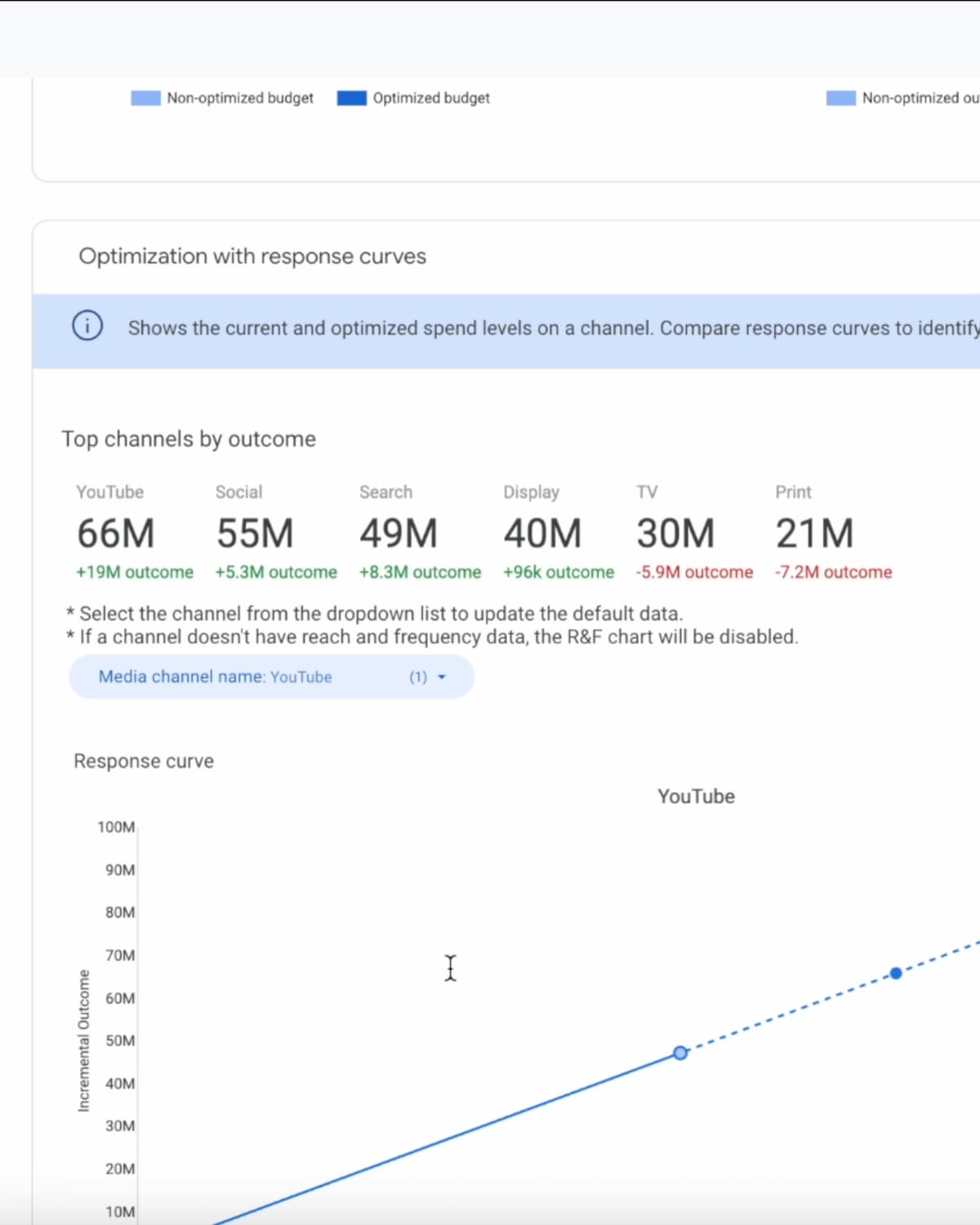
Meridian Scenario Planner response curves showing optimized vs non-optimized budget by channel.
Meridian Scenario Planner response curves showing optimized vs non-optimized budget by channel.
Google launched a new interface for its open-source Marketing Mix Model on February 19, 2026, designed to make the outputs of complex modeling software accessible to people who have never written a line of code. The tool, called Scenario Planner, is an addition to Meridian - Google's open-source MMM framework - and was announced through the company's Ads & Commerce Blog by Harikesh Nair, Senior Director of Data Science & Engineering at Google.
The central problem the launch addresses is well-documented. According to a Harvard Business Review Analytic Services report published in October 2025, nearly 40% of marketers surveyed say their organizations struggle to connect MMM outputs to real-world business decisions. That number has become a recurring reference point in industry discussions, and it frames the rationale behind Google's decision to layer a planning interface on top of Meridian's existing analytical engine.
0:00
/0:18
What Scenario Planner does
Scenario Planner is, at its core, a budget simulation tool. According to Google's announcement, it allows marketers to experiment with different budget allocations across channels and view real-time return on investment estimates - without requiring access to a data science team or any programming skills. The interface operates on top of Meridian's existing Bayesian modeling framework, translating outputs that would ordinarily require statistical interpretation into visual planning tools.
The tool is intended to shift the practical use of MMM outputs from backward-looking reporting - examining what happened in a past period - toward forward-looking investment planning. According to the announcement, the interface allows teams to "stress test" future budget scenarios to find paths forward, rather than using the model primarily as an audit of past spend. This is a meaningful functional distinction. Most MMM implementations in practice end with a slide deck that gets presented to a finance or strategy team; the analytical work and the planning work remain in separate conversations. Scenario Planner is designed to collapse those two steps into a single interface.
Matthew Rivard, Director of Strategy & Product Acceleration at Google, described the tool on LinkedIn two days after the announcement, writing that the priority for any marketer is to "understand how campaigns are performing and know exactly where to shift the budget next." He framed the new interface as a direct response to the gap between model complexity and organizational decision-making capacity.
The gap between model capability and organizational use is structural, not just a training problem. Teams that commission or run MMMs typically need a data scientist to interpret outputs, a strategist to translate those outputs into planning language, and then a separate planning process to actually move budget. Each handoff introduces delay and friction, and each translation introduces the risk of losing nuance from the original model.
Open-source dynamics and competitive context
Meridian's open-source model sits in a competitive space. Meta's Robyn MMM has established a significant presence as an open-source alternative. The marketing measurement sector has seen substantial consolidation and new entrants, including Prescient AI, which announced in July 2025 what it described as the first MMM built from scratch since the technique was introduced in the 1960s. IAB Australia published a vendor landscape in September 2025 profiling 12 MMM providers, including Meridian, Robyn, Recast, Mutinex, and Kantar, among others.
The open-source nature of Meridian creates particular expectations from its user base. Because the underlying code is available for inspection and modification, practitioners with strong technical backgrounds can and do customize it significantly. Scenario Planner does not change that - it sits on top of the model rather than replacing it. But the tool implicitly acknowledges that the primary bottleneck in MMM adoption is not modeling capability but usability at the organizational layer. Data scientists who have built Meridian implementations will continue to have access to the full technical surface. The new interface is aimed at the decision-makers who receive the outputs.
The practical question is whether a no-code interface changes behavior in organizations that have already invested in Meridian implementations. The tool's value depends partly on whether teams actually trust model outputs enough to act on them in a planning context - which is not guaranteed. Grant West, a professional described on LinkedIn as working on marketing investment measurement, commented on Matthew Rivard's post with a direct reservation: "My experience with doing forward-looking exercises with Meridian is that the baseline completely falls apart. Media contributions may stay reasonable, but the sales prediction overall is a total unreasonable mess." Rivard acknowledged the comment and invited West to share specifics directly, indicating the team would review the feedback.
That exchange illustrates a persistent challenge in MMM deployment: forward-looking scenarios require model confidence that current implementations do not always deliver consistently. Making scenario planning accessible to non-technical users amplifies this concern, because those users may lack the statistical background to identify when a model's baseline has deteriorated.
Measurement confidence and the broader context
The Scenario Planner launch arrives at a moment when marketing measurement confidence has stalled despite significant tooling investment. Measurement professionals have access to more data and more sophisticated models than at any prior point, yet the TransUnion and EMARKETER research found that organizational trust in metrics has not kept pace. Internal stakeholders question metrics in 60.2% of organizations surveyed, putting between 11% and 20% of budgets at risk for 28.6% of those organizations.
According to the Google announcement, "Meridian has always been transparent; now, it's truly accessible." That framing reflects a genuine technical development: the underlying model was already public and documented, but usability at the planning layer was constrained by the requirement for technical expertise to operate it. Whether accessibility at the interface level translates into improved decision-making at the organizational level depends on factors well outside the software itself, including how well the underlying model fits a given company's data environment, how much organizational trust has been built around its outputs, and whether the planning processes that Scenario Planner is designed to feed into are structured to act on model recommendations.
Why this matters for the marketing community
For the programmatic advertising community, Meridian's evolution has broader implications. Privacy changes have accelerated the shift toward aggregate measurement methods as user-level tracking becomes less reliable across the web. MMM is one of the primary beneficiaries of that shift - the methodology does not depend on individual user data, making it structurally durable relative to deterministic attribution in a post-cookie environment. Kochava research published in September 2025 demonstrated that marketing mix modeling revealed 35% higher incremental impact for TikTok campaigns compared to last-touch attribution, a figure that illustrates the measurement gap between methods.
At the same time, the industry has documented that MMM implementation quality varies enormously depending on data hygiene, model calibration, and ongoing maintenance. Kochava's work on data validation for MMM inputs and third-party tooling from companies like Adverity - which introduced an MMM Agent for Meridian in September 2025 to automate data preparation - reflect how much supporting infrastructure is required to get reliable outputs from these models in the first place.
Google's Scenario Planner addresses the final-mile problem: getting outputs into the hands of people who can act on them. It does not address the input-side challenges of data quality and model calibration, which remain the primary determinants of whether an MMM produces trustworthy results. For teams that have already worked through those foundational requirements, the new interface represents a genuine reduction in friction. For teams that have not, it may accelerate adoption of planning outputs before the underlying model has been sufficiently validated.
September 2025 - Adverity introduces an MMM Agent for Google Meridian, automating data preparation workflows; Kochava research shows MMM reveals 35% higher incremental TikTok impact versus last-touch attribution
October 2025 - Harvard Business Review Analytic Services report finds 40% of organizations struggle to translate MMM outputs into real-world decisions
October 21, 2025 - TransUnion and EMARKETER research reveals 54.1% of marketers report no improvement in measurement confidence year-over-year; 46.9% plan to increase MMM investment in the next 12 months
February 19, 2026 - Google announces Scenario Planner for Meridian, a code-free interface for real-time budget scenario modeling and ROI estimation
Summary
Who: Google, through its Ads & Commerce Blog, authored by Harikesh Nair, Senior Director of Data Science & Engineering. The tool is intended for marketing decision-makers and data scientists using the Meridian open-source MMM platform.
What: The launch of Scenario Planner - a no-code, user-facing interface built on top of Meridian that allows marketers to model different budget allocation scenarios and view real-time ROI estimates without requiring programming expertise. The tool is designed to close the gap between MMM analytical outputs and organizational planning processes.
When: Announced on February 19, 2026, via Google's Ads & Commerce Blog.
Where: The tool operates within the Meridian open-source MMM framework, which is available globally. The announcement was published on Google's Ads & Commerce Blog and shared via LinkedIn by Google product team members.
Why: According to a Harvard Business Review Analytic Services report from October 2025, nearly 40% of organizations struggle to translate MMM outputs into actionable business decisions. Scenario Planner is Google's direct response to that documented usability gap - making Meridian's modeling capabilities accessible to non-technical users who hold budget planning authority, without requiring them to interact with the model's underlying code or statistical outputs directly.
Share this article
The link has been copied!
Your link has expired. Please request a new one.
Your link has expired. Please request a new one.
Your link has expired. Please request a new one.
Great! You've successfully signed up.
Great! You've successfully signed up.
Welcome back! You've successfully signed in.
Success! You now have access to additional content.