Google's new bidding trick calculates what first-time buyers are actually worth
Google Ads tests ROAS-driven tool that suggests conversion values for new customers, moving beyond manual estimates advertisers have relied on for years.


Google Ads tests ROAS-driven tool that suggests conversion values for new customers, moving beyond manual estimates advertisers have relied on for years.
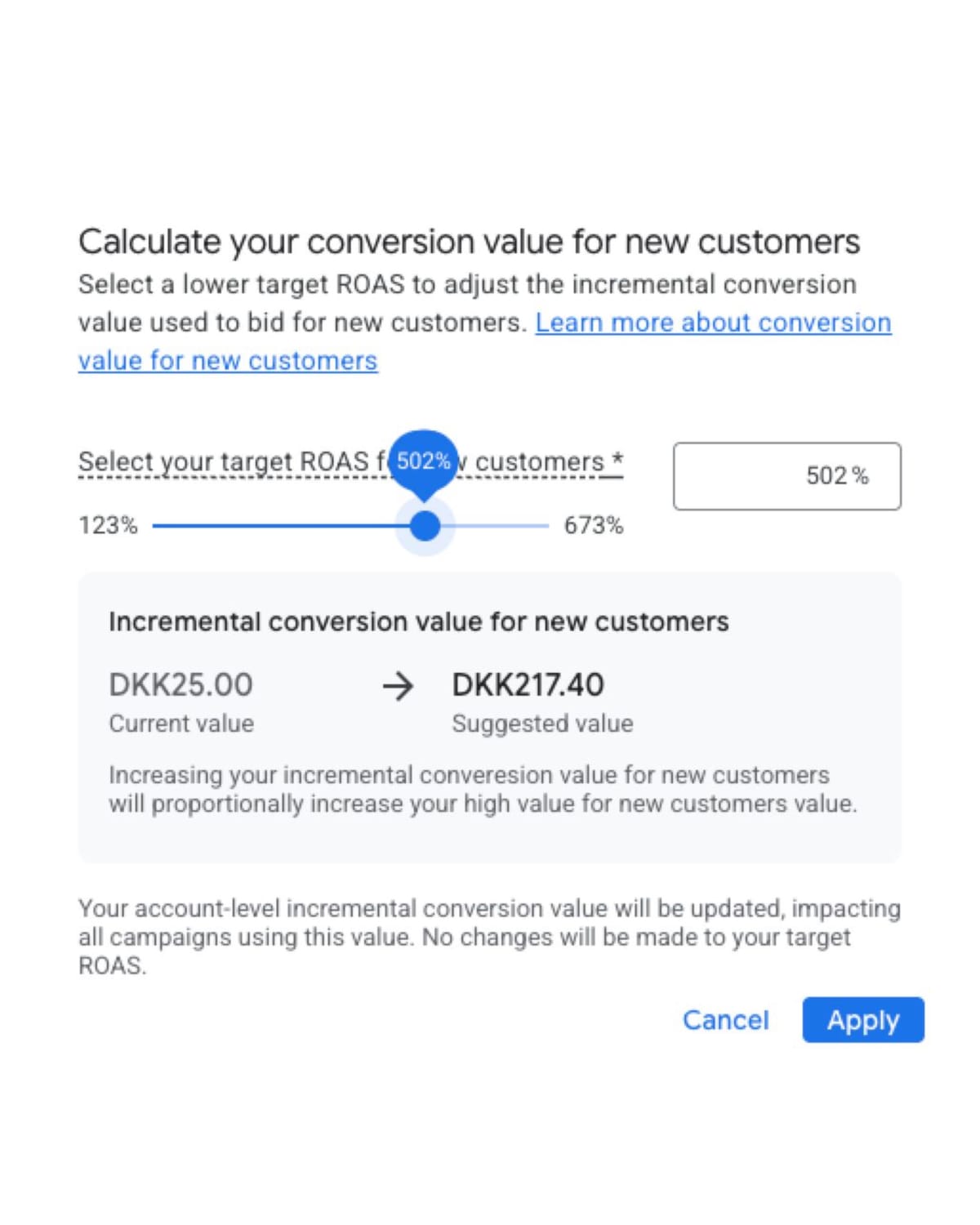
Google this month introduced a testing feature that generates suggested conversion values for new customers by accepting a target return on ad spend as input, removing manual estimation from a process that has consistently challenged advertisers optimizing for customer acquisition.
The tool addresses a fundamental weakness in new customer acquisition campaigns. Advertisers enter their desired ROAS target specifically for first-time buyers. Google Ads then proposes a conversion value aligned with that profitability goal. The calculation replaces static manual inputs that rarely reflected actual business economics or long-term customer value strategies.
Andrew Lolk, founder of Savvy Revenue, shared the interface on LinkedIn on February 13. His screenshot displayed a modal titled "Calculate your conversion value for new customers" with options to select a target ROAS between 123% and 673%. The system showed a current incremental conversion value of DKK 25.00 alongside a suggested value of DKK 217.40 based on the selected 502% ROAS target.
The feature operates at a campaign configuration level rather than adjusting dynamically during auctions. Advertisers apply the suggested value as a broad setting. The system does not vary bids based on specific campaign contexts, product categories, or real-time auction conditions.
"I wish this could be further improved to evaluate at the auction level, adjusting based on whether it's higher or lower, at the campaign or product level, for example," Lolk stated in his February 13 post. His critique highlighted how the tool represents progress over manual guesswork while falling short of sophisticated automation that could optimize values across different inventory segments.
The current implementation addresses one layer of the customer acquisition challenge. Setting appropriate conversion values for new customers has historically required advertisers to estimate lifetime value, calculate acceptable acquisition costs, and translate those business metrics into bidding signals. Many resorted to flat multipliers - such as valuing new customers at 1.5 times or 2 times their initial purchase - without rigorous connection to profitability targets.
The interface design suggests Google prioritized simplicity over sophistication in this initial testing phase. Advertisers interact with a single slider to select their target ROAS percentage. The system displays the current incremental conversion value alongside the suggested value, providing immediate visual feedback about how the ROAS target translates into bidding signals.
That simplicity carries trade-offs. E-commerce businesses selling diverse product portfolios face particular challenges. A retailer offering both $20 accessories with 40% margins and $2,000 furniture with 25% margins cannot differentiate new customer values between categories. The account-level setting applies identical incremental values regardless of product economics.
Service businesses encounter similar constraints. A software company selling both $10 monthly subscriptions and $10,000 annual enterprise contracts would apply the same new customer conversion value premium to vastly different customer lifetime value profiles. The tool lacks mechanisms to segment new customer valuations by purchase size, product category, or predicted lifetime value.
Google's Smart Bidding systems have demonstrated increasing sophistication in other areas. The platform considers device type, location, time of day, audience signals, and numerous other contextual factors when determining bid amounts during auctions. However, this new customer value calculation feature does not extend that granular optimization to the conversion value inputs those bidding systems consume.
The gap between what the feature delivers and what optimization theoretically enables represents a significant missed opportunity. Auction-level intelligence could adjust new customer values based on real-time signals about conversion probability, competitor activity, and inventory availability. Campaign-level differentiation could align values with strategic priorities across different business initiatives. Product-level granularity could reflect margin structures and repurchase patterns specific to each catalog segment.
Google's ROAS-based calculation introduces strategic alignment between acquisition bidding and business objectives. An advertiser targeting 300% ROAS on new customer acquisition can now let the system calculate the corresponding conversion value rather than reverse-engineering that number through spreadsheets.
The problem this feature addresses has plagued performance marketers since Google expanded customer lifecycle targeting options in April 2025. New customer value mode, high-value new customer mode, and new customer only mode all required advertisers to specify how much premium value a first-time buyer represented compared to repeat customers.
Those valuation decisions directly influenced automated bidding behavior. Set the new customer value too low and acquisition campaigns underperformed against retention-focused initiatives. Set it too high and the account burned budget on unprofitable conversions while reporting artificially inflated conversion values.
The interface Lolk shared indicated the suggested value would be applied account-wide. "Your account-level incremental conversion value will be updated, impacting all campaigns using this value," the modal stated. "No changes will be made to your target ROAS."
That account-level application creates both efficiency and risk. Advertisers gain consistency across campaigns using new customer acquisition goals. However, they sacrifice the ability to differentiate new customer values between product categories with different margin structures or customer lifetime value profiles.
Microsoft implemented similar customer acquisition features for Performance Max campaigns in January 2026, recommending that advertisers establish conversion values for new customers representing at least 30% of average revenue from typical sales. That guidance provided a starting framework but still required manual calculation and assumption-making about profitability.
Lolk advocated for a different approach to new customer acquisition optimization. "In my view, setting a lower ROAS target for new customers is the best approach," he wrote, contrasting that strategy against inflating conversion values.
The distinction carries significant implications for campaign reporting and optimization. Advertisers using lower ROAS targets for acquisition campaigns maintain accurate conversion value reporting that matches actual revenue. Those inflating new customer conversion values create artificial metrics that obscure true performance.
Gianpaolo Lorusso, identified as among the world's top 50 PPC experts, responded to Lolk's post on February 14. "Your point about lower ROAS targets for new customers versus higher conversion values is the right strategic framing," he stated. "Inflating new customer value feels artificial and creates weird reporting where your revenue numbers don't match reality."
That reporting concern extends beyond internal dashboards. When conversion values don't align with actual transaction amounts, advertisers struggle to reconcile Google Ads data with analytics platforms, attribution systems, and financial records. The discrepancies complicate performance analysis and undermine confidence in automated bidding systems.
The debate reflects fundamental tensions in performance marketing measurement. Marketers need bidding systems that understand strategic priorities - such as valuing customer acquisition higher than retention - while simultaneously requiring accurate reporting that reflects economic reality. Google's various approaches to this challenge have created complexity rather than resolution.
Value rules, introduced as a mechanism for adjusting conversion values based on attributes like location or audience, faced criticism for inflating reported metrics. The original conversion value metric launched in November 2025 specifically addressed transparency concerns by showing baseline performance before value rule adjustments.
Customer lifecycle goals introduced another layer of conversion value manipulation. New customer value mode and high-value new customer mode both rely on incremental conversion values that artificially inflate reported figures to signal bidding priorities to automated systems. The ROAS-based calculation tool continues that pattern.
Qadeer Atta commented on the same LinkedIn thread, stating "ROAS should be a smaller number not the desired. A ROAS campaign needs flexibility to win smaller wins that eventually make higher converting value ones."
His observation touched on learning period dynamics and algorithmic optimization patterns. Bidding systems require conversion volume to train machine learning models effectively. Setting aggressive ROAS targets limits the auction opportunities where campaigns can compete, reducing conversion volume and extending learning periods.
The alternative approach - using lower ROAS targets for new customer campaigns while maintaining accurate conversion values - enables broader auction participation. Campaigns accumulate conversions faster, train bidding models more effectively, and provide clearer performance signals that connect to business outcomes.
However, that approach requires campaign structure changes and organizational discipline. Advertisers must segment new customer acquisition into dedicated campaigns with distinct ROAS targets rather than relying on value adjustments within mixed-audience campaigns. Finance teams must understand that acquisition campaigns intentionally operate at lower profitability thresholds than retention initiatives.
The organizational complexity explains why many advertisers prefer conversion value inflation despite its reporting downsides. A single campaign targeting both new and existing customers can operate with unified ROAS targets when new customer conversions carry inflated values. That simplification comes at the cost of reporting clarity and strategic visibility.
The tool does not yet support granular application across different business segments. An e-commerce retailer selling both low-margin commodity products and high-margin exclusive items cannot specify different new customer ROAS targets for each category. Both product types receive the same account-level incremental conversion value calculation.
Similarly, multi-region advertisers cannot customize new customer valuations by geographic market. A business operating in both high-customer-lifetime-value and low-customer-lifetime-value regions applies identical new customer premiums despite different economic realities.
The account-level implementation creates particular challenges for agencies managing multiple clients or brands within consolidated Google Ads accounts. Each client's business economics, customer lifetime value profiles, and strategic acquisition priorities differ substantially. Yet the tool applies uniform new customer conversion values across all campaigns sharing an account.
Subscription businesses face additional complexity. A streaming service acquiring customers with 30-day free trials followed by $15 monthly subscriptions requires different acquisition economics than one offering annual prepayment at $150. The former accepts higher upfront acquisition costs amortized over longer retention periods. The latter demands immediate profitability on initial conversions. The tool provides no mechanism to differentiate these scenarios.
Branden Antolick indicated in a February 15 comment that some accounts had access to the customer acquisition feature for approximately two months. "Our account has had this feature for almost 2 months, but we stopped using the Customer Acquisition feature - it inflates your conversion value column just like Value Rules does," he stated. "Best to just make a new campaign to target only new customers."
His observation highlighted a continuing tension between conversion value rules and reporting transparency. Google introduced the original conversion value metric in November 2025 specifically to show unadjusted baseline performance before value rule modifications, addressing advertiser concerns that automated adjustments obscured actual results.
The recommendation to create separate campaigns for new customer acquisition represents the workaround sophisticated advertisers have adopted. Campaign-level segmentation enables distinct ROAS targets, accurate conversion value reporting, and clearer attribution of budget allocation to acquisition versus retention initiatives. However, that approach requires additional campaign management overhead and strategic coordination across teams.
Julian Diep noted that deriving new customer conversion value from a target ROAS "makes way more sense than manually assigning a number with no real context." He added that the approach comes "much closer to how acquisition decisions are actually made."
The validation from practitioners suggests the feature addresses a genuine pain point despite its limitations. Manual new customer value estimation has relied on rough heuristics, competitive benchmarking, and educated guessing rather than rigorous financial modeling. Even a simplified ROAS-based calculation provides more strategic grounding than arbitrary multipliers.
The feature builds on Google's systematic expansion of value-based bidding capabilities. Target ROAS and maximize conversion value strategies have become central to campaign optimization across Search, Shopping, Performance Max, and Demand Gen campaign types. However, those strategies require accurate conversion value data as input - precisely the challenge this new tool attempts to address.
Demand Gen campaigns, for example, require at least 50 conversions with value within the past 35 days before accessing maximize conversion value or target ROAS bidding options. That volume threshold ensures sufficient data for algorithmic optimization but creates chicken-and-egg problems for new accounts or businesses entering new markets. Accurate conversion value configuration from campaign launch improves the quality of data accumulated during learning periods.
Performance Max campaigns similarly depend on conversion value signals to allocate budget across Google's full advertising inventory. The completion of Performance Max feature rollouts in August 2025 included new customer acquisition goal with high-value mode, further emphasizing the platform's focus on sophisticated customer lifecycle optimization.
Customer acquisition efficiency has emerged as a defining challenge for digital advertisers navigating rising costs and increasing competition. Analysis of $996 million in Google Ads spending across 100 consumer brands revealed dramatic cost variations between industries, with customer lifetime value calculations becoming essential for justifying premium advertising costs in competitive sectors.
The new ROAS-based valuation tool represents another step in Google's progression toward more sophisticated automated bidding. The platform has systematically deprecated manual and semi-automated strategies including Enhanced CPC, pushing advertisers toward fully automated options like maximize conversions and maximize conversion value.
That automation expansion creates dependencies on accurate conversion value data. Garbage in, garbage out remains the fundamental challenge. Automated bidding systems optimize toward the signals advertisers provide. When those signals - such as manually estimated new customer values - poorly reflect business economics, the resulting optimization drives campaigns toward suboptimal outcomes.
Manuel Arrufat commented on February 14 that the limitation remains granularity. The feature provides account-level guidance rather than the auction-level, product-level, or campaign-level intelligence that would enable true optimization.
Yousaf Yunes suggested that "definitely something more advertisers should be leveraging for new customer acquisition," indicating industry recognition that customer acquisition optimization requires more sophisticated approaches than basic conversion counting.
The testing phase suggests Google plans to expand the feature based on advertiser feedback and performance data. Whether that expansion includes the auction-level intelligence Lolk advocated for, product-level differentiation, or geographic customization remains to be determined.
For now, the tool offers a structured methodology for calculating new customer value that connects acquisition bidding to profitability objectives. That represents material progress over spreadsheet guesswork and arbitrary multipliers, even if the implementation stops short of the granular optimization that would maximize its strategic value.
Who: Google Ads platform affecting advertisers using new customer acquisition goals in Search, Performance Max, and Shopping campaigns, with early documentation by Andrew Lolk and industry commentary from PPC specialists including Gianpaolo Lorusso, Branden Antolick, and Julian Diep.
What: A testing feature that calculates suggested conversion values for new customers based on advertiser-specified target ROAS, replacing manual estimation with automated calculation tied to profitability objectives. The tool operates at account level without auction-level, campaign-level, or product-level differentiation.
When: First publicly documented on February 13, 2026, through Andrew Lolk's LinkedIn post, with some accounts reportedly having access for approximately two months prior. Search Engine Land published coverage the same day.
Where: Available within Google Ads accounts that use new customer acquisition goals, applied at the account level affecting all campaigns using incremental conversion values for new customers across Search, Shopping, and Performance Max campaign types.
Why: Addresses systematic inefficiency in new customer acquisition bidding where advertisers manually estimated conversion values without rigorous connection to business profitability targets, often using arbitrary multipliers that failed to reflect actual customer lifetime value economics or strategic ROAS objectives. The feature attempts to align acquisition bidding with business goals while improving on static manual inputs that created reporting discrepancies and suboptimal automated bidding performance.