Google's shopping AI sparks surveillance pricing debate
Google faces accusations about personalized upselling in Universal Commerce Protocol after January 11 announcement, while company denies claims about price manipulation.


Google faces accusations about personalized upselling in Universal Commerce Protocol after January 11 announcement, while company denies claims about price manipulation.
On January 11, 2026, Google CEO Sundar Pichai announced the Universal Commerce Protocol, establishing open-source technical standards for AI agents to execute purchases across retail platforms. However, the announcement immediately triggered controversy when Lindsay Owens, Executive Director of Groundwork, characterized the initiative as enabling "personalized upselling" through analysis of chat data to "overcharge" consumers.
Pichai stated on X that "AI agents will be a big part of how we shop in the not-so-distant future." The protocol arrived through partnerships with Shopify, Etsy, Wayfair, Target, and Walmart, along with endorsements from more than 20 companies including Adyen, American Express, Best Buy, Flipkart, Macy's, Mastercard, Stripe, The Home Depot, Visa, and Zalando.
Owens published a series of posts on January 11 and 12 analyzing what she described as Google's construction of "an NSA for capitalism." She argued that "by merging search history, conversational AI, and retailer data, their new 'Universal Commerce Protocol' could create the ultimate surveillance pricing squeeze." Her posts, which received 456,200 views for the initial tweet, identified companies including Lowe's, Michael's, and Reebok as pilot participants for what she characterized as a "price gouging behemoth."
Google responded on January 13 through its News from Google account, specifically addressing Owens' pricing claims. "These claims around pricing are inaccurate," the company stated. "We strictly prohibit merchants from showing prices on Google that are higher than what is reflected on their site, period." The response accumulated 67,300 views within hours of publication.
The company provided two specific clarifications about terminology and functionality. First, Google explained that "upselling" refers to standard retail practice rather than overcharging. "The term 'upselling' is not about overcharging," according to the statement. "It's a standard way for retailers to show additional premium product options that people might be interested in. The choice is always with the user on what to buy." Second, Google addressed "Direct Offers" as a pilot program enabling merchants to offer lower prices or additional services. "Direct Offers is a pilot that enables merchants to offer a lower priced deal or add extra services like free shipping—it cannot be used to raise prices," the company clarified.
The Universal Commerce Protocol defines technical specifications for AI agents to discover products, negotiate checkout parameters, link customer identities, and manage post-purchase workflows, according to documentation published January 11. The protocol establishes REST and JSON-RPC transport layers with built-in support for three complementary standards: Agent Payments Protocol for cryptographic transaction authorization, Agent2Agent for multi-agent collaboration, and Model Context Protocol for connecting AI applications to external systems.
The Model Context Protocol operates as the foundational layer connecting AI applications to external systems. Originally developed by Anthropic and donated to the Linux Foundation, MCP provides what Google describes as "a USB-C port for AI applications." The protocol enables AI systems like Claude or ChatGPT to access data sources including local files and databases, tools such as search engines and calculators, and specialized workflows through standardized interfaces.
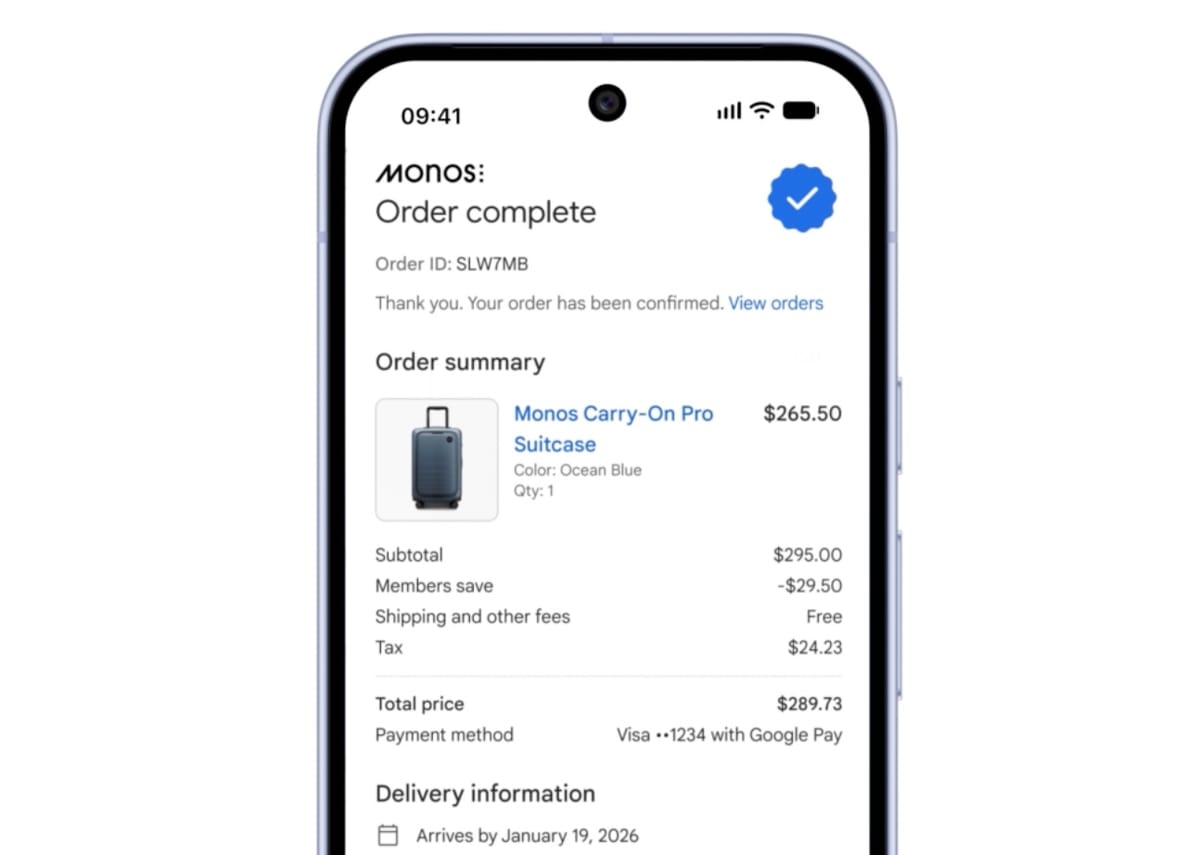
Google announced that UCP will power a new checkout feature on eligible product listings in AI Mode within Search and the Gemini app. Shoppers can complete purchases from eligible United States retailers using Google Pay with payment methods and shipping information already saved in Google Wallet. PayPal support is planned for future releases.
The feature builds on Google's expanding AI shopping capabilities introduced November 13, 2025. That deployment included agentic checkout enabling autonomous purchases of price-tracked items when prices reach target budgets, Duplex-powered phone calls verifying local store inventory, and conversational shopping powered by the Shopping Graph containing 50 billion product listings with 2 billion receiving hourly updates.
Target and Walmart announced separate integrations on January 11 that allow consumers to browse inventory and complete purchases without leaving Google's Gemini app or AI Mode in Search. The implementations differ from traditional retail media advertising, which typically involves sponsored product placements within search results or marketplace interfaces. Instead, these integrations embed entire commerce transactions within AI-generated responses.
When Gemini suggests products, those recommendations draw from retailer inventory based on the query's semantic meaning rather than keyword matching or paid placement. Ashish Gupta, vice president and general manager of Merchant Shopping at Google, stated that "agentic commerce is creating a pivotal moment for retail, which will require the industry working together through standards like the Universal Commerce Protocol to solve retailer and consumer challenges."
The controversy highlights tensions between Google's technical implementations and public perception of personalization capabilities. Owens' characterization of the system as surveillance pricing drew significant social media engagement, while Google's response emphasized existing merchant policy restrictions. The exchange received mixed reactions from industry observers, with some noting the distinction between technical capabilities and actual implementation practices.
Steven Liss, commenting on the thread, argued that "from my experience running millions of ads in AI search: cross-selling/upselling is better aligned with the user experience." Liss explained that "if the organic AI answer recommends brand A, it's a contradiction to advertise a direct competitor." However, Owens responded that her "read of the ucp. seems like the proposed eventual capabilities expand beyond what you are describing."
The implementation introduces new competitive dynamics in retail media. Traditional retail media networks monetize through sponsored product listings, display advertising on retailer websites and apps, and off-site advertising that drives traffic to retailer properties. When transactions occur entirely within AI assistant interfaces, these monetization models require adaptation.
Google's existing retail advertising business primarily operates through Shopping ads in Search results and YouTube video advertising. The Gemini integration creates a distinct channel where product discovery occurs through conversational responses rather than search result listings. Whether Google will introduce sponsored placements within Gemini's product recommendations—and how such advertising would function in conversational interfaces—remains unaddressed in current announcements.
The protocol arrives as Amazon blocks third-party AI agents to protect its advertising business, while Google positions itself as the infrastructure provider enabling open commerce across competing platforms. The company co-developed UCP with major retailers who have separate economic interests in maintaining direct customer relationships versus intermediated transactions through Google's AI systems.
Privacy considerations around data sharing between Google's AI systems and retail partners remain partially documented in public materials. The protocol's cryptographic authorization mechanisms for payments suggest security infrastructure, but the extent of behavioral data transmission between participants has not been comprehensively disclosed. European data protection frameworks would apply different requirements than United States implementations, though Google has not announced specific geographic limitations beyond the initial United States launch.
The controversy demonstrates how platform announcements about AI capabilities can generate interpretive conflicts between technical specifications and potential applications. Owens' analysis focused on what she characterized as "proposed eventual capabilities" rather than launch features, suggesting concerns about future development directions. Google's response emphasized current merchant policy restrictions, which exist as platform rules rather than technical limitations preventing different implementations.
The implementations launching in early 2026 will provide market data on whether conversational interfaces actually improve shopping convenience or represent technological capabilities searching for consumer demand. Past retail technology innovations from QR codes to augmented reality shopping apps have struggled to achieve mainstream adoption despite significant investment.
Target and Walmart's participation as UCP co-developers gives them early positioning advantages. If agentic commerce gains traction, their integration timeline means competitors will face catch-up periods. However, if consumer adoption lags, the investments in integration and protocol development may deliver limited returns.
The integration of retail transactions directly into AI assistants could accelerate the broader shift away from traditional search engines. Google's core Search product already faces pressure from AI assistants that provide direct answers rather than links to external websites. Brands are set to cut open web display spend 30% in response to AI search, according to Forrester analysis published on November 6, 2025.
The controversy also intersects with ongoing regulatory scrutiny of Google's advertising practices. The U.S. Federal Trade Commission launched investigations into Amazon and Google on September 12, 2025, examining whether the tech giants misled advertisers who place advertisements on their platforms. The probe focuses specifically on whether these companies properly disclosed terms and pricing for advertisements.
Google has faced parallel challenges in European markets regarding transparency in advertising pricing. The company rolled out price transparency reports for advertisers within the European Economic Area in March 2024, providing insights into daily fees associated with ads shown on third-party and Google-owned platforms.
The distinction between personalization for relevance versus personalization for price manipulation remains contested. Dynamic pricing implementations in programmatic advertising typically focus on auction efficiency rather than consumer targeting, though the technical infrastructure could theoretically support both applications.
The January 11 announcement's timing aligned with CES 2025, where technology companies traditionally showcase future capabilities. The immediate controversy demonstrates how announcements about AI capabilities can trigger public concern about data usage and pricing practices, regardless of technical implementation details.
Whether the Universal Commerce Protocol represents genuine infrastructure for open commerce or a strategic move to maintain Google's advertising dominance remains debated among industry observers. The protocol's open-source nature suggests interoperability goals, while Google's control over the Shopping Graph and AI Mode interfaces provides structural advantages over competitors.
The implementations will test whether consumers adopt AI-mediated shopping experiences or continue preferring direct website interactions. Early adoption metrics from Target and Walmart integrations should provide initial market signals about demand for conversational commerce interfaces versus traditional e-commerce browsing.
The controversy highlights persistent tensions between platform capabilities, merchant policies, and consumer protection in AI-powered commerce systems. As autonomous agents gain purchasing authority, questions about data usage, price transparency, and algorithmic intermediation will likely intensify across the industry.
Who: Google CEO Sundar Pichai announced the Universal Commerce Protocol in partnership with Shopify, Etsy, Wayfair, Target, and Walmart. Lindsay Owens, Executive Director of Groundwork, criticized the announcement. Google responded through its News from Google account.
What: Google launched the Universal Commerce Protocol establishing technical standards for AI agents to execute purchases across retail platforms. The protocol includes Model Context Protocol, Agent2Agent, and Agent Payments Protocol. The announcement triggered controversy about personalized upselling and surveillance pricing. Google denied claims about price manipulation, stating merchants cannot show prices higher than on their sites.
When: Sundar Pichai announced the protocol on January 11, 2026. Lindsay Owens published critical analysis on January 11 and 12, 2026. Google responded on January 13, 2026. The feature builds on November 13, 2025 AI shopping capabilities deployment.
Where: The protocol launches in the United States through AI Mode in Google Search and the Gemini app. Target and Walmart integrations enable checkout without leaving Google's AI interfaces. The announcement occurred via X posts during CES 2025 period.
Why: Google positions the protocol as enabling open commerce across competing platforms through standardized AI agent interactions. The company aims to establish infrastructure for agentic commerce while maintaining Shopping Graph data advantages. Critics argue the system enables surveillance pricing through merged search history, conversational AI, and retailer data. The controversy highlights tensions between technical capabilities and potential applications in AI-powered commerce systems.