IAB Ireland releases retail media report for brands and agencies
IAB Ireland published December 2025 report examining retail media infrastructure, measurement approaches, and first-party data readiness in Irish advertising market.

IAB Ireland published a comprehensive retail media report on December 4, 2025, marking the first dedicated analysis of Ireland's retail media landscape and providing strategic recommendations for brands, agencies, and retailers operating in the market.
The report, authored by Colin Lewis, founder of Retail Media Works and a globally recognized retail media thought leader, draws from interviews with senior executives across Irish agencies, brands, and retail media networks. Contributors included David Macken, Head of Digital, Data and Technology at WPP Media; David Mulligan, Head of Programmatic at Core; Harry Eustace, Media Manager for Diageo Ireland; John Urch, Head of Clients at dentsu Ireland; Sinead Browne, Head of Elevate at Musgrave Group; and Sylvia Cawley, Head of Country at Tesco Media.
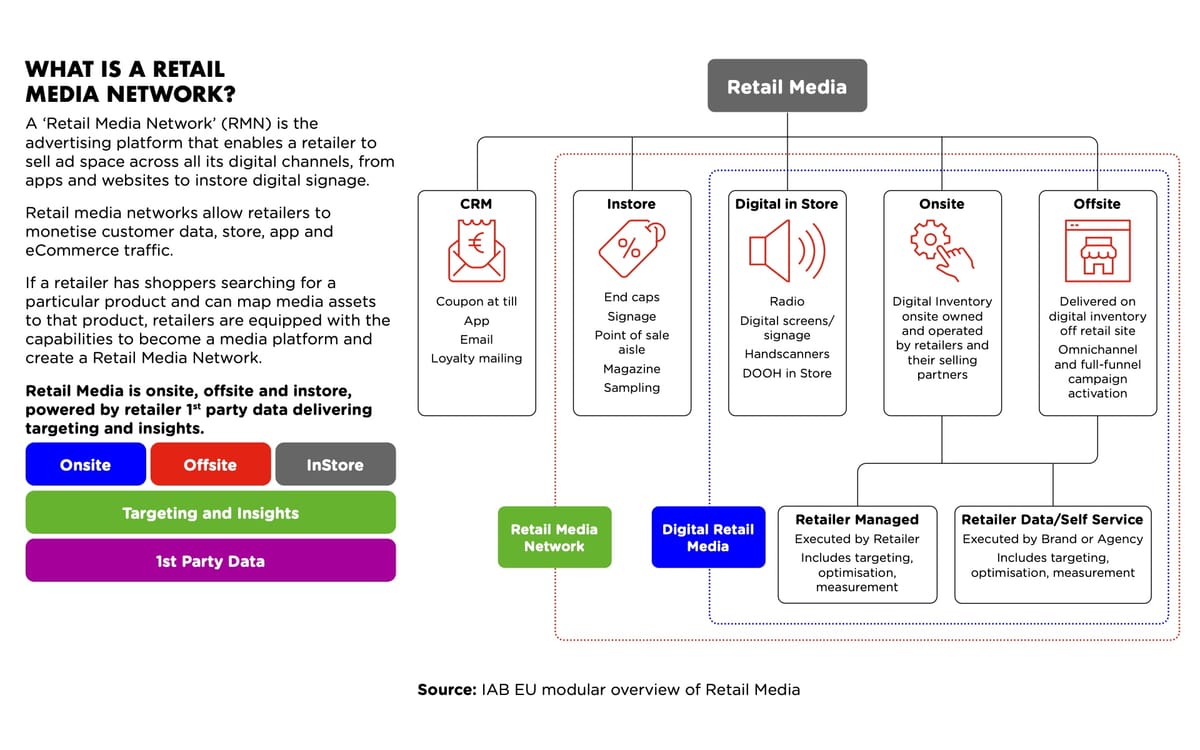
According to the report, retail media represents advertising sold by retailers on owned channels—online, apps, and in-store—as well as across the open web and social media using retailer first-party audience data. The research positions retail media as strategic infrastructure rather than simply another advertising channel, fundamentally transforming relationships between consumer brands and retail partners.
Subscribe PPC Land newsletter ✉️ for similar stories like this one
Digital retail media in Ireland remains in early-stage development, with growth progressing more slowly than brands and agencies initially anticipated, according to the research. The market exhibits fragmentation, inconsistent retailer offerings, and varying maturity levels across different players and channels.
Tesco Media emerged as the clear market leader. The network offers the broadest suite of formats, including capabilities for onsite sponsored products, sponsored video innovations, and data-driven targeting, according to the report. Tesco Media Ireland benefits from learnings and support from Tesco Media and Dunnhumby operations in the United Kingdom, where they lead the grocery retail media market.
SuperValu and Elevate Media are building from strong in-store foundations while investing in technology and data capabilities, the research found. Musgrave Wholesale has advanced further in online operations than the retail business, creating a unique situation where B2B wholesale retail media development exceeds consumer retail progress—an unusual dynamic compared to other markets.
Other retailers, both local and international, are investing in retail media opportunities within the Irish market but operate at earlier development stages, according to the report. Online grocery penetration remains below 10%, limiting the scale of first-party data activation compared to larger markets. Offsite advertising remains nascent, with isolated capability pockets rather than sophisticated infrastructure comparable to operations in the United States and United Kingdom.
First-party data utilization represents one of Ireland's largest unrealized retail media opportunities, according to the research. Major grocers maintain loyalty and transaction data, yet access for brands and agencies to activate campaigns or gain insights remains inconsistent.
Agencies reported they can purchase category performance reports and basket composition analysis, but cannot integrate this data into broader audience planning or establish always-on targeting mechanisms. Core characterized the challenge succinctly: retailer first-party data remains "locked up for now," according to the report.
Competitive tension between supermarkets contributes to data protection strategies. Households frequently shop across multiple retail banners within a single week, making retailers highly protective of first-party data assets, the research found. One interviewee suggested Ireland may not see demand-side platforms like The Trade Desk operating in the country or enabling brand advertisers to purchase digital retail media across multiple retailers through DSPs in the short to medium term—a situation that would be unique in global retail media markets.
Tesco Media represents the market outlier due to its substantial Clubcard base. With 1.8 million active Tesco Clubcards, the network's data and insights are representative of Ireland as a whole, according to Sylvia Cawley. Tesco Media already uses first-party data to plan campaigns targeting lapsed, existing, and prospective customers. The network also employs data to identify performance gaps between a brand's online category share versus in-store achievement.
The limited first-party data sophistication in Ireland means the retail media industry may struggle to deliver on the fundamental retail media promise of closed-loop measurement, which uses first-party data to connect advertising activity with precise views of what drove sales with true attribution, according to the research.
Retailers in Ireland recognize their first-party data represents a strategic differentiator, but need to build systems and commercial models supporting retail media capabilities, according to the report. Most critically, the industry should adopt appropriate mindsets about using first-party data to benefit shoppers, brand advertisers, and retailers simultaneously.
Brands in Ireland operate largely in test-and-learn mode with retail media, with several front-runners pushing the agenda forward, according to the research. Diageo emerged as one of the most advanced advertisers, defining retail media as data-led digital activation with retailers while building mission-based retail media strategies.
Agencies indicated throughout the research that major FMCG clients remain "dipping their toes" and actively experimenting with onsite sponsored search and Amazon advertising, achieving pockets of success. Brands are expected to scale investment from 2026 onwards, depending on whether retailers deliver better measurement and more sophisticated first-party data collaboration, according to the report.
The challenge for brands investing in retail media advertising centers on team structure, mirroring dynamics observed across global markets, the research found. FMCG brands typically organize teams and budgets into distinct categories: brand budgets for building and promoting brands to enhance reputation and drive salience; shopper marketing budgets for affecting in-store behavior to generate purchase decisions; trade budgets used as investment tools to influence supplier performance at retail; and digital marketing budgets encompassing display, video on demand, digital audio, digital out-of-home, search, and social advertising.
These organizational silos now create coordination challenges as stakeholders struggle to determine budget control for retail media investments. Marketing teams are restructuring around retail media capabilities because trade, shopper, digital media, and brand marketing teams operate with different objectives, different key performance indicators, and different datasets that create segregation, according to the report.
Various organizational structures are being tested, but all focus on driving new forms of collaboration, positioning this challenge as central to retail media growth in Ireland and globally, the research found.
Measurement represents one of the primary constraints on retail media growth in Ireland, according to the research. Brands and agencies struggle to obtain robust, comparable evidence of impact across different retailers.
Retail media metrics in Ireland rely excessively on return on ad spend as a primary measure, mirroring global patterns where retail media networks, advertisers, and agencies use ROAS and ROI as main key performance indicators—primarily because these metrics were championed by platforms like Google and Facebook, according to the report. The fundamental problem with ROAS centers on its inverse relationship with scale: as spend increases, ROAS decreases even while top-line revenue grows, meaning ROAS diminishes with increased incremental sales. ROI decreases as spending rises and increases as spending falls, making the easiest path to increased ROI simply reducing spend, which limits growth potential.
Retail media networks in Ireland have opportunities to build new measurement approaches rooted in superior data capabilities, according to one interviewee quoted in the report: "brand advertisers and media agencies won't accept the measurement that they're getting today."
Ireland maintains a reputation for innovation, flexibility, and serving as a marketing test market. Substantial learning opportunities exist from major international retail media players who have already made measurement mistakes, the report noted. Retail media measurement frameworks did not exist three years ago but have completely transformed since then. Because Ireland lacks the budgets available in other markets, the industry should quickly embrace measurement and create frameworks based on IAB standards working for the local market, according to the research.
Tesco Media Ireland became the first retail media network in Ireland signing up to IAB Europe retail media measurement standards, according to Sylvia Cawley. The standards aim to define metric sets and measurement models for industry adherence to provide advertisers with clarity and consistency. Tesco Media currently delivers measurement adhering to these standards, from basic impressions, clicks, and reach to ROAS and incremental ROAS through control and exposed tests. To continue growing investment, measurement proving ROI remains necessary, and the network welcomes opportunities to discuss client measurement needs, according to Cawley.
Buy ads on PPC Land. PPC Land has standard and native ad formats via major DSPs and ad platforms like Google Ads. Via an auction CPM, you can reach industry professionals.
Retail media across Europe has grown in double-digit figures over recent years and now exceeds €10 billion, according to Dr. Daniel Knapp, Chief Economist at IAB Europe, quoted in the report. Growth was driven by consumer behavior shifts, media format innovation, and focus on measurable, performance-driven outcomes. Knapp expects similar growth in Ireland, though the broader digital advertising ecosystem will need to navigate this expansion with agility, innovation, and focus on delivering value for shoppers and advertisers.
Retail media and connected television are converging as consumers shift from linear television to streaming platforms while simultaneously changing shopping behaviors. IAB Europe analysis published in November 2025 examined how retail media networks position themselves beyond traditional advertising channels, providing infrastructure that powers all media formats rather than functioning solely as a single channel.
The retail media sector is positioned to capture approximately 20% of total global advertising revenue by 2030, according to Omdia research published in September 2025. The projection indicates retail media networks will exceed $300 billion in spending, marking a fundamental transformation in advertiser budget allocation across digital channels.
The report outlines ten strategic actions the Irish retail media industry should pursue to accelerate market growth. First, strategies should start with shopper needs and appropriate marketing objectives. Most retail media conversations ignore shopper roles, but understanding what shoppers attempt to accomplish—quick stock-ups, planned weekly shops, gifting occasions, or last-minute top-ups—enables retail media strategy success. When retail media planning considers shopper needs and ties to clear marketing objectives, results become clearer, easier to measure, and budgets flow more readily, according to the research.
Second, buying and measuring retail media must become simpler. For many brand advertisers and agencies, accessing retail media ad inventory and measuring results presents challenges. Retail media inventory must be easy to purchase and easy to measure alongside other channels.
Third, all stakeholders must fulfill their respective roles. Retailers must establish paths toward standardized measurement frameworks using IAB best practices and open opportunities for first-party data collaboration. Brand advertisers should push for better measurement and data partnerships while demonstrating they are willing collaborators alongside agency partners, according to the report.
Fourth, the industry requires shared vocabulary and common definitions. Having consistent terminology ensures everyone discusses the same concepts: what constitutes retail media; definitions of onsite, offsite, and in-store; proper metric usage. Without common definitions, comparing results, briefing campaigns consistently, or building joined-up plans across retailers, brands, and agencies becomes impossible, the research found.
Fifth, focus should center on "why" rather than "how." Most brands initiate retail media campaigns with mechanics: how to activate search, how to purchase sponsored display, what constitutes first-party data. The more critical question addresses why: why use retail media for this mission or occasion; what role does it play in penetration, trade-up, or new occasions; how does it integrate into overall marketing plans; how will success be determined. Focusing on clear reasoning transforms retail media into opportunities for brand and category growth, according to the report.
Sixth, insights should receive priority attention. Retail media's greater value extends beyond driving short-term sales, basket size, or cross-sell opportunities. The larger prize involves using shopper insight to create and capture more value through insights enabling growth for brands and retailers simultaneously.
Seventh, genuine partnerships must replace transactional relationships. Retail media will only grow if brand-retailer relationships evolve from rate-card selling—"here is our sponsored product" or "here is a package to buy"—toward true partnership approaches. This means joint planning across brands, retailers, and agencies; shared key performance indicators and test-and-learn programs; and willingness to co-invest in data, measurement, and creative development, the research found.
Eighth, budget consolidation should break down organizational silos. Retail media growth globally and in Ireland faces obstacles from divided budgets spanning trade, shopper, ecommerce, and brand categories. Over time, retail media should exist within single marketing investment frameworks, with clear protocols for how trade and brand investments work together. Single budgets simplify planning, enable ROI comparisons across channels, and facilitate scaling successful approaches instead of fighting over budget ownership, according to the report.
Ninth, creating and investing in specialist skills remains essential. Ireland needs deeper, locally based retail media expertise. Brands and agencies require specialists understanding nuances of sponsored products, offsite advertising, and first-party data, as well as how each network operates. Retailers need personnel capable of integrating in-store, out-of-home, onsite, customer relationship management, and offsite elements into coherent propositions. Agencies need planners and analysts who can interpret retailer data, challenge weak measurement, and connect retail media to broader marketing effectiveness. Without skills upgrades, Ireland cannot fully tap retail media opportunities, the research found.
Tenth, collaboration represents the critical success factor. If one word summarizes requirements for retail media growth in Ireland, it is "collaboration," according to the report. This represents the new dynamic emerging between brands and retailers because of retail media. Total collaboration between retailers and brands is needed to unlock value in this transformed relationship.
Subscribe PPC Land newsletter ✉️ for similar stories like this one
Subscribe PPC Land newsletter ✉️ for similar stories like this one
Who: IAB Ireland released the report with authorship by Colin Lewis, Founder of Retail Media Works. Contributors included executives from WPP Media, Core, Diageo Ireland, dentsu Ireland, Musgrave Group, and Tesco Media. The research targets retailers, brand advertisers, and agencies operating in the Irish market.
What: The report provides comprehensive overview of retail media ecosystem, formats, measurement approaches, and key players with emphasis on Irish market opportunities. It includes practical action plan designed to accelerate retail media growth and performance in Ireland, covering topics including first-party data readiness, brand advertiser approaches, measurement challenges, and strategic recommendations for market development.
When: IAB Ireland announced the report launch on December 4, 2025, at its biannual conference, IAB Connect. The research was conducted through two phases: interviews with participants across advertisers, agencies, and retailers to understand each party's approach to digital retail media and future perspectives, and research drawing from previous reports, interviews, and advisory work with leading retail media networks and brand advertisers worldwide.
Where: The report focuses specifically on the Irish advertising market, examining retail media infrastructure and capabilities within Ireland while drawing comparisons to more mature markets in the United Kingdom, United States, and broader Europe. The research examines both grocery retail including Tesco, SuperValu, and Musgrave operations, as well as broader retail categories and quick service delivery companies like Uber, Just Eat, and Deliveroo.
Why: Retail media represents the fastest-growing advertising channel globally, with European retail media spending growing 22.1% in 2024 compared to 6.1% for the broader advertising market. The report addresses knowledge gaps in the Irish market where many brand advertisers, retailers, and agencies remain uncertain about retail media's role, importance, and their respective functions. The research aims to help the retail media industry in Ireland grow and flourish by providing clear frameworks, establishing common terminology, and outlining actionable strategies for all stakeholders. Insights from the report guide the agenda for IAB Ireland's Retail Media Council as it works to support and advance this digital advertising opportunity.