IAB Tech Lab CEO warns industry chasing 'shiny pennies' in agentic AI
IAB Tech Lab CEO Anthony Katsur warns advertising industry must fix transparency and privacy issues before embracing agentic AI during 2025's hectic pace.


IAB Tech Lab CEO Anthony Katsur warns advertising industry must fix transparency and privacy issues before embracing agentic AI during 2025's hectic pace.
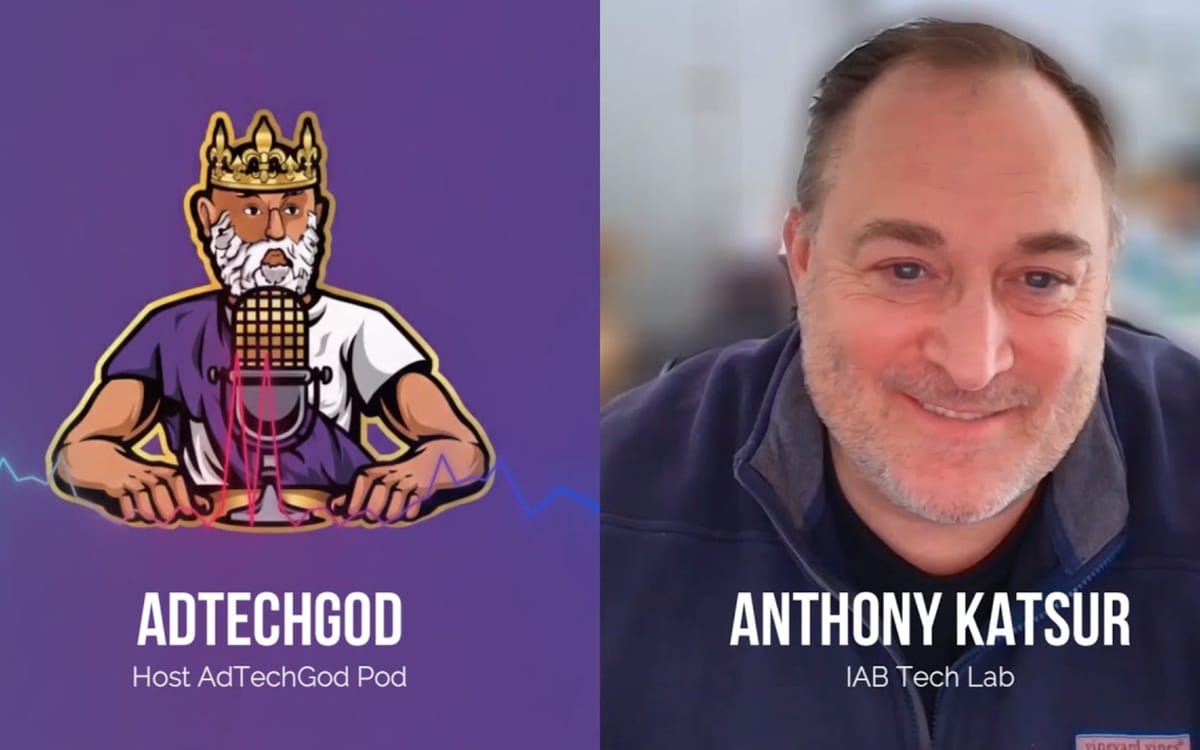
Anthony Katsur has spent more than 25 years in digital media, but 2025 stands out as the most hectic period in his career. Speaking on the AdTechGod podcast on December 29, 2025, the IAB Tech Lab CEO addressed the advertising industry's rush toward agentic AI while fundamental problems remain unresolved.
Katsur characterized the current agentic AI discourse as reaching "a fevered pitch" of hype. Conversations with holding companies, publishers, and ad tech firms consistently involve stakeholders claiming they want to "do something agentic" without clear definitions of what that means.
"I want to do an agentic CTV buy. Okay, what is an agentic CTV buy? I don't know. I was hoping you tell me," Katsur said, describing typical exchanges he encounters. The South Park underpants gnome episode provides an apt comparison: step one involves declaring agentic intentions, step two remains blank, and step three promises profit.
The agentic AI infrastructure remains extremely young. Model Context Protocol, one framework enabling agent communication, is approximately one year old. Companies developing agentic solutions have largely built them on proprietary code or legacy programming languages including C++ and Python rather than emerging protocols like ACP or MCP.
"I'm not hearing anything about, you know, oh, we built this in ACP or MCP or agent to agent just because all those things are so new," Katsur explained. Some holding companies have operated agentic approaches for nearly two years, but these internal or external-facing solutions don't necessarily rely on standardized protocols.
General Motors ran its first artificial intelligence-generated advertisement recently, followed by Nike and Coca-Cola's second AI-created holiday spot. Generative AI already disrupts copywriting and creative production. Katsur expects AI to impact the ecosystem most immediately through creative and copywriting, with agentic AI bringing efficiencies to media discovery, negotiation, planning, and buying.
The CEO acknowledges agentic AI introduces advanced automation through natural language processing. Interfaces for buying and selling media will gradually evolve, though traditional user interfaces won't disappear. Natural language approaches to describing audiences, transacting against audiences, and setting up campaigns represent where the technology ultimately leads.
Supply chain transparency remains a persistent challenge that protocols alone cannot address. Katsur pushed back against assertions that agentic AI will solve supply chain transparency issues.
"Protocols don't solve for misaligned incentives and bad actors. They don't like that's not what protocols address," he stated. The advertising industry still needs to tackle fundamentals like supply chain transparency and privacy before jumping to new phases of agentic development.
Privacy concerns persist despite widespread industry fatigue with the topic. Laws have passed at an unprecedented rate, evolving rapidly while creating complete fragmentation within the United States. The European Union introduced new omnibus legislation potentially relaxing some privacy laws, particularly around AI. Regulators continue issuing fines and subpoenaing companies, with activity expected to increase in 2026.
Guard rails must address what happens when an agent for one company interacting with an agent for another company violates a privacy law. The IAB Tech Lab works with User Context Protocol, donated by LiveRamp, which functions as an audience and signaling trading protocol. Privacy guard rails need integration into agents to prevent stepping on the industry's own feet.
"We do need to build privacy guard rails around that. We do need to make sure TCF, the global privacy protocol, things like the data deletion request framework are built in to these agents," Katsur emphasized. The Transparency and Consent Framework has undergone multiple updates, with version 2.3 addressing vendor disclosure ambiguity.
Measurement remains unsolved as an ecosystem problem. Katsur doesn't believe any protocol will solve measurement challenges, characterizing them as business incentive issues rather than technical problems.
"They can be solved technically if we would all just agree on a common set of telemetry to create a baseline of a measurement framework for the industry. We could probably solve the measurement challenge. A protocol is not going to do that," he explained.
The industry needs foundational work before embracing the agentic phase. Agentic AI doesn't represent an end-all solution. Talk has emerged about agents replacing real-time bidding, but RTB isn't disappearing soon.
"RTB is incredibly efficient when used properly, the ability to inspect every single media impression and the audience attached to that and determine a fair market value of that between hundreds of buyers and sellers, you know, billions of transactions happening per second. That is an incredibly powerful protocol," Katsur said.
Agentic interfaces connecting with RTB become interesting, but guard rails remain necessary. Katsur sees authentic solutions pointed at direct media buying and selling, though he views agents as particularly effective for high cardinality problems like discrepancy resolution or troubleshooting creative issues across connected TV partners.
The concept of agentic interfaces centers on transforming how users interact with advertising systems. Rather than predefined audience segments, natural language capabilities of large language models could enable buyers to discover more refined audiences.
"I think the natural language capabilities of an LLM powering an agentic audience platform probably allows buyers to sus out maybe more refined audiences. It probably allows sellers to curate maybe more nuanced audiences for buyers to buy," Katsur explained.
Prompts will increasingly complement knobs, dials, and sliders rather than replacing them entirely. The comparison to self-driving cars applies: hands remain on the wheel occasionally even with autonomous systems engaged.
Ad operations departments will likely experience the greatest impact from agentic AI, though not necessarily through downsizing. Katsur expects a slowdown in hiring patterns because automation enables doing more with less.
"I'm already hearing from some publishers, they've closed a lot of open roles for junior ad operations people because AI or Agentic solutions allow you to. It's a tool. It allows you to do more with less," he stated.
The traditional professional pyramid model—with wide bases of junior talent gradually moving up through lifelong apprenticeships—is transforming into a diamond shape. Fewer opportunities will exist at junior levels, with big tech companies not hiring as many junior engineers. AI can write unit tests that junior engineers once handled. Junior ad operations tasks like reconciling discrepancies between campaigns now get automated through agents that complete in seconds what previously took humans hours, days, or weeks.
Mid-level management remains necessary but must become more hands-on because AI enables better task management, project management, and status tracking. Business development, sales, account management, and technical account management represent sound roles now and into the future. These people-to-people interactions figuring out collaboration and revenue optimization cannot be automated.
Some ad operations professionals will evolve into these relationship-focused roles. Understanding how the engine room works helps influence it properly using agents to drive outcomes.
AI-powered browsers present two fundamental implications for advertising. First, they function as trojan horses for continued crawling from residential IP addresses. Second, they fundamentally change web design and information architecture.
"What is incredibly powerful is that you and I could be looking at the same content and Atlas could lay it out differently for each of us. So it's almost like personalized curation of content. The content doesn't change. It's just the way it's presented to each of us could be slightly or radically different," Katsur explained regarding ChatGPT's Atlas browser.
This capability affects page layout, ad positioning, presentation, and consumer experience. The industry may head toward a world where web servers publish markdown files while AI browsers lay out content based on individual preferences.
Subscribe PPC Land newsletter ✉️ for similar stories like this one
The IAB Tech Lab begins strategic planning for each year in June of the prior year. The 2026 planning started in early June, involving conversations with members, working groups, and internal team debates about trends shaping the industry.
Those discussions get presented to the board through one-on-one meetings at least twice yearly with each board member, sometimes three times. The tech lab board summit brings together entire boards where board member company employees can participate. A Magnite board seat might bring a product lead and engineers to engage in strategic conversations determining final roadmaps.
"Some of it frankly is some of it's a little thumb in the air like I think this is where the ecosystem is going. So there's a little bit of art to it," Katsur acknowledged. The organization has increased outreach to holding companies and publishers this year compared to previous years.
"We've done a good job this year of really getting more holdco feedback and more direct publisher feedback than I say we've done in years prior because I think sometimes when we roll out our specifications where the rubber hits the road is in adoption and that is occasionally due to the fact that we did not get principal buyin," he explained.
Ad tech facilitates how buyers and sellers want to transact, making their input critical for effective standards development.
The agentic AI bubble discussion raises questions about whether it will pop or deflate. Katsur referenced a recent article noting that first agentic AI projects will likely fail, which represents normal innovation patterns.
Thomas Edison didn't invent the light bulb but perfected the filament to keep light bulbs illuminated longer. Early movers in agentic approaches will see mixed success before some implementations take hold.
"I think we're going to see subsequent failures and successes I think before we stabilize around an approach. And I don't know if there's going to be one approach," Katsur said. Multiple protocols could support agentic AI rather than a single standardized method.
The innovation period will span two to three years, following the Gartner hype cycle's peaks and troughs. The industry currently sits at the peak of optimism and will hit troughs of despair, but agentic AI won't disappear.
"I don't think it's going to necessarily pop I think we'll see a deflation," he predicted. The wider AI ecosystem's outcome depends more on financial management and investment between major players including OpenAI, Nvidia, Anthropic, and Perplexity. Some bubbles may burst depending on investment success.
The IAB Tech Lab announced its 2025 technical standards roadmap in January, focusing on specifications addressing market changes in privacy regulations, data handling, and streaming media. The organization plans to deliver 31 new specifications or updates throughout 2025, compared to 23 releases in 2024.
Subscribe PPC Land newsletter ✉️ for similar stories like this one
Subscribe PPC Land newsletter ✉️ for similar stories like this one
Who: Anthony Katsur, CEO of IAB Tech Lab, an organization that develops technical standards for digital advertising with input from over 800 member companies globally. Katsur has worked in digital media for more than 25 years.
What: Katsur warned that the advertising industry's rush toward agentic AI represents peak hype while fundamental issues including supply chain transparency, privacy compliance, and measurement challenges remain unresolved. He emphasized protocols cannot solve problems caused by misaligned business incentives and bad actors. The CEO expects agentic AI will bring efficiency improvements through natural language interfaces and automation but cautioned against viewing it as a solution to structural industry problems.
When: The discussion occurred on December 29, 2025, during what Katsur described as the most hectic year in his 25-year career in digital media. The conversation addressed developments throughout 2025 and projected impacts extending through 2026 and beyond, including the expected two-to-three-year innovation period for agentic AI implementations.
Where: The context spans the global digital advertising ecosystem, affecting publishers, advertisers, agencies, and ad tech platforms. Specific challenges include fragmented privacy regulations across 14 enforceable U.S. state laws at the start of 2025 with six more expected throughout the year, European Union GDPR requirements, and evolving standards affecting programmatic advertising infrastructure worldwide.
Why: The advertising industry faces a critical decision point between chasing agentic AI innovation and addressing foundational problems that have plagued programmatic advertising for years. Transparency issues result in only 36% of post-transaction programmatic budgets reaching valid, viewable, measurable impressions according to 2023 research. Katsur emphasized the need for privacy guard rails, measurement framework agreements, and supply chain transparency before agentic systems scale, warning that protocols alone cannot eliminate dysfunction caused by misaligned incentives between supply chain participants. His position matters because IAB Tech Lab develops technical standards that determine how digital advertising infrastructure operates globally.