Instagram brings 13+ content ratings and Limited Content setting to India
Instagram expanded its 13+ content rating and new Limited Content setting to India on April 9, 2026, tightening default protections for all users under 18.

Meta announced on April 9, 2026, the expansion of Instagram's revamped Teen Accounts system to India, introducing an updated 13+ content rating framework and a new, stricter parental control option called Limited Content. All users under 18 in India will be automatically placed into the updated 13+ content setting, with no ability to opt out without a parent's approval.
The move extends a content moderation architecture that Instagram first aligned with movie ratings criteria in October 2025, when the platform rolled it out across the United States, United Kingdom, Australia, and Canada. India, which received its first version of Teen Accounts on Safer Internet Day in February 2025, is now receiving the more refined iteration of those same controls.
The scale of what is at stake is significant. India has one of the world's largest populations of internet users aged 13 to 17, and Instagram is among the most widely used social media platforms in the country. Meta has not disclosed country-specific user figures for India, but the company reported that at least 54 million Teen Accounts were active globally as of April 2025.
According to Meta's announcement, the 13+ content setting is directly inspired by the criteria used to rate films for audiences aged 13 and above. The stated goal is for teenage users in India to see content on Instagram that is comparable to what would appear in an age-appropriate movie by default.
Instagram's existing policies already prohibited recommending sexually suggestive content, graphic or disturbing images, and adult content such as tobacco or alcohol sales to teen users. The updated 13+ setting goes further. According to the announcement, the revised policies will now hide or stop recommending posts containing strong language, certain risky stunts, and additional content that could encourage potentially harmful behaviours - including posts showing marijuana paraphernalia.
Meta acknowledged the inherent limits of any automated content system. "Just like you might see some suggestive content or hear some strong language in a movie rated for ages 13+, teens may occasionally see something like that on Instagram," the company said, "but we're going to keep doing all we can to keep those instances as rare as possible." The company added: "We recognise no system is perfect, and we're committed to improving over time."
The 13+ setting applies across multiple surfaces on Instagram. Teens should not encounter content that goes against the updated guidelines in recommendations - including Explore, Reels, and in-Feed - nor in Feed or Stories, even when the content is shared by someone they follow. Comments are also covered. If someone sends a teen a link to restricted content via direct messages, they will not be able to open it.
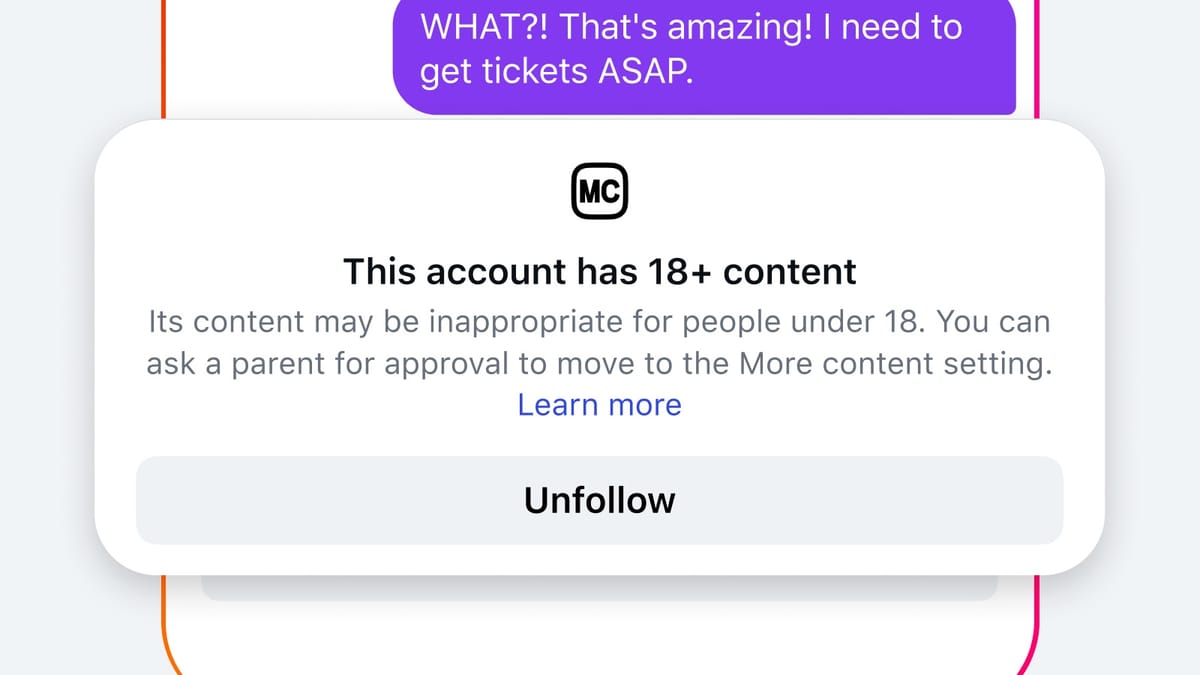
The protections extend beyond the content feed into how accounts are followed and how search operates. According to the announcement, teens will no longer be able to follow accounts that Instagram has identified as regularly sharing age-inappropriate content, or accounts whose name or biography suggests the account is inappropriate for teens. Where a teen already follows such an account, they will lose the ability to see or interact with that content, send direct messages to the account holder, or view that account's comments elsewhere on the platform. The restrictions are bidirectional: these accounts will similarly be blocked from following teens, messaging them, or commenting on their posts.
On search, Instagram already blocked results for terms related to suicide, self-harm, and eating disorders. The updated system expands that list to a wider range of mature search terms - the announcement cites "alcohol" and "gore" as examples. Meta says the platform is also working to ensure these terms remain blocked even when misspelled, addressing a common technique used to circumvent keyword-based filters.
The update also covers Instagram's AI-powered chat experiences. According to the announcement, AI features for teen users have been updated so that AI responses should not be age-inappropriate - that is, they should not produce outputs that would feel out of place in a movie rated for 13+. This brings the AI layer of the platform into alignment with the broader content rating framework.
Alongside the 13+ default, Meta introduced a new, stricter option called Limited Content. It is designed for families who find even a 13+ threshold too permissive for their teenager. According to the announcement, the Limited Content setting will filter a greater amount of content from the Teen Account experience than the standard 13+ setting. It will also remove teens' ability to see, leave, or receive comments under posts entirely.
The introduction of Limited Content creates a three-tier architecture for teen users on Instagram. At the most restrictive end sits Limited Content. The default is the 13+ setting. At the other end, teens with parental permission can access a More Content setting, described as generally aligned with content ratings for ages 18+ but with additional protections for teens.
This tiered system acknowledges that parental preferences vary - a point Meta made explicitly, noting that "every family is different." Limited Content is presented as an option for parents who prefer the most restrictive configuration, while the standard 13+ setting is positioned as the appropriate baseline for most teenage users.
According to the announcement, the updated content settings began rolling out gradually to Teen Accounts in India on April 9, 2026, and the full rollout is expected to be completed over the coming months. No specific end date was given.
The India expansion is part of a multi-year sequence of changes to how Instagram handles teenage users. Instagram first introduced Teen Accounts in September 2024, applying default private account settings, messaging restrictions, and sensitive content filters for users under 18. Existing teen users in the US, UK, Canada, and Australia were moved to Teen Accounts within 60 days of the initial launch.
India received its first version of Teen Accounts in February 2025, announced on Safer Internet Day. That rollout included automatic private account settings, a sleep mode activating between 10 PM and 7 AM, and a time-tracking system that sends notifications after 60 minutes of daily use.
In April 2025, Meta tightened restrictions further, announcing that teens under 16 would lose the ability to go Live or disable image-blurring protections in direct messages without a parent's permission. Meta also announced at that point that Teen Accounts would expand to Facebook and Messenger, beginning with the US, UK, Australia, and Canada. By that time, at least 54 million Teen Accounts were active globally.
By October 2025, Instagram formally aligned its teen content filtering with PG-13 movie rating standards, marking the most substantial modification since the September 2024 launch. That update was rolled out initially in the four English-speaking markets. The April 9, 2026, India announcement extends the same framework to a new geography, and notably introduces the Limited Content tier - which was not part of the October 2025 rollout.
Meta's progressive rollout of Teen Account protections takes place against a backdrop of mounting legal and regulatory pressure. On April 10, 2026 - the day after the India announcement - the Massachusetts Supreme Judicial Court ruled that Section 230 of the Communications Decency Act does not shield Meta from state claims that Instagram was deliberately designed to addict children. The ruling does not determine liability; it allows the case to proceed past the motion-to-dismiss stage.
Separately, amended rules under the Children's Online Privacy Protection Act took effect in the United States on June 23, 2025, introducing stringent new requirements for operators collecting personal information from children under 13. Those amendments require separate consent for third-party data sharing and impose stricter data retention policies - changes that affect how Meta and other platforms structure their advertising and data practices.
Google has moved in a parallel direction. In January 2025, Google consolidated its advertising policies for minors into a centralised framework covering YouTube, Google Display Ads, and Display & Video 360. In July 2025, Google began using machine learning to detect the age of users who had not specified their age, extending content and advertising restrictions to those identified as minors.
The Teen Accounts framework has direct consequences for advertisers and marketers operating on Instagram, particularly those targeting or reaching younger demographics in India.
The bidirectional account restriction - where accounts identified as regularly sharing age-inappropriate content cannot follow teen users or comment on their posts - creates de facto reach limitations for certain categories of content creators and branded accounts. Accounts whose name or biography is flagged as inappropriate for teens face reduced discoverability in Search and cannot have their content recommended to teen users, even organically.
The search filtering changes also constrain discoverability for a range of topics. The expansion of blocked search terms beyond historically sensitive categories into areas such as "alcohol" limits the ability of any content - including health information or harm reduction messaging - to appear in teen users' search results for those terms.
India is a major and growing market for Meta's advertising business, and Meta has previously introduced India-specific advertising requirements such as mandatory verification for securities and investment advertisers. The progressive layering of Teen Account restrictions in the country signals that the regulatory and product environment for reaching younger Indian users on Instagram is continuing to tighten.
The three-tier content system - Limited Content, 13+, and More Content - gives parents a visible, named hierarchy of controls. For the advertising and marketing community, the default placement of all under-18 users in the 13+ tier, with no ability to self-select into the More Content setting without parental permission, effectively establishes the 13+ content standard as the minimum baseline for any content reaching teen accounts in India.
The transition to cinema-style age ratings as a frame for content moderation is also notable for what it communicates to a general audience. Rather than describing algorithmic thresholds or policy categories, the 13+ label maps onto a classification system that most parents already understand - which was a stated design objective according to Meta's announcement. Whether the actual content experience reliably approximates that standard in practice is a separate question - one that Meta itself qualified by acknowledging the imperfection of the system.
Who: Meta, through Instagram, announced the expansion of updated Teen Account content settings to users in India, affecting all Instagram users under 18 in the country.
What: Instagram introduced its updated 13+ content rating - inspired by movie ratings criteria - and a new Limited Content parental control setting to India. All users under 18 are automatically placed in the 13+ tier and cannot opt out without parental permission. The update also expands search filtering, account-level restrictions, and AI response controls for teen users, alongside a stricter optional setting that removes teens' ability to see, leave, or receive post comments.
When: Meta made the announcement on April 9, 2026. The rollout to Teen Accounts in India began on that date and is expected to be completed gradually over the coming months.
Where: The update applies to Instagram users under 18 in India. It follows earlier rollouts of the same framework in the United States, United Kingdom, Australia, and Canada in October 2025.
Why: Meta has been progressively hardening teen content protections since the original launch of Teen Accounts in September 2024, in response to parent feedback, regulatory scrutiny, and legal challenges. The 13+ framework maps content restrictions to a familiar cinema classification system. The India expansion brings a major market into alignment with the updated standards already deployed in English-speaking markets, while the new Limited Content tier adds a more restrictive option for parents who want it.