
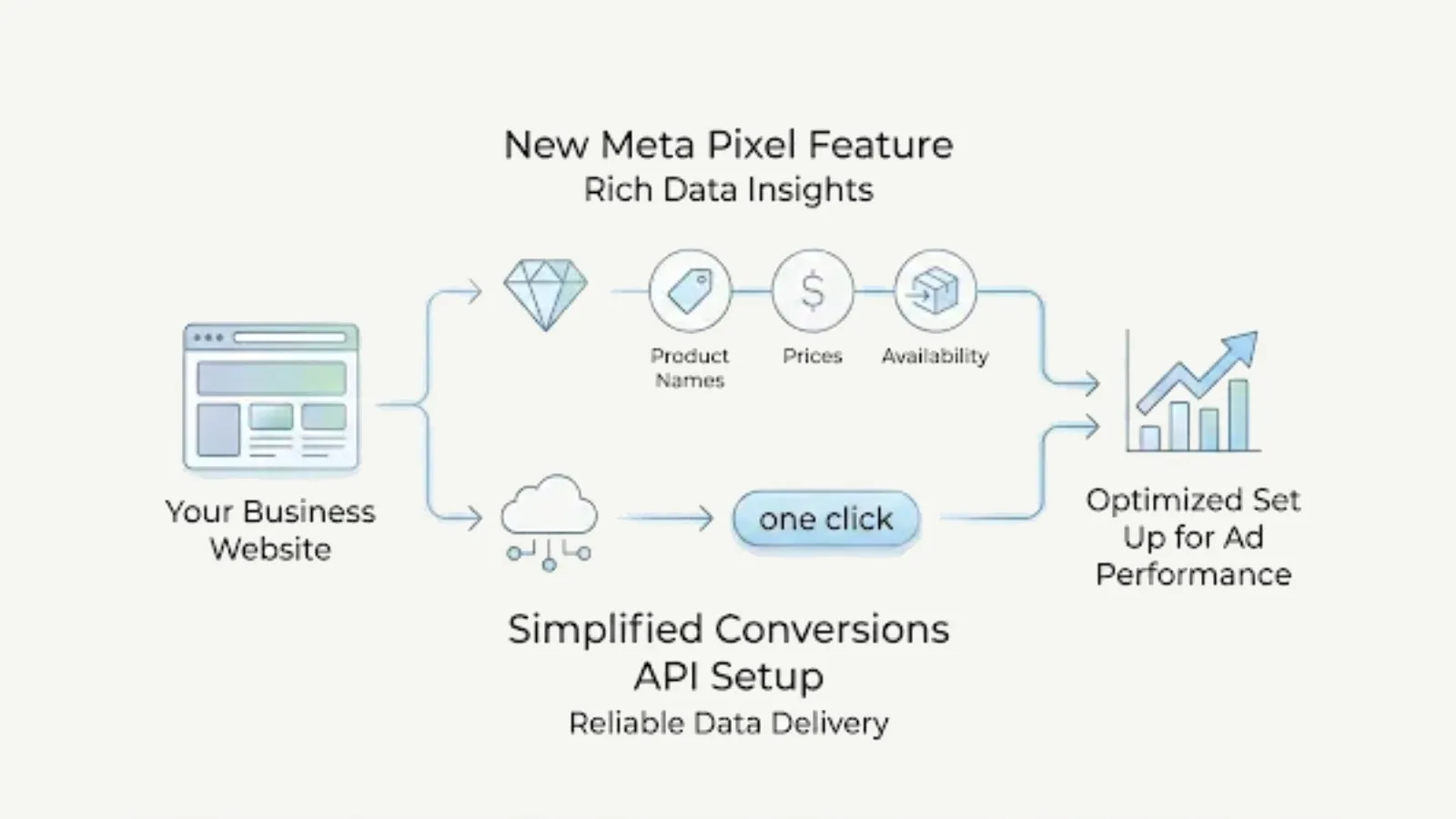

Meta today announced two significant updates to its advertising measurement infrastructure: an AI-assisted upgrade to the Meta Pixel and a simplified, one-click setup path for the Conversions API. Both changes, published in a Meta for Business announcement dated April 15, 2026, are framed around reducing the technical complexity that has historically separated well-resourced advertisers from those with leaner teams.
The timing matters. Meta's advertising business reported $50.08 billion in ad revenue for Q3 2025, a 26% year-over-year increase, and the company has been accelerating automation across its ad stack throughout 2025 and into 2026. Against that backdrop, the Pixel and Conversions API changes represent a direct attempt to extend the technical baseline that high-performing advertisers already maintain - and to do so without requiring smaller businesses to hire developers or manage ongoing code changes.
What changed with the Meta Pixel
The Meta Pixel is a piece of JavaScript code that website owners embed on their sites. Once installed, it reports user behavior back to Meta - actions like page views, product views, add-to-cart events, and purchases. That behavioral data feeds Meta's ad delivery system, helping it optimize which ads to show to which people and when. The fundamental technology is not new, but the way advertisers have historically enriched that data has required ongoing technical effort.
According to Meta's announcement, the new feature allows businesses to use AI to automatically include additional page and product information with the events shared with Meta. Specifically, the system can automatically attach product names, availability, and business details to the event data that flows from a website to Meta's servers. This is information many advertisers already share with Meta to run product-based ads, Meta noted - the change automates what was previously a manual, technical process.
Why does that distinction matter in practice? Meta's ad delivery system, like any machine learning system, benefits from context. When a retailer sells 2,000 SKUs and a visitor browses a specific category, the pixel event alone - "page view" - carries relatively little signal. Pairing that event with structured product metadata (the name, the price, whether it is in stock, the category) gives Meta's system far more to work with when deciding which audiences to target and how to bid. Until now, maintaining that product-level context required developers to manually update code whenever inventory, pricing, or product details changed. For large teams, that is a manageable process. For a business with two people and no dedicated developer, it is often simply not done.
The new AI-assisted feature handles that synchronization automatically. The mechanism Meta describes works by having the Pixel itself use AI to read page and product information at the time of the event, rather than relying on a developer to have embedded that information manually. Meta has not published technical documentation spelling out the exact machine learning approach, but the practical effect is that a page update - a product going out of stock, a price change, a new item added to a catalog - gets reflected in the event data without a code deployment.
Access to the feature is not universal. According to Meta, access may not be available to advertisers that have certain data source categories. The company did not specify which categories are excluded, but the caveat is likely related to data sensitivity classifications - for example, advertisers in healthcare or financial services who operate under stricter data handling rules. Advertisers are responsible for complying with the Meta Business Tools terms when using the Pixel, including ensuring that sensitive data is not shared with Meta.
Existing Meta Pixel users will not have the feature switched on without notice. According to the announcement, they will receive a notification with a 30-day window to review the feature before it is enabled. Advertisers can adjust or turn it off at any time through Events Manager, and they can also review and manage which specific data categories are shared. The opt-out mechanism is persistent - the feature does not reactivate automatically after being disabled.
The Conversions API: from technical project to one-click setup
The Conversions API - often abbreviated to CAPI - is a server-side tracking mechanism that allows businesses to send event data directly from their own servers to Meta, bypassing the browser entirely. Where the Pixel relies on JavaScript executing in a user's browser, the Conversions API operates at the infrastructure level, making it less susceptible to ad blockers, browser privacy restrictions, and ITP (Intelligent Tracking Prevention) policies. Meta has long recommended that advertisers use both in combination.
The performance case for Conversions API adoption is quantified in the announcement. According to Meta, advertisers with a Conversions API setup for web events saw an average 17.8% lower cost per result compared to those without Conversions API. That is a material efficiency difference, and it has been enough to make CAPI a standard recommendation from any agency or consultant managing Meta campaigns at scale.
The problem has been implementation. Setting up a proper Conversions API configuration has historically required either direct server access and developer knowledge, or integration through one of Meta's third-party partner platforms such as Shopify, WooCommerce, or similar. Neither path is trivial. Building a custom integration requires understanding Meta's server-side API, configuring authentication, mapping events correctly, and maintaining the integration over time as the API evolves. Partner integrations simplify some of that, but they still require the advertiser to have the right platform, the right plan, and someone who knows how to configure it.
The new Meta-enabled Conversions API setup changes the equation. According to the announcement, this is a one-click option that requires no technical expertise, no costs, no ongoing maintenance, and will allow businesses to get set up in minutes. Meta describes it as a "Meta-enabled" setup - meaning Meta itself handles the infrastructure, rather than requiring the advertiser to provision servers or write code.
For advertisers already using a partner integration or a custom Conversions API setup, nothing changes. The new option is additive. Meta is specifically targeting two groups: advertisers with low event coverage (a metric visible in Events Manager that measures what proportion of conversions are being captured) and advertisers who have been aware of Conversions API but have not acted on it because the technical overhead felt too high.
What does "one-click" actually mean technically? Meta has not published a detailed architecture diagram, but the framing - "Meta-enabled" with no ongoing maintenance - suggests Meta is running the server-side infrastructure itself, acting as an intermediary that captures web events and forwards them to its ad systems. This would be conceptually similar to how Meta Pixel already works for browser-side events, extended to cover scenarios where the browser-side signal is incomplete. The practical implication is that advertisers no longer need to maintain their own servers or worry about API versioning when Meta updates the Conversions API specification.
This matters because CAPI adoption has been uneven across the industry. The IAB published a guide in October 2025 on the role of Conversion APIs in closing the outcome gap for CTV, noting that two-thirds of advertisers reported improved return on ad spend after CAPI implementation. That research covered the broader industry standard, not Meta-specific implementations, but it underscores why the measurement community has been pushing CAPI adoption hard - and why the barrier of technical setup has been a genuine obstacle.
The signal quality problem in context
These changes arrive at a complicated moment for Meta's measurement infrastructure. In February 2026, a German court delivered legally binding judgments against Meta for Business Tools data collection, finding illegal collection of personal data across third-party websites and apps. The Dresden Higher Regional Court ordered Meta to pay four Saxon users 1,500 euros each in damages, and prohibited Meta from collecting data about the plaintiffs on third-party sites with immediate effect. The court indicated that website operators embedding Meta's tracking tools may share liability for GDPR violations.
In June 2025, researchers disclosed that Meta Pixel had been involved in covert Android tracking via localhost ports, a method that circumvented standard privacy controls including Incognito Mode and Android's permission system. Meta responded quickly - as of June 3, 2025, the Pixel script stopped sending packets to localhost - but the episode drew attention to the degree to which Meta's measurement tools operate in contested legal and technical territory.
Meanwhile, Meta's 2026 DMA compliance report, filed in March 2026, confirmed that a segment of EU users has now actively selected the less personalized advertising option, which involves a roughly 90% reduction in the data signals used for targeting. That level of signal loss has direct consequences for lookalike audiences, retargeting pools, and conversion optimization - precisely the functions that the Pixel and Conversions API are designed to support.
The new Pixel and CAPI updates sit within that context. More automated data collection, handled by Meta's own AI rather than by developer teams, reduces the gap between what data Meta can theoretically use and what data advertisers actually send. At the same time, that automation makes it harder for individual advertisers to audit precisely what is being transmitted - a concern that the 30-day review window and the Events Manager controls are designed to address, at least partially.
Why the marketing community should pay attention
For practitioners managing Meta campaigns, the 17.8% cost per result figure cited by Meta is the most immediately actionable number in this announcement. If that figure holds across a range of advertisers - and Meta's internal data, however it was measured, provides the baseline claim - then the Conversions API setup change has direct budget implications. A campaign spending 100,000 euros per month and achieving a 17.8% lower cost per result effectively delivers the same outcome volume for roughly 82,000 euros, or equivalent volume gains on the same budget.
The Pixel AI enhancement is harder to quantify in advance, because the improvement it delivers depends on the gap between the product information a given advertiser was previously passing and what the AI can now add automatically. An advertiser with a well-maintained product feed and a custom CAPI setup may see minimal change. An advertiser who installed the base Pixel years ago and has not touched it since may see a more significant shift in event quality.
Meta's broader push toward automation - including the Advantage+ campaign structure migration required by Q1 2026 and the deprecation of legacy campaign APIs in October 2025 - has drawn mixed reactions from the advertising community. Some practitioners have welcomed the efficiency gains; others have raised concerns about reduced control over targeting, creative, and placement decisions. The Pixel and CAPI changes occupy slightly different territory: they are about measurement infrastructure rather than campaign management, and the case for better measurement data is harder to argue against.
Google's equivalent infrastructure has been moving in a parallel direction. Google Ads announced in April 2026 that enhanced conversions for web and for leads will be merged into a single toggle starting June 2026, simultaneously accepting user-provided data from website tags, Data Manager, and API connections. The structural similarity - reducing implementation complexity to increase signal quality - reflects a shared recognition across major platforms that measurement infrastructure has become a significant performance variable, and that the complexity of proper setup has been holding back data quality at scale.
What advertisers should do now
According to the announcement, the new Pixel feature will be enabled for existing users after a 30-day notification window. That means advertisers who have not already received a notification should expect one in the coming weeks. The 30 days is a review period - not an opt-in process - so advertisers who take no action will have the feature enabled by default once that window closes.
Checking Events Manager before and after the feature activates would establish a baseline for event quality metrics, including event match quality scores. Those scores measure how effectively Meta can match a pixel event to a Facebook or Instagram account, which directly affects targeting accuracy. An improvement in match quality after the AI feature activates would indicate that the additional product and page data is being put to use.
For the Conversions API, the one-click setup path is available now for advertisers who have low event coverage or no existing CAPI implementation. Advertisers already using a partner integration or custom server-side setup are not affected and do not need to take action.
Timeline
- June 2025: Researchers disclose covert Android tracking by Meta Pixel via localhost ports; Meta halts the behavior within days. Coverage on PPC Land
- October 2025: Meta deprecates legacy Advantage Shopping Campaigns and Advantage App Campaign APIs as part of shift to unified Advantage+ structure. Coverage on PPC Land
- October 30, 2025: IAB releases guide on Conversion APIs and their role in closing the outcome gap for CTV, with two-thirds of advertisers reporting improved ROAS after CAPI implementation. Coverage on PPC Land
- February 3, 2026: Dresden Higher Regional Court delivers legally binding judgments against Meta for Business Tools tracking, including Meta Pixel, finding GDPR violations and ordering 1,500 euro damages per affected user. Coverage on PPC Land
- March 6, 2026: Meta files its third DMA compliance report, confirming a segment of EU users has selected the less personalized advertising option with roughly 90% reduced data signals. Coverage on PPC Land
- March 11-12, 2026: IAB Sweden expels Meta from membership over insufficient action against deceptive advertising on its platforms. Coverage on PPC Land
- April 10, 2026: Google Ads announces enhanced conversions unification into a single toggle starting June 2026, accepting data from tags, Data Manager, and APIs simultaneously. Coverage on PPC Land
- April 15, 2026: Meta announces AI-enhanced Meta Pixel feature and one-click Meta-enabled Conversions API setup, targeting technical barriers for smaller advertisers.
Summary
Who: Meta Platforms, affecting advertisers of all sizes using the Meta Pixel and Conversions API across Facebook and Instagram.
What: Meta introduced two updates - an AI-assisted Meta Pixel feature that automatically enriches event data with product names, availability, and business details; and a one-click, no-cost, no-maintenance Conversions API setup option called the Meta-enabled Conversions API. Existing Pixel users receive a 30-day notification before the AI feature is enabled. Advertisers with Conversions API setups for web events have seen an average 17.8% lower cost per result versus those without, according to Meta.
When: The announcement was made on April 15, 2026. Existing Meta Pixel users will receive a 30-day notification window before the AI feature activates. The one-click Conversions API setup is available immediately.
Where: The changes apply globally through Meta's Events Manager and affect all advertisers using the Meta Pixel and Conversions API on Meta's advertising platforms, including Facebook and Instagram.
Why: Meta framed the changes as a way to remove technical barriers that have historically given well-resourced advertisers a performance advantage. Maintaining detailed page and product information in event data and setting up server-side tracking have both required developer resources - giving larger teams an edge. The updates automate those processes so smaller businesses can operate with the same data quality infrastructure, while larger advertisers can redeploy technical staff to other priorities.


Discussion