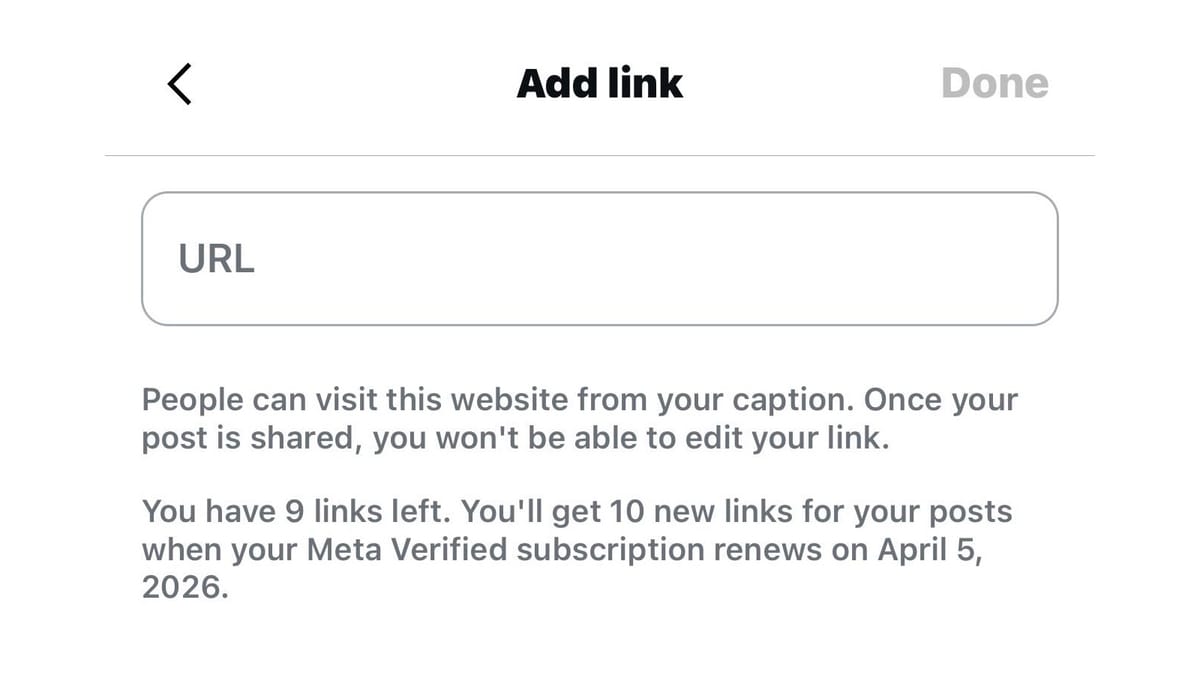
Meta this month is testing a feature that allows certain Instagram users to embed clickable links directly inside post captions - a departure from a policy that, for over a decade, kept Instagram closed to hyperlinks within the feed itself. The test, confirmed by Meta, is limited to Meta Verified subscribers, and the company has not disclosed further details about timing, pricing tiers involved, or whether a broader rollout is planned.
The capability surfaced publicly around March 12, 2026, when a travel blogger posting under the handle @itsatravelod shared a thread on Threads describing the feature. "OMG, Instagram finally gave us the option to add a link in the caption," the post read, generating more than 12,100 views and hundreds of replies. The blogger posted a follow-up: "Look, here it is. It's the first time I see it & use the feature. Apparently, you can only do it 10 times in one month - according to the message I got when I did it."
According to a report by MediaPost's Colin Kirkland published on March 14, 2026, Meta has confirmed the link-in-post test for some Meta Verified subscribers. The company has not provided any further details beyond that confirmation.
The blogger's example showed a Substack newsletter link placed at the bottom of an Instagram carousel post. According to the MediaPost report, clicking the link takes users directly to the welcome page of the newsletter, bypassing the need for any redirect. The link appeared integrated into the standard caption field, not as a separate call-to-action sticker or overlay element - a meaningful distinction from how links function in Stories or Reels.
How the feature appears
Screenshots shared by the blogger in response to questions from followers show a dedicated "Add link" field appearing within the Instagram post creation interface. The URL entry box appears beneath thumbnail and payment options in the flow. A note visible in the interface warns users that they cannot add content from their captions - and, according to the blogger's account, a pop-up message explains the 10-link-per-month limit.
Several users in the Threads discussion replied that the feature had not appeared for them, suggesting a limited rollout. One user based in the UK wrote that the feature was not present on their account. Another commented that they had the capability "and you can do it how many times you want to" - a contradiction of the 10-per-month cap reported by the original poster, which may indicate that different subscription tiers carry different terms. According to user @littletechgirl responding in the thread, the feature "is part of one of the tiered Verified subscriptions."
According to the MediaPost report, one commenter suggested a cost of $50 for the Meta Verified Plus membership tier to gain access to 2 links per month - though this was a user comment, not a confirmed Meta statement. Separately, @jenns_trends asked in the thread whether the original poster was on a Meta Verified premium plan, and the blogger confirmed she was. The exact subscription tier required, and the terms per tier, remain unconfirmed by Meta.
Instagram's long-standing link restriction
To understand why this test matters, it is necessary to revisit Instagram's historical policy. Since its launch in 2010, Instagram kept hyperlinks out of post captions entirely. The sole placement for a clickable external link was the profile biography - a single field that drove the entire "link in bio" convention that shaped how influencers, publishers, and brands communicated their external content.
That constraint spawned a cottage industry. Linktree, founded in 2016, became one of the best-known tools for aggregating multiple URLs behind a single bio link, allowing creators to point followers to several destinations at once without repeatedly updating their profile. The platform grew significantly on the back of Instagram's restriction.
According to the MediaPost report, Linktree faced its first structural challenge from Instagram itself in April 2023, when Meta increased the number of links permitted in Instagram bios from one to five. That change reduced some of the utility of link aggregator tools, though the convention remained in widespread use. The current caption link test goes considerably further: if rolled out broadly, it would allow creators to attach a specific link to each individual post, something that bio links - even five of them - cannot replicate with the same contextual precision.
MediaPost's Kirkland concluded that if Instagram makes the feature available to all paying subscribers, "Linktree could eventually be rendered obsolete on the app."
The Meta Verified subscription context
Meta Verified is a paid subscription service Meta introduced in 2023. It provides a blue verification badge, impersonation protection, and access to account support, among other benefits. Meta expanded the subscription to businesses in Canada in October 2023, and later launched it for businesses in India in July 2024, where tiered pricing starts at approximately INR 639 per month and can reach INR 30,000 per month for the most comprehensive bundled plan.
The subscription has a tiered structure - Standard, Plus, Premium, and Max - with each successive tier offering additional platform features. Linking the caption link capability to a specific paid tier is consistent with how Meta has historically introduced premium functionality. Access to dedicated support, advanced analytics, and now potentially caption links, is positioned as a value-add for subscribers willing to pay above the base level.
One user in the Threads discussion raised a pointed concern: "If it's apart of the you have to pay than no thanks they already treat us like crap lol I'ma pay to be treated like more crap they don't value it as a customer smh." The reaction illustrates a recurring tension in Meta's subscription strategy - the company is commercializing capabilities that free users historically received, or that creators expected to be part of the platform's basic functionality.
Reach effects and creator questions
The discussion thread raised another question that directly interests digital marketing professionals: does embedding a link in a post caption affect the content's reach? The original poster addressed the question directly in a reply. "I used it in a carousel," she wrote, "and so far (it's been like 14 hours), it's a bit slower than my usual carousels, yes." That observation - anecdotal and early - mirrors a long-held concern among creators that Instagram's algorithm disadvantages posts with external links, given the platform's commercial interest in keeping users on-platform rather than directing them away.
No formal data from Meta exists on this point in the current test. What is clear is that the algorithm question will be among the first things marketers evaluate if the feature becomes more widely available. Instagram's recommendation systems have undergone sustained changes throughout 2025, and the platform's introduction of a follows metric for advertising reporting in August 2025 signals the company's ongoing focus on quantifying audience-building actions. A link placement that measurably suppresses reach would substantially undercut the feature's commercial value.
For marketers and creators, the structural significance of caption links goes beyond convenience. Each Instagram post could carry its own destination URL, enabling direct attribution from a specific piece of content to a specific campaign or product page. This closes a gap that has long frustrated performance marketers operating on Instagram, who could only observe traffic from bio link clicks without knowing which post drove the visit.
Meta's phasing out of Facebook and Instagram shops checkout in 2025 moved transactions off-platform to merchant websites - a shift that increases the importance of any mechanism that drives users from Instagram to an external URL. Caption links, if broadly deployed, would provide a more direct and measurable route for that traffic.
There are also implications for content strategy. A creator currently producing carousel posts, Reels, and grid images operates within a publishing model where all content funnels toward a single bio link. Caption links would allow differentiation by post: a Tuesday product post links to the store, a Thursday editorial post links to a newsletter, a Saturday lifestyle post links to an affiliate. That granularity changes the information architecture of how Instagram functions as a traffic channel.
The 10-per-month cap introduces a planning constraint that is itself meaningful. Ten posts per month at a link-eligible cadence means creators must make choices about which content earns an outbound link. That selectivity may, paradoxically, increase the attention users pay to captioned links when they do appear - because their relative scarcity signals editorial intent.
From a competitive standpoint, the feature, if expanded, narrows the distance between Instagram and platforms that have long allowed free hyperlinking, including X (formerly Twitter) and LinkedIn. Facebook has permitted links in posts for years. Instagram's historical restriction stood out precisely because of the platform's scale and influence on creator economics. Closing that gap - even partially, even behind a paywall - updates the platform's position in a creator's toolkit.
The UK-based account that noted the feature was not available in their region raises an additional dimension. Geographic rollout patterns for new Meta features often follow regulatory and infrastructure considerations. The EU and UK operate under distinct data protection and digital market frameworks, meaning feature access may vary by jurisdiction, at least initially. Meta's 2026 DMA compliance report, submitted on March 6, 2026, revealed the company actively managing product rollouts against European regulatory requirements - a context that makes geographic discrepancies in feature access entirely plausible.
Meanwhile, Instagram's approach to monetization and platform architecture is shifting in multiple directions simultaneously. The platform is ending support for end-to-end encrypted chats on May 8, 2026 - a decision that signals Instagram's continued orientation toward public-facing content and commercial interaction rather than private communication. Caption links fit within that same arc: making Instagram more useful as a distribution and commerce channel, at a price.
Whether the test expands beyond Meta Verified subscribers, what the per-tier link allocations look like, and how Instagram's algorithm treats captioned URLs at scale remain open questions. Meta has offered no public timeline for a broader rollout.
Timeline
- 2010 - Instagram launches, with no support for hyperlinks in post captions; the single bio link becomes the platform's only clickable external URL location
- 2016 - Linktree launches, building its business model around Instagram's single-link restriction
- April 2023 - Instagram increases the number of links permitted in user bios from one to five, posing the first structural challenge to link aggregator tools
- October 2023 - Meta expands Meta Verified subscription to businesses in Canada, establishing the tiered commercial subscription infrastructure
- July 2024 - Meta Verified launches for businesses in India with four subscription tiers, pricing from INR 639 to INR 30,000 per month
- June 2025 - Meta begins phasing out on-platform checkout for Facebook and Instagram shops, redirecting transactions to merchant websites and raising the value of external links
- July 2025 - Instagram follows metric introduced in Meta ads reporting, expanding attribution capabilities for paid campaigns
- July 2026 - Instagram content becomes indexable by Google for professional accounts, further extending the reach implications of Instagram posts
- March 6, 2026 - Meta submits third annual DMA compliance report to the European Commission, confirming active management of product rollouts against EU regulatory requirements
- ~March 12, 2026 - Blogger @itsatravelod posts on Threads documenting the caption link feature for the first time, noting a 10-link-per-month cap via an Instagram pop-up message
- March 14, 2026 - MediaPost's Colin Kirkland reports on the caption link test; Meta confirms the test for some Meta Verified subscribers without providing additional details
- March 15, 2026 - Instagram announces end to end-to-end encrypted chats effective May 8, 2026, reinforcing the platform's direction as a public content and commerce channel
Summary
Who: Meta and Instagram subscribers on the Meta Verified paid subscription plan, specifically those on higher tiers. The test was first publicly documented by travel blogger @itsatravelod on Threads, and confirmed by Meta to MediaPost.
What: Instagram is testing the ability to embed clickable external links directly into post captions, with a cap of 10 links per month according to an in-app message seen by at least one user. Previously, the only location for a clickable link on Instagram was the profile biography field.
When: The feature was first reported publicly around March 12, 2026, when the blogger shared screenshots and details on Threads. MediaPost published its report on March 14, 2026, which included Meta's confirmation of the test.
Where: The feature is appearing for certain Meta Verified subscribers on Instagram globally, though at least one user in the UK noted the feature was not available on their account, suggesting geographic variation in the rollout.
Why: The test represents Meta's gradual commercialization of premium platform capabilities through the Meta Verified subscription tier. For creators and marketers, clickable caption links would enable per-post traffic attribution - a long-requested capability. For Meta, the feature deepens the value proposition of its paid subscription product while potentially challenging the economics of third-party link aggregation services like Linktree that were built around Instagram's historic link restriction.
Share this article
The link has been copied!