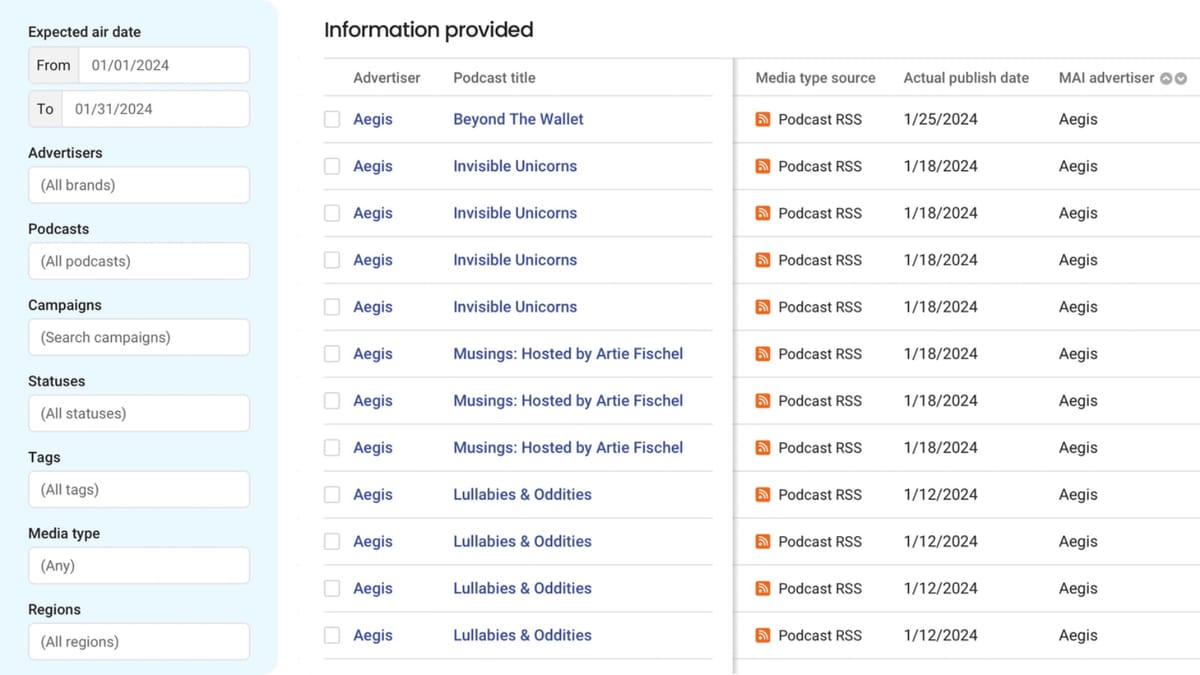
Magellan AI today launched Broadcast Radio Attribution, a new measurement product that enables advertisers to evaluate the performance of broadcast radio campaigns within the same platform they use to measure podcasts, streaming audio, and connected television. The announcement, made in March 2026 by the company operating under the legal name Twenty Nine Enterprises, Inc., extends Magellan AI's attribution capabilities to one of the largest unmeasured advertising channels remaining in the United States audio market.
The practical effect is direct. For the first time, a brand running campaigns simultaneously on AM/FM broadcast radio, podcast networks, streaming audio, and CTV can assess which channels are driving form fills, leads, and purchases - without switching between separate systems or reconciling incompatible methodologies.
What the product actually measures
Broadcast Radio Attribution connects radio campaign exposure to lower-funnel business outcomes. According to the company's announcement, measurable outcomes include form fills, leads, and purchases. These are the same outcome categories that digital channel measurement has tracked for years; the difference is that broadcast radio has not, until now, been incorporated into the same unified reporting environment.
Magellan AI's measurement platform already supports several distinct attribution methodologies. The company's product suite includes pixel-based attribution, pod-to-pod attribution, incremental lift measurement, and ListenLinks - a format that creates trackable links within audio content. Broadcast Radio Attribution becomes the fifth attribution product in that stack. Advertisers do not need to operate a separate tool; the radio measurement sits alongside the existing methods within a single dashboard.
The company, which has built what it describes as the world's largest database of podcast advertising data covering over 50,000 podcasts, now positions that infrastructure as the foundation for a broader audio and cross-channel measurement offering. International capabilities cover USA Spanish, Canada, UK, Ireland, Germany, and Australia.
According to Cameron Hendrix, CEO and Co-Founder of Magellan AI, "Measurement needs to reflect how media actually works today - across channels, not in silos. Broadcast Radio Attribution brings radio into that unified view, helping advertisers understand performance and make better decisions across their campaigns."
Why broadcast radio has been difficult to measure
Broadcast radio presents measurement challenges that digital channels do not. Unlike digital audio, where pixel tracking and identifier-based attribution can connect a listener's device to subsequent website activity, broadcast radio is received over the air without a digital handoff. Listeners cannot be tracked directly through a URL parameter or a cookie equivalent. This technical gap has historically made it difficult to connect a radio campaign's flight dates and creative content to conversions occurring on an advertiser's website or app.
The consequence has been a persistent information asymmetry. Advertisers running campaigns across both broadcast and digital channels have lacked a consistent framework for comparing performance. A podcast campaign that generates measurable leads can be evaluated against other digital channels with relative precision. A broadcast radio campaign running on the same brand's media plan has, until now, required entirely separate measurement infrastructure - or simply gone unmeasured in terms of direct business outcomes.
Christine Hess, Director of Account Strategy at Mynt Agency, addressed this directly in the announcement. According to Hess, "Radio has always delivered meaningful impact, but it hasn't been measured with the same precision as digital channels. If you're only measuring one channel, you're seeing a distorted view of performance. With Broadcast now included in Magellan AI's multi-channel measurement, we have the visibility we need to understand and optimize holistically."
Mynt Performance Marketing, the agency that provided the client testimonial for today's announcement, is described as a performance video and audio media partner. According to the company's own documentation, Mynt has generated more than $3.1 billion in incremental client revenue and delivers a 4x average ROAS on evergreen campaigns. The agency is backed by investors including Wedbush Capital and led by Scott Termini as CEO and Shane Yarchin as COO.
The broader measurement gap that radio sits within
Broadcast Radio Attribution does not exist in isolation. It arrives at a moment when the audio advertising industry is actively constructing a unified measurement infrastructure - and when the gap between consumer audio engagement and advertiser investment has become a documented structural problem.
PPC Land's coverage of audio advertising market dynamics has documented a 22-percentage-point gap between consumer engagement and advertiser investment in audio: consumers spend 31% of their media time with audio content, yet advertisers allocate only 9% of budgets to audio platforms. That gap persists despite years of growth in podcast advertising and increasing programmatic access to broadcast radio inventory.
The commercial momentum in podcast advertising has been strong. Podcast advertising spending grew 26% year-over-year in Q3 2025, according to a Magellan AI benchmark report analyzing 94,724 podcast episodes. The pace accelerated further in Q4 2025, when spending rose 32% year-over-year as 1,482 new brands entered the channel, with total Q4 spending exceeding Q3 by 17%.
On the broadcast radio side, the infrastructure for programmatic buying has been expanding in parallel with measurement. StackAdapt announced in November 2025 an integration with iHeartMedia that brought broadcast radio inventory into its programmatic platform, enabling unified planning, forecasting, and reporting across AM/FM broadcast and digital audio. iHeartMedia subsequently opened that OTA broadcast radio inventory to Viant's programmatic buyers, further expanding the supply-side infrastructure.
But programmatic access to radio inventory solves a different problem than attribution. Programmatic buying makes purchasing more efficient. Attribution answers the question of whether the purchase produced results. Magellan AI's new product addresses the latter.
Context: how radio's measurement compares to the wider industry
The measurement challenge for broadcast radio is not merely technical. It reflects a structural feature of the American audio market. Nielsen's audio research has shown that radio captures nearly 70% of average daily time spent by listeners on ad-supported audio, a figure that reflects the medium's continued reach even as podcast and streaming audio grow rapidly. Radio audience data itself has become a source of significant legal dispute. A federal court in early 2026 blocked aspects of Nielsen's Subscriber First Policy, which had restricted competitor access to summary-level local radio ratings data - a ruling later subject to an appellate stay.
That legal context matters for advertisers. Audience measurement and outcome attribution are distinct functions, but both depend on the availability of reliable data infrastructure. The court proceedings involving Nielsen and Cumulus Media have demonstrated how access to radio measurement data has direct commercial consequences for station revenue. Magellan AI's Broadcast Radio Attribution product operates on the outcome measurement side - that is, connecting campaign exposure to downstream advertiser conversions - rather than on the audience measurement side that the Nielsen litigation concerns.
The broader industry has been moving toward unified cross-channel measurement for several years. Nielsen and Edison Research announced a collaboration in August 2025 to launch Nielsen Podcast Fusion, integrating Edison Podcast Metrics into Nielsen Media Impact (NMI) for the first time, enabling planners to compare podcasts, TV, radio, digital, and social within a single tool. That integration addressed the planning and audience side. Magellan AI's Broadcast Radio Attribution addresses the performance and attribution side.
Earlier this month, Magellan AI also announced a separate integration of Nielsen's DMA data into its podcast attribution dashboard, enabling advertisers to measure podcast campaign performance across 210 U.S. media markets at the local level for the first time. That announcement and today's Broadcast Radio Attribution launch together represent a sustained effort to close measurement gaps across the full audio channel stack. Podcast attribution now has local market segmentation. Broadcast radio now has outcome attribution. Both expansions are live for existing Magellan AI customers.
Audience data adds urgency
The timing of both announcements coincides with a significant audience milestone. Edison Research's Infinite Dial 2026, released on March 12, 2026, found that 58% of Americans - approximately 167 million people - now listen to podcasts monthly, a new record. The 35 to 54 demographic reached 68% monthly podcast consumption, establishing the medium as one of the few channels with documented majority reach among a premium advertising demographic. Online audio monthly reach stood at 81%.
For advertisers planning audio campaigns, those figures represent a large audience that overlaps across broadcast radio, streaming audio, and podcast consumption. The value of Magellan AI's cross-channel attribution model is directly tied to the degree to which listeners move between formats - and the data suggests they do.
What it means for measurement practice
Broadcast Radio Attribution is now available to advertisers and agencies. According to the announcement, it is offered as an integrated product within the Magellan AI platform rather than as a separate standalone tool. This means that existing clients on the platform can add broadcast radio measurement to campaigns that already include podcast and streaming attribution - without adopting a new vendor or reconfiguring their reporting environment.
The question for media planners is what the practical workflow change looks like. Under existing conditions, a media buyer comparing podcast and broadcast radio performance would typically access those measurements through different systems, apply different attribution windows, and reconcile the results manually before presenting to internal stakeholders. Unified attribution collapses those steps. It also creates a common denominator for optimization: if broadcast radio and podcast campaigns are measured using the same outcome definitions - form fills, leads, purchases - budget allocation decisions can be made on a consistent basis.
PPC Land's coverage of cross-platform measurement challenges has documented that media fragmentation, platform-specific metrics, and incompatible identity systems have left advertisers with data richness that does not translate into decision confidence. Attribution metrics rank second in importance among measurement domains, cited by 20% of marketers as the single most critical domain after media performance at 39%. A product that unifies attribution across broadcast and digital audio directly addresses one of the fragmentation points that has made cross-channel comparison difficult.
Magellan AI was founded by Cameron Hendrix, who serves as CEO and Co-Founder. The platform is used by advertiser and agency media buyers for media planning, competitive intelligence, ad verification, and measurement across podcast, streaming audio, and YouTube. Publishers use it for ad sales intelligence, content acquisition, and ad operations. With today's launch, the platform's measurement scope extends formally to broadcast radio for the first time.
Timeline
- July 25, 2024 - Magellan AI integrates UID2.0 and ID5 cookieless identifiers into podcast and streaming audio measurement
- August 6, 2025 - Nielsen and Edison Research launch Nielsen Podcast Fusion, integrating podcast metrics into Nielsen Media Impact for unified cross-platform planning
- July 26, 2025 - Audio advertising market analysis documents 22% gap between consumer engagement time and advertiser budget allocation
- November 4, 2025 - Magellan AI releases Q3 2025 Podcast Advertising Benchmark Report showing 26% year-over-year spending growth across 94,724 analyzed episodes
- November 10, 2025 - StackAdapt integrates iHeartMedia broadcast radio into its programmatic platform, enabling unified buying and reporting across AM/FM and digital audio
- December 26, 2025 - iHeartMedia opens OTA broadcast radio inventory to Viant's programmatic buyers through Triton Digital
- January 2, 2026 - Federal judge blocks Nielsen's Subscriber First Policy affecting local radio ratings access for competing stations
- February 7, 2026 - Nielsen wins appellate court stay, reversing the earlier injunction blocking its radio ratings policy
- February 10, 2026 - Magellan AI Q4 2025 Benchmark Report released, documenting 32% year-over-year podcast advertising spending growth and 1,482 new advertisers entering the channel
- March 12, 2026 - Edison Research Infinite Dial 2026 shows 58% of Americans now listen to podcasts monthly, a new record; online audio reaches 81% monthly
- March 2026 - Magellan AI integrates Nielsen DMA data into podcast attribution, enabling local market measurement across 210 U.S. media markets
- March 24, 2026 - Magellan AI launches Broadcast Radio Attribution, enabling outcome measurement for broadcast radio campaigns alongside digital channels in a single platform
Summary
Who: Magellan AI, an audio advertising intelligence and measurement company operating as Twenty Nine Enterprises, Inc., made the announcement. Mynt Performance Marketing, a performance video and audio media agency backed by Wedbush Capital and reporting more than $3.1 billion in cumulative client revenue, served as the launch partner agency providing testimonial.
What: Magellan AI launched Broadcast Radio Attribution, a new product within its existing measurement platform that enables advertisers to measure the outcome impact - specifically form fills, leads, and purchases - of broadcast radio campaigns. The product integrates with Magellan AI's existing attribution methods including pixel-based attribution, pod-to-pod attribution, incremental lift, and ListenLinks, enabling cross-channel comparison across broadcast radio, podcasts, streaming audio, and connected television from a single platform.
When: The announcement was made in March 2026. The product is available to advertisers and agencies immediately as of the announcement date.
Where: The attribution product is accessible within the Magellan AI platform. The company's platform covers international markets including the United States, Canada, UK, Ireland, Germany, Australia, and USA-Spanish language content. Magellan AI maintains a database of over 50,000 podcasts.
Why: Broadcast radio has remained one of the largest unmeasured advertising channels relative to digital standards, making direct performance comparisons between radio and digital campaigns practically difficult for media planners. The launch responds to demand from advertisers running multi-channel audio campaigns who require a consistent attribution framework to evaluate and optimize spending across both traditional and digital formats.
Share this article
The link has been copied!