Microsoft Advertising requires Clarity for third-party publishers
Microsoft Advertising mandates Clarity installation across all third-party publishers starting immediately, filtering non-compliant traffic as nonbillable.

Microsoft Advertising now requires all third-party publishers on its platform to install Microsoft Clarity across their placements to ensure editorial and safety standards. The requirement took effect immediately following an announcement from Microsoft Ads Liaison Navah Hopkins on November 11, 2025. Publishers failing to implement the behavioral analytics tool will see their traffic filtered out, resulting in nonbillable impressions and clicks.
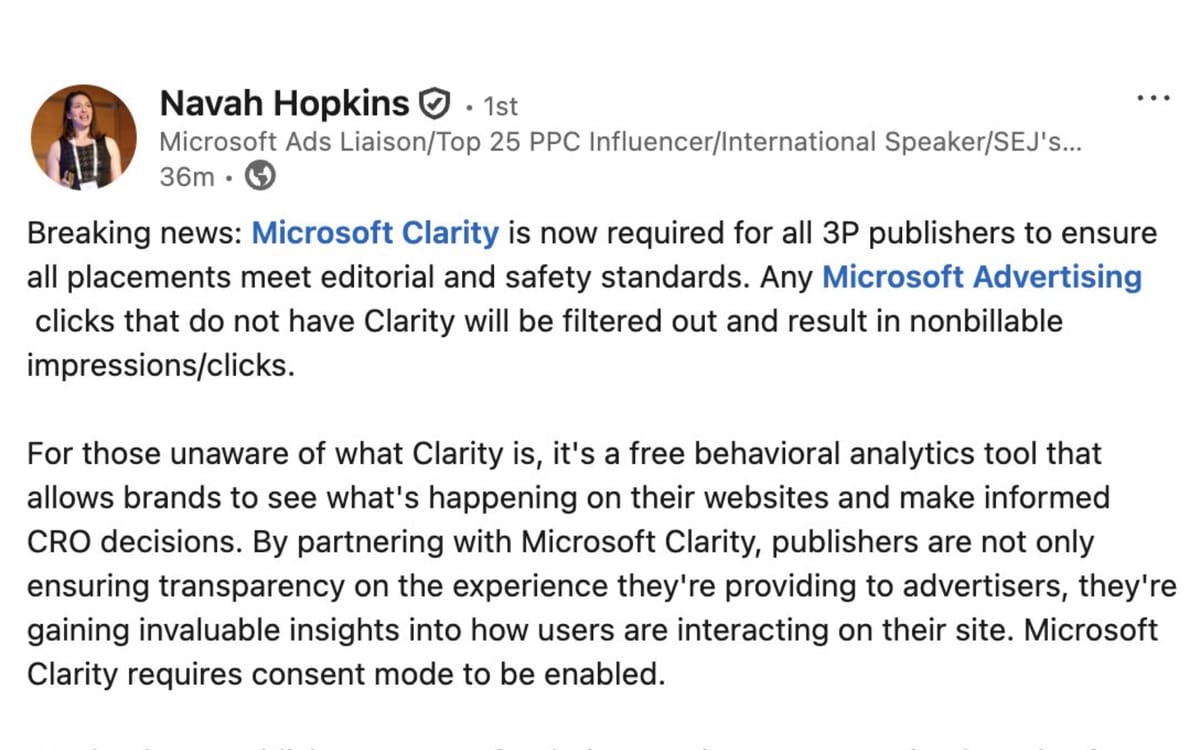
"Breaking news: Microsoft Clarity is now required for all 3P publishers to ensure all placements meet editorial and safety standards," Hopkins stated in a LinkedIn post. "Any Microsoft Advertising clicks coming from pages that do not have Clarity will be filtered out and result in nonbillable impressions/clicks."
Subscribe PPC Land newsletter ✉️ for similar stories like this one
The mandate represents a significant shift in how Microsoft Advertising manages publisher relationships and inventory quality. Microsoft Clarity previously operated as an optional analytics tool that publishers could deploy to analyze user behavior through session recordings and heatmap visualizations. The platform enables brands to observe website interactions and make conversion rate optimization decisions based on behavioral data.
The requirement specifically targets third-party publishers—websites and platforms that display Microsoft Advertising inventory but are not directly owned or operated by Microsoft. These publishers represent a substantial portion of the Microsoft Audience Network, which extends advertiser reach beyond Microsoft's own properties like Bing and MSN.
A critical component of this new requirement involves consent mode enablement. Microsoft Clarity requires consent mode to be properly implemented for analytics data collection in regulated markets. Publishers must send valid user consent signals before Clarity collects analytics data or sets cookies on visitor browsers, particularly for traffic originating from the European Economic Area, United Kingdom, and Switzerland.
Hopkins, who joined Microsoft as Ads Liaison with direct Product team reporting earlier in 2025, emphasized the dual benefits of the mandate. "For those unaware of what Clarity is, it's a free behavioral analytics tool that allows brands to see what's happening on their websites and make informed CRO decisions," she explained. "By partnering with Microsoft Clarity, publishers are not only ensuring transparency on the experience they're providing to advertisers, they're gaining invaluable insights into how users are interacting on their site."
The timing of this requirement aligns with broader industry movements toward increased transparency and brand safety protections. Microsoft has strengthened enforcement against low-quality "Made for Advertising" content and implemented multiple verification partnerships throughout 2025. The platform removed over one billion advertisements in 2024 as part of comprehensive trust and safety initiatives.
Third-party publishers now face technical implementation requirements to maintain their ability to monetize Microsoft Advertising traffic. Clarity installation involves adding tracking code to website properties and configuring consent management systems to meet privacy compliance standards. The analytics platform operates without usage fees, distinguishing it from many enterprise analytics solutions with tiered pricing models.
The mandate creates potential operational challenges for publishers operating across multiple advertising networks. Each platform maintains distinct verification and analytics requirements. Google Ad Manager recently introduced AI-powered brand safety tools, while the Media Rating Council established new standards restricting property-level verification services from claiming brand safety capabilities without content-level analysis.
Publishers must implement four consent methods to comply with Clarity requirements: the Clarity Consent API, Consent Management Platform integration, third-party platform integration, or Google Consent Mode integration. Sites receiving European traffic face mandatory consent signal implementation that Microsoft began enforcing across its advertising products in May 2025.
The filtering mechanism for non-compliant traffic represents a substantial enforcement measure. Microsoft will identify clicks originating from pages lacking Clarity installation and exclude them from billable metrics. This approach differs from softer compliance measures where platforms gradually encourage adoption through incentives rather than mandatory participation tied to monetization.
Microsoft's behavioral analytics integration strategy extends beyond basic traffic verification. The company has systematically expanded Clarity's capabilities throughout 2025, introducing Google Ads data integration, enhanced column management features, and AI-powered Campaign Insights. These enhancements position Clarity as a comprehensive analytics solution connecting advertising performance metrics with user behavior tracking.
The announcement did not specify grace periods or transition timelines for existing publishers. Hopkins indicated that Microsoft sent emails to all affected partners, with an official announcement forthcoming through Microsoft's standard communication channels. The immediate enforcement suggests Microsoft prioritized rapid implementation over extended transition periods that could delay brand safety improvements.
For advertisers, the mandate promises increased confidence in inventory quality across the Microsoft Audience Network. Brand safety concerns have driven multiple platform initiatives throughout 2025, including enhanced website exclusion tools enabling advertisers to manage 10,000 domain exclusions and individual mobile app performance monitoring.
Publishers operating within Microsoft's advertising ecosystem must now evaluate technical resources required for Clarity deployment. Implementation involves coordinating with consent management platforms, ensuring proper JavaScript event tracking, and maintaining server-side processing infrastructure. The requirement affects publishers globally, though consent mode provisions apply specifically to European traffic.
Buy ads on PPC Land. PPC Land has standard and native ad formats via major DSPs and ad platforms like Google Ads. Via an auction CPM, you can reach industry professionals.
Microsoft Advertising generated $13.9 billion in search advertising revenue during fiscal 2025, representing 21% year-over-year growth. The platform reached milestone annual revenue exceeding $20 billion across all advertising products, driven partly by AI-powered formats in Bing and Edge search experiences. Third-party publisher relationships represent significant components of this revenue growth, making inventory quality crucial to maintaining advertiser confidence.
The Clarity mandate extends Microsoft's privacy and verification framework that includes Universal Event Tracking consent mode, third-party brand safety partnerships with Integral Ad Science, and enhanced content quality standards. These interconnected requirements create comprehensive compliance obligations for publishers seeking to maintain monetization capabilities.
Industry observers noted the potential impact on smaller publishers lacking dedicated technical resources for implementing multiple platform-specific requirements. The mandate arrives as digital advertising platforms increasingly balance automation with transparency, creating parallel requirements across walled garden environments. Publishers must navigate distinct verification protocols, consent frameworks, and analytics implementations for each major advertising partner.
Hopkins concluded her announcement by acknowledging publisher cooperation. "We thank our publisher partners for their commitment to creating brand safe inventory for advertisers," she stated. The requirement positions Microsoft Clarity as mandatory infrastructure rather than optional tooling, fundamentally reshaping publisher participation requirements within the Microsoft Advertising ecosystem.
Your go-to source for digital marketing news.
No spam. Unsubscribe anytime.
Subscribe PPC Land newsletter ✉️ for similar stories like this one
Who: Microsoft Advertising implemented the requirement affecting all third-party publishers on its platform, announced by Microsoft Ads Liaison Navah Hopkins.
What: Microsoft Advertising now mandates Microsoft Clarity installation across all third-party publisher placements to ensure editorial and safety standards. Publishers without Clarity implementation will have their traffic filtered as nonbillable impressions and clicks. The requirement includes mandatory consent mode enablement for proper analytics data collection in regulated markets.
When: The requirement took immediate effect following the November 11, 2025 announcement. Microsoft sent emails to all affected publisher partners, with an official platform announcement forthcoming.
Where: The mandate applies globally to all third-party publishers within the Microsoft Advertising ecosystem, with specific consent mode requirements for traffic originating from the European Economic Area, United Kingdom, and Switzerland.
Why: Microsoft implemented the requirement to ensure transparency regarding publisher experiences provided to advertisers while maintaining editorial and safety standards across its advertising network. The mandate aligns with broader industry movements toward increased inventory quality verification and brand safety protections, addressing advertiser concerns about ad placement quality while providing publishers with behavioral analytics insights for conversion rate optimization.