Microsoft bets on AI to rewrite Windows after code it wrote broke the OS
Microsoft plans to eliminate C and C++ code by 2030 using AI after admitting months of Windows 11 malfunctions caused by components that started failing in July 2025.


Microsoft plans to eliminate C and C++ code by 2030 using AI after admitting months of Windows 11 malfunctions caused by components that started failing in July 2025.
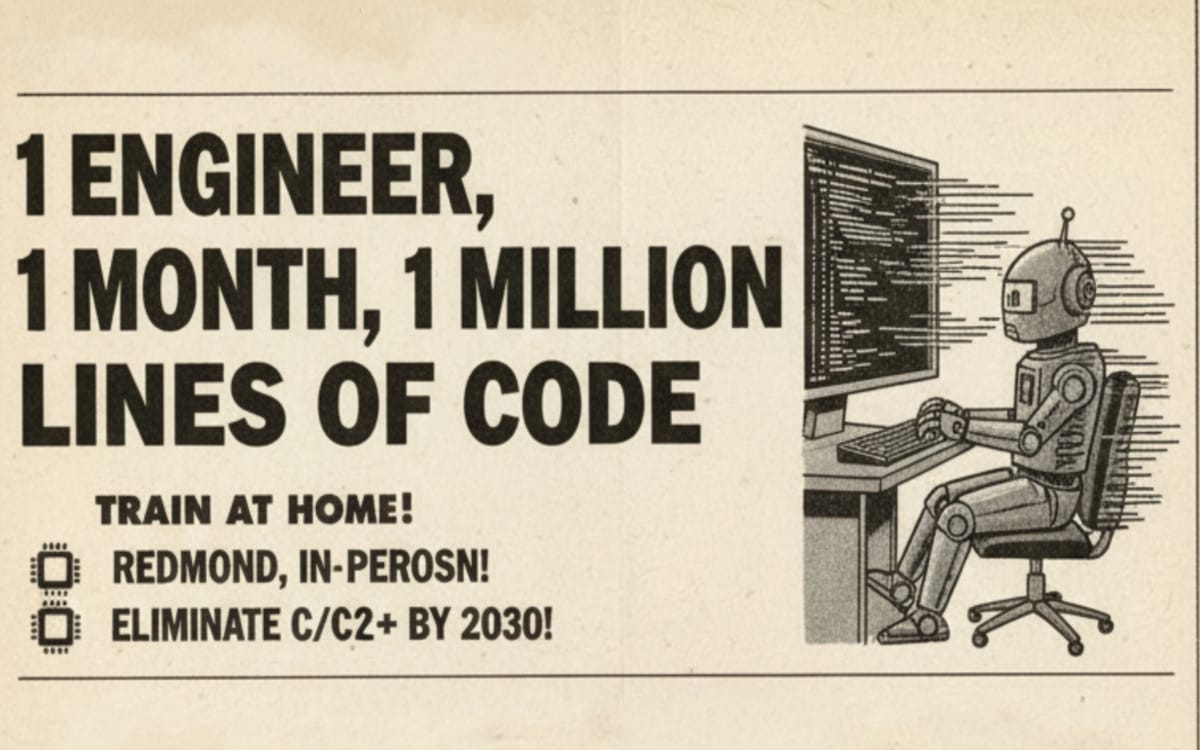
Microsoft announced an ambitious plan to eliminate all C and C++ code from its products by 2030 through AI-assisted rewrites on November 25, 2025, months after acknowledging that core Windows 11 components had been malfunctioning since July. According to a LinkedIn post by Galen Hunt, Distinguished Engineer at Microsoft, the company established a goal of "1 engineer, 1 month, 1 million lines of code" as its north star for the transformation.
The announcement came four months after Windows 11 users began reporting widespread system failures affecting the Start Menu, Taskbar, File Explorer, and System Settings. Microsoft officially acknowledged these issues in late November 2025, though problems had persisted through each monthly update from July through October. The timing raises questions about connections between the company's aggressive AI code generation strategy and fundamental operating system stability.
In April 2025, Microsoft CEO Satya Nadella stated that AI was writing between 20% and 30% of the company's code. Chief Technology Officer Kevin Scott indicated expectations for 95% AI-generated code by 2030. By July, core Windows components stopped functioning properly for millions of users.
Subscribe PPC Land newsletter ✉️ for similar stories like this one
According to Hunt's LinkedIn post, the malfunctions stemmed from complications with XAML components, the framework Microsoft uses for building Windows interfaces. Users reported unresponsive Start Menus, vanishing Taskbars, sluggish File Explorer behavior, and erratic System Settings. IT professionals described hours lost troubleshooting issues that affected daily operations across enterprise environments.
Gartner estimates that software bugs of this magnitude cost global enterprises billions annually in lost productivity. Microsoft recommended temporary fixes including resetting apps or rolling back updates, acknowledging these solutions served as "bandaids." The company promised a December 2025 patch to address the underlying problems, five months after the initial failures.
Social media platforms filled with commentary from software engineers and developers questioning Microsoft's testing capabilities. "Microsoft's push for feature-rich updates seems to be outpacing their testing capabilities," one engineer noted in response to Hunt's post about the rewrite initiative.
The company's infrastructure creation strategy involves building powerful code processing capabilities. Hunt described an algorithmic infrastructure that creates a scalable graph over source code, combined with AI processing infrastructure that enables application of AI agents guided by algorithms to make code modifications at scale. This core infrastructure already operates on problems such as code understanding.
Hunt opened a position for a Principal Software Engineer role requiring in-person work in Redmond, Washington. The job posting specifies that critical requirements include at least three years of experience writing systems-level code in Rust, with compiler, database, or operating system implementation experience highly desired.
"Our strategy is to combine AI and Algorithms to rewrite Microsoft's largest codebases," according to Hunt's post. The team operates as part of the Future of Scalable Software Engineering group within the EngHorizons organization in Microsoft CoreAI. The mission focuses on building capabilities to eliminate technical debt at scale.
Hunt emphasized that the team operates with a growth mindset, describing team members as diverse with a wide range of skills and perspectives. "We take on bold risks. We work and play well with others. We love to bring value to internal and external customers," he wrote. The post highlighted that diversity and growth mindset remain critical to success in the rapidly changing world of AI-based tools.
Rust, a programming language emphasizing memory safety and concurrency, has gained traction in systems programming contexts where C and C++ traditionally dominated. Microsoft's bet on Rust reflects broader industry trends toward languages designed to prevent entire categories of security vulnerabilities common in legacy codebases.
However, responses to Hunt's announcement revealed skepticism about the approach. Several developers noted that large language models struggle with Rust code generation due to limited training data compared to more established languages. "Anyone who used AI to write rust knows LLMs are fucking terrible at it (not enough training data). This is going to be a disaster," one developer commented.
Questions arose about whether the rewrite strategy addressed Microsoft's actual problems. Multiple commenters pointed out that the most broken parts of Windows 11 do not consist of C or C++ code, but rather newer components built with modern technologies. "The problem here isn't Rust. It's that the core parts of the windows kernel are mostly fine. All of the most broken parts are not in C/C++ at all," noted one respondent.
Buy ads on PPC Land. PPC Land has standard and native ad formats via major DSPs and ad platforms like Google Ads. Via an auction CPM, you can reach industry professionals.
The announcement generated substantial discussion across technology communities. Some industry observers questioned the economics of the approach. "So to save a few hundred thousand dollars, they end up losing billions. Masterful gambit, sir," wrote one commenter, referencing the potential cost savings from AI-generated code versus the productivity losses from system failures.
Concerns about AI-generated code quality extend beyond Microsoft. The technology industry has documented numerous cases where AI code generation tools produce plausible-looking but fundamentally incorrect implementations. These systems frequently reference non-existent functions, libraries, or APIs while presenting the fabricated information with apparent confidence.
Microsoft's advertising business, which has integrated AI capabilities extensively throughout 2025, provides context for the company's broader AI strategy. Microsoft's advertising revenue surpassed $20 billion annually by April 2025, with search and news advertising revenue climbing 21% in recent quarters. The company deployed advertising formats specifically designed for Copilot experiences throughout fiscal year 2025.
Microsoft Copilot research published in August 2025 documented 73% higher click-through rates and 16% stronger conversion rates compared to traditional search advertising. These results, spanning November 2024 through May 2025, demonstrated commercial viability of AI-integrated features in consumer-facing products.
The difference between consumer AI features in advertising and core operating system infrastructure highlights distinct risk profiles. Advertising systems tolerate experimentation and iteration in ways that foundational operating system components cannot. When search results underperform, users see irrelevant ads. When operating system components fail, millions of devices become partially non-functional.
Microsoft's approach to AI-assisted development carries workforce implications that extend beyond technical considerations. The company announced plans to resume hiring with "more leverage" from AI tools in November 2025, suggesting expectations for significant productivity gains from the technology.
Nadella positioned the current moment as analogous to the introduction of spreadsheet software, word processors, and email in the 1980s and 1990s. Those transitions required organizations to redesign business processes rather than simply automating existing workflows. Organizations that reimagined forecasting, document collaboration, and communication patterns succeeded more than those that merely digitized manual processes.
The emphasis on "leverage" suggests Microsoft expects to capture significant value from AI deployment rather than passing all benefits to employees through higher compensation or to consumers through lower prices. The company expects roughly one year for employees to master new workflows before productivity gains from AI deployment reach their potential.
Marketing and advertising professionals managing complex campaigns face particular uncertainty as platforms consolidate around proprietary AI systems. Microsoft's decision to sunset its Xandr DSP by February 28, 2026, demonstrates how AI-driven consolidation affects specialized platforms. The platform provided unprecedented visibility into fee structures and money flows throughout advertising supply chains.
Microsoft's infrastructure spending supports its AI ambitions at unprecedented scale. The company announced plans to spend $80 billion during 2025 on AI datacenter construction worldwide, with more than half allocated to United States facilities. The investment exceeds the gross domestic product of numerous countries.
Microsoft completed its Fairwater datacenter in Wisconsin on September 20, 2025, featuring hundreds of thousands of NVIDIA GB200 processors. The facility represents the company's single largest AI infrastructure investment, designed to deliver 10 times the performance of today's fastest supercomputers. Construction required 46.6 miles of deep foundation piles, 26.5 million pounds of structural steel, and 120 miles of medium-voltage underground cable.
This infrastructure enables the code generation and processing capabilities Hunt described in his announcement. The scale of these investments demonstrates Microsoft's commitment to AI-driven development strategies despite ongoing questions about the technology's reliability for mission-critical systems.
Microsoft's announcement highlighted a fundamental tension between rapid AI-assisted development and the rigorous testing required for operating system reliability. Windows serves as the foundation for most business computing globally, with millions of organizations depending on its stability for daily operations.
The four-month delay between when problems began and when Microsoft officially acknowledged them suggests organizational challenges in detecting and responding to systematic failures. One software engineer noted that the company's monthly update schedule combined with aggressive feature development appears to strain testing capabilities.
"After spending a decade at Microsoft, mostly working on analyzing process memory dumps and later writing postmortem debugger to automate analysis, I feel C/C++ requires deep understanding of memory management, pointer arithmetic, and low-level system interactions," commented one former employee. The observation raises questions about whether AI systems possess sufficient understanding to safely rewrite complex system code.
Microsoft has not disclosed what testing methodologies will verify the correctness of AI-generated code at the scale Hunt described. Traditional software testing approaches struggle to validate systems containing millions of lines of code, even when written by experienced human developers following established practices.
The situation carries relevance for marketing professionals beyond Microsoft's immediate product ecosystem. As advertising platforms increasingly incorporate AI capabilities for campaign optimization, creative generation, and audience targeting, understanding the technology's limitations becomes essential.
Microsoft introduced Image Animation capabilities on November 17, 2025, transforming static images into video assets through Copilot. The feature extends asset performance across Microsoft Advertising Network's video publishers globally. Research from the Interactive Advertising Bureau revealed that 86% of buyers use or plan to implement generative AI for video advertisement creation by 2026.
Amazon expanded Video Generator capabilities to all United States advertisers in June 2025, producing six different video options per request. Amazon Ads measurement data indicated brands using Image Generator between October 2023 and June 2024 experienced approximately 5% increased sales per advertiser on average. These consumer-facing AI applications demonstrate different risk profiles than core infrastructure code.
The distinction between experimental consumer features and foundational system components matters. Advertising platforms can iterate rapidly on creative tools and targeting algorithms because failures affect individual campaigns rather than entire business operations. When Microsoft's operating system fails, the consequences extend across every application and workflow depending on that foundation.
Microsoft's December 2025 patch for Windows 11 component failures will provide the first indication of whether the company successfully resolved issues that persisted since July. The promised fix addresses immediate symptoms but does not resolve questions about how similar problems might emerge as AI-generated code becomes more prevalent.
Hunt's job posting remains open for Principal Software Engineers willing to relocate to Redmond and work in-person. The requirement for physical presence suggests Microsoft recognizes the complexity of the transformation it proposes. Remote collaboration may prove insufficient for the level of coordination required to rewrite millions of lines of critical system code.
The company has not announced timelines for when AI-generated Rust code will begin replacing existing C and C++ components in shipping Windows versions. Given the scale of the undertaking and the consequences of failure, extensive testing and validation will likely precede any production deployments.
Microsoft's quarterly earnings reports will provide ongoing metrics about AI impact across the business. The company's cloud revenue hit $49.1 billion in recent quarters, with AI features reaching 900 million monthly active users across Microsoft's products. This user base provides substantial testing ground for AI capabilities, though most applications remain consumer-facing rather than infrastructure-critical.
Industry observers will track whether competitors follow Microsoft's lead or pursue alternative strategies for modernizing legacy codebases. Apple, Google, and other technology companies face similar challenges maintaining decades-old system code while meeting contemporary security and performance requirements.
Subscribe PPC Land newsletter ✉️ for similar stories like this one
Subscribe PPC Land newsletter ✉️ for similar stories like this one
Who: Galen Hunt, Distinguished Engineer at Microsoft, announced the initiative affecting millions of Windows users who experienced system malfunctions. CEO Satya Nadella and CTO Kevin Scott previously disclosed AI's increasing role in code generation across Microsoft products.
What: Microsoft plans to eliminate all C and C++ code from its products by 2030 using AI-assisted rewrites, targeting "1 engineer, 1 month, 1 million lines of code." The announcement followed acknowledgment that Windows 11 core components malfunctioned from July through October 2025, affecting Start Menu, Taskbar, File Explorer, and System Settings due to XAML framework complications.
When: Hunt announced the elimination plan on November 25, 2025, four months after Windows 11 problems began in July 2025. Microsoft officially acknowledged component malfunctions in late November 2025 and promised a December 2025 patch. The company established 2030 as the target date for completing C and C++ elimination across all products.
Where: The initiative operates within Microsoft's Future of Scalable Software Engineering group in the EngHorizons organization under Microsoft CoreAI. Hunt opened a Principal Software Engineer position requiring in-person work in Redmond, Washington. Windows 11 malfunctions affected users globally across enterprise and consumer installations.
Why: Microsoft aims to eliminate technical debt at scale while pursuing "1 engineer, 1 month, 1 million lines of code" productivity through AI-assisted development. The strategy combines algorithmic infrastructure creating scalable graphs over source code with AI processing infrastructure applying agents guided by algorithms. The approach reflects broader industry movement toward memory-safe languages like Rust, though the initiative emerged after months of system failures potentially connected to AI-generated code quality issues.