Netflix writers repeat plot points for phone-scrolling viewers, says Matt Damon
Netflix asks content creators to dumb down dialogue and repeat story beats because viewers watch while distracted by devices, according to comments from Matt Damon during a January 16 podcast appearance that sparked debate about streaming's impact on storytelling quality.
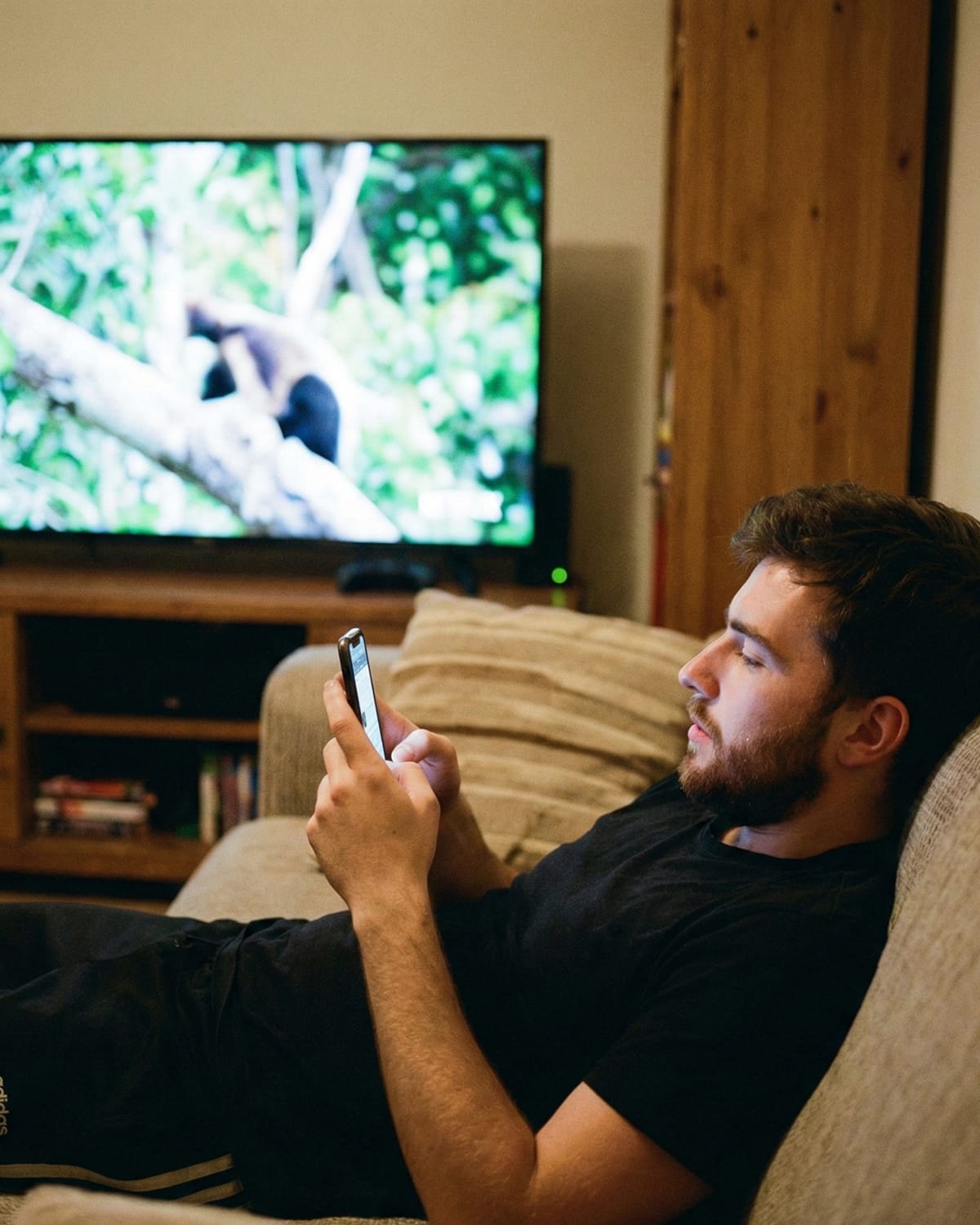
Viewer watches TV while scrolling phone, illustrating Netflix's distracted audience challenge
Viewer watches TV while scrolling phone, illustrating Netflix's distracted audience challenge
Matt Damon revealed on the Joe Rogan Experience that Netflix explicitly instructs writers to repeat crucial plot information multiple times throughout films and series. "They're like can we get a big one in the first five minutes to get somebody, you know, we want people to stay tuned in and and can and you know it wouldn't be terrible if you reiterated the plot three or four times in the dialogue because people are on their phones while they're watching," Damon stated during the podcast conversation with Ben Affleck.
The directive stems from Netflix's internal viewing data showing audiences frequently miss narrative information while simultaneously browsing other content on mobile devices. According to Damon, the streaming giant prioritizes retention metrics over artistic integrity, fundamentally altering how filmmakers structure narratives for the platform's 283 million global subscribers.
The practice represents a stark departure from traditional filmmaking principles. Damon noted the standard action film structure typically features three major set pieces distributed across three acts, with dialogue advancing the plot naturally. Netflix's approach inverts this model, front-loading spectacular sequences while embedding redundant exposition throughout runtime to accommodate distracted viewing habits.
"Now they're, you know, they're like can we get a big one in the first five minutes to get somebody, you know, we want people to stay tuned in," Damon explained. The emphasis on immediate engagement reflects competitive pressures within streaming's dominance of television consumption, where platforms compete for attention against infinite content alternatives.
PPC Land Newsletter
Subscribe PPC Land newsletter ✉️ for similar stories like this one
The revelation sparked significant discussion across social media platforms following a viral post from news outlet NEXTA on January 17. "Netflix deliberately dumbs down dialogue - because viewers simply don't follow the plot," the post stated, accumulating 4.8 million views within days. The post condensed Damon's observations into three core problems confronting streaming content: simplified dialogue for distracted audiences, frontloaded action sequences, and degraded cinematography optimized for small screens.
Damon provided specific context for how data analytics drive content decisions at Netflix. "Netflix um you know standard way to make an action movie that we learned was you know you usually have like three set pieces. One in the first act, one in the second, one in the third and you know you kind they kind of ramp up and the big one with all the explosions and you spend most of your money on that one in the third act," he said, describing traditional theatrical structure before contrasting Netflix's approach.
The algorithmic influence extends beyond structural changes. Netflix's content strategy increasingly incorporates data-driven targeting and optimization based on viewer behavior patterns captured through its sophisticated measurement infrastructure. The platform tracks completion rates, pause points, and abandonment moments, feeding this intelligence back into content production guidelines.
Cinematography quality has suffered alongside narrative structure. Damon noted directors increasingly question the value of meticulous visual composition when most viewers consume content on phones, tablets, and laptops rather than theatrical screens or even television displays. "You know, you're watching in a room, the lights are on, other shit's going on, the kids are running around, the dogs are running around, whatever it is. You know what I mean? It's just a very different level of attention that you're willing to or that you're able to give to it," Damon observed.
The attention crisis affecting streaming content extends across the advertising industry. Attention metrics have emerged as a critical measurement category for evaluating consumer engagement beyond traditional viewability metrics. According to Lucy Wallace, Head of Programmatic at Publicis Next, attention has become "easier than ever to test" in recent months as agencies explore beyond traditional metrics during an IAB Europe panel session in July 2025.
Research demonstrates that attention-based metrics reveal substantial engagement differences across content types. TVision data shows streaming content captures 64% attention compared to 59% for library content, with original streaming content demonstrating 8.5% higher attention rates than traditional programming. These findings suggest superior engagement quality despite the challenges Damon described regarding distracted viewing habits.
The shift toward mobile viewing represents a fundamental challenge for cinematographers trained in theatrical exhibition standards. "My buddy Tony Hinchcliffe you know he's got Kill Tony and now it's on Netflix and so they're giving him notes now and they can give him like but they're not telling him what to do but they're saying like this is when people are tuning out and so let's you know just so you have that data now decide how you want to edit things," Affleck added, illustrating how platforms provide granular engagement metrics to influence editorial decisions.
The industry has developed sophisticated infrastructure to measure these attention patterns. DoubleVerify launched social attention measurement with Snapchat in June 2025, combining platform exposure data with eye-tracking insightsfrom Lumen Research to deliver impression-level attention metrics. According to Mike Follett, CEO at Lumen Research, "Through our work with Snapchat over the years, we've determined just how much visual attention is generated by Snapchat's rich media ads through eye-tracking technology."
The practice contradicts traditional filmmaking values emphasizing audience investment through sustained attention. Damon contrasted contemporary streaming consumption with theatrical exhibition, where audiences commit to focused viewing without competing distractions. "I always say it's more like going to going to church like you show up at an appointed time," Damon stated, describing the theatrical experience as fundamentally different from ambient streaming consumption.
The algorithmic pressure manifests most clearly in Netflix's emphasis on early retention hooks. "They're like can we get a big one in the first five minutes to get somebody, you know, we want people to stay tuned in," Damon repeated, emphasizing the platform's focus on preventing early abandonment. The directive aligns with broader streaming market dynamics where platforms compete intensively for viewer attention during critical opening sequences.
Industry standards have emerged to address attention measurement challenges. The Media Rating Council and Interactive Advertising Bureau released comprehensive attention measurement guidelines in November 2025 after extensive industry feedback. The framework establishes minimum requirements designed to ensure quality, transparency, and comparability in reported metrics across measurement vendors, media platforms, and advertising environments. Importantly, the guidelines reinforce that attention should not be considered or used as a measure of outcomes for evaluating campaign performance, but represents an important data point in understanding exposure and engagement beyond delivery metrics.
Damon cited the limited series "Adolescence" as an exception to Netflix's formulaic approach. The four-episode series employs single-take episodes with minimal exposition, demonstrating that sophisticated storytelling can succeed despite contradicting platform guidelines. "Netflix um you know standard way to make an action movie that we learned was you know you usually have like three set pieces," Damon said before noting, "and now they're, you know, they're like can we get a big one in the first five minutes."
Affleck provided additional context regarding the business pressures driving Netflix's content strategies. The streaming model eliminates traditional theatrical exhibition's physical commitment, reducing audience investment thresholds. "The bar for for walking out of a movie theater is a lot higher than from just changing the channel," Affleck explained. Viewers can abandon streaming content instantly without financial or social cost, creating intense pressure on creators to maintain engagement through constant stimulation.
The conversation revealed how economic imperatives shape creative decisions. Netflix's advertising business expansioncreates additional pressure to optimize content for advertiser-friendly metrics including completion rates and engagement duration. The platform's transition to programmatic advertising partnerships intensifies focus on quantifiable performance indicators that influence content commissioning decisions.
Practical implementations demonstrate attention optimization's commercial impact. EssenceMediacom Franceachieved 7% cost efficiency improvements using attention-based bidding in Google's Display & Video 360 platform, according to IAB Europe research. The campaign demonstrated that attention optimization can improve traditional media metrics while enhancing engagement quality.
Damon acknowledged legitimate applications for data-driven insights while questioning their influence on narrative construction. "It's like, you know, it's hard to fight supply and demand. That's the trick, right? If people want to watch a bunch of stuff at home because they invested in TVs and cost us money, they will," Damon stated, acknowledging market realities while expressing concern about artistic compromises.
The discussion highlighted tensions between artistic integrity and business optimization. "I think what you can do is make the best you can make it really good and you know people can still go to the movies it's not I think we have this idea of that's like an existential threat," Damon argued, suggesting quality content can transcend platform-specific limitations despite systematic pressures favoring formulaic approaches.
Viewer attention spans represent a central concern for content creators navigating streaming platforms. Americans watch six hours of television daily, according to Damon's observation during the podcast, with streaming accounting for 46% of total TV consumption as measured by Nielsen. This fragmented attention creates challenges for storytelling requiring sustained focus.
The mobile viewing phenomenon extends beyond Netflix. European streaming data reveals concentrated viewing patternsacross major platforms including Amazon Prime Video, Disney+, and HBO Max, with audiences consistently focusing on limited content selections despite vast catalog availability. The concentration suggests broader attention limitations affecting all streaming services regardless of content strategy variations.
Technical infrastructure supporting attention measurement continues expanding across the advertising ecosystem. According to research presented at IAB Europe panels, Anya Libova, Senior Director of Publisher Sales at DoubleVerify, emphasized that attention measurement has progressed beyond theoretical discussion. "We have seen enough data to very firmly say that improved attention does bring outcomes across the full funnel and we are in the outcomes era and everyone is talking about it," she stated.
The measurement sophistication has yielded quantifiable improvements. Integral Ad Science expanded Quality Attention measurement to include optimization capabilities, demonstrating up to 130% conversion rate improvements when comparing high versus low attention impressions, according to industry reports. These findings suggest that despite fragmented attention patterns, measurement precision enables significant performance optimization.
Damon's observations align with broader industry concerns about streaming's impact on cinematic language. The conversation revealed how platforms optimize content for ambient consumption rather than focused attention, fundamentally altering storytelling approaches developed over cinema's century-long history. "It's like the the bar for for walking out of a movie theater is a lot higher than from just changing the channel," Affleck stated, emphasizing the structural differences between theatrical and streaming exhibition.
The discussion occurred during promotion for "The Rip," a Netflix action thriller starring Damon and Affleck that premiered January 16. The film's production predated Damon's public comments about Netflix's content directives, though the actors' insider perspective provided unusual transparency regarding platform demands typically discussed only in private industry conversations.
Industry implications extend beyond individual creative decisions. Netflix's programmatic advertising capabilities through partnerships with Amazon DSP, The Trade Desk, Google Display & Video 360, Microsoft, and Yahoo DSP create additional pressure to optimize content for advertiser-friendly metrics. Completion rates and engagement durationdirectly influence advertising effectiveness, potentially prioritizing commercial considerations over narrative complexity.
The conversation highlighted exceptions demonstrating sophisticated storytelling can succeed despite platform pressures. Damon praised "Adolescence" for its single-take episodes and minimalist approach, noting "they didn't do any of that" regarding Netflix's typical directives. The series demonstrates audiences can engage with complex narratives requiring sustained attention, contradicting assumptions that contemporary viewers universally demand simplified, repetitive content.
The technological infrastructure enabling these practices reflects broader changes in media production. Nielsen's big data measurement combining 42,000 panel homes with 45 million household inputs provides platforms with unprecedented visibility into viewing behavior, enabling granular optimization based on audience retention patterns. This measurement sophistication creates opportunities for data-driven refinement while raising questions about algorithmic influence on creative expression.
Attention and media responsiveness have become fundamental to advertising strategy. IAB Australia research reveals 16 audience segmentation methods retailers must deploy to compete as retail media hits projected $300 billion by 2030 market size, with attention-based segments classifying audiences based on engagement levels with specific media channels to optimize media mix by channel.
The discussion revealed fundamental tensions between artistic ambition and commercial pragmatism in streaming content production. Damon expressed skepticism about claims that limitations justify artistic compromises, suggesting filmmakers should prioritize quality regardless of viewing contexts. "I think what you can do is make the best you can make it really good," Damon stated, advocating for creative excellence despite platform-specific constraints.
January 16, 2026: Matt Damon and Ben Affleck appear on Joe Rogan Experience podcast discussing Netflix content directives
January 16, 2026: "The Rip" starring Matt Damon and Ben Affleck premieres on Netflix
January 17, 2026: NEXTA posts viral summary of Damon's comments, accumulating 4.8 million views
Summary
Who: Matt Damon and Ben Affleck discussed Netflix's content creation directives during the Joe Rogan Experience podcast, revealing how the streaming platform instructs writers to accommodate distracted viewing habits while industry measurement providers like DoubleVerify, Integral Ad Science, and Lumen Research develop sophisticated attention metrics.
What: Netflix explicitly asks content creators to repeat crucial plot points multiple times throughout films and series because internal viewing data shows audiences frequently watch while simultaneously browsing mobile devices. The platform prioritizes early retention hooks with major action sequences in opening minutes while embedding redundant exposition throughout runtime, contradicting traditional theatrical storytelling approaches that assume sustained audience attention.
When: Damon made the revelations on January 16, 2026, during promotion for "The Rip," though the practices he described have been ongoing as Netflix has expanded its content library and advertising business throughout 2024 and 2025. The attention measurement infrastructure has developed significantly during this period, with major guideline releases from MRC and IAB in November 2025 and measurement partnerships launched throughout 2025.
Where: The discussion occurred on the Joe Rogan Experience podcast and applies to content produced for Netflix's global streaming platform, which serves 283 million subscribers across international markets and commands 8.3% of total television viewing time in the United States. The attention measurement developments span global advertising markets with particular concentration in North America and Europe.
Why: The directives stem from competitive pressures within the streaming market where platforms compete for attention against infinite content alternatives, combined with viewing data showing audiences consume content while simultaneously engaging with mobile devices. Netflix's expanding advertising business creates additional pressure to optimize content for engagement metrics that directly influence commercial effectiveness, while the broader advertising industry has embraced attention-based measurement as a critical metric for evaluating consumer engagement beyond traditional viewability standards.
Share this article
The link has been copied!
Your link has expired. Please request a new one.
Your link has expired. Please request a new one.
Your link has expired. Please request a new one.
Great! You've successfully signed up.
Great! You've successfully signed up.
Welcome back! You've successfully signed in.
Success! You now have access to additional content.