News publishers dodge AI traffic hit - but health and education crater
Index Exchange data from 1,200 publishers shows news ad requests fell just 7% while health and careers dropped 40-50% as AI overviews reshape web traffic in 2025.


Index Exchange data from 1,200 publishers shows news ad requests fell just 7% while health and careers dropped 40-50% as AI overviews reshape web traffic in 2025.
Index Exchange analyzed 1,200 publishers throughout 2025 and found that AI-driven search is reshaping monetization at starkly different rates depending on content type - with news emerging as a relative outlier while information-heavy verticals absorb some of the sharpest declines on record.
The findings were published on March 31, 2026, in a report authored by Marybeth McGaugh, chief customer officer at Index Exchange. The analysis draws on ad opportunity data across the company's exchange and cross-references it against Semrush measurements of AI overview prevalence in search engine results pages between September 2024 and March 2025.
According to the report, 69% of publishers on the Index Exchange platform experienced year-over-year declines in ad opportunities throughout 2025. The average decline across that group was 14%. These figures represent what Index Exchange describes as its "closest proxy for monetizable traffic" - slot requests, which reflect the volume of ad calls publishers generate rather than direct traffic counts.
The numbers add weight to a pattern that has been building throughout 2024 and 2025. Media leaders surveyed by Reuters Institute in January 2026 described Google Web Search traffic falling from 51% to 27% of referrals between 2023 and the fourth quarter of 2025. SISTRIX's March 2026 review documented a click-through rate collapse from 27% to 11% at the top organic search position - a finding that frames the Index Exchange data as part of a wider structural shift rather than platform-specific volatility.
What makes the Index Exchange analysis particularly useful is its granularity by content category. The decline in ad opportunities is not evenly distributed. At one end of the spectrum, verticals built around "answerable" content - queries where a concise AI summary can satisfy a user's need without a click - show the steepest losses.
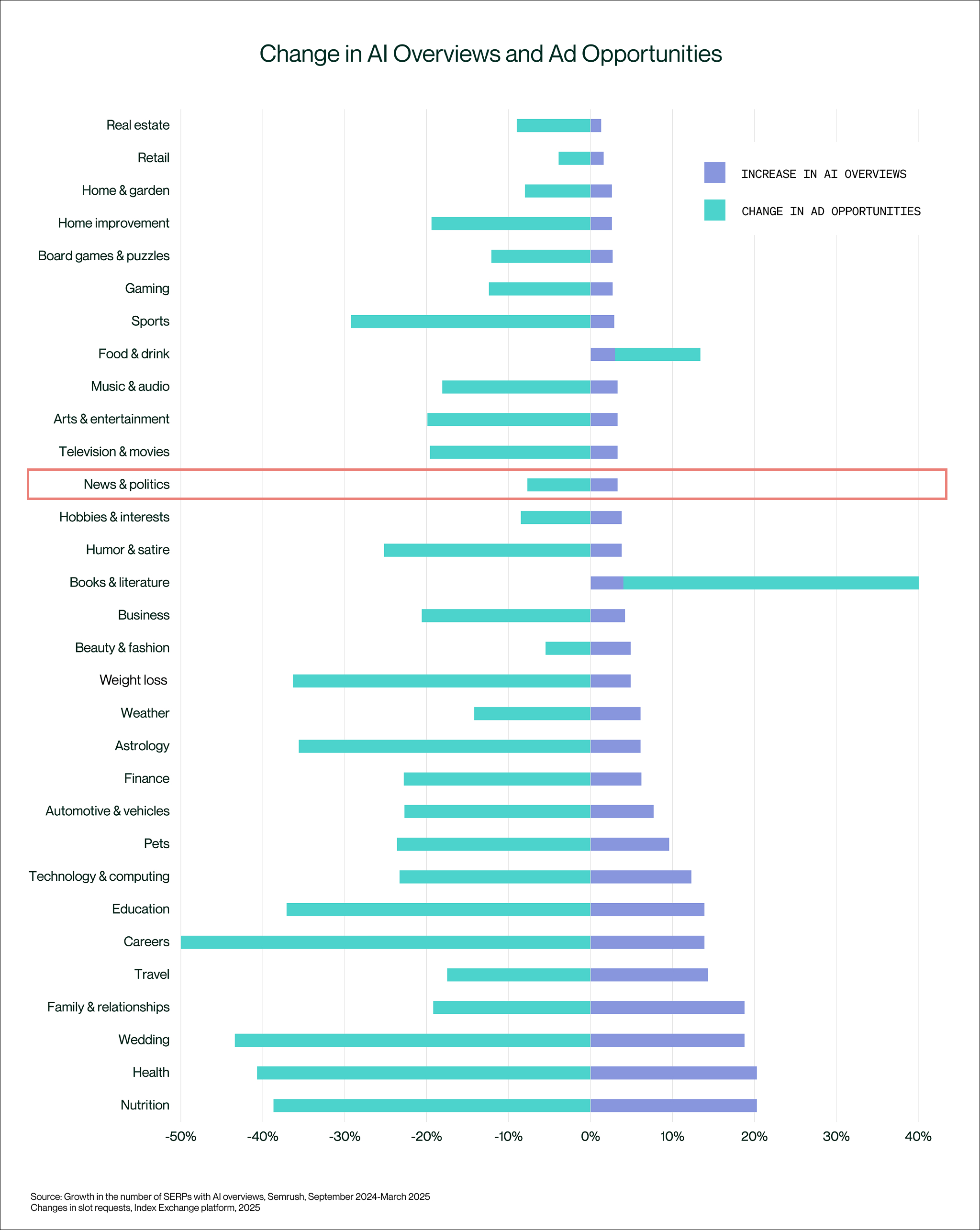
According to the report, health and nutrition verticals saw ad opportunity declines in the range of 40 to 50%. Careers and education posted similar trajectories. These categories also recorded some of the largest increases in AI overview prevalence in Semrush's SERP data, which Index Exchange treats as a structural explanation for the monetization decline. When a search result for "symptoms of iron deficiency" or "how to write a resume" is answered directly by a generated overview, the click that would previously have landed on a publisher's page - and triggered an ad call - never happens.
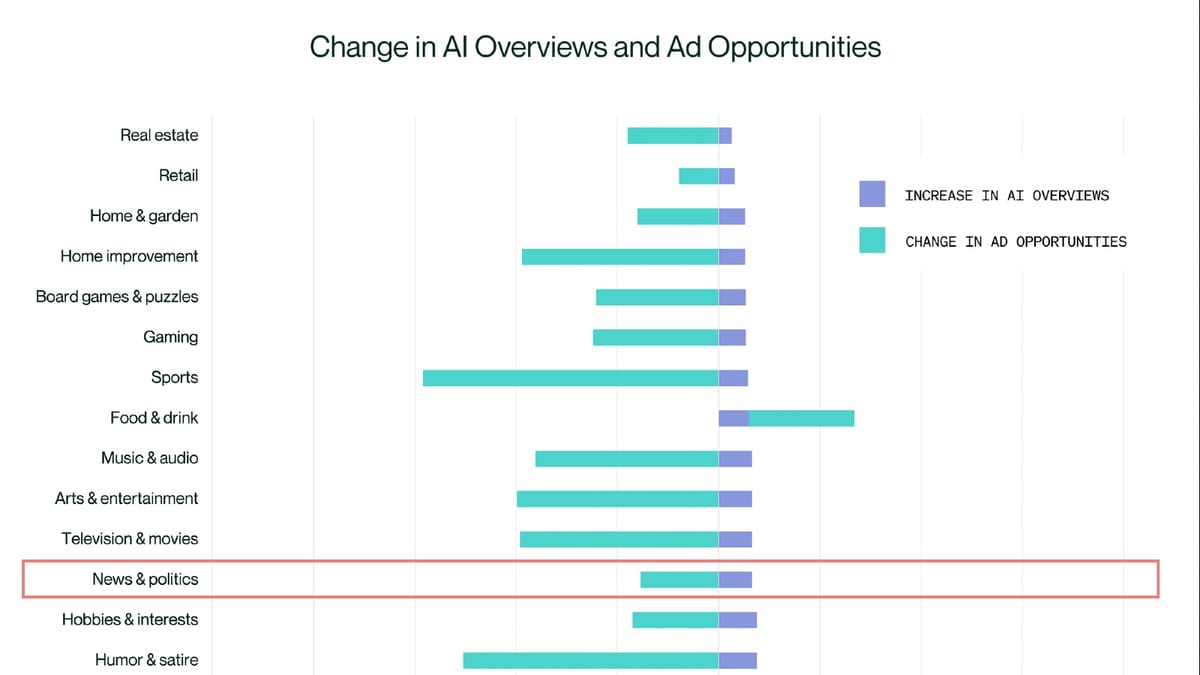
The correlation is visible across the chart in the report. Categories with high increases in AI overview exposure tend to show corresponding drops in ad opportunities. The relationship holds across real estate, retail, home improvement, gaming, food and drink, travel, and family-focused content. Weather, astrology, finance, and automotive also appear in the middle of the distribution.
News and politics occupy a distinct position. According to the Index Exchange data, ad requests in that vertical fell only 7% year over year - a markedly different outcome compared to the broader platform average of 14% and dramatically smaller than the 40-50% declines in health and careers.
The report attributes this resilience partly to the nature of news content. Breaking stories, opinion, and curated editorial judgment are harder to compress into a single AI-generated answer than factual health or career queries. A user asking "what happened in parliament yesterday" may still need to click through to understand context, read multiple perspectives, and engage with the full piece. That engagement behavior preserves the ad call in ways that purely informational queries do not.
Vanessa Otero, founder and CEO of Ad Fontes Media, a company that rates media sources for political bias and reliability using a combination of human analysts and AI, is quoted in the report addressing this dynamic directly. "There have been growing concerns about how AI-driven search may impact traffic to news publishers," according to Otero. She went on to describe the value news publishers retain: "These publishers provide essential value that AI cannot fully replicate - particularly trusted reporting and thoughtfully curated experiences that help audiences understand what matters most."
The report notes that while traffic and monetization signals face pressure across the web broadly, high-quality news is showing up as one of the more durable areas of the open internet based on platform-level data.
One of the less expected findings in the report concerns the relationship between ad opportunities and ad spend among highly ranked news publishers. According to the analysis, in several cases spend actually increased even as audience-level measures softened. Index Exchange cross-referenced its ad opportunity data with publisher rankings from Ad Fontes Media and found that demand dynamics - CPMs, fill rates, and buyer appetite - can move in the opposite direction from raw traffic.
That pattern has a logical explanation. As the total supply of premium, trusted inventory contracts in relative terms, buyers willing to pay for quality environments may bid more aggressively for the inventory that remains. Scarcity can push CPMs upward in a way that partially or fully offsets volume losses. The result is that revenue may hold up - or even improve - for publishers whose inventory is perceived as contextually safe, brand-suitable, and audience-engaged, even if the absolute number of impressions available has decreased.
This is not a universal outcome. The report is explicit that growth depends on identifying, valuing, and investing in quality signals rather than treating all news inventory as equivalent.
Index Exchange has been building an infrastructure argument around quality signals for some time. The report coincides with the launch of a partnership in which Ad Fontes Media joins Index Marketplaces, making its NewsAI data available through the company's Data Vendor Ecosystem. According to the announcement, Ad Fontes Media's system - which identifies high-quality news at the article level in real time - can now be applied at the point of impression on the sell side, enabling buyers to direct spend toward trusted journalism through standard programmatic workflows.
The framing here is consistent with a broader strategic direction Index Exchange has pursued throughout 2025 and into 2026. The company introduced Transparent Dynamic Take Rates in October 2025, a per-impression pricing model designed to improve publisher yield while maintaining transparency through auditable logs. It became the first SSP to integrate Gracenote contextual intelligence in September 2025, embedding show-level brand safety data directly into programmatic streaming TV workflows. More recently, the company published case study results in February 2026 showing a major retailer cutting cost per site visit by 75% through sell-side AI decisioning deployed within Index Marketplaces infrastructure.
The Ad Fontes Media integration extends this logic to editorial quality. Where attention signals and show-level metadata help buyers optimize for engagement and context in entertainment and video environments, article-level news quality ratings offer a parallel mechanism for display and native advertising adjacent to journalism.
The report cites survey data from Stagwell and HarrisX to support the audience case for news. According to those findings, 73% of Americans follow the news closely, and one in four describe themselves as "news junkies" who check in an average of 5.6 times per day. That frequency of intentional visits - rather than algorithmic discovery - is what Index Exchange is positioning as a differentiating factor.
This matters because the AI traffic disruption is partly a disruption of passive discovery. Users who stumble onto a health or recipe article via a Google search and find their question answered in an AI overview may never need to visit the underlying page. Users who deliberately seek out a trusted news source to read coverage of a specific event are expressing a different kind of intent - one that is harder for an AI summary to intercept. The Index Exchange data appears to reflect that behavioral distinction at scale.
Otero's commentary in the report captures this concisely: "When it's important enough that you want to be accurately and fully informed about some big international, national, or local event, a quality news site is still a much better experience than asking an AI chatbot, which may give a genericized or inaccurate answer. AI users already know this, which is why most news consumers still go direct to their trusted sites."
The marketing community has been navigating a rapidly changing distribution landscape since AI overviews became standard in Google Search. Research published in November 2025 by Seer Interactive found that organic click-through rates for informational queries featuring AI overviews fell 61% from 1.76% to 0.61% between June 2024 and September 2025. Paid click-through rates on those same queries dropped 68%, from 19.7% to 6.34%. The study covered 3,119 informational queries across 42 organisations.
Google's own executives have offered a contested narrative, with CEO Sundar Pichai claiming in May 2025 that AI overviews send traffic to a wider set of websites. Independent research has consistently pointed in the other direction. Ahrefs published research in February 2026 showing AI overviews now correlate with a 58% reduction in click-through rates for top-ranking pages - nearly double the 34.5% decline the same company documented in April 2025, as covered by PPC Land at the time.
For media buyers, the Index Exchange analysis introduces a practical observation into that debate: not all verticals are equally exposed. Health, careers, and education - the categories most susceptible to AI overview interception - should probably be treated differently in programmatic planning than news and politics, which appears to retain stronger monetization characteristics. That distinction has implications for how marketers allocate spend across content types within open web programmatic channels.
The report's argument, at its core, is that as zero-click search expands, the environments that audiences actively choose to visit become more commercially scarce - and therefore more valuable. News publishers who attract that kind of intentional traffic are, at least by this dataset, holding their position better than much of the broader open web.
Index Exchange filed an antitrust lawsuit against Google in November 2025 over conduct it alleges suppressed its growth. The company therefore has its own commercial interest in narratives that support the open web and programmatic infrastructure outside Google's owned properties. That context is worth bearing in mind when weighing the framing of any analysis that emerges from an exchange operator - though the underlying data on vertical-level ad opportunity declines, cross-referenced against Semrush's SERP measurements, represents a specific and checkable empirical claim rather than editorial opinion.
Whether the resilience of news publishers holds as AI capabilities continue advancing remains an open question. The 7% ad opportunity decline that looks modest relative to health or careers is still a decline. And it covers only one year of data. The structural question - whether editorial judgment and trusted reporting will remain difficult to synthesize into AI overviews, or whether AI systems will improve to the point of substituting for news consumption in ways they currently cannot - is not answerable from a single year of platform-level ad call data.
What the data does show, with reasonable clarity, is that March 2025 was a meaningfully different moment for a health publisher and a news publisher facing the same underlying shift in how people discover content online.
Who: Index Exchange, an independent supply-side platform, with Vanessa Otero and Ad Fontes Media as partners in the analysis and resulting marketplace integration.
What: An analysis of ad opportunity data across 1,200 publishers on the Index Exchange platform throughout 2025, showing that 69% experienced year-over-year declines in ad requests. The average decline was 14%. News and politics verticals saw a 7% decline, while health, careers, and education verticals dropped 40 to 50%. Ad Fontes Media's article-level NewsAI quality data has been added to Index Marketplaces as a tool for programmatic buyers targeting news inventory.
When: The report was published on March 31, 2026, drawing on platform data from across 2025 and Semrush SERP data covering September 2024 through March 2025.
Where: The data originates from Index Exchange's global programmatic exchange. The AI overview prevalence data is drawn from Semrush's analysis of search engine results pages. Ad Fontes Media is a US-based media ratings company. The analysis covers publishers globally.
Why: AI-powered search features - particularly AI overviews in Google Search - have altered how users discover and consume content online. Queries that can be answered directly within a search results page no longer generate the clicks that drive publisher ad calls. Information-dense verticals like health and careers are particularly exposed to this dynamic. The analysis is relevant to programmatic advertising buyers deciding how to allocate open web spend as the traffic landscape shifts.