Perion Network Ltd. (NASDAQ and TASE: PERI) yesterday filed its Form 20-F annual report for fiscal year 2025 with the U.S. Securities and Exchange Commission, completing a disclosure cycle that provides the advertising industry's first audited, SEC-filed financial record of what an AI-native execution infrastructure looks like in practice. The report, covering the year ended December 31, 2025, is now accessible at perion.com and was filed in compliance with Nasdaq Listing Rule 5250(d)(1)(C).
The numbers confirm what Perion's earnings calls described throughout the year: a company that rebuilt its entire operating model around a proprietary AI agent called Outmax, and whose three fastest-growing revenue lines - Connected TV, Digital Out-of-Home, and Retail Media - all delivered double-digit growth precisely in the channels where that agent was most active. Those are not coincidental outcomes. They are the financial trace of a specific technical thesis about how artificial intelligence should be deployed in advertising.
What Outmax is, technically
Understanding the Form 20-F numbers requires first understanding the architectural claim Perion makes about Outmax, because the claim is unusual in the current landscape. Most AI tools deployed by advertising platforms in 2025 - Google's Ads Advisor, Amazon's Ads Agent, Yahoo DSP's agentic capabilities - optimize within a single platform's own inventory. They are, by design, tools that maximize performance inside a walled garden. Outmax is positioned as the opposite: a layer that sits above multiple DSPs and executes across them simultaneously, allocating spend to whichever environment delivers the best outcome against a specific advertiser goal.
CEO Tal Jacobson articulated the distinction plainly during the February 18 earnings call: "We're not trying to replace other DSPs. I would carefully predict that all DSPs are going to have their own AI tools if some of them don't already have them. But that's not the case for us. What we're trying to do is to be a layer above all of those DSPs and optimize cross-channel." The investor presentation elaborated further: Outmax acts as the execution agent on YouTube, Facebook, Instagram, NBC, Disney+ and DOOH screens simultaneously - not as a buyer optimizing a single feed but as an algorithmic decision layer determining in real time where each dollar should go based on live performance signals.
That architecture has a specific implication that matters for the marketing community. Industry analysis published in July 2025 by Marketecture Media's Ari Paparo argued that agentic AI could eliminate core DSP functions by automating campaign setup, targeting and optimization in ways that bypass traditional programmatic infrastructure. Perion's thesis is narrower but operationally similar: rather than eliminating DSPs, Outmax treats them as interchangeable inventory pipes, routing spend based on outcome rather than platform loyalty.
The learning period and the Outcome Delta
Outmax does not produce instant results. The system requires a learning period before its dynamic bid and execution adjustments achieve full calibration. According to investor materials, the agent "continuously applies dynamic bid and execution adjustments across dimensions, reallocating spend based on live performance signals" following a short initial learning phase. Perion terms the measurable difference between Outmax-optimized performance and a control group the "Outmax Outcome Delta."
The most specific performance data in the filing cycle comes from two cases. In the CTV environment, Outmax was applied to a Webroot cybersecurity campaign during October 2025. The cost per action, tracked week by week, fell from $4.61 in the week of September 25 to $0.53 by October 22 - an 89% reduction over four weeks - while site visitation rates rose 1.8%. Jacobson noted that Webroot "had full transparency into performance, allowing them to see what was working and scale with confidence."
The DOOH case is even more compressed. An unidentified publisher integrated Perion's DOOH Player in September 2025 and scaled from €200 per month in spend to €506,078 per month by December - a trajectory that covered roughly 90 days. "This is not an isolated win," Jacobson told analysts. "It demonstrates the repeatability of our execution model across environments and formats." Both examples reflect the same underlying logic: the AI agent learns, the learning produces compounding efficiency gains, and those gains attract larger budget commitments from the same client.
The 24-month spend trajectory: from $50K to $20M
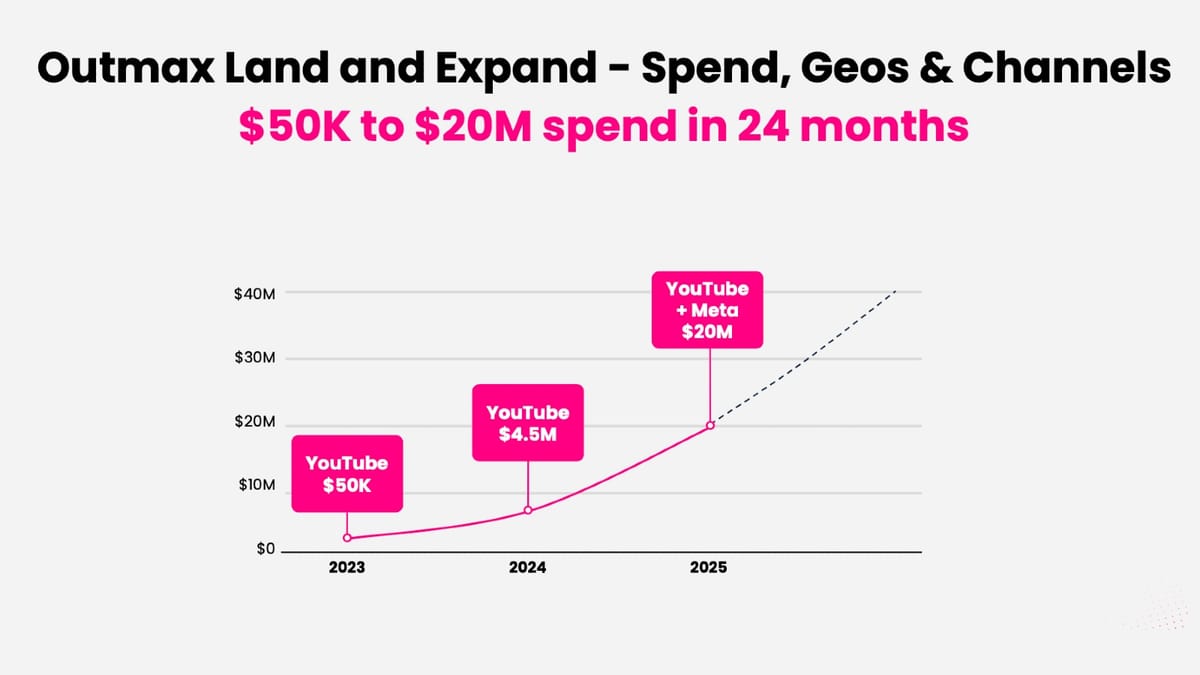
The most striking data point in Perion's investor presentation is a single advertiser timeline. According to company materials, the Outmax algorithmic model was tested on a YouTube budget of $50,000 for one advertiser in 2023. Performance justified expansion to $4.5 million in 2024. By 2025, that same advertiser had extended to YouTube and Meta, running $20 million through the system. The compound growth factor over 24 months is 400x. Perion describes this as the "land and expand" business model, in which demonstrated performance is the primary sales tool. "When technology drives performance, scale comes organically," Jacobson told investors.
This trajectory is significant not just as a commercial success but as a test of the AI agent model itself. The system's ability to scale from a single YouTube placement to a cross-platform deployment at $20 million in spend - while maintaining and improving performance metrics - validates the architectural premise that the optimization logic is channel-agnostic. The agent is not constrained by platform-specific ad formats or inventory access agreements. It operates wherever it has been given buying authority, and it reallocates that authority continuously as performance data accumulates.
The Form 20-F now places this case study within an audited financial context. The aggregate CTV revenue figure of $62.1 million for 2025, up 42% from the prior year, and the Q4 CTV figure of $25.1 million, up 59% year-on-year, represent the population of similar trajectories across Perion's client base. The 52 Fortune 100 companies Perion serves - including 17 of the 19 largest consumer and retail companies, all four of the largest telecommunications companies, and five of the six largest pharmaceutical companies - represent the scale at which the Outmax system is operating.
Why the cross-DSP architecture matters now
The advertising industry spent much of 2025 debating how AI agents should be structured. The Ad Context Protocol launched October 15, 2025 with promises that AI agents could buy advertising directly across platforms. IAB Tech Lab published its Agentic RTB Framework v1.0 for public comment on November 13, establishing technical standards for containerized AI agents within real-time bidding infrastructure. PubMatic launched its AgenticOS in January 2026 as the first operating system built for autonomous advertising execution, with early tests showing 87% reductions in campaign setup time. Yahoo DSP embedded agentic capabilities directly into its platform in January 2026.
What distinguishes Perion's position in this landscape is that Outmax was not announced in late 2025 as a response to the agentic trend. The system grew out of Perion's acquisition of Greenbids in March 2025, an AI-first algorithm optimization company whose capabilities were absorbed into the Outmax engine by Q3, and before that from Perion's algorithmic work across its CTV and DOOH infrastructure. The 2025 Form 20-F is the financial record of a system that was already running at scale while competitors were still debating protocols.
The architectural difference also has a specific implication for how the system handles the fragmentation problem that most industry participants describe as the central challenge in cross-channel advertising. Analysis from Paparo and others noted that AI agents optimizing within single platforms reinforce intermediary roles rather than solving buyer-seller fragmentation. Perion's response to this challenge is not a protocol but a client relationship: the company holds buying authority across platforms on behalf of its advertiser, and Outmax allocates that authority algorithmically. No new standard is required because the coordination happens within Perion's own execution layer.
AI and operating leverage: what the margin data shows
The AI story in Perion's Form 20-F is not only about Outmax serving advertisers. It is also about AI reducing internal operating costs. The Adjusted EBITDA to Contribution ex-TAC margin expanded from 29% in Q4 2024 to 37% in Q4 2025, and CFO Elad Tzubery attributed part of that improvement to "AI-based automation we implemented and built on our day-to-day operation," specifically around G&A and cost of revenues. The company's non-GAAP operating expense decoupling from revenue - what Tzubery described as having "successfully decoupled our expense base from our revenue growth" - is as much an AI story as the channel performance numbers.
Full-year Adjusted EBITDA reached $45.2 million against Contribution ex-TAC of $203.4 million, representing a 22% margin. That is below the 37% Q4 figure because the first three quarters of 2025 carried the weight of transition-year investment costs. The 2026 outlook targets Adjusted EBITDA of $50 million to $54 million against Contribution ex-TAC of $215 million to $235 million, implying a midpoint margin of approximately 23%. The 2028 target is 28%. Tzubery's explanation of the progression combines two levers: continued AI-driven cost efficiency in G&A and cost of revenues, and the natural margin expansion that comes as Perion One platform revenue displaces lower-margin legacy activities.
Operating cash flow for the full year was $41.9 million, up 504% from $6.9 million in 2024. The Q4 figure was $21.8 million, against $4.3 million in Q4 2024. Adjusted Free Cash Flow for the year reached $40.2 million, representing 89% conversion from Adjusted EBITDA, a ratio that reflects both the business model and the cost discipline that AI tooling enables.
No AI execution system operates in a vacuum. Three partnerships announced with Q4 2025 earnings - and now reflected in the Form 20-F context - are best understood as data supply agreements for Outmax. Amazon DSP integration provides access to Amazon's audience data and measurement capabilities alongside Perion's premium inventory, giving the AI system shopper-level behavioral signals that have historically been confined within Amazon's own ecosystem. Walmart Connect integration connects Perion's Dynamic Creative Optimization to Walmart's first-party audience and sales data, enabling the AI system to optimize creative variation based on closed-loop sales signals rather than proxies. Mastercard provides aggregated purchase insights across the U.S. and Europe - PII-free with independent third-party anonymization - giving Outmax transaction-level behavioral data to inform DOOH screen and CTV slot selection.
Each partnership extends the scope of signal that Outmax can incorporate. An AI agent that optimizes across YouTube, Facebook, NBC and DOOH simultaneously becomes considerably more precise when it can correlate media exposure with offline purchase signals in real time. The Mastercard integration in particular represents a notable development: transaction data as an AI input for physical-world advertising channels, not just for retail-specific placements. Perion's DOOH full-stack position, established through its Hivestack acquisition and extended by the DOOH Player launch, makes it an unusually credible recipient for that kind of data.
Search decline and what AI cannot fix
The audited numbers include one material drag that artificial intelligence has not solved: the Search Advertising segment, which fell 44% to $91 million for full-year 2025 following changes Microsoft Bing implemented in 2024. The earlier PPC Land coverage of that decline documented the speed with which Microsoft's distribution changes hit Perion's revenue base. The Q4 2025 quarterly figure of $26.2 million shows stabilization - search revenue ran at $19.6 million, $22.4 million, $22.8 million and $26.2 million across the four quarters of 2025 - but recovery to prior levels is not anticipated. Perion's plan treats search as a stable but diminishing percentage of the overall mix, with the Perion One platform expected to represent 85% to 90% of Contribution ex-TAC in 2026 as legacy search activities become a smaller proportion.
Web advertising revenue, which encompasses Perion's programmatic display and video outside of its defined growth channels, fell 13% for the full year and 17% in Q4. Company management was explicit that some of this decline was engineered: low-margin legacy activities were discontinued in late 2024. On a pro forma basis excluding those discontinued activities, full-year web revenue declined roughly 1%. The web decline reflects a real behavioral shift - Jacobson described human attention migrating toward "other Walled Gardens" - but Outmax's channel-agnostic architecture means the system routes budget away from web programmatic and toward CTV, DOOH and social when those channels deliver better performance outcomes.
What the 2028 targets imply about AI's role
The Form 20-F gives legal weight to the three-year targets Perion published on February 18. The 2028 Target Plan calls for Perion One platform spend to grow at a CAGR of at least 25% through 2028, Perion One Contribution ex-TAC to grow at a CAGR of at least 20%, and the consolidated Adjusted EBITDA margin to reach 28% of Contribution ex-TAC. Critically, these targets are stated as organic and exclude M&A. They are a claim about what AI-driven execution infrastructure can deliver on its own.
The implied revenue trajectory is substantial. Perion One platform spend on a pro forma basis grew at a 34% CAGR from 2022 to 2025, according to investor materials. Sustaining at least 25% through 2028 while expanding margins requires the Outmax system to continue delivering measurable performance improvements across an expanding client base, in an environment where every major advertising platform is now building competing agentic capabilities. The company projects that Perion One spend will reach approximately $1.2 billion by 2028, up from roughly $0.6 billion in 2025.
Whether that trajectory is achievable depends substantially on whether the Outmax "Outcome Delta" continues to compound as the client base grows. Larger datasets generally improve algorithmic performance, but they also attract more competitive pressure. The 2028 target plan assumes the cross-DSP architecture remains differentiated even as Amazon, Google, Yahoo and others build platform-specific agents. That differentiation rests on one thing: Perion's ability to demonstrate that an agent optimizing across all platforms outperforms any agent optimizing within a single one.
The audited baseline
Total revenue for fiscal year 2025 was $439.9 million, down 12% from $498.3 million in 2024. Non-GAAP net income reached $51.3 million or $1.13 per diluted share, against $64.4 million and $1.27 in 2024. GAAP net loss was $7.9 million, compared with GAAP net income of $12.6 million in 2024. The cash position at December 31, 2025 was $312.9 million, comprising cash equivalents, short-term bank deposits and marketable securities - down from $373.3 million a year earlier, primarily reflecting the $71.2 million share repurchase executed through 2025. The board has expanded the total share repurchase authorization to $200 million, of which $118.1 million has been executed since inception.
The Form 20-F filing converts these figures from investor presentation slides to audited SEC filings - the version that carries legal accountability and that institutional investors, auditors, and regulatory bodies treat as authoritative. For the advertising technology community, the significance is different: it is the first time the financial outcomes of a fully deployed AI execution agent operating across CTV, DOOH, retail media and social have been submitted to a major securities regulator under audit.
Timeline
- December 2023 - Perion acquires Hivestack for $100 million, building out DOOH full-stack infrastructure that would later become part of Outmax's execution environment
- Q1 2024 - Microsoft Bing changes begin hitting search revenue, forcing strategic acceleration away from search dependency
- Q2 2024 - Total revenue falls 39% year-on-year as search collapse intensifies
- February 3, 2025 - Perion One platform and Outmax AI agent announced; all technologies unified under single AI execution infrastructure
- March 2025 - Greenbids acquisition completed; AI-first algorithm optimization integrated into Outmax engine by Q3
- July 21, 2025 - Industry analyst argues agentic AI threatens traditional DSP models, validating Perion's cross-DSP positioning
- Q2 2025 - Advertising Solutions revenue returns to year-on-year growth for first time since Q3 2023
- September 2025 - DOOH Player launched; publisher scales from €200/month to €506,078/month in 90 days via AI optimization
- October 15, 2025 - Ad Context Protocol launches as industry debates standards for agentic advertising; Outmax already operating at scale
- October-November 2025 - Webroot CPA falls 89% over four weeks via Outmax CTV optimization
- November 12–13, 2025 - IAB Tech Lab releases Agentic RTB Framework v1.0; advertising platforms accelerate AI agent rollouts
- January 2026 - PubMatic launches AgenticOS; Yahoo DSP embeds agentic capabilities - Perion's competitive landscape deepens
- February 18, 2026 - Q4 and FY 2025 earnings: Outmax drives CTV +59% in Q4, DOOH +28% in Q4, Contribution ex-TAC +19% in Q4; Amazon DSP, Walmart Connect and Mastercard data partnerships announced; 2028 organic target plan published
- March 16, 2026 - Form 20-F filed with SEC; first audited financial record of Outmax-driven performance now publicly available
Summary
Who: Perion Network Ltd. (NASDAQ and TASE: PERI), an advertising technology company headquartered in Tel Aviv and New York, whose Outmax AI execution agent serves 52 of the Fortune 100 across CTV, DOOH, retail media and social channels.
What: Filed its Form 20-F for fiscal year 2025 on March 16, 2026, providing the first SEC-audited financial record of an AI execution agent operating at scale across multiple advertising channels. Key audited figures include $62.1 million in CTV revenue (+42%), $94.9 million in DOOH revenue (+36%), $109.9 million in retail media revenue (+36%), $41.9 million in operating cash flow (+504%), and an Adjusted EBITDA to Contribution ex-TAC margin that expanded from 29% to 37% in Q4 year-on-year. Outmax case studies include a client whose spend grew from $50,000 to $20 million over 24 months and a CTV campaign that reduced cost per action 89% in four weeks.
When: Filed March 16, 2026, covering fiscal year ending December 31, 2025. Earnings were reported February 18, 2026.
Where: Filed with the SEC in the United States. Outmax operates across YouTube, Facebook, Instagram, NBC, Disney+, DOOH screens and other channels globally, with data partnerships covering the U.S. and Europe.
Why: Beyond the regulatory requirement, the filing matters for the advertising industry because it documents, under audit, the financial outcomes of deploying a cross-DSP AI execution agent at Fortune 100 scale - at a moment when every major advertising platform is building competing agentic capabilities, IAB Tech Lab is defining standards for agentic RTB, and the industry is actively debating whether AI agents should optimize within platforms or across them. Perion's audited numbers provide the first externally verified data point in that debate.
Share this article
The link has been copied!