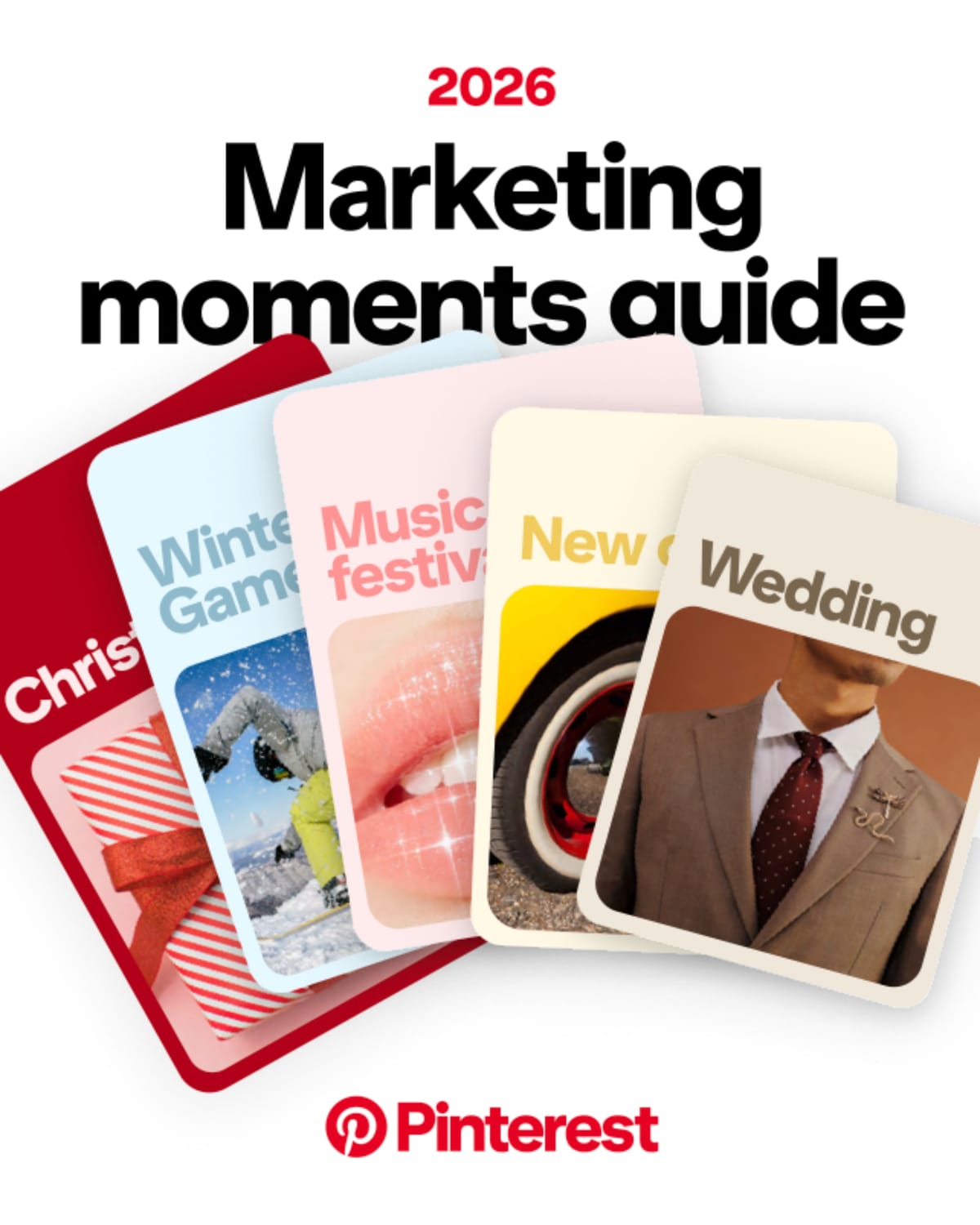
The visual discovery platform serving 600 million monthly active users organized the annual planning resource into three distinct categories: calendar moments covering predictable seasonal events, life moments addressing personal milestones, and big moments encompassing major global sporting competitions. The guide released on January 15, 2026, through Pinterest Business includes search trend data, demographic breakdowns, and recommended activation timelines for each moment category throughout the year.
Calendar moments demand early activation
Calendar moments encompass fixed-date events including Christmas, Valentine's Day, Easter, Halloween, summer holidays, back-to-school periods, Black Friday, Cyber Monday, and cultural celebrations such as Lunar New Year, Diwali, Ramadan, and Pride. The platform's internal data demonstrates consumers initiate planning activities substantially earlier than most brands deploy campaigns.
Christmas searches begin accumulating volume in October according to Pinterest's search analysis. Halloween content gains momentum in September. Easter planning intensifies during February and March. These patterns reveal a consistent two-month lead time between initial consumer research and actual event dates, creating significant opportunities for advertisers willing to activate campaigns ahead of traditional timelines.
The planning window extends beyond major holidays. Father's Day, Mother's Day, Ramadan, St. Patrick's Day, and Prom each generate distinct search patterns tied to preparation cycles. Back-to-school campaigns face particularly complex timing considerations, as students and parents research desk essentials, technology requirements, storage solutions, organizational apps, lunch preparation ideas, and fashion selections across multiple weeks.
Pinterest established itself as a planning-centric platform rather than a passive scrolling environment. The company positions this characteristic as fundamental competitive differentiation from social media competitors focused on real-time content consumption. Users create boards, save pins, and return repeatedly to refine decisions over extended periods.
The platform released data showing 90 percent of Pinterest users find products relevant to them, while 70 percent report higher likelihood of purchasing items discovered through the platform. These metrics reflect the intent-driven nature of Pinterest behavior compared to incidental product exposure on entertainment-focused platforms.
Tesco demonstrates early activation impact
Tesco validated the early activation strategy during its festive campaign deployment. The British retailer launched advertising aligned with rising seasonal searches using Trend Badges, achieving CPMs up to 2.6 times lower than non-badged advertisements. The campaign averaged an 88 percent cost reduction across its duration compared to standard placements.
The Tesco results demonstrate measurable financial benefits from timing alignment. Lower CPMs indicate reduced competition for advertising inventory during early planning phases, before the majority of brands activate seasonal campaigns. Advertisers capturing consumers during initial research stages secure advantages in both cost efficiency and impression share.
Pinterest's Trend Badges functionality identifies emerging search patterns before mainstream adoption. The system analyzes query volume increases, demographic composition, and acceleration rates to flag topics gaining momentum. Advertisers incorporating these trending keywords into campaigns position themselves ahead of broader market awareness.
Life moments create year-round opportunities
Life moments represent personal milestones including home purchases, renovations, weddings, new babies, retirements, milestone birthdays, career changes, and pet adoptions. Unlike calendar-based events occurring on fixed dates, life moments distribute across the entire year with consistent underlying demand.
The guide identifies specific search patterns for each life moment category. New home searches include terms such as "new year new home," "house party," "housewarming gifts," and "first house." Birthday planning encompasses "birthday nails," "birthday wishlist," "birthday cake," and "birthday present ideas." Engagement content centers on "engagement rings," "proposal," "engagement dress," and "gold engagement ring."
New baby preparation generates substantial search activity around "baby shower ideas," "gender reveal ideas," "baby girl nursery," and "nursery décor." Retirement searches focus on "retirement gifts," "retirement cake," "retirement quotes," and "retirement party ideas." New pet owners research "cat," "dogs," "bunny," and specific breeds including "golden retriever."
These personal milestones often cascade into subsequent moments. Engagement planning transitions into wedding preparation, followed by honeymoon research and potential home purchase activity. New homeowners investigate furniture, décor, renovation projects, and home improvement solutions. The sequential nature of life moments creates extended advertising opportunities as consumers progress through related planning stages.
Pinterest introduced local inventory advertising on September 25, 2025, enabling retailers to display real-time pricing for in-stock merchandise within shoppers' local store radius. Canadian Tire Company tested this format as the first Canadian retailer, reaching interested shoppers 48 percent more efficiently than standard shopping campaigns. The automotive and home goods retailer observed a 16.5 percent higher in-store visit rate when incorporating local inventory ads into overall shopping strategy.
The local inventory capability particularly benefits life moment advertising, as many personal milestones involve physical product purchases requiring immediate availability. Wedding planning, nursery preparation, and home furnishing projects often demand in-store verification before final purchase decisions.
Big moments centered on sporting events
The 2026 calendar features two major global sporting competitions: worldwide football tournaments during summer months and the Olympic Winter Games. Pinterest's data shows 1.5 billion sport-related searches and saves accumulated across the platform during the past year, representing a five percent increase compared to the previous 12-month period.
Research conducted among weekly U.S. Pinterest users indicates 78 percent express excitement about the 2026 Winter Games. This enthusiasm translates into search activity around watch parties, themed outfits, travel planning, décor ideas, food preparation, and celebration concepts. The searches extend well beyond sports fans themselves, encompassing social planners, hosts, and participants seeking creative ways to engage with major events.
Football tournament preparation generates similar patterns. Consumers research party food ideas, team-themed decorations, viewing party setups, fan apparel, and travel arrangements for attending matches. The planning cycle for these events spans multiple months, beginning with travel and accommodation bookings progressing through party supply purchases and food preparation plans.
Pinterest emphasized that sporting event advertising should target broader audiences beyond dedicated fans. The platform's user research demonstrates substantial engagement from individuals planning social experiences around competitions rather than following athletic performance. This distinction matters for creative strategy and product positioning, as party supplies, food items, decorative elements, and entertaining tools often generate more search volume than sports-specific merchandise.
Pinterest expanded its artificial intelligence capabilities throughout 2025 to support advertisers capturing moment-based opportunities. The platform launched Performance+ automated campaign optimization in October 2024, delivering at least 10 percent improvement in cost per acquisition for most advertisers during initial testing periods.
Performance+ ROAS bidding analyzes thousands of signals to predict conversion value in real-time, helping advertisers maximize investment returns. Alpha testing showed most advertisers experienced at least 15 percent increases in return on ad spend using this bidding strategy. The system became available to all qualified advertisers across Pinterest's monetized markets.
Performance+ creative uses generative AI to transform product images automatically. The technology converts white, blank, or flat color backgrounds into lifestyle imagery, enhancing Product Pins and potentially increasing user engagement. Walgreens applied Performance+ creative to approximately 50 products across multiple categories, generating measurable improvements when comparing Pinterest-generated backgrounds to standard white backgrounds.
The platform introduced Promotions functionality available by request in select markets including the United States, United Kingdom, Canada, Australia, France, Germany, Mexico, Brazil, and Japan. This tool surfaces sale items more effectively to users through personalized promotions based on search history and pin activity. Early results showed advertisers using Promotions experienced 12.7 percent increases in conversions compared to advertisements without promotional elements.
Custom haircare and skincare company Prose leveraged Promotions functionality and achieved cheaper incremental checkouts compared to standard conversion campaigns. These outcomes highlight potential benefits from combining AI-driven targeting with promotional content to drive engagement and conversions during moment-based campaigns.
Pinterest predicts trends before mainstream adoption
The platform maintains an 80 percent historical accuracy rate for its trend forecasting, publishing the Pinterest Predicts 2026 report on December 9, 2025. The research identified 21 emerging consumer trends across fashion, food, home decor, beauty, travel, and celebrations categories based on search data analysis covering September 2023 through August 2025.
Trends included "Gimme Gummy" tactile aesthetics, "Afrohemian Decor" cultural fusion, "Cabbage Crush" culinary patterns, "Vamp Romantic" gothic beauty, and "Darecations" adrenaline tourism. Each trend includes specific search term percentage increases and demographic adoption patterns, enabling advertisers to position campaigns ahead of mainstream awareness.
Pinterest derived predictions from normalized English-language search queries comparing September 2024 through August 2025 activity against the previous 12-month period. The methodology tracked percentage increases in specific search terms, with some queries demonstrating growth exceeding 200 percent year-over-year. Demographic segmentation identified which generational cohorts drove each trend's search volume.
The trend forecasting enables advertisers to position campaigns ahead of consumer demand curves. Unlike reactive trend reports documenting existing popularity, Pinterest positions this research as "not-yet-trending" analysis designed to help advertisers capture opportunities before competitive saturation occurs.
Programmatic expansion increases inventory access
Pinterest expanded programmatic advertising capabilities through partnerships with Index Exchange and Criteo, marked by additions to the platform's ads.txt file. Index Exchange appeared on November 28, 2024, followed by Criteo on January 25, 2025, according to Internet Archive snapshots.
These integrations broadened advertiser access to Pinterest inventory through wider ranges of demand-side platforms. The expansion creates multiple pathways for advertisers to reach Pinterest's user base through programmatic channels, following IAB Tech Lab's standardized approach for authorized digital sellers.
The timing of programmatic expansion aligns with moment-based advertising strategies, as automated buying enables more precise targeting and budget allocation across multiple seasonal peaks. Advertisers managing campaigns across numerous moments throughout the year benefit from programmatic efficiency in reaching specific audiences during optimal planning windows.
Pinterest acquired tvScientific on December 12, 2025, to expand into connected television advertising. The transaction combined Pinterest's intent-rich visual search platform with tvScientific's performance CTV engine, enabling advertisers to connect television exposure with tangible business outcomes beyond traditional brand awareness metrics.
Connected television advertising budgets doubled from 14 percent of total media spending in 2023 to 28 percent in 2025 according to industry data. This growth created mounting pressure for measurement solutions connecting television exposure to purchase behavior, which Pinterest aims to address through the tvScientific integration.
Data partnerships improve audience matching
Pinterest integrated with Epsilon's audience platform on November 17, 2025, enabling advertisers to push custom audience segments from Epsilon Clean Room to Pinterest in what the company described as "just a few clicks" without requiring spreadsheets or manual uploads.
The integration delivered 5-15 percent improvements in match rates, allowing brands to reach more target audience members on Pinterest's platform. Higher match rates directly translate to expanded campaign reach, as more first-party customer records successfully connect with Pinterest users. Service level agreement improvements reduced audience activation time by approximately three days compared to traditional methods.
Advertisers in the United States, United Kingdom, and France can currently access the functionality. The automated delivery system creates schedules for audience refreshes and end dates, with Epsilon ensuring each segment reaches the correct account. Audiences become available on Pinterest within 24-48 hours after creation in Epsilon Clean Room, representing significant acceleration compared to traditional audience activation requiring manual file transfers.
The Epsilon partnership matters for moment-based campaigns requiring precise audience targeting during specific planning windows. Faster activation speeds enable advertisers to respond more quickly to seasonal opportunities or competitive dynamics, particularly important for time-sensitive campaigns around product launches or promotional periods.
Technical implementation requires proper planning
The guide emphasizes three tactical approaches for maximizing moment-based opportunities: reviewing creative best practices, aligning with trending content, and implementing Pinterest Performance+ automated campaigns. These tactics operate in combination rather than as isolated strategies.
Creative best practices focus on lifestyle brand imagery that sparks inspiration rather than product-only shots. The platform recommends diversifying ad formats to identify resonant approaches, noting different formats perform differently across various moments and audience segments. Testing carousel formats, video content, static images, and collection ads reveals which formats generate optimal engagement for specific moments.
Aligning with trending content requires regular consultation of Pinterest Trends tool, which surfaces real-time keyword momentum. The platform provides data on search term velocity, demographic composition, and category penetration. Advertisers incorporating trending keywords into campaigns while search volume accelerates capture audiences during active planning phases.
Pinterest Performance+ automates targeting, budgets, bidding, and creative optimization, reducing time spent launching and scaling campaigns. The system particularly benefits advertisers managing multiple moment-based campaigns throughout the year, as automation handles routine optimization while maintaining strategic control over positioning and messaging.
Education programs support advertiser adoption
Pinterest launched Performance Essentials certification on April 21, 2025, consisting of ten courses covering technical aspects of performance marketing within the Pinterest ecosystem. Participants must complete all required coursework and pass a 20-question assessment to earn a shareable digital badge.
The program curriculum centers on driving measurable results through Pinterest's advertising tools, progressing through strategic concepts to tactical implementation before culminating in measurement techniques. Notable emphasis on Pinterest Performance+, catalog management, and conversion tracking reflects the platform's growing investment in algorithm-driven advertising solutions.
The certification became available to advertisers in the United States, Canada, Mexico, United Kingdom, France, Germany, Spain, Italy, Netherlands, Switzerland, Sweden, Australia, Japan, and Brazil. This phased rollout aligns with Pinterest's broader international expansion strategy, reflecting the platform's growing advertiser base outside North American markets.
Google Analytics added Pinterest cost data import integration on October 1, 2025, enabling automated transfer of advertising spend and campaign performance metrics. The integration requires business and advertising accounts for Pinterest Ads, plus at least Editor role permissions in Google Analytics properties.
All paid Pinterest traffic must be tagged with consistent UTM parameters in destination URLs. Campaign source and campaign medium values must align precisely with utm_source and utm_medium parameters specified on destination URLs for Pinterest Ads campaigns. Imports require up to 30 minutes to complete, with data becoming available in reports within 24 hours.
The integration matters for marketers managing multi-platform advertising campaigns across seasonal moments. Centralizing cost data from multiple platforms within a single analytics property enables better attribution analysis across channels, supporting more informed budget allocation decisions during high-competition periods.
Pinterest's focus on early activation timing creates strategic advantages for advertisers willing to challenge traditional campaign scheduling. The two-month planning window preceding major moments represents periods of reduced competition and lower costs, while targeting consumers during active decision-making phases rather than final purchase moments.
Timeline
Summary
Who: Pinterest Business released the guide targeting advertisers, marketing professionals, and brands planning seasonal campaigns across the platform's 600 million monthly active users.
What: The 2026 Marketing Moments Guide provides search trend data, demographic breakdowns, and recommended activation timelines across three categories: calendar moments (fixed seasonal events), life moments (personal milestones), and big moments (major global sporting events). The guide includes specific keyword research, planning window recommendations, and case study results demonstrating early activation impact.
When: Pinterest published the guide on January 15, 2026, based on search data analysis covering multiple years of user behavior patterns. The guide provides activation timelines for moments throughout 2026, emphasizing two-month lead times before major events.
Where: The guide applies globally across Pinterest's monetized markets, with specific demographic data segmented by generational cohorts including Generation Z, Millennials, Generation X, and Baby Boomers. The platform serves 600 million monthly active users worldwide.
Why: Consumer planning behaviors begin substantially earlier than traditional campaign activation periods, creating opportunities for advertisers to capture audiences during active research phases. Early activation delivers measurable benefits including lower CPMs, reduced competition, and positioning during decision-making windows rather than final purchase moments. Pinterest's intent-driven platform behavior differs from entertainment-focused social media, as 70 percent of users report higher likelihood of purchasing items discovered through the platform.
Share this article
The link has been copied!