Podcast ad spending hits 32% growth but you won't believe what's driving it
Magellan AI's Q4 2025 report shows podcast advertising surged 32% year-over-year, with shaving brands leading 77% growth as 1,482 new advertisers test the channel.


Magellan AI's Q4 2025 report shows podcast advertising surged 32% year-over-year, with shaving brands leading 77% growth as 1,482 new advertisers test the channel.
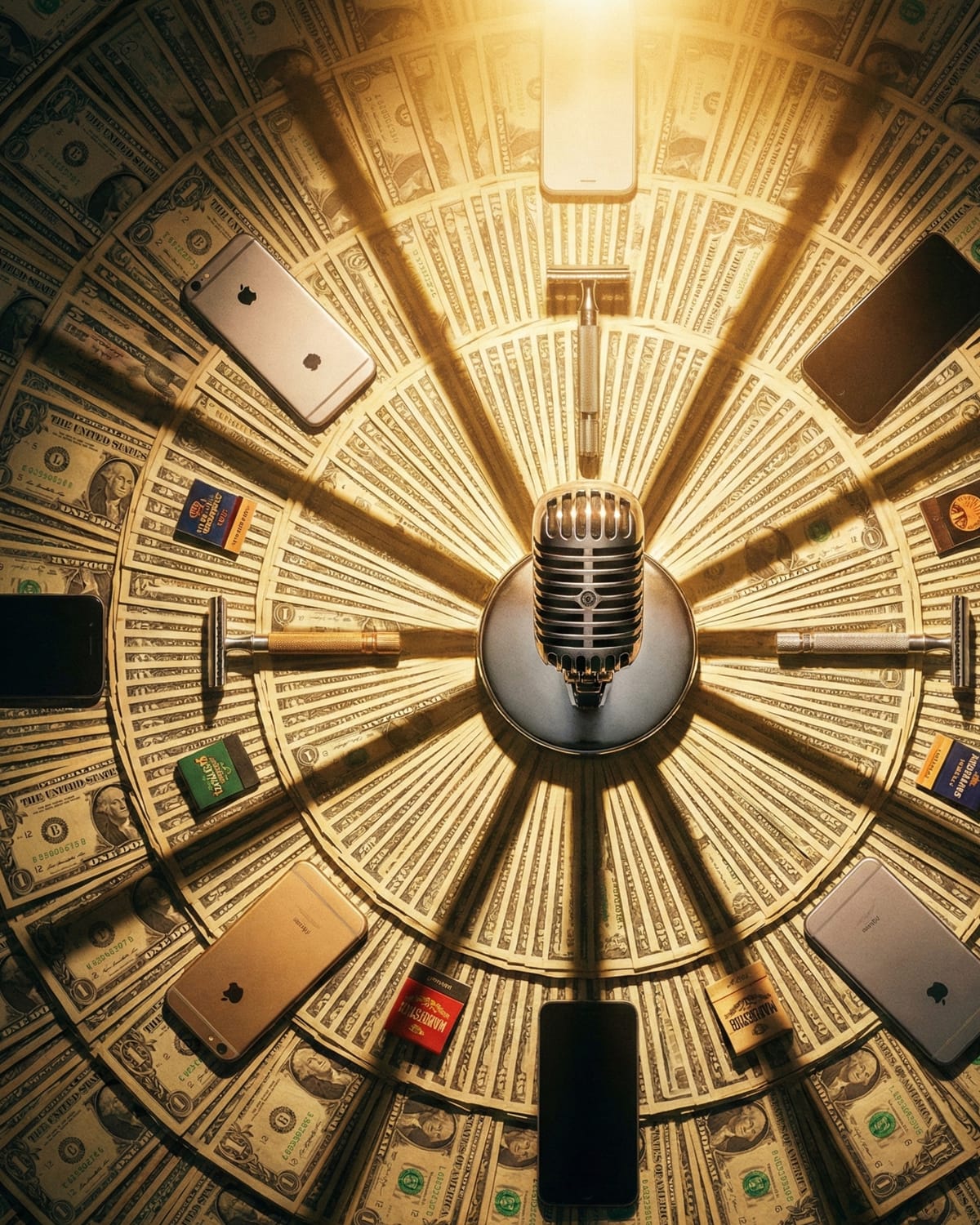
Podcast advertising spending accelerated sharply during the fourth quarter of 2025, climbing 32% year-over-year as the channel attracted nearly 1,500 new brands and experienced its most pronounced seasonal surge in recent memory. Magellan AI analyzed 94,422 podcast episodes to document spending patterns, advertiser behavior, and content trends across the final three months of 2025, revealing sustained momentum that positions podcasting as one of digital advertising's fastest-growing channels.
The fourth quarter commenced with October spending reaching 115% of the third quarter monthly average, followed by November at 111%, before December surged to 127%. According to the February 10, 2026 announcement, overall Q4 spending exceeded Q3 by 17% while the year-over-year comparison showed the 32% increase that outpaced Q3's 26% growth rate.
Nine of the top 10 advertisers maintained their positions from the previous quarter, with AT&T entering the rankings for the first time in the past year. T-Mobile claimed the top position with $17.9 million in estimated spending, followed by Toyota at $17.0 million and BetterHelp at $16.9 million. Amazon and Quince completed the top five at $15.7 million and $14.9 million respectively. The top 10 collectively spent an estimated $142 million, representing a 5% increase from Q3's $135 million.
Financial Services dominated industry spending at $109.6 million with 31% year-over-year growth, according to the methodology that incorporates proprietary spend modeling. Business Services & Software reached $82.9 million with 44% growth, while Consumer Services & Software hit $77.8 million with 53% expansion. Food generated $64.2 million with 41% growth, and Consumer Packaged Goods contributed $59.6 million with 27% growth.
The shaving industry posted the fastest spending growth among tracked categories, surging 77% from $1.5 million in Q3 to $2.6 million in Q4. Brands including Manscaped, Gillette, and Harry's Razors led the category's expansion. Socks spending increased 54% from $2.2 million to $3.4 million, while Health Services climbed 49% from $27.5 million to $40.9 million. Phone, Internet, Cable spending rose 40% from $36.6 million to $51.2 million, and Gambling increased 34% from $35.2 million to $47.3 million.
The analysis identified 1,482 brands advertising on podcasts for the first time during Q4, representing new advertiser testing across multiple genres. These newcomers spent an average of $33,900 during the quarter, typically running 50-second advertisements with mid-roll placement being the most common position. Sports podcasts attracted approximately 18.6% of new brands, making it the most popular genre for first-time podcast advertisers. News attracted 11% of new brands, Comedy 9%, Arts 9%, and Business 7%.
The influx of new brands demonstrates podcasting's evolution from experimental channel to strategic advertising platform. The $33,900 average spending level among newcomers indicates meaningful budget allocation beyond minimal testing, though substantially below the multi-million dollar commitments from established podcast advertisers in the top 10 rankings.
Genre preference among new brands reveals strategic thinking about audience matching. Sports podcasts' dominance at 18.6% of new brand activity reflects the genre's demonstrated effectiveness for direct response advertising and brand awareness campaigns. The format delivers engaged, passionate audiences with strong parasocial relationships to hosts, creating favorable conditions for advertiser messaging.
News podcasts at 11% likely attract advertisers seeking authoritative environments and current events relevance, while Comedy at 9% appeals to brands comfortable with entertainment contexts. Arts programming captures brands targeting culturally engaged audiences, while Business content attracts B2B advertisers and professional services seeking decision-maker reach.
Ad load across sampled episodes increased from 8.33% in Q3 to 8.82% in Q4. The Q4 figure represented growth from 8.20% in Q4 2024, with advertiser ad load increasing 6.6% year-over-year. Advertiser ad load specifically reached 7.77% of episode runtime, while podcast-to-podcast promotional content comprised 1.05% of runtime, down from 1.10% in Q3.
True Crime shows demonstrated the highest total ad loads when combining advertiser and promotional content. The genre reached 11.37% ad load in Q4 2025, up from 10.15% in Q4 2024. Pod-on-pod ad loads for True Crime specifically grew from 1.87% to 3.18% year-over-year, representing a 70% increase in promotional cross-pollination within the genre. This pattern suggests True Crime networks are aggressively leveraging audience overlap to drive listener acquisition across related programming.
Society & Culture shows posted 10.15% total ad load, Education reached 9.16%, Business hit 8.83%, and Comedy achieved 8.72%. Sports podcasts demonstrated 8.48% ad load, while News content reached 7.88%. Kids & Family programming hit 8.39%, Health & Fitness achieved 7.85%, and Arts content reached 7.75%.
Genre-specific ad load variations demonstrated how different content categories monetize at distinct rates. Science podcasts averaged 6.94% ad load in Q4 2025 compared to 6.34% in Q4 2024, representing the lowest monetization density among tracked genres. Technology shows reached 7.10% from 6.55% year-over-year, while Arts programming hit 7.75% compared to 7.39% in the prior year.
The True Crime category's dramatic growth in podcast-to-podcast promotional activity reflects strategic network building within the genre. Networks operating multiple True Crime properties use high-performing shows to drive audience sampling of newer or less-established programming, creating cross-promotional synergies that build listener habits across portfolio offerings.
Episode length patterns showed the 30-60 minute duration remained most common at 40.1% of analyzed episodes. Episodes shorter than 15 minutes averaged 22.1% ad load, while 15-30 minute episodes averaged 13.6%. The dominant 30-60 minute episodes averaged 10.4% ad load, and episodes exceeding 60 minutes averaged 7.3%.
The inverse relationship between episode length and ad load percentage reflects practical listener tolerance constraints. Shorter episodes can dedicate higher percentages to advertising because absolute advertisement duration remains modest even at elevated percentage rates. A 10-minute episode with 22% ad load contains approximately 2 minutes and 12 seconds of advertisements, while a 60-minute episode at 10% ad load contains 6 minutes of advertising - nearly three times the absolute duration despite half the percentage.
True Crime shows under 15 minutes in length achieved 42% average ad load in Q4, representing the highest monetization intensity in the analysis. Society & Culture shows exceeding 60 minutes averaged 8% ad load, demonstrating how long-form content balances monetization with listener experience across extended runtime.
Ad load patterns varied significantly by show popularity tiers. The top 500 podcasts averaged 9.4% ad load in Q4 2025, while shows ranked 501-3,000 averaged 8.5%, and podcasts ranked beyond 3,000 averaged 8.3%. The distribution remained relatively compressed compared to spending concentration, indicating that less popular shows maintain similar ad density to top-tier programming despite generating substantially lower absolute revenue.
Campaign approach analysis revealed direct response spending increased 13% quarter-over-quarter, brand awareness climbed 21%, while tune-in advertisers decreased 4%. Direct response campaigns represented 40% of overall market spend during Q4, with brand awareness accounting for 58% and tune-in capturing 2% of total spending.
The 21% quarter-over-quarter increase in brand awareness spending signals growing advertiser confidence in podcasting's effectiveness for upper-funnel marketing objectives beyond immediate conversion goals. Brand awareness campaigns typically pursue reach, frequency, and sentiment objectives that require sustained exposure across multiple touchpoints, suggesting advertisers view podcasting as viable for building long-term brand equity rather than solely driving immediate response actions.
Direct response spending's 13% quarterly growth demonstrates continued strength in performance marketing applications. Podcast advertising enables precise attribution through unique promo codes and vanity URLs, allowing performance marketers to measure cost per acquisition and return on ad spend with accuracy approaching digital channels while maintaining the intimacy and trust associated with audio content.
The 4% decline in tune-in advertising reflects either seasonal factors or strategic reallocation as entertainment and media properties optimize promotional spending across channels. Tune-in campaigns promote content consumption on other platforms or properties, representing internal marketing rather than commercial advertising from external brands.
The top 500 podcasts accounted for 49% of total podcast ad spending in Q4, with advertisers spending an average of $422,000 per month on those shows. Podcasts ranking 501-3,000 generated an average of $48,000 per month in revenue. December showed particularly strong concentration toward top-tier shows, with the top 500 capturing 63% of spending compared to 48% in the Q3 monthly average.
The spending concentration toward top-tier inventory reflects advertiser preferences for established audiences and proven performance. Premium podcasts command higher CPMs justified by larger listener bases, stronger engagement metrics, and more sophisticated production values that create favorable environments for advertiser messaging.
The $422,000 monthly average spending on top 500 shows represents substantial advertiser commitment approaching half a million dollars per month per show. This figure encompasses advertisers buying across multiple episodes, positions, and formats within individual podcast properties, demonstrating how premium inventory generates significant revenue streams for successful publishers.
Mid-tier podcasts ranking 501-3,000 generate $48,000 monthly on average, representing meaningful monetization for professional podcast operations while falling well below top-tier revenue levels. This tier likely encompasses shows with dedicated but smaller audiences, emerging properties building listener bases, and niche content serving specialized interests.
The December concentration surge to 63% of spending flowing to top 500 shows suggests advertisers prioritize proven inventory during peak seasonal periods when competition for attention intensifies and marketing efficiency becomes paramount. Brands launching major holiday campaigns naturally gravitate toward established shows offering predictable reach and performance rather than experimenting with untested inventory during crucial selling periods.
Ad format preferences showed continued evolution throughout Q4. The 30-second format dominated at 39% of all detected advertisements, while 60-second spots represented 14% and 15-second ads captured 13% of placements. Longer-form 90-second advertisements accounted for 5% of detected ads, and 120-second spots comprised 1% of total placements.
The 30-second dominance reflects industry consensus around optimal message length balancing creative storytelling with listener tolerance. The format provides sufficient duration for brand introduction, value proposition communication, and call-to-action while avoiding extended interruptions that risk listener disengagement or skip behavior.
Sixty-second advertisements at 14% share suggest certain advertiser categories require extended creative duration for effective messaging. Complex products, detailed offers, or narrative-driven campaigns benefit from the additional time, though advertisers balance enhanced messaging against higher production costs and potentially lower CPMs compared to standard 30-second units.
Position analysis revealed mid-roll placements as the overwhelming preference at 54% of all ad positions, reflecting advertiser confidence in engaged listener attention during episode content. Pre-roll advertisements captured 28% of placements, while post-roll positions represented 18%. The distribution pattern remained consistent with previous quarters, suggesting established best practices around placement timing have solidified across the industry.
Mid-roll dominance reflects research demonstrating higher completion rates and attention levels compared to pre-roll and post-roll positions. Listeners who reach episode midpoints demonstrate commitment to content, creating more receptive audiences for advertiser messages compared to pre-roll positions where skip behavior may be more prevalent or post-roll placements where listener attention naturally declines.
Shows simulcast on YouTube demonstrated distinct characteristics compared to podcasts distributed solely via RSS feeds. Simulcast shows showed 45% host-read advertisement share versus 34% for RSS-only podcasts. Ad load reached 8.34% for simulcasts compared to 7.77% for RSS podcasts. Direct response brand share hit 33% for simulcasts versus 24% for RSS podcasts, while renewal rates among direct response brands reached 43% for simulcasts compared to 34% for traditional podcasts.
The elevated host-read share for YouTube simulcasts suggests advertisers value visual integration and authentic endorsement in video-enabled formats. Host-read advertisements in video contexts allow viewers to observe host interactions with products or services, potentially enhancing credibility and persuasiveness compared to audio-only presentations.
Higher ad loads for simulcast programming may reflect stronger monetization efficiency enabled by visual elements. Advertisers may accept or prefer slightly higher ad densities in video formats due to enhanced creative opportunities including product demonstrations, on-screen graphics, or visual calls-to-action that complement audio messaging.
The 33% direct response share for simulcasts versus 24% for RSS podcasts indicates performance marketers recognize video's conversion advantages. Visual elements enable more effective product showcases, demonstration of use cases, and clearer presentation of promotional codes or URLs that drive immediate response actions.
Renewal rate differentials demonstrate simulcast effectiveness for sustained advertiser relationships. The 43% renewal rate among direct response brands on simulcasts substantially exceeds the 34% rate for RSS podcasts, suggesting video-enabled formats deliver performance justifying continued investment while audio-only placements experience higher churn as advertisers test and optimize channel allocations.
Single advertiser episodes represented 5% of Q4 episodes, where one brand filled all typically available advertisement slots. Among these single-advertiser episodes, 56% featured one ad, 24% included two ads, and 14% contained three ads. Business genre shows posted the highest single-advertiser episode rate at 10%, followed by Education at 9% and Technology at 8%.
The pattern suggests certain genres attract advertisers willing to secure exclusive episode sponsorship rather than sharing placements with competitors. Business, Education, and Technology content likely appeals to B2B advertisers and professional services seeking undiluted brand association with authoritative content environments.
Single-advertiser strategies enable brands to dominate episode mindshare, eliminating competitive messaging that might dilute impact or create confusion. The approach particularly benefits complex B2B offerings requiring extended explanation or thought leadership positioning where uninterrupted brand presence reinforces expertise and authority.
The 56% rate of single-ad executions within single-advertiser episodes suggests many exclusive sponsors opt for focused messaging rather than repetitive exposure. Brands choosing this approach likely value quality over quantity, preferring one well-crafted advertisement to multiple exposures that risk diminishing returns or listener fatigue.
Women's Clothing emerged as a significant spending category at $56.9 million with 81% year-over-year growth, placing it sixth among all industries. Phone, Internet, Cable reached seventh position at $51.2 million with 77% growth. Insurance climbed to ninth position with $47.2 million and 87% growth. Nutritional Supplements rounded out the top 10 industries at $47.1 million with 45% expansion.
The concentration of spending among top advertisers remained substantial but showed slight distribution broadening. FanDuel ranked sixth with $14.1 million, State Farm seventh at $11.9 million, and DraftKings eighth with $11.4 million. AT&T entered at ninth position with $11.2 million, while Shopify completed the top 10 at $11.1 million.
Historical Q1 spending patterns from previous years indicated potential upcoming advertiser behavior. Intuit increased spending 1,049% from Q4 2023 to Q1 2024, then 350% from Q4 2024 to Q1 2025. Hungryroot showed 917% growth in Q1 2024 and 438% in Q1 2025. Acorns demonstrated 475% and 408% growth in respective Q1 periods, while Thrive Market posted 253% and 280% increases.
The historical Q1 surge patterns suggest specific advertiser categories align podcast spending with New Year resolution themes, tax season urgency, or Q1 budget deployment patterns. Financial services providers like Intuit leverage tax preparation season, food delivery services target resolution-driven behavior changes, and financial planning applications capitalize on fresh-start mentality.
The methodology relied on Magellan AI's proprietary spend estimation model incorporating ad variation detection, download estimates, CPM data from media kits, ad format analysis (host-read versus produced), and delivery method classification (programmatic, run-of-network, or direct purchase). The model accounted for dynamic insertion rescanning to detect changes in programmatically inserted advertisements across multiple samplings of individual episodes.
Campaign objectives were classified as direct response when ads included unique promo codes or vanity URLs, with other brands categorized as brand awareness or tune-in. Ad load calculations included advertisements promoting other podcasts unless specifically noted otherwise. The report distinguished between advertiser ad load representing commercial advertising and pod-on-pod ad load representing promotional cross-marketing between podcast properties.
The analysis sampled multiple copies of certain episodes to account for dynamic insertion, where advertisements change based on download timing and listener characteristics. This approach captures the full spectrum of advertiser participation including both baked-in advertisements permanently embedded in episode audio and dynamically inserted spots that vary across downloads.
Magellan AI operates across eight countries including the United States, Canada, United Kingdom, Ireland, Germany, France, Spain, and Australia, analyzing podcast advertising data in English, Spanish, German, and French languages. The company provides intelligence, verification, and attribution capabilities for advertisers, publishers, and agencies navigating podcast advertising's sustained growth trajectory.
The Q4 performance coincided with broader podcast industry developments including enhanced brand safety capabilitiesand listener loyalty research showing 46% of U.S. podcast listeners never skip favorite show episodes. The sustained advertising growth occurs as the industry addresses gaps between consumer engagement and advertiser investment.
Platform-level developments throughout 2025 provided infrastructure supporting the spending growth. SiriusXM reported podcast advertising revenue climbing 41% during 2025, demonstrating major media company commitment to podcast monetization. Technology providers advanced targeting and measurement capabilities, with episode-level contextual targeting enabling advertisers to evaluate individual episodes before programmatic bids execute.
Who: Magellan AI analyzed advertising activity from thousands of brands including T-Mobile, Toyota, BetterHelp, Amazon, and Quince across more than 50,000 podcasts in eight countries spanning the United States, Canada, United Kingdom, Ireland, Germany, France, Spain, and Australia.
What: Podcast advertising spending increased 32% year-over-year in Q4 2025, with total spending exceeding Q3 by 17%. The top 10 advertisers spent $142 million collectively, representing a 5% increase from Q3. Shaving industry spending surged 77% from $1.5 million to $2.6 million, while 1,482 brands entered the channel for the first time spending an average of $33,900. Average ad load reached 8.82% of episode runtime, up from 8.33% in Q3 and 8.20% in Q4 2024.
When: The fourth quarter of 2025 spanning October through December, with December posting the strongest monthly performance at 127% of Q3 average spending. October reached 115% of Q3 baseline while November achieved 111%. Magellan AI announced the findings on February 10, 2026, based on analysis of 94,422 podcast episodes.
Where: Analysis covered eight countries with data collected across more than 50,000 podcasts in English, Spanish, German, and French languages. The United States represented the dominant market with the top 500 podcasts capturing 49% of total spending, reaching 63% during December's peak seasonal period.
Why: The growth reflects podcast advertising's maturation as a strategic channel for brand awareness and direct response campaigns. Sports podcasts attracted the highest percentage of new brands at 18.6%, while established categories including Financial Services at $109.6 million, Business Services & Software at $82.9 million, and Consumer Services & Software at $77.8 million demonstrated sustained spending increases. The 32% year-over-year growth rate exceeded Q3's 26% expansion, indicating accelerating momentum as podcasting captures advertising budgets from traditional media and competing digital channels.