
Sponsored stores and quick web results spotted inside Google AI Mode
Google AI Mode now shows sponsored store listings inside product panels and organic quick links above answers, signaling deeper ad monetization of conversational search.

Google AI Mode now shows sponsored store listings inside product panels and organic quick links above answers, signaling deeper ad monetization of conversational search.
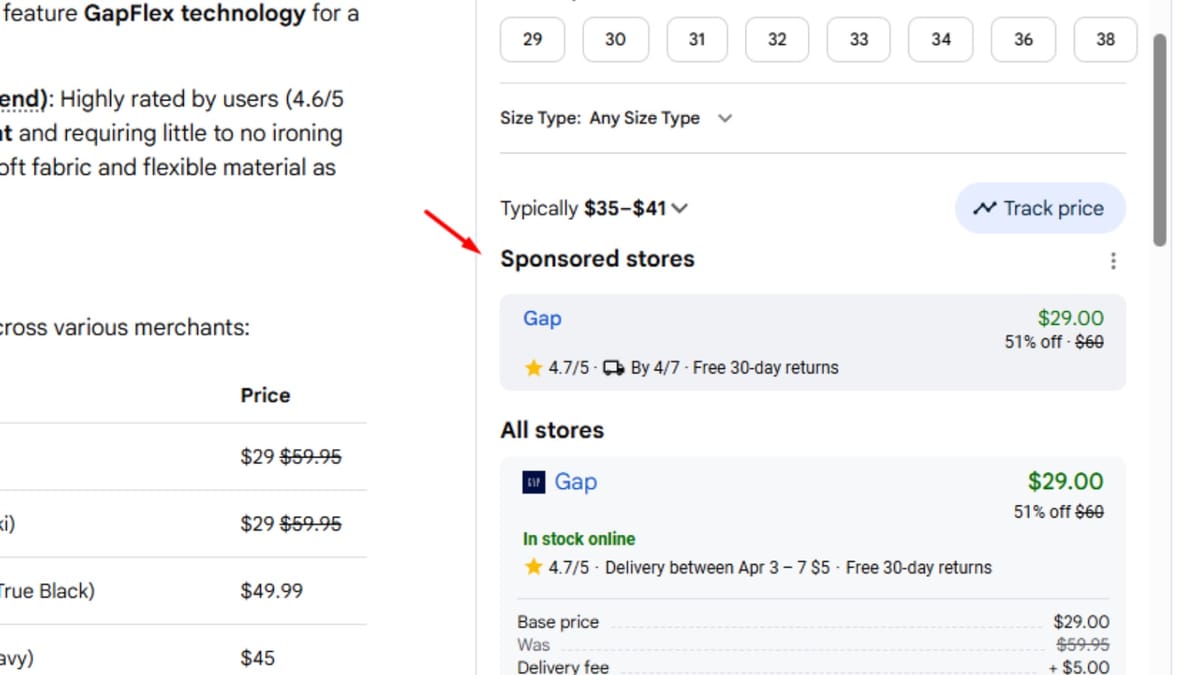
A new ad placement and an organic shortcut pattern have been spotted inside Google's AI Mode, adding fresh detail to how the search interface is being built out commercially. The observations, made on March 25, 2026, by Glenn Gabe, a search industry analyst, were shared via an X post at 1:37 pm that day and quickly circulated among digital marketing professionals. They point to two distinct features: a sponsored stores unit appearing within product detail panels, and a "Quick results from the web" block surfacing at the top of AI Mode responses before the conversational answer loads.
Neither feature has been formally announced by Google. Both were captured during a shopping-related query for Gap men's chinos, and both carry implications for how retailers and advertisers should approach Google's fastest-growing search surface.
According to Gabe's post and the screenshots attached to it, the sponsored stores label appeared after he clicked on a product result within AI Mode. When a product is selected, AI Mode populates a right-hand sidebar with pricing, sizing options, merchant comparisons, and other ecommerce data. The sponsored stores unit sat within this sidebar, positioned above the "All stores" organic merchant list.
In the documented example, Gap appeared as the sole sponsored store, listed at $29.00 - a 51 percent discount off the original $59.95 price. Below the sponsored entry, the "All stores" section showed Gap again as an organic listing at the same $29.00, with delivery estimated between April 3 and 7, a $5.00 delivery fee, and a total of $34.00 plus tax. The Gap rating shown was 4.7 out of 5, based on 1,413 reviews. Free 30-day returns were listed alongside both entries.
The placement sits inside a product detail layer rather than in the main AI-generated answer panel. That distinction matters technically. The main AI Mode answer synthesizes a response and presents it conversationally. The sidebar product panel operates more like the Shopping Graph-powered commerce interface that Google has been building separately. Inserting a sponsored entry at the top of that merchant list follows the same structural logic as sponsored product placements in standard Google Shopping results, but relocates it to a surface that operates inside a conversational AI interface.
According to the Search Engine Roundtable article documenting Gabe's findings, published March 26, 2026, Google's AI Mode is considered "the future of Search," and the platform has been working to expand ad options across it. The sponsored stores unit, as Gabe described it, represents "a great, and easy, way for Google to generate ad revenue within AI Mode."
The second feature Gabe flagged was the "Quick results from the web" block. In the documented query for "gap mens chinos," two links to gap.com appeared at the top of the AI Mode interface before the full conversational answer was presented. These links were labeled organic - not ads - and pointed directly to Gap's own website product pages, bypassing the AI-synthesized response.
According to Gabe, "Quick results" is not an entirely new concept within Google's surfaces, but he noted he had not seen it deployed for a search of this type. The two-link format, positioned above the AI answer rather than within it, functions differently from how sponsored units operate. It appears to shortcut users directly to the retailer's site at the moment of highest intent, before the AI response even completes. Whether this pattern consistently appears for branded retail queries, or whether it reflects testing on specific query types, remains unclear from available documentation.
The organic nature of the quick links adds a separate dimension to the observation. Google has faced sustained questions about traffic redistribution as AI features expand. Studies tracking organic click-through rates have documented significant reductions when AI summaries appear, while Google itself has argued that clicks from AI surfaces carry higher commercial intent. The quick links pattern, if deployed widely, would route some traffic directly to retailer sites - a different dynamic from the zero-click concern that dominates publisher discussions.
The sponsored stores observation lands against a backdrop of steady ad expansion across Google's AI surfaces. The timeline stretches back to October 2024, when Google first introduced ads within AI Overviews for mobile users in the United States, with text and shopping formats from existing Search, Shopping, and Performance Max campaigns becoming eligible for placement.
By November 2025, Adthena, a search intelligence firm, detected ads appearing inside AI Overviews at a frequency of 0.052 percent across 25,000 search engine results pages - the first third-party evidence of Google monetising AI-generated answers at scale. That same month, Google deployed agentic checkout, Duplex-powered store-calling, and conversational shopping in AI Mode and Gemini, powered by a Shopping Graph containing 50 billion product listings with 2 billion updated hourly.
On December 19, 2025, Google expanded AI Overview ads to 11 countries beyond the United States - Australia, Canada, India, Indonesia, Kenya, Malaysia, New Zealand, Nigeria, Pakistan, Philippines, and Singapore - without a formal announcement. Advertisers discovered the change through documentation updates.
January 11, 2026, marked a significant infrastructure step. Google announced the Universal Commerce Protocol (UCP) in partnership with Shopify, Etsy, Wayfair, Target, and Walmart, establishing open technical standards for AI agents to execute purchases across retail platforms. Target and Walmart launched integrations enabling product discovery and checkout directly within Google's Gemini app and AI Mode in Search. The protocol also introduced Direct Offers, a new ad format allowing retailers to surface exclusive discounts within AI Mode when shoppers signal purchase intent. The Direct Offers format appeared labeled as "Sponsored deal" within the interface.
Then on February 11, 2026, Google formally announced a shopping ad format designed specifically for AI Mode, by which point the surface had already reached over 75 million daily active users. Research Google commissioned between October and December 2025 with 4,773 participants found that AI Mode provides a more useful shopping experience when users can compare brands and stores simultaneously. The ads in that format appeared clearly labeled as sponsored, positioned within AI-generated conversations during product discovery.
On March 25, 2026 - the same day Gabe posted his findings - Google separately expanded its loyalty program features in Google Merchant Center to 14 countries and extended loyalty annotations to AI Mode and Gemini for the first time. The loyalty expansion allows merchants to surface member pricing, loyalty-specific delivery options, and in-store benefits on AI surfaces.
The sponsored stores unit that Gabe spotted differs from the February shopping ad format in at least one respect: it appears inside the product detail panel triggered by clicking a product result, rather than within the main conversational answer. That means it activates at a different stage of the shopping journey - after a user has already engaged with a specific product and expanded its details. The intent signal at that moment is, in principle, more advanced than at initial query stage.
For retailers, the practical question is whether sponsored stores is accessible through existing campaign structures - Standard Shopping, Performance Max, or a dedicated campaign type - or whether it requires a separate configuration. No Google documentation confirming how merchants access or bid for the sponsored stores placement has been published as of the time of writing.
What is documented is that Google's Shopping Graph underlies the merchant data appearing in AI Mode product panels. The graph contains over 50 billion product listings and updates more than 2 billion of them every hour. Retailers with poorly maintained product feeds - outdated pricing, incorrect availability, missing shipping attributes - risk lower visibility across these placements regardless of ad spend, since the underlying data quality determines whether the feed entry appears accurately in the panel.
The broader monetisation pattern across AI Mode now includes at minimum: the February shopping ad format within conversational answers, the Direct Offers "Sponsored deal" format for purchase-intent moments, loyalty annotations surfaced on AI Mode, and now the sponsored stores entry within product detail panels. The quick links observation adds a fifth behaviour - organic shortcuts - that operates differently but shapes how traffic flows through the interface.
Search marketers tracking AI Mode's commercial development have watched Google test and deploy monetisation features at a pace that does not always come with advance notice or detailed documentation. The sponsored stores and quick results observations by Gabe fit a pattern that PPC Land has tracked since AI Overviews first received ad inventory in 2024: each new AI surface eventually acquires paid placement options, often beginning with low-frequency testing before wider deployment.
The specific mechanics of sponsored stores - whether it operates as a standard auction, how it interacts with the existing merchant list, whether it is accessible to all retailers or only those in a pilot - remain questions without public answers. The same applies to the quick links format: the conditions under which it triggers, and whether it represents a stable product feature or a test, have not been clarified.
For paid search teams, the emergence of these placements underscores the importance of maintaining clean, complete product data in Merchant Center, given that both organic and sponsored AI Mode surfaces draw from the Shopping Graph. For SEO teams, the quick links pattern is worth monitoring: if organic retailer links surface before AI answers on branded queries, that creates a distinct traffic pathway that sits outside the usual AI Overview and AI Mode click attribution discussion.
Dan Taylor, VP of Global Ads at Google, previously acknowledged that AI Mode presents timing challenges for ad placement. Ads shown too early in a conversational interaction risk feeling intrusive. The sponsored stores unit, which triggers only after a user has actively clicked into a product panel, represents one way to address that tension by inserting paid placement at a moment of demonstrated, specific commercial intent rather than at the opening of a conversation.
Who: Glenn Gabe, search industry analyst, documented the features in a post on X on March 25, 2026. Google has not commented.
What: A sponsored stores ad unit was observed inside the product detail panel in Google AI Mode, placing a paid merchant listing above the organic "All stores" section. A separate "Quick results from the web" block was also observed, showing two organic links to gap.com at the top of an AI Mode response before the conversational answer appeared.
When: Both features were observed and posted on March 25, 2026, at 1:37 pm. The Search Engine Roundtable article documenting the findings was published March 26, 2026.
Where: Inside Google AI Mode, a conversational search interface available in the United States. The sponsored stores unit appeared in the right-hand product sidebar triggered by clicking a product in an AI Mode ecommerce result. The quick results appeared at the top of the main AI response panel.
Why: The observations matter because they add two previously undocumented commercial behaviours to an interface that has been steadily acquiring ad formats since at least October 2024. Sponsored stores extends paid placement into the post-click product detail layer - a high-intent moment in the shopping journey. Quick results introduces organic direct-to-retailer shortcuts above AI answers, with implications for both traffic attribution and the role AI-generated content plays in commercial queries.