Spotify hands playlist control back to listeners with AI-driven prompts
Spotify expands Prompted Playlist beta to US and Canada, letting Premium subscribers create personalized playlists using natural language while maintaining algorithmic discovery.
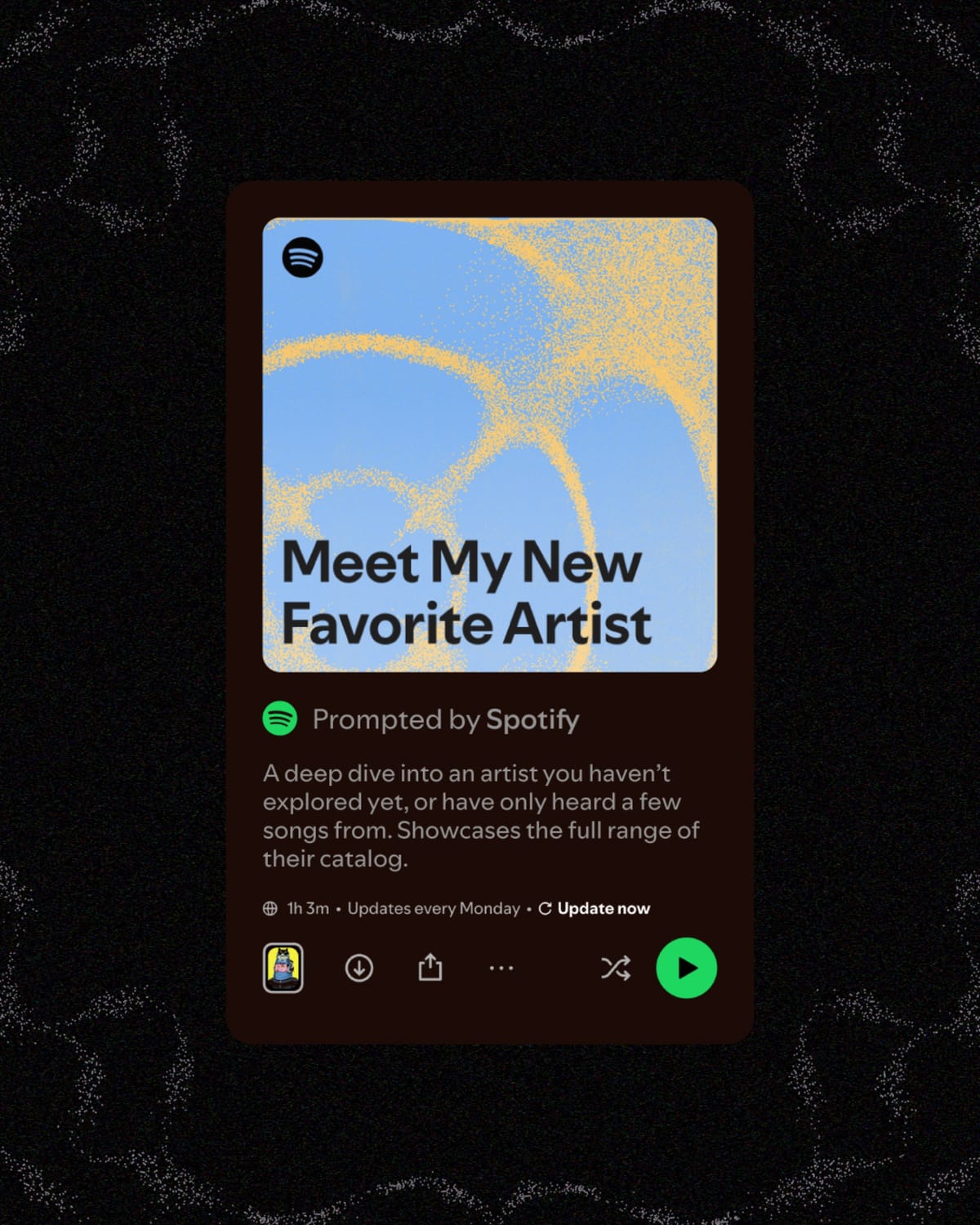
Spotify Prompted Playlist interface showing "Meet My New Favorite Artist" with natural language prompts
Spotify Prompted Playlist interface showing "Meet My New Favorite Artist" with natural language prompts
Spotify this week extended its Prompted Playlist feature to Premium subscribers across the United States and Canada, introducing a natural language interface that transforms how listeners curate music while maintaining connection to their listening history. The streaming platform announced the beta expansion on January 22, 2026, following initial testing in New Zealand that began in December 2025.
The feature allows Premium subscribers to describe desired listening experiences in their own words rather than selecting from predetermined categories or artist lists. According to the announcement, Spotify generates playlists "informed by your listening history and what's happening in music right now," combining personalization algorithms with real-time music trend data.
"We believe that technology is only as good as the humans behind it," according to the announcement. "That's why we created Prompted Playlist, which lets you describe exactly what you want to listen to using your own words, then generates a playlist informed by your listening history and what's happening in music right now."
0:00
/0:25
Technical architecture combines history with current trends
The system processes user prompts through what Spotify describes as collaboration between listener intent and algorithmic curation. Users can specify moods, scenarios, cultural moments, or filtering criteria. The platform then generates playlists using "real-time information about the world of music, including trends, charts, culture, and history."
Listening history dating back to when users first joined Spotify factors into playlist generation. According to the announcement, "Your entire listening history from when you first joined Spotify is factored in, meaning each playlist reflects not only what you love today, but the full arc of your taste."
The temporal depth distinguishes Prompted Playlist from recommendation systems that prioritize recent listening patterns. Spotify's approach enables playlist generation that synthesizes years of accumulated preference data with current music landscape information.
Users can edit prompts at any time or initiate new playlist creation when preferences shift. The platform offers refresh options allowing playlists to update daily or weekly, maintaining alignment with evolving musical trends and user interests.
User prompts demonstrate filtering sophistication
Beta testers in New Zealand demonstrated diverse prompt applications. According to the announcement, "Listeners are using prompts to bring back songs tied to specific moments, like late nights during the winter, while filtering out tracks they've overplayed recently."
The filtering capabilities extend beyond simple mood descriptions. Users can request "long, lyric-free electronic playlists to power through a workday" or combine "artists connected to current pop culture moments and viral trends."
Example prompts cited in the announcement include "mood-boosting indie-pop for getting ready to go out with friends including songs recently featured on hit competition and reality shows that fit my taste, along with songs I love but haven't played this year" and "warm acoustic songs for a slow Sunday morning, plus hidden gems and covers from singer-songwriters trending globally right now."
The natural language processing accommodates scenario-based requests, temporal filtering, genre specifications, and cultural moment references within single prompts. This flexibility addresses what Sulinna Ong, Global Head of Editorial at Spotify, identified as a persistent user challenge.
"We hear from listeners all the time that they love playlists, but making their own can feel daunting," Ong stated in the announcement. "Our editors spend a lot of time thoughtfully curating playlists, and that level of intention can be hard to replicate when you're starting from scratch. Prompted Playlist offers a more intuitive entry point, letting users begin with moods, moments, or ideas in their own words, and build something that feels personal."
Transparency layer explains algorithmic decisions
Each song included in generated playlists receives what Spotify describes as "a quick one-liner that tells you exactly why it landed in your playlist." This explanatory layer provides visibility into algorithmic decision-making processes that typically remain opaque to users.
For users unfamiliar with prompt construction, Spotify provides an "Ideas" feature offering inspiration for playlist creation. The platform will also surface example prompts on user home screens created by Spotify music editors and culture experts, described as "a mix of playful prompts that generate personalized playlist ideas you can easily customize."
Social sharing maintains personalization through individual taste profiles
Prompted Playlists can be shared with other users, but the platform applies recipient-specific personalization. According to the announcement, "Share your Prompted Playlist with friends and we'll tune it to their taste so everyone gets their own personalized version."
The cited example describes "songs that feel like my early-2000s college years mixed with upbeat tracks from the TV shows, movies, and pop culture moments that defined that decade" being adapted to individual taste profiles when shared across friend groups.
This approach preserves the social discovery element of playlist sharing while preventing direct replication of another user's listening preferences. The technical implementation suggests Spotify applies prompt instructions to each recipient's individual listening history rather than simply copying the original user's generated playlist.
Beta constraints apply during testing phase
The announcement indicated that "as we expand in this beta phase, some aspects may evolve, with usage limits in place while we test and learn." Specific limits on prompt frequency, playlist refresh rates, or feature access were not disclosed.
Spotify projects full rollout to Premium users in the United States and Canada "by the end of the month," suggesting gradual deployment rather than immediate universal access. The beta structure allows the platform to gather user feedback and usage data before committing to permanent feature implementation.
The December 2025 New Zealand testing period provided Spotify with approximately one month of user behavior data before the North American expansion. Testing duration suggests the company prioritized rapid iteration over extended single-market validation.
Platform context: automation expansion across Spotify ecosystem
Prompted Playlist arrives as Spotify systematically deploys AI-powered features across its platform. The streaming service introduced AI-powered advertising tools in April 2025, enabling marketers to generate scripts and voiceovers for audio advertisements through generative AI technology at no additional cost.
Automated podcast buying expansion to 170 million listeners across 12 markets in July 2025 demonstrated Spotify's commitment to reducing manual processes across its audio ecosystem. The platform has systematically automated multiple aspects of its business, from advertising purchases to content discovery, with AI-generated summaries and prompted playlists representing the latest automation frontier.
The contrast between Premium feature expansion and advertising revenue struggles suggests Spotify prioritizes subscriber experience enhancement over ad-supported monetization optimization. Prompted Playlist exclusively serves Premium subscribers, reinforcing value differentiation between paid and free tiers.
While Spotify faces less regulatory scrutiny than social media platforms regarding content amplification, the streaming service operates within evolving frameworks demanding explainability in automated decision-making systems. The Digital Services Act, GDPR, and emerging AI regulations collectively push toward making algorithms auditable and transparent.
Spotify's decision to provide per-song explanations demonstrates proactive transparency implementation that could mitigate future regulatory requirements. The approach contrasts with platforms that deploy algorithmic changes without public disclosure or user-facing explanation mechanisms.
Competitive positioning in streaming personalization
The streaming industry broadly embraces AI-driven personalization as audiences fragment across platforms and content libraries expand beyond manual navigation capabilities. However, implementation approaches vary significantly. Some platforms prioritize fully automated recommendation without user input, while others like Spotify emphasize human-algorithm collaboration.
Spotify's framing of Prompted Playlist as "collaboration, not automation" positions the feature as user empowerment rather than algorithmic replacement of human curation. "You set the rules, and Spotify works from there," according to the announcement.
Marketing implications: personalization without demographic targeting
For advertisers operating on Spotify's platform, Prompted Playlist represents additional engagement data potentially informing targeting strategies. User-generated prompts reveal explicit preference signals beyond passive listening behavior.
However, the feature exclusively serves Premium subscribers who experience ad-free listening. This limits direct advertising applications while potentially increasing Premium tier attractiveness, indirectly supporting Spotify's subscription revenue that grew 12% year-over-year to €3.74 billion in Q2 2025.
The divergence suggests different optimization priorities between ad-supported and subscription business models. Advertising platforms optimize for conversion metrics that may conflict with user preferences, while subscription services optimize for engagement that retains paying customers.
Implementation timeline and market availability
Spotify initiated Prompted Playlist testing with Premium listeners in New Zealand during December 2025. The limited geographic scope allowed controlled evaluation before broader deployment.
The January 22, 2026 announcement extending the feature to United States and Canada Premium subscribers represents the first major market expansion. These markets contain substantially larger user populations than New Zealand, providing scale testing opportunities while limiting global exposure during beta phases.
According to the announcement, the feature "will be rolling out to Premium users in the U.S. and Canada by the end of the month," suggesting phased deployment through January 2026. This approach allows infrastructure scaling to accommodate increased usage while maintaining service quality.
No timeline was provided for expansion to other markets or transition from beta to general availability status. The announcement's emphasis on continued improvement "as we learn from listeners and their feedback" indicates Spotify will evaluate beta performance before committing to permanent feature status or geographic expansion.
The cautious rollout mirrors testing patterns across streaming platforms deploying AI-powered features. Beta testing programs enable platforms to identify technical issues, gather user feedback, and refine features before full-scale launches that could damage user experience if poorly executed.
Technical requirements and access
Prompted Playlist exclusively serves Spotify Premium subscribers, excluding the platform's 433 million ad-supported users. The Premium-only restriction reinforces subscription tier differentiation while limiting potential feature exposure.
Users access the feature by opening Spotify, tapping Create, then selecting Prompted Playlist. The interface design emphasizes accessibility through familiar navigation patterns rather than requiring specialized knowledge or settings adjustments.
The announcement provided no information about device compatibility, suggesting the feature should function across Spotify's supported platforms including iOS, Android, desktop, and web interfaces. Cross-platform availability would align with Spotify's standard feature deployment patterns.
Processing requirements for natural language understanding and playlist generation occur server-side, meaning users need internet connectivity but not enhanced device capabilities. This approach maintains feature accessibility across Spotify's diverse device ecosystem.
Open questions and unspecified limitations
The announcement left several technical and operational details unspecified. Prompt length limitations, if any, were not disclosed. The system's handling of complex multi-criteria prompts beyond cited examples remains unclear.
Refresh frequency options mention daily or weekly updates, but whether users can specify custom refresh intervals or disable automatic updates was not addressed. The balance between maintaining playlist stability and incorporating new music through refresh cycles will affect user experience.
Usage limits mentioned for beta testing were not quantified. Whether restrictions apply to prompt submissions per day, playlist generation frequency, or total active Prompted Playlists per user could significantly impact feature utility.
The relationship between Prompted Playlist and Spotify's existing algorithmic curation like Discover Weekly and Daily Mix was not explained. Whether the systems share underlying recommendation engines or operate independently affects how users should conceptualize the feature's capabilities.
Integration with Spotify's broader personalization ecosystem including AI DJ features and editorial playlists remains undefined. The announcement did not specify whether Prompted Playlist data influences other recommendation systems or operates as isolated functionality.
Who: Spotify developed Prompted Playlist for Premium subscribers, with the announcement featuring commentary from Sulinna Ong, Global Head of Editorial. The feature initially tested with New Zealand Premium listeners before expanding to United States and Canada markets.
What: Prompted Playlist is a natural language playlist generation system that allows Premium subscribers to describe desired listening experiences in their own words. The platform generates playlists combining user listening history spanning their entire Spotify membership with real-time music trend data. Each song includes an explanation of why it appeared in the playlist. Users can edit prompts, set daily or weekly refresh schedules, and share playlists that adapt to recipients' individual taste profiles.
When: Spotify began testing in December 2025 with New Zealand Premium listeners. The beta expansion to United States and Canada was announced January 22, 2026, with full market rollout projected by month end. The feature operates in beta phase with usage limits while Spotify gathers user feedback.
Where: The feature launched initially in New Zealand during December 2025. The January 2026 expansion extends availability to Premium subscribers across the United States and Canada. No timeline was provided for additional market expansion or general availability status.
Why: Spotify aims to address user difficulties in creating personalized playlists from scratch while maintaining meaningful algorithmic control. According to Sulinna Ong, listeners frequently express that "making their own can feel daunting" despite loving playlists. The feature provides "a more intuitive entry point, letting users begin with moods, moments, or ideas in their own words" while generating playlists that "feel personal." The transparency layer explaining song selections addresses growing demands for algorithmic accountability. The Premium-exclusive feature reinforces subscription tier value differentiation while expanding AI-powered personalization across Spotify's platform.
Share this article
The link has been copied!
Your link has expired. Please request a new one.
Your link has expired. Please request a new one.
Your link has expired. Please request a new one.
Great! You've successfully signed up.
Great! You've successfully signed up.
Welcome back! You've successfully signed in.
Success! You now have access to additional content.