TAG hands out 307 seals to 196 companies in 2026 recertification
TAG awarded 307 seals to 196 companies in 2026, with 32 reaching Platinum status. Here's what the numbers reveal about ad fraud, brand safety, and transparency standards.


TAG awarded 307 seals to 196 companies in 2026, with 32 reaching Platinum status. Here's what the numbers reveal about ad fraud, brand safety, and transparency standards.
The Trustworthy Accountability Group last week announced the companies worldwide that achieved TAG Certifications for 2026, issuing 307 seals across 196 companies through its four programs: Certified Against Fraud, Certified Against Malvertising, Brand Safety Certified, and Certified for Transparency. The announcement, dated March 5, 2026, marks another annual cycle in TAG's effort to build a more accountable digital advertising supply chain.
Thirty-two companies reached Platinum status - TAG's highest designation - by earning three or more seals. That figure matches the record set in 2024, when TAG also awarded Platinum status to 32 companies. The total seal count of 307 is lower than the 321 issued in 2024, but the number of certified companies and the geographic breadth of the program have shifted in ways that carry real significance for buyers and sellers in programmatic markets.
Eighty percent of the 307 seals awarded covered more than one market. Nearly three-quarters - 74% - were independently audited rather than self-attested. These two metrics matter because they indicate not merely that companies signed up, but that external reviewers verified their practices across multiple jurisdictions.
According to Todd Miller, VP Policy and Compliance at TAG, "The record number of seals covering multiple markets is a testament to how seriously global companies are taking compliance, not just in their home markets, but everywhere they operate. Threats like ad fraud and malvertising don't stop at national borders, and neither does the impact of TAG Certification. For participants across the global supply chain, the TAG Seal provides a worldwide assurance of industry leadership and commitment to high standards."
The global dimension of the 2026 cohort is relevant context for media buyers operating across European and Asia-Pacific markets. A June 2025 TAG report on European ad fraud found that unprotected channels still sustained losses of approximately €1.19 billion in 2023, a figure derived by applying an unfiltered invalid traffic (IVT) rate of 10.36% to the €11.5 billion in European advertising spending that flowed through non-certified channels. The 2026 certification cycle reflects an ongoing attempt to close that gap.
TAG operates four distinct certification programs, each targeting a different vector of supply chain risk.
The Certified Against Fraud seal requires companies to follow TAG's anti-fraud guidelines and, in most cases, submit to third-party auditing. The program has maintained IVT rates below 1% in TAG Certified Channels in the U.S. market for four consecutive years, and below the same threshold in European markets for six years, according to TAG's February 2025 impact report. Earlier analysis published on PPC Land showed that collaborative anti-fraud industry efforts saved U.S. advertisers $10.8 billion in 2023, a 92% reduction compared to what losses would have been without those programs.
The Certified Against Malvertising seal addresses malicious ad content - creatives that redirect users to harmful sites or install unwanted software. The certification requires companies to implement creative scanning protocols, maintain filtration infrastructure, and conduct incident reviews. As PPC Land reported in December 2024 when Opera Ads achieved TAG Platinum status, the technical requirements include specific best practices for creative scanning and robust filtration tools, all verified through extensive third-party audits.
Brand Safety Certified covers the placement of advertising alongside content that could damage brand reputation. The seal is particularly relevant for programmatic buyers running open exchange campaigns across large, heterogeneous publisher pools, where manual review of every placement is not operationally feasible.
Certified for Transparency is the newest of the four programs and requires companies to engage with a TAG-recognised transparency utility capable of creating a trusted record for transactions through real-time reconciliation and sharing of advertising log files with marketers. TAG's TrustNet platform, which serves as the primary infrastructure for this program, was cited in a 2023 ANA Programmatic Media Supply Chain Transparency Study published on PPC Land as a mechanism for addressing findings that only 36% of post-transaction programmatic budgets reach valid, viewable, measurable, and non-MFA impressions.
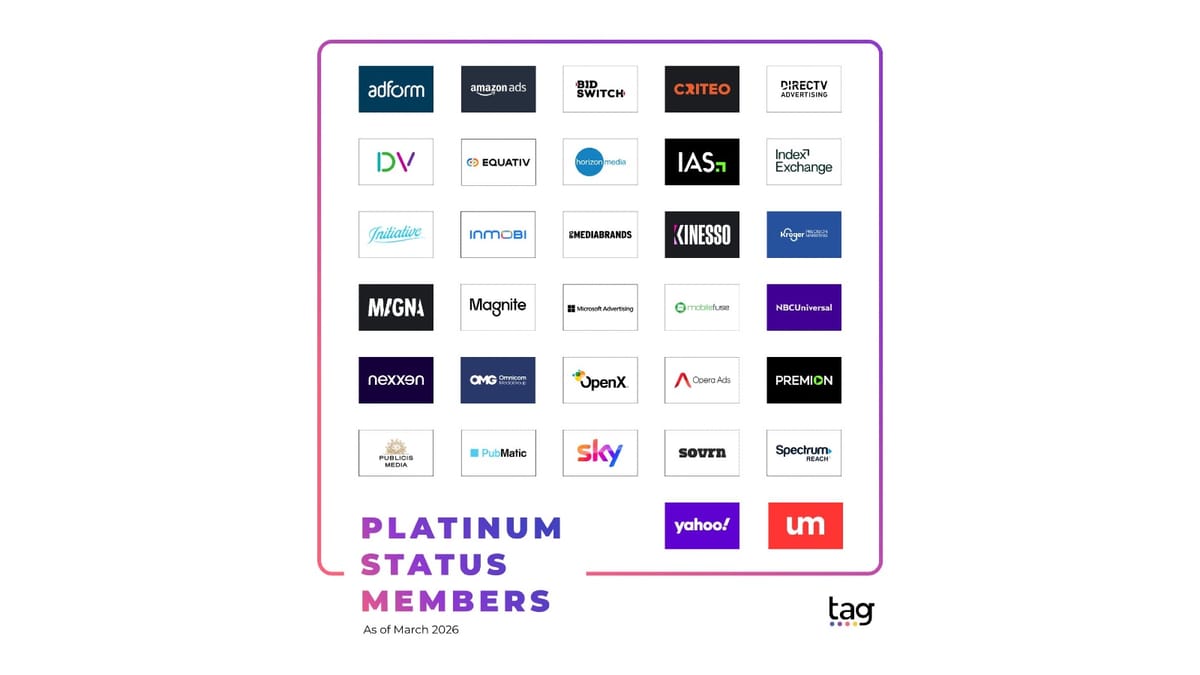
Thirty-two companies achieved Platinum status for 2026 by earning three or more of the four available seals. The list includes companies operating across the full advertising supply chain - buy side, sell side, verification, and measurement.
Among the Platinum members are Adform, Amazon Ads, BidSwitch, Criteo, DIRECTV Advertising, DoubleVerify, Equativ, Horizon Media, Integral Ad Science (IAS), Index Exchange, Initiative, InMobi, IPG Mediabrands, KINESSO, Kroger Precision Marketing, MAGNA Global, Magnite, Microsoft Advertising, MobileFuse, NBCUniversal, Nexxen, Omnicom Media Group, OpenX, Opera Ads, PREMION, Publicis Media, PubMatic, Sky, Sovrn, Spectrum Reach, Yahoo, and UM Worldwide.
The list spans demand-side platforms, supply-side platforms, agency holding companies, independent verification vendors, and media owners. That breadth is significant. For a TAG Certified Channel to carry maximum weight in reducing fraud, multiple entities within a single transaction - the media agency, the buy-side platform, the sell-side platform, and the publisher - each need to hold the relevant seal. A channel where three or more certified participants are involved qualifies as a TAG Certified Channel (TCC), which has historically demonstrated the lowest IVT rates.
According to Mike Zaneis, CEO of TAG, "Across digital advertising and around the world, TAG Certification has become our industry's trusted badge for high standards and accountability. The companies that have achieved TAG Certification are doing the vital and ongoing work required to keep our supply chain safe, transparent, and accountable, and their commitment helps protect the entire ecosystem. As the threats to digital advertising continue to grow and evolve, so does the rigor of our programs, and we commend this year's TAG Seal recipients for setting a new standard for responsible and forward-looking leadership."
The TAG Platinum designation carries a specific meaning beyond the seal count. According to the Platinum Status Members documentation, the name was chosen deliberately: platinum is the heaviest of the precious metals and is impervious to corrosion. As Zaneis described it, "we felt that TAG Platinum was an appropriate designation for those companies that have taken all of the steps necessary to ensure that their digital advertising operations are impervious to the corroding effects of fraud, malware, piracy, and lack of transparency."
Christine Foster, Group Vice President at Kroger Precision Marketing, said in a statement that the certification reflects the company's "commitment to transform digital media through transparency and accountability." John Gentry, President at OpenX, noted that "Platinum Status from TAG is a great way for advertisers and publishers to separate the companies that are truly committed from those that may just be doing the minimum required."
Beyond the 32 Platinum companies, the broader list of 196 certified organizations spans buy-side agencies and their trading desks, premium publishers, ad tech intermediaries, and retail media operators. The full certification list includes familiar names across each segment.
On the agency and trading desk side: GroupM Nexus, Mindshare, Wavemaker, Essence, Xaxis, iProspect, MediaCom, Carat, MiQ Digital, Assembly, and Dentsu, among others. Major media owners and publishers holding at least one seal include Disney+, ESPN.com, NBCUniversal, Hulu, Fox Corporation, Sky, News Corp UK & Ireland, The Walt Disney Company, The Weather Company, Spotify, TripAdvisor, Pinterest, Snap, X, and TikTok.
On the technology side, ad verification companies DoubleVerify and Integral Ad Science hold Platinum status - a relevant detail given that both are frequently positioned as measurement layers within campaigns that already run through TAG-certified supply chains. The presence of retail media operators including Kroger and Walmart signals that certification has extended into environments that did not exist in their current form when TAG launched its first programs in 2016.
Companies seeking TAG certification must first become TAG members, then apply for individual seal programs. The application process for most seals involves completing a self-assessment against TAG's published guidelines, followed - for most participating companies - by an independent audit conducted by a TAG-approved third-party auditor.
For the Certified Against Fraud program, the technical requirements are specific. Companies must implement TAG's anti-fraud guidelines, use a TAG-approved fraud detection solution, and in the case of intermediaries, pass along fraud detection signals through the supply chain. The TAG-ID system provides a unique identifier for each certified company, searchable through the TAG Registry. Each seal entry in the registry lists the specific programs covered, the valid term for that seal, and whether the seal was based on self-attestation or independent validation.
The multi-market dimension of the 2026 certifications reflects how TAG handles the geographic complexity of global campaigns. A company operating in both the U.S. and European markets, for example, would receive seals covering each geography separately, because the underlying content standards, privacy regulations, and audit procedures can differ across jurisdictions. The 80% multi-market coverage reported in the 2026 cycle is a practical measure of how many certified companies have extended their compliance programmes beyond their domestic operations.
The 2024 certification cycle, covered extensively on PPC Land, produced 321 seals for that year. The 2026 figure of 307 is lower by 14 seals, but the number of participating companies - 196 in 2026 versus figures implied by the 2024 data - reflects the natural churn of the certification cycle. Companies must recertify annually, which means the cohort shifts year to year. Some companies that held seals in prior years do not recertify; others enter the program for the first time.
The 74% independent audit rate for 2026 is a notable data point. In earlier cycles, self-attestation was more common. The shift toward external verification reflects both TAG's own requirements tightening over time and the growing commercial pressure on buyers and platforms to demonstrate third-party-validated standards.
TAG's member base had grown to more than 700 companies as of late 2024. The 226 companies that held at least one certification seal by the end of 2024 represented a subset of that broader membership. The 196 certified companies in the 2026 cycle are the companies that completed the recertification process for this specific annual cycle.
For media buyers, the practical utility of TAG certification comes down to risk reduction at scale. Programmatic campaigns route through dozens of intermediaries in a single transaction; verifying each one manually is not realistic. TAG Certified Channels provide a contractual and audit-backed shorthand for supply chain hygiene.
The February 2025 analysis from TAG - conducted in partnership with the 4A's, ANA, and IAB - found that the industry-wide adoption of certification standards prevented $10.8 billion in U.S. ad fraud losses in 2023 alone. Even within certified channels, $979 million was still lost to IVT that year. The persistence of that residual loss figure, even inside protected channels, is a reminder that certification reduces risk but does not eliminate it.
For sell-side companies, holding multiple seals - and particularly achieving Platinum status - creates a differentiation argument in a crowded market. When programmatic buyers are selecting supply-path optimization (SPO) partners or constructing preferred supply lists, the presence of TAG Platinum status among competing SSPs and publishers provides a standardised signal of compliance investment.
The global dimension is particularly relevant for European buyers and sellers operating under GDPR and the broader EU digital regulatory framework. TAG's certification program operates independently of privacy regulation compliance but increasingly intersects with it, as transparency requirements in both regimes converge on similar demands for data visibility and audit trails.
More information about the certified companies is available through the TAG Registry at www.tagtoday.net, where each company's TAG-ID, specific seals, valid terms, and audit status can be searched directly.
Who: The Trustworthy Accountability Group (TAG), a global certification body for digital advertising, announced the results. Recipients include 196 companies spanning ad agencies, DSPs, SSPs, publishers, verification vendors, and retail media operators worldwide. Thirty-two companies - including Amazon Ads, DoubleVerify, Integral Ad Science, Magnite, Microsoft Advertising, NBCUniversal, Omnicom Media Group, PubMatic, and Yahoo, among others - reached Platinum status.
What: TAG awarded 307 certification seals across four programs: Certified Against Fraud, Certified Against Malvertising, Brand Safety Certified, and Certified for Transparency. Thirty-two companies achieved the Platinum designation by earning three or more of those seals. Eighty percent of seals covered more than one geographic market, and 74% were independently audited.
When: The announcement was made on March 5, 2026, covering certifications for the 2026 annual cycle. Companies must recertify each year to maintain their seals.
Where: TAG is headquartered in Washington, D.C. The certifications cover companies operating globally, with the 80% multi-market coverage rate indicating that the majority of certified firms have extended compliance verification beyond a single country.
Why: TAG's certification programs provide a standardised, third-party-verified signal of supply chain hygiene in digital advertising - a sector where fraud, malvertising, and opacity remain persistent financial risks for buyers. The programs also serve as a differentiation mechanism for sell-side companies competing for preferred supply relationships with programmatic buyers.