TikTok and Samba reveal 172% ticket sales lift in new box office study
TikTok and Samba's Box Office Lift study across 38 U.S. theatrical campaigns shows 172% median ticket purchase lift and $1.70 incremental ROAS, outperforming linear TV by 15x.


TikTok and Samba's Box Office Lift study across 38 U.S. theatrical campaigns shows 172% median ticket purchase lift and $1.70 incremental ROAS, outperforming linear TV by 15x.
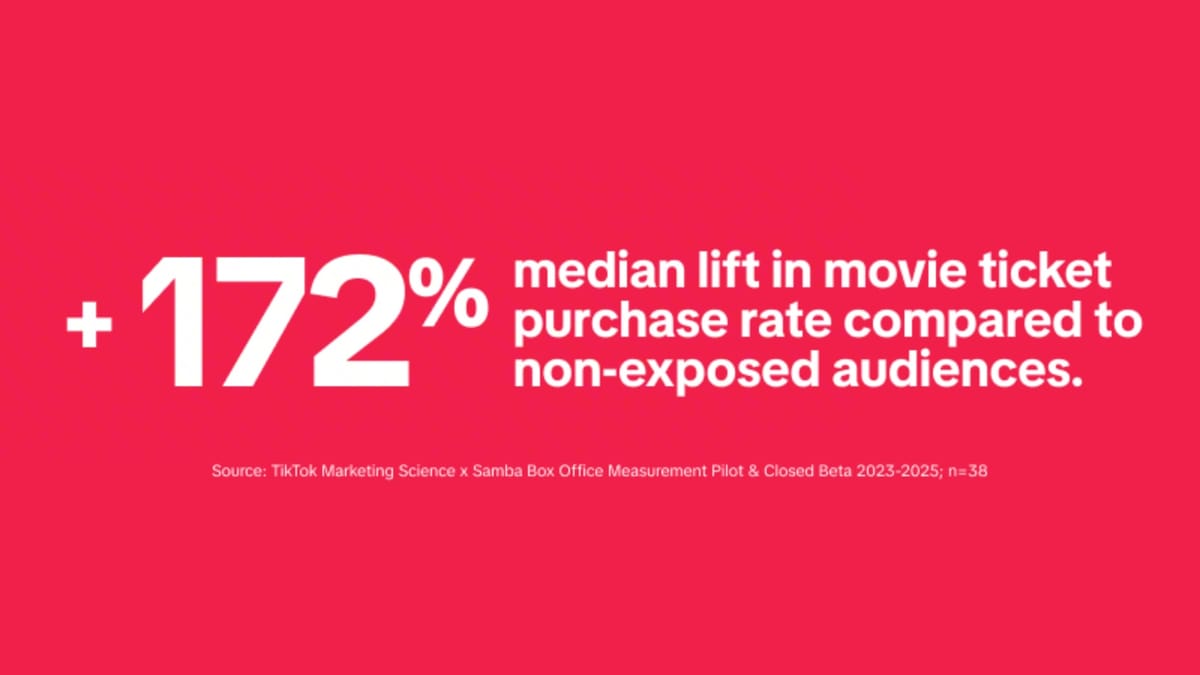
TikTok today published findings from a measurement study conducted with Samba showing that exposure to TikTok advertising drove a median 172% increase in movie ticket purchase rates compared to audiences who were not exposed. The announcement, dated March 5, 2026, introduces a third-party measurement product called Box Office Lift, built on Samba's cross-platform data infrastructure and designed to connect TikTok ad exposure directly to verified ticket purchases.
The study spans 38 theatrical campaigns in the United States conducted between early 2023 and mid-2025, covering major releases from leading studios. It is positioned as a meta-analysis, not a single campaign case study, which gives the findings broader statistical weight than most platform-commissioned research of this kind.
The measurement product works by matching TikTok ad exposure data against verified ticket purchase records using Samba's household-level dataset. According to the announcement, this dataset spans millions of U.S. households and enables what TikTok describes as "deterministic matching" - a direct link between a specific ad exposure and a subsequent real-world transaction, rather than a modeled or probabilistic estimate.
Alyson Sprague, VP of Measurement Science at Samba, explained the approach in a statement included in the announcement: "Our partnership with TikTok represents an important step forward for theatrical measurement... By combining cross-platform exposure data with verified ticket purchase outcomes, we're able to move beyond correlation and deliver clear insight into incremental impact."
The distinction between correlation and incremental impact is significant. Much of the measurement debate in digital advertising centers on whether a platform is actually driving new behavior or simply reaching people who would have converted anyway. The Box Office Lift methodology attempts to isolate the former - ticket purchases that would not have occurred absent TikTok ad exposure.
Samba has been an active player in cross-platform measurement for several years. The company partnered with Kochava in July 2025 to create a unified TV and digital measurement solution. In October 2025, Aquila - the Association of National Advertisers' measurement subsidiary - selected Samba to provide streaming viewership data for its independent cross-media platform. The TikTok partnership adds another dimension to Samba's measurement coverage, extending its data reach into short-form social video alongside its existing television infrastructure.
The headline figure - 172% median lift in ticket purchase rate - reflects the difference between the purchase behavior of TikTok-exposed audiences and non-exposed audiences across the full set of 38 campaigns. This is not an average of best-performing campaigns; it is the median across the entire study cohort.
Genre performance varied. Horror titles produced the strongest results, with a 215% median lift in ticket purchases. The announcement attributes this to the fandom dynamics and anticipation that characterize genre audiences - where excitement about an upcoming release translates more directly into action when reinforced by social discovery.
The return on ad spend figure of $1.70 represents incremental revenue - meaning revenue generated beyond what would have occurred without TikTok advertising - per dollar of media spend. According to the announcement, this compares favorably to linear television by a factor of more than 15, based on conservative CPM comparisons. The methodology note states that incremental ROAS is "calculated based on projected total ticket sales and compared to linear TV using a CPM estimate," which introduces some modeling assumptions. The comparison is directional rather than a controlled side-by-side test against actual linear TV campaign results.
The 60% figure may be the most commercially significant data point in the study. According to the announcement, 60% of ticket purchases attributed to TikTok came from audiences who had not been exposed to linear television advertising for the same film. This means TikTok is not, in this dataset, primarily reaching the same people already targeted by broadcast campaigns. It is adding net new audience to the box office funnel - a finding that directly challenges the assumption that social media advertising and television advertising are largely redundant.
The relationship between linear TV and digital advertising channels has been a persistent subject of measurement debate. Research from iSpot analyzing 224.2 billion TV advertising impressions across 87 brands found that entertainment brands had the lowest connected TV adoption rate of any measured sector, at just 7.6%. If entertainment studios are indeed underinvesting in digital channels while TikTok delivers non-duplicated reach at stronger efficiency than broadcast, the Samba data suggests a meaningful reallocation case.
The meta-analysis surfaced specific product and creative formats correlated with stronger outcomes. On the product side, the study identifies TopView and Top Feed placements as effective for building reach and generating awareness ahead of release windows. In-Feed Ad and Web Conversion campaign types are associated with stronger ticket purchase rates. Pulse contextual placements, which align ads with trending content categories, contribute to what the announcement describes as "lower-funnel outcomes."
The creative analysis is notable for its specificity. Studios that outperformed relied on formats beyond traditional trailer cuts. The study identifies five high-performing creative approaches: critic reviews and social proof; clear ticketing calls-to-action; highlights from the film itself; behind-the-scenes storytelling; and creator-led content produced natively for TikTok.
The last category is particularly relevant. "Creator-led content that feels TikTok-first" implies that repurposed broadcast assets - 30-second trailers converted to vertical format - perform differently from content designed to fit how TikTok users actually engage with the platform. This aligns with broader findings from TikTok's marketing mix modeling study with NIQ on Romanian beauty brands, released in December 2025, which noted that the creative requirements for TikTok differ substantially from television advertising - a distinction that has operational implications for studio marketing teams.
The Samba analysis also examined how targeting strategy affected conversion performance. Broad audience targeting remains essential for scale - reaching enough potential moviegoers to generate statistically meaningful lift. But conversion rates improved when campaigns layered in high-affinity segments.
Fans of cast members and directors converted at more than twice the rate of broad audiences, according to the announcement. Interest-based segments and multicultural audiences consistently outperformed baseline targeting. Retargeting also delivered stronger purchase efficiency. The finding points toward a blended approach: broad targeting for reach, affinity segments for conversion efficiency.
This kind of layered targeting architecture is consistent with how incremental measurement frameworks have evolved more broadly. Kochava's research published in September 2025 demonstrated that marketing mix modeling revealed TikTok campaigns generated an average of 35% higher incremental impact compared to last-touch attribution reporting. The measurement gap suggests that broad-funnel TikTok influence on purchase behavior is frequently underrepresented in standard attribution models - particularly relevant for entertainment, where the decision to buy a movie ticket may follow a chain of inspiration and consideration that starts weeks before the actual transaction.
TikTok has invested in expanding its measurement partner program since January 2024, when it introduced Cross-Channel and Lift specialties under its Measurement Badge category. These designations recognize partners who specialize in attribution beyond last-click and in measuring incremental impact on specific marketing objectives - including sales lift studies and tune-in lift measurement. The Box Office Lift product fits squarely within this expanded measurement posture.
Film studios have been under sustained pressure to demonstrate measurable returns from digital media investment. The theatrical business was structurally disrupted during the pandemic, and while attendance has recovered for major franchise releases, the marketing spend required to drive opening-weekend performance has increased substantially.
At the same time, the measurement infrastructure available to entertainment marketers has lagged behind what direct-response advertisers can access. A brand selling consumer goods online can track clicks to purchases in near real-time. A film studio advertising to drive weekend attendance must rely on less direct signals - social conversation volume, trailer view counts, and - until now - no standardized framework for connecting ad exposure to ticket transactions with the specificity that Box Office Lift claims to offer.
Geo Lift Tests on TikTok, which use geographic control groups to measure incremental sales attributable to advertising, have been available as a methodology. But the Samba partnership delivers something different - a persistent, transaction-level matching capability that can operate across a full campaign run rather than as a one-time experiment.
The broader measurement context matters here. The IAB's September 2025 incrementality framework defined incrementality as measuring "additional business outcomes directly driven by campaigns, compared to what would have occurred without marketing activity" - precisely the question Box Office Lift is designed to answer for theatrical releases. The IAB framework noted that commerce media advertising was approaching $150 billion across the U.S. and Europe, placing increasing pressure on marketers to justify media investments with causal evidence rather than correlated metrics.
Television measurement has also been under scrutiny. Research examining Mixed Media Model reliability found that entertainment brands show the lowest CTV adoption at 7.6% - the bottom of all measured sectors - suggesting that film marketers may be systematically over-reliant on channels where measurement is weakest and underinvesting in digital channels where incrementality can be more precisely quantified.
The 15x efficiency advantage over linear TV that TikTok and Samba report is based on CPM comparisons rather than a controlled experiment. Still, the directional finding aligns with a broader pattern in which marketing measurement research has repeatedly found that linear TV's apparent dominance in media plans reflects attribution methodology as much as actual effectiveness.
The announcement is a TikTok-commissioned study, and the document itself includes a disclaimer: "Past performance does not guarantee or predict future performance. All claims related to brand products... are brand-reported and not endorsed or verified by TikTok." The third-party involvement of Samba provides independent measurement infrastructure, but the study design, selection of campaigns, and communication of findings were managed within TikTok's marketing science function.
The 38-campaign dataset covers early 2023 through mid-2025 - a period of meaningful variation in theatrical performance. The announcement does not specify which studios participated, which genres beyond horror are represented, or how budget levels varied across measured campaigns. These gaps make it difficult to assess how broadly the findings apply to the range of theatrical releases from smaller or mid-budget productions.
The ROAS comparison to linear TV also rests on a CPM estimate rather than actual linear buy data from the same campaigns. The announcement acknowledges this with the phrase "conservative CPM comparisons," which signals that the assumption favors linear TV rather than inflating TikTok's apparent advantage. But the estimate remains modeled, not measured.
Who: TikTok's marketing science team and Samba, a cross-platform measurement company, in collaboration with major U.S. film studios whose campaigns formed the study cohort. Alyson Sprague, VP of Measurement Science at Samba, provided the key executive statement.
What: The launch of Box Office Lift, a third-party measurement product that uses Samba's household-level data to connect TikTok ad exposure to verified movie ticket purchases. The associated meta-analysis covers 38 U.S. theatrical campaigns and reports a 172% median lift in ticket purchase rates, a $1.70 incremental ROAS, a 15x efficiency advantage over linear TV based on CPM estimates, and 60% non-duplicated reach versus linear TV audiences.
When: The announcement was published on March 5, 2026. The underlying study spans early 2023 through mid-2025.
Where: The study is limited to U.S. theatrical campaigns and U.S. household data. The Box Office Lift product is described as a solution available to studios for future campaign measurement.
Why: Film studios have historically lacked tools to connect digital advertising exposure directly to ticket sales transactions. The Box Office Lift product attempts to fill that gap using deterministic data matching rather than modeled estimates, giving studio marketing teams third-party evidence to inform media allocation decisions - particularly around the balance between TikTok and linear television spending.