VIZIO appears in Walmart Connect Ad Center's new display beta tab
Walmart Connect Ad Center's beta Publishers & Social tab lists VIZIO as a selectable media type, potentially unifying CTV and retail media buying with Walmart's first-party data.


Walmart Connect Ad Center's beta Publishers & Social tab lists VIZIO as a selectable media type, potentially unifying CTV and retail media buying with Walmart's first-party data.
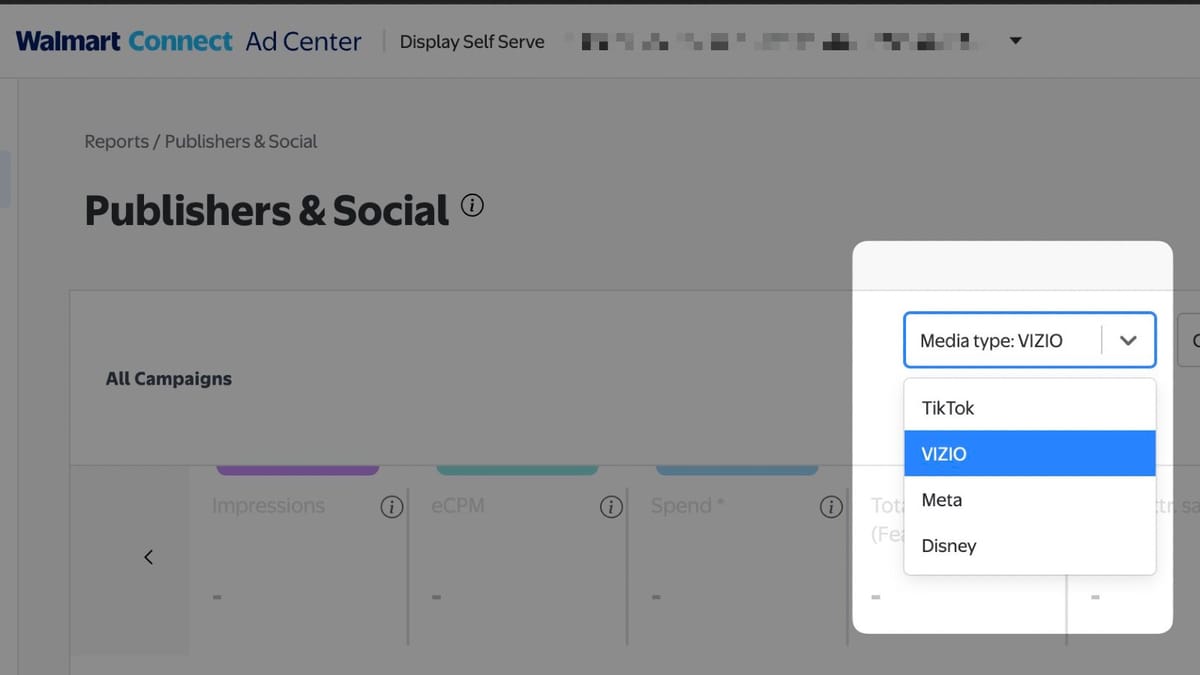
A screenshot shared yesterday on LinkedIn by Niccolò Gloazzo, identified as a Top Retail Expert 2026 and a P2PI 40 Under 40 honoree, reveals a previously unannounced Publishers & Social section inside the Walmart Connect Ad Center's Display tab. Among the four media types visible in the beta interface - TikTok, Meta, Disney, and VIZIO - it is VIZIO's presence that carries the most structural weight. VIZIO is not a third-party publisher Walmart has partnered with. It is a company Walmart owns. Seeing it listed alongside external social platforms inside the same ad buying interface raises a direct question about how Walmart intends to sell and manage VIZIO's connected television inventory within its broader retail media stack.
Walmart completed the acquisition of VIZIO during fiscal year 2026. The deal was completed in fiscal year 2026 and immediately reshaped the financial profile of Walmart's advertising business. According to Walmart CFO John David Rainey, VIZIO delivered triple-digit advertising revenue growth in the fourth quarter of FY26, as reported in the February 19, 2026 earnings release. That growth came from a comparatively small base. Still, Rainey's language on the earnings call was precise: the VIZIO segment is treated separately from Walmart Connect's U.S. supply-side advertising, allowing investors and analysts to track the acquired CTV layer independent of organic retail media growth.
Now, the beta interface suggests those two layers - Walmart Connect's retail media and VIZIO's CTV inventory - may be converging inside the same campaign management surface.
VIZIO operates the SmartCast platform, a smart television operating system installed on millions of devices across U.S. households. SmartCast powers the WatchFree+ free ad-supported streaming television service as well as the broader app ecosystem on VIZIO TVs. The advertising value of VIZIO is twofold: it provides access to connected television inventory in premium home viewing environments, and it generates automatic content recognition (ACR) data - passive viewership data derived from what consumers watch on their TV screens, regardless of the input source. That ACR data is one of the more valuable first-party signals a retail media network can possess, because it can connect what a household watches - whether that is a streaming series, a sporting event, or a linear broadcast - to what that household subsequently purchases.
As PPC Land tracked in June 2022, VIZIO had already been developing its CTV advertising capabilities well before Walmart entered the picture. At that time, Adam Bergman, VP of National Ad Sales at VIZIO, described the company's philosophy directly: "In our eyes, all TV is CTV, and we're on a mission to bridge the gap between linear and streaming." VIZIO launched overlay ads - including a format called Jump Ads that allowed viewers to interact with content from within the viewing experience - in partnership with FOX. That product philosophy, which treats the television set as an interactive surface rather than a passive broadcast medium, is now inherited by Walmart.
The strategic logic of the acquisition was articulated by Rainey during Walmart's earnings call. VIZIO enables non-endemic advertising - a category that traditional retail media cannot serve. Non-endemic means brands whose products are not sold on Walmart.com. Rainey used a Ford F-150 as the example: a vehicle manufacturer has no Walmart shelf presence to defend, but it can still reach Walmart's tens of millions of shoppers through VIZIO's CTV inventory. That expands Walmart Connect's total addressable advertiser market substantially. It shifts the platform from a tool for consumer packaged goods suppliers - who advertise to protect shelf space and drive trial - into something closer to a full-funnel media network that can serve automotive, financial services, travel, and other non-retail categories.
The screenshot in Gloazzo's LinkedIn post shows the Walmart Connect Ad Center under a Reports / Publishers & Social section header. The visible panel includes a campaign-level chart with multiple coloured performance lines, consistent with a unified dashboard tracking activity across channels simultaneously. A dropdown menu, labelled "Media type: VIZIO," expands to show four options: TikTok, VIZIO, Meta, and Disney. The default selection appears to be VIZIO, which places it at the top of the visible list.
That visual hierarchy - VIZIO as the default selection, with social platforms listed below it - is notable. It suggests VIZIO may be the primary or first-activated channel within the Publishers & Social tab, rather than an afterthought appended to a social-first integration. Whether that reflects the technical sequencing of the build, or a deliberate product prioritization, is not clear from the screenshot alone.
According to Gloazzo, the full capability allows advertisers to "run Meta and TikTok campaigns with the Walmart 1P audience and have a full closed loop attribution." The explicit mention of Walmart's first-party audience as the targeting layer means the proposition is not simply that VIZIO CTV inventory can now be purchased through Walmart's platform. It means that VIZIO inventory can be purchased using Walmart's transactional data to define the target audience - and that resulting conversions can be tracked back to Walmart purchases within the same dashboard.
The pairing of retail media first-party data with connected television inventory has been one of the most discussed structural trends in the advertising industry over the past two years. As PPC Land reported in August 2025, VIZIO contributed approximately 28 percentage points to Walmart's 46% advertising revenue growth in Q2 FY26 - while simultaneously creating an 80 basis point headwind to adjusted operating income due to integration costs. That cost-growth tension reflects the substantial infrastructure investment required to merge a consumer electronics company's ad stack with a retail media network's campaign management systems.
What the beta interface today suggests is that some of that integration work has reached the campaign management layer. The fact that VIZIO appears selectable within the Walmart Connect Ad Center - rather than being managed through an entirely separate VIZIO advertising platform - implies that a meaningful degree of technical unification has already occurred, at least in testing form.
The broader industry context matters here. CTV advertising spending in the United States reached $33.35 billion in 2025, with streaming TV advertising projected to grow 19.3% that year while linear television faced a 3.4% decline, according to GroupM forecasts. Retail media and CTV are widely understood to be converging - IAB Europe documented the trend formally in November 2025 analysis noting that retail networks are positioning themselves as infrastructure powering all media formats, not just onsite placements. Walmart's beta capability, if it scales, would represent one of the most direct technical implementations of that convergence to date.
VIZIO had already established itself as a recognized CTV publisher within the programmatic supply chain before the Walmart acquisition. As Magnite's Q1 2025 earnings results showed, VIZIO was listed alongside Roku, LG, Warner Bros. Discovery, Fox, and Netflix as one of the major streaming platforms contributing to Magnite's CTV growth. VIZIO inventory was also available through Mediaocean's integration with Magnite, enabling television buyers to access it alongside premium publishers including Disney, FOX Digital, and Warner Bros. Discovery. The question now is whether Walmart pulls more of that transaction activity into its own Ad Center, or whether the beta capability complements existing programmatic pathways.
The architectural distinction of the Walmart Connect approach - relative to simply buying VIZIO inventory through an open exchange - is the first-party data overlay. Walmart has more than 255 million customer visits per week across its physical stores and digital properties. That purchase history enables audience segmentation at a level of behavioural granularity that neither VIZIO nor any third-party data provider can fully replicate.
A CPG brand advertising baby products on VIZIO CTV, using Walmart's first-party data to target households that have purchased diapers in the previous 90 days, is not simply running a CTV campaign. It is running a commerce-informed CTV campaign, targeting audiences whose purchase behaviour is known with first-party certainty rather than inferred from probabilistic modelling. Closing the loop - connecting that CTV ad exposure back to a subsequent Walmart purchase - produces an attribution signal that is also grounded in first-party transaction data, not cookie-dependent probabilistic matching.
The measurement challenge in CTV has been one of the persistent friction points for brands increasing streaming budgets. As PPC Land covered in a November 2025 analysis of CTV campaign execution errors, programmatic director Vlad Chubakov identified open-market targeting without curation and reliance on web-based measurement approaches as among the most common mistakes brands make when activating CTV campaigns. A closed-loop system anchored in Walmart's first-party data would address both of those problems directly - applying curated, purchase-based audience targeting and producing conversion attribution that does not depend on web-side tracking infrastructure.
VIZIO's appearance alongside Disney in the same Publishers & Social dropdown is not coincidental. Disney is also a media company with significant CTV and streaming inventory. Fubo Sports Network, for instance, already streams on VIZIO WatchFree+ as well as on Amazon Prime Video, Roku, Samsung TV Plus, and other platforms. The co-appearance of Disney and VIZIO within the Walmart Connect interface suggests Walmart may be building a premium CTV publisher layer within its ad platform - one where VIZIO is the owned-and-operated inventory source and Disney (alongside other potential partners) provides external premium supply.
That architecture would give Walmart Connect advertisers access to a meaningfully large CTV footprint, combining VIZIO's owned inventory with licensed premium supply from entertainment studios. For non-endemic advertisers - the Ford F-150 example Rainey described - the combination of Walmart's shopper data with a diversified CTV supply stack could represent a genuinely differentiated product versus what Amazon's advertising business currently offers in streaming.
Amazon's advertising services segment generated approximately $56 billion in 2024. Walmart Connect's global advertising revenue reached $6.4 billion in FY26. The gap is substantial. But the VIZIO acquisition and the integration work visible in the beta interface represent a structural expansion of what Walmart Connect is, not merely incremental growth within the existing model.
The beta feature carries no confirmed timeline for general availability. Gloazzo noted an intention to test the workflow and report results within the coming months. As of the time of publication, Walmart has issued no press release or product announcement confirming the feature's specifications or launch date.
Who: Walmart Connect, the retail media arm of Walmart, with VIZIO - Walmart's wholly owned connected television platform - appearing inside the Walmart Connect Ad Center beta interface. The discovery was reported today by Niccolò Gloazzo, Top Retail Expert 2026, on LinkedIn.
What: A new Publishers & Social section in the Walmart Connect Ad Center Display tab, currently in beta, shows VIZIO as a selectable media type alongside TikTok, Meta, and Disney. The interface suggests advertisers can activate VIZIO CTV campaigns using Walmart's first-party shopper audience data, with conversion tracking running back to Walmart purchases through a closed-loop attribution system built into the dashboard.
When: The beta interface was spotted and shared on April 1, 2026. The VIZIO acquisition was completed during Walmart's fiscal year 2026. No general availability date for the Publishers & Social feature has been disclosed by Walmart.
Where: Inside the Walmart Connect Ad Center, Walmart's self-serve advertising management platform. VIZIO campaign delivery would run on VIZIO SmartCast connected television devices and the WatchFree+ FAST service across U.S. households.
Why: Walmart acquired VIZIO specifically to expand its advertising capabilities into connected television and to unlock non-endemic advertising - inventory sold to brands not present on Walmart shelves, such as automotive and financial services. Integrating VIZIO's CTV inventory into the Walmart Connect Ad Center, layered with Walmart's first-party transactional data and closed-loop attribution, is the natural commercial endpoint of that acquisition rationale. It transforms VIZIO from a standalone CTV publisher into a proprietary inventory layer within one of the fastest-growing retail media networks in the United States.