Web3 is dead and AI killed it
Web3 funding crashed 74% while AI investment hit $124.3B in 2024. Developers abandoned blockchain for AI tools as 90% of Web3 projects failed. Here's why it matters.


Web3 funding crashed 74% while AI investment hit $124.3B in 2024. Developers abandoned blockchain for AI tools as 90% of Web3 projects failed. Here's why it matters.
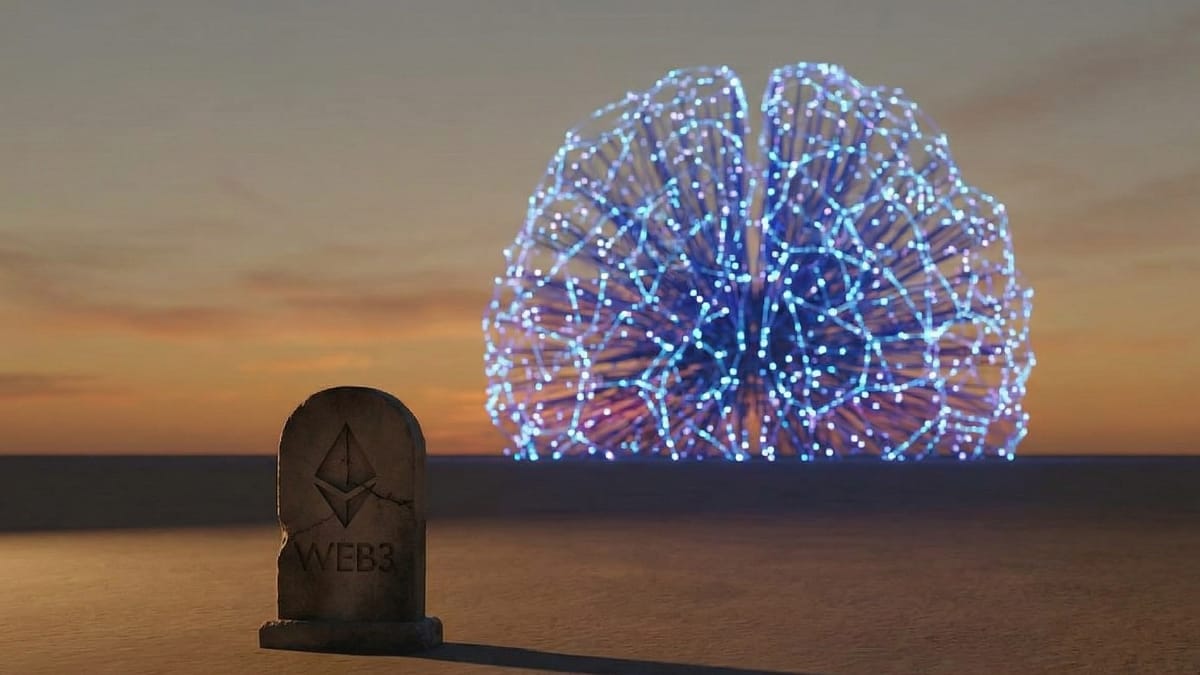
The Web3 boom promised to decentralize the internet, empower users with digital ownership, and fundamentally reshape how businesses and consumers interact online. That vision died somewhere between 2023 and 2025, not with dramatic headlines announcing its demise, but through a steady exodus of developers, investors, and genuine use cases toward artificial intelligence.
A Reddit discussion thread on r/webdev from January 2025 captured the sentiment plainly. "Yup, all the Web3 shills have moved on to AI," wrote one developer. Another commented: "Web3 was never a thing. It required masses of people to transfer real money into arbitrary tokens backed by shady millennials with no business background."
Numbers tell the complete story. Web3 funding collapsed 74 percent from $26.6 billion in 2022 to less than $7 billion in 2023, according to Crunchbase data. By mid-2025, Web3 companies had raised just $2.09 billion across 176 rounds through June, representing a 44.61 percent drop compared to the same period in 2024. Meanwhile, artificial intelligence attracted $124.3 billion in equity investment during 2024 alone, according to McKinsey analysis.
Before examining Web3's collapse, understanding what it actually was—and what it promised—provides essential context. Web3, also called Web 3.0, represents the proposed third iteration of the internet built on blockchain technology and controlled communally by its users rather than centralized corporations.
The term "Web3" was coined by computer scientist Gavin Wood, Ethereum co-founder, who described it as a "Secure Social Operating System." The vision positioned Web3 as combining the decentralized architecture of Web 1.0—the original internet with user-hosted blogs and RSS feeds—with the rich, interactive experience of Web 2.0 social media platforms and applications.
Web 1.0, spanning roughly 1990 to 2004, consisted of static, read-only websites where users primarily consumed information created by businesses and institutions. Web 2.0, emerging in the mid-2000s, introduced interactivity through social media, user-generated content, and dynamic web applications. However, this came at a cost: data and control centralized in the hands of tech giants like Google, Facebook (now Meta), and Amazon.
Web3 aimed to shift this dynamic, creating a "read-write-own" version of the internet where users controlled their data, digital identities, and assets through cryptographic keys rather than relying on intermediaries. The technology stack included several key components:
Blockchain technology forms the foundation—a digitally distributed, decentralized ledger that exists across a computer network and facilitates recording of transactions. As new data are added to a network, a new block is created and appended permanently to the chain, with all nodes updated to reflect the change.
Smart contracts are self-implementing contracts with predefined rules written in code. They automatically enforce agreement terms when certain conditions are met. For example, if a contract specifies that ownership of an item transfers to whoever pays for it, sending the asking price to that contract triggers automatic ledger updates reflecting the new owner.
Cryptocurrencies serve as the economic backbone, providing digital currencies for transactions without requiring banks or government intermediaries. Bitcoin and Ethereum represent the largest by market capitalization, though thousands of alternatives emerged during Web3's peak.
Non-fungible tokens (NFTs) represent unique digital or physical items with ownership recorded on the blockchain. Unlike cryptocurrencies where each unit is interchangeable, NFTs are individually distinct and theoretically provide proof of authenticity and ownership.
Decentralized autonomous organizations (DAOs) are agreed-upon smart contracts that automate decentralized decision-making over a pool of resources. Users with tokens vote on how resources get spent, and code automatically performs the voting outcome.
Decentralized applications (dApps) run on blockchain networks rather than centralized servers, distributing control and data storage across multiple nodes. This architecture theoretically reduces single points of failure and corporate control over user experiences.
The vision promised several compelling benefits: enhanced privacy through user-controlled data, censorship resistance through decentralization, true digital ownership through blockchain verification, and direct financial interactions without intermediaries. Users could theoretically move their data, reputation, and digital assets between platforms, breaking the walled gardens that defined Web 2.0.
The metaverse represented Web3's most visible consumer-facing application—immersive virtual worlds where users could socialize, work, play, and transact using blockchain-based assets. Multiple competing platforms emerged, each claiming to be building the foundation for this digital future.
Decentraland launched publicly in February 2020 as a browser-based platform overseen by the nonprofit Decentraland Foundation. The Argentine developers Ari Meilich and Esteban Ordano had been developing the project since 2015. In its 2017 initial coin offering, the platform raised $26 million. By 2022, indy100 reported it had a $1.2 billion market evaluation.
When digital land parcels launched in 2017, they sold for about $20, with MANA tokens at $0.02. The promise: users could purchase virtual real estate, host events, create experiences, and monetize their digital presence. Ownership recorded on the Ethereum blockchain supposedly guaranteed scarcity and authenticity.
The Sandbox followed a similar model, positioning itself as a gaming metaverse built on Ethereum where players could trade in-game NFTs. The Hong Kong-based platform attracted significant investment and partnerships with brands like Gucci seeking virtual presence.
Roblox represented the Web 2.0 counterpoint—a gaming metaverse not based on blockchain technology. Unlike its Web3 competitors, Roblox demonstrated actual user engagement and growth, reporting 52 million daily active users in the second quarter of 2022 and 11.3 million monthly unique payers. The platform's daily active users reached 59.9 million by late 2022, with monthly active users hovering around 200 million.
The contrast exposed Web3 metaverse platforms' fundamental weakness. In October 2022, DappRadar data revealedDecentraland had 379 daily active users while The Sandbox had 616, despite both maintaining billion-dollar valuations. The headline from CoinDesk—"It's Lonely in the Metaverse"—sparked backlash from the projects, which argued the numbers undercounted true usage.
Decentraland claimed approximately 8,000 daily users based on their own metrics, with 56,697 monthly active users. The Sandbox reported 39,000 daily users during its Alpha Season 3, with 201,000 monthly users. Even accepting these higher figures, The Verge compared them unfavorably with the 2009 PC game Left 4 Dead 2, which had 18,000 active users playing simultaneously during the same month.
The discrepancy stemmed from measurement methodology. DappRadar tracked on-chain transactions via smart contracts, counting unique wallet addresses interacting with decentralized applications. Most metaverse activities—walking around, exploring, chatting—didn't require blockchain transactions. Users could experience these platforms without ever touching the blockchain, rendering the supposed benefits of decentralization largely irrelevant to actual user experience.
Metaverse real estate markets reflected the broader collapse. In 2021, users of major platforms traded $500 million in virtual real estate. The market expanded to $1.4 billion in 2022, with individual sales reaching 333 Ethereum (roughly $1 million at the time). However, by October 2022, weekly volume of digital land purchases fell from $64.1 million in November 2021 to $710,177—a collapse of nearly 99 percent.
The Sandbox saw average land sale volume drop from $35,500 to just $2,800. Ethereum-based metaverse project sales plunged to about $2,500 from almost $21,000 in January 2022. By April 2023, trading volumes remained rock-bottom, with only about $50,000 in virtual land changing hands weekly on Decentraland.
Technical problems plagued these platforms. Journalist Zachariah Kelly's January 2022 review for Gizmodo praised 3D models created for Decentraland's virtual Australian Open space but found poor draw distance and clunky navigation made it feel empty. When he revisited for the closing concert, technical issues dominated his experience, with footage comparing unfavorably to online concerts in Fortnite.
A viral video clip from a Decentraland rave posted to Twitter in January 2022 by DJ Alex Moss drew widespread mockery on social media. Business Insider's April 2022 review praised architecture and minigames but criticized the world's emptiness, glitches, and technical issues.
Buy ads on PPC Land. PPC Land has standard and native ad formats via major DSPs and ad platforms like Google Ads. Via an auction CPM, you can reach industry professionals.
Major corporations invested heavily in Web3 and metaverse platforms between 2021 and 2023, viewing blockchain technology as the next frontier for customer engagement, brand building, and revenue generation. These investments spanned fashion, luxury goods, entertainment, sports, and consumer products, with companies spending hundreds of millions on NFT collections, virtual real estate, and Web3 strategies.
Nike made the most aggressive bet, acquiring NFT sneaker studio RTFKT in December 2021 for an undisclosed sum rumored to exceed $100 million. RTFKT, known for its CloneX NFT collection featuring 20,000 pieces, generated 436 ETH ($584,240) in trading volume at the time. In February 2022, RTFKT gave commercial rights to CloneX NFT holders, allowing derivative projects and merchandise.
Nike launched metaverse sneaker line RTFKT x Nike Dunk Genesis CryptoKicks in April 2022, followed by the .SWOOSH platform announcement in November 2022. According to McKinsey analysis, .SWOOSH was meant to serve as a hub for new product launches and customer-shared virtual apparel designs. Nike has launched 9 NFT collections to date, making it one of the most active traditional brands in the space.
Adidas pursued a community-driven approach, partnering with Bored Ape Yacht Club, influencer Gmoney, and Pixel Vault to develop its "Into The Metaverse" NFT collection in November 2021. The German sportswear brand established Three Stripes Studio, a dedicated Web3 internal team, and launched 12 NFT collections through 2023.
The Into The Metaverse collection reached a floor price of 0.57 ETH (about $1,000) and generated 48,771 ETH (approximately $93.4 million) in trading volume since launch. Adidas expanded the project into ALTS by Adidas in April 2023, transitioning from the original concept into a dynamic NFT system with eight "ALT[er] egos" representing different interests: Strikes (Soccer), Sprints (Running), Hoops (Basketball), Thrills (Gaming), Amps (Music), Soles (Sneakers), Decos (Art), and Drips (Fashion).
Adidas purchased virtual land in The Sandbox to develop themed experiences called Gucci Vault, though the amount remained undisclosed. The company also partnered with Coinbase in November 2021, though details were never fully disclosed.
Puma entered the space in September 2022 with Black Station, introducing NITRO NFRNO and NITRO Fastroid sneakers alongside the Nitro Collection. The Black Station experience featured exclusive NFTs with limited edition redeemable physical sneakers as part of its Futrograde show. Puma unveiled the experience at New York Fashion Week, demonstrating quick movement into providing value to NFT holders.

Gucci pursued the most multifaceted Web3 strategy among luxury brands. In May 2021, Gucci turned its Aria fashion collection into an NFT video that sold for $25,000 at Christie's Proof of Sovereignty auction. The brand followed with 1,000 NFTs in partnership with toy company Superplastic in February 2022, priced at 1.5 ETH (roughly $2,623 at the time), exchangeable for Italian ceramic sculptures with Gucci design.
Gucci bought virtual land on The Sandbox to develop Gucci Vault, spent $25,000 in RARE tokens to join SuperRareDAO in June 2022, and began accepting Bitcoin and Dogecoin at select U.S. stores in May 2022, adding ApeCoin by August. The brand also created Gucci Vault Land in The Sandbox as an experimental concept store with exclusive collectibles and gaming experiences, plus Gucci Town in Roblox.
In April 2023, Gucci announced partnership with Yuga Labs's Otherside metaverse, introducing Otherside Relics—a collection of 3,333 silver necklaces or "KodaPendant" with physical versions, available only to Otherdeed holders (Otherside land NFTs) for 450 APE ($1,053 at the time).
Tiffany & Co entered with CryptoPunks collaboration in August 2022, unveiling 250 digital necklaces for 30 ETH each (about $50,000), available exclusively to CryptoPunk NFT holders. These diamond-encrusted pendant NFTs allowed redemption for physical necklaces. One user flipped a Tiffany CryptoPunk necklace for 55 ETH, nearly double the original price, representing the highest sale.
Louis Vuitton was among the first fashion brands exploring blockchain, creating a NFT-based game and launching Louis Vuitton Mystery Box in 2023. The brand introduced VIA Treasure Trunks showing how fashion brands use NFTs to provide gated experiences for customers.
Burberry released first NFTs in August 2021 through partnership with Mythical Games. The Burberry-branded NFTs were available in blockchain-based gaming platform Blankos Block Party and sold out in 30 seconds. In June 2022, Burberry introduced new NFT accessories and a branded virtual world inside Blankos again.
Dolce & Gabbana's September 2021 NFT collection "Collezione Genesi" included nine NFTs including "The Impossible Tiara," a rare tiara adorned with diamonds and red emeralds. The collection generated significant attention for luxury brand NFT experimentation.
According to CoinGecko research published in January 2024, 21 out of the top 50 fashion brands worldwide had launched NFTs, representing 42 percent of major apparel companies. Among these, 9 brands maintained only a single NFT collection while 6 had just two collections each. Most fashion NFT collections were "considered as unimportant, with low awareness or impact due to brands investing less resources compared to their overall marketing efforts."
Warner Music and Disney staffed up for Web3 expansions during 2022, viewing the technology as critical for future entertainment distribution and fan engagement. Both companies explored NFT-based collectibles, virtual concerts, and metaverse experiences, though specific investment amounts remained undisclosed.
Starbucks announced NFT loyalty program Odyssey in 2022, attempting to integrate blockchain technology into its existing rewards ecosystem. The program aimed to provide members with NFT-based "journey stamps" as they completed various activities, offering new ways to earn rewards and access exclusive experiences.
Budweiser made significant bets on NFTs and Web3 projects, purchasing high-profile NFTs and incorporating them into marketing campaigns. The beer brand's Web3 strategy focused on connecting with younger, crypto-native consumers through digital collectibles and virtual experiences.
The NFL announced partnership with Mythical Games in May 2022 to launch a play-to-earn game in 2023, becoming the first American sports league to pursue such a venture. The NFL also partnered with Polygon to send "Virtual Commemorative Tickets" as NFTs to Ticketmaster wallets, giving unique NFTs to every fan at Super Bowl LVI.
Ralph Lauren arrived late to Web3 but made headlines in April 2023 through partnership with BitPay, introducing its Miami store as the first to accept cryptocurrency payments. Ralph Lauren hosted a private party and airdropped Ethereum NFTs as invites, though the brand's subsequent Web3 experiments remained limited.
BMW filed trademark applications in November 2022 for NFT-authenticated media, virtual vehicles, clothing, footwear, retail stores for virtual vehicles, and virtual environments. The German automaker's applications signaled intentions to establish significant metaverse presence, though actual implementation remained limited.
Rolex filed trademark applications in November 2022 claiming plans for NFTs, NFT-backed media, NFT marketplaces, crypto keys and transactions, virtual goods auctions, and virtual cryptocurrency exchange services. The luxury watchmaker's filings indicated serious exploration of Web3 opportunities.
Reebok joined Nike and Adidas in filing trademark applications with USPTO to trademark its name for virtual footwear, headwear, and sports equipment, signaling intent to compete in virtual worlds alongside its athletic rivals.
According to Mike Kondoudis, trademark attorney, over 367 U.S. trademark applications were filed for metaverse and virtual goods/services in November 2022 alone, demonstrating the breadth of corporate interest in Web3 technologies.
The collective investment from major brands in Web3 likely exceeded several billion dollars when accounting for acquisitions (like Nike's RTFKT purchase), virtual real estate purchases, NFT development costs, dedicated team formation, and marketing expenses. However, most of these investments failed to generate sustainable returns or meaningful user engagement, with brands quietly abandoning or significantly scaling back their Web3 initiatives by 2024.
Subscribe PPC Land newsletter ✉️ for similar stories like this one
Major advertising holding companies and agencies pursued Web3 strategies alongside their brand clients, viewing blockchain technology as critical for the industry's future. The six major holding companies—WPP, Omnicom, Publicis Groupe, IPG, Dentsu, and Havas—collectively generated $68.933 billion in revenue in 2023, with each exploring Web3 applications for clients.
WPP, the largest holding company with $17.375 billion in 2023 revenue and over 100,000 employees, explored blockchain applications primarily through data management and digital rights management initiatives. The company's subsidiaries investigated blockchain for programmatic advertising transparency and fraud prevention, though specific investment amounts remained undisclosed.
Publicis Groupe, generating $15.823 billion in revenue in 2023, explored blockchain through its technology arm Publicis Sapient. CEO Arthur Sadoun revealed $11 billion investment in AI technology rather than blockchain, signaling the company's pivot toward artificial intelligence over Web3. The company's AI talent management tool Marcel connected 90,000 employees globally, representing the future direction for technology investment.
Omnicom Group, with $14.692 billion in 2023 revenue and 75,900 employees, capitalized on partnerships with AI frontrunners like Google, Microsoft, and Amazon through its Omni platform, which serves as a central hub for generative text and image capabilities. The company's agencies including BBDO, TBWA, and DDB explored blockchain for digital rights management and NFTs, though emphasis shifted toward AI by 2024.
IPG (Interpublic Group) acquired Acxiom in 2018 for $2.3 billion, strengthening data management and analytics capabilities that could theoretically support blockchain applications. However, the company focused primarily on data-driven marketing using traditional databases rather than decentralized systems. Agencies like McCann, R/GA, and FCB explored blockchain applications in digital rights management and community engagement with limited implementation.
Dentsu Group, employing approximately 71,000 people in 145 countries, actively invested in blockchain startups through Dentsu Ventures, focusing on blockchain for programmatic advertising and fraud prevention. The group explored capabilities in customer experience, digital transformation, and blockchain consulting, though specific project outcomes remained unclear.
Accenture Song, having reaped benefits from a $3 billion AI investment, offered AI Navigator for Enterprise employing generative AI to help businesses integrate AI solutions. The consulting-driven approach positioned Accenture as focusing on AI rather than Web3 technologies for client transformation.
Independent agencies also explored Web3 capabilities. Horizon Media introduced "Neon," an AI tool intended to optimize media investments targeting consumer packaged goods brands. Huge developed Creative Capital Index (CCI)using AI to optimize internal creativity, functioning like a stock market index for brand assets.
Specialized Web3 and crypto PR agencies emerged to serve blockchain projects, DeFi platforms, DAOs, and NFT collections. These agencies understood how to explain complex technology to non-technical audiences and shape narratives in fast-moving ecosystems.
Serotonin, founded in 2019 and headquartered in Lisbon, blends agency and venture studio DNA, helping design tokenomics, go-to-market strategies, and ecosystem alignment alongside PR execution. Notable clients included Polkadot, DFINITY, Oasis Network, and OKX. The agency helped 250+ blockchain projects raise over $200 million, deeply embedding with founders to align media strategy with token economics and user acquisition.
Coinbound remained one of the most recognizable names in crypto PR, blending media relations with influencer marketing, social amplification, and community growth. The agency offered crypto-native PR with a strong distribution engine and large ecosystem footprint, working with clients including MetaMask and Cosmos on ongoing PR and influencer amplification campaigns.
Outset PR positioned itself at the forefront of modern crypto PR by moving beyond traditional media outreach into data-driven visibility engineering. Rather than treating press placements as isolated wins, the agency focused on how information propagates and how brands become discoverable long after publication.
However, as documented by High Vibe PR in August 2025, Web3 PR agencies faced fundamental challenges as the industry contracted. With tools like ChatGPT, Gemini, and Perplexity.ai becoming trusted discovery platforms, brands needed to optimize for AI-generated answers rather than just Google rankings. This gave rise to LLMO (Large Language Model Optimization), requiring agencies to understand how LLMs are trained and where they pull information.
By 2025, the role of PR in crypto had fundamentally changed. Rather than securing headlines during token launches or funding rounds, Web3 companies competed for algorithmic credibility across search engines, AI assistants, aggregators, and large language models. The key question shifted from "Who can get us press?" to "Who can make our story last—and be found—in an AI-mediated world?"
The shift happened with remarkable speed. Funding for Web3 startups in the second quarter of 2023 reached just $1.8 billion across 322 deals, reflecting a 76 percent decline from $7.5 billion in the same quarter the previous year. The deal count dropped to its lowest level since the final quarter of 2020. The first half of 2023 saw Web3 startups raise $3.6 billion, a massive 78 percent drop from nearly $16 billion in H1 2022.
Large rounds vanished. In Q2 2022, startups raised 15 rounds of more than $100 million. The corresponding quarter in 2023 saw only three: Islamic Coin raised $200 million from ABO Digital in May; messaging protocol LayerZero Labs closed a $120 million Series B from 33 investors including a16z crypto and Sequoia Capital at a $3 billion valuation in April; and Worldcoin developer Tools For Humanity raised a $115 million Series C led by Blockchain Capital, with a16z crypto, Bain Capital Crypto, and Distributed Global participating.
The fourth quarter of 2023 witnessed only $1.1 billion raised by Web3 startups in 221 deals—a 21 percent drop from the previous quarter and 65 percent from Q4 2022 when investors spent $3.1 billion. For all of 2023, Web3 startups saw only eight rounds of $100 million or more, compared to 118 such rounds in 2022.
The pattern continued through 2024 and into 2025. The third quarter of 2024 brought mixed results, with $2 billion raised in just over 300 deals. The dollar amount represented a 43 percent increase from $1.4 billion raised in Q3 2023, but a 13 percent decline from Q2 2024. The deal count marked the lowest total since Q2 2020—just before investment in the sector exploded.
Through June 2025, Web3 companies raised $2.09 billion across 176 rounds, down 44.61 percent from $3.78 billion across 506 rounds in the same period of 2024. The contraction reflected not just reduced capital but dramatically fewer deals, indicating investor retreat across the board.
Outlier Ventures' 2024 fundraising review revealed troubling details about funding composition. Pre-seed and seed stage rounds ended 2024 with higher median round sizes than in January, showing positive trends. However, Series A struggled significantly, with median round size in December 2024 less than half of what it started at in January. Series A Web3 fundraising suffered due to increased risk aversion among investors, shifting macro conditions, and preference for earlier-stage bets with higher upside potential.
Mining and Validation funding surged to $37.1 million median round size in 2024, likely due to post-Bitcoin halving recalibration and growing institutional interest amid regulatory shifts. Compute Networks reached $14.38 million, possibly driven by AI and DePIN-related investment trends. Meanwhile, Cross-Chain Interoperability funding plummeted to $2.3 million median round size, suggesting reduced appetite for bridge-related projects following security concerns.
The decline in Consultancy and Advisory funding ($7.8 million to $2.3 million) and Metaverse and Gaming ($2.85 million to $1.74 million) suggested investor focus shifted away from speculative narratives toward more utility-driven categories. This directly impacted brands and agencies that had invested in metaverse experiences and Web3 consulting capabilities.
While Web3 withered, artificial intelligence exploded. McKinsey data indicates $1.1 billion in equity investment flowed into agentic AI during 2024, with job postings related to the technology increasing 985 percent from 2023 to 2024. The Technology Trends Outlook documented artificial intelligence attracted $124.3 billion in equity investment during 2024, representing the highest funding levels among 13 analyzed trends.
Agentic AI represents artificial intelligence systems that operate autonomously to plan and execute complex workflows without constant human supervision. Unlike traditional AI that responds to specific prompts, agentic AI creates virtual coworkers capable of managing entire marketing campaigns, from audience analysis to budget optimization. This technology marked a fundamental shift from passive AI tools to active collaborators that adapt strategies based on real-time performance data.
The advertising industry moved quickly to implement these systems. Yahoo DSP integrated agentic AI directly into its demand-side infrastructure on January 6, 2026, creating systems where AI agents continuously monitor campaigns, diagnose performance issues, and execute corrective actions autonomously. Adam Roodman, general manager at Yahoo DSP, framed the capability as fundamental workflow transformation rather than incremental optimization.
IAB Tech Lab unveiled its agentic roadmap on January 6, 2026, extending OpenRTB and existing standards with modern protocols to scale AI agents without rebuilding digital advertising infrastructure. Anthony Katsur, chief executive officer at IAB Tech Lab, stated the organization will make substantial engineering investment focused solely on artificial intelligence development.
Amazon introduced agentic capabilities across its advertising platform on November 11, 2024, transforming tools from question-answering systems into autonomous agents that monitor accounts, optimize inventory, and manage campaigns around the clock. The system processes natural language instructions to execute complex workflows including campaign creation, audience targeting, and analytics query generation.
Google Ads celebrated 25 years in October 2025 with reflections on transformation from pay-per-click pricing to AI-powered automation across search advertising, serving over one million active advertisers globally. The platform's Asset Studio, announced September 10, 2025, enables advertisers to generate and edit media assets directly within Google Ads, integrating Imagen 4 for advanced image creation and video generation capabilities.
Media professionals surveyed in December 2025 showed 61 percent expressed excitement about AI-generated content opportunities while 53 percent cited unsuitable adjacencies as a top 2026 challenge. Integral Ad Science's research surveyed 290 U.S. digital media experts, including advertisers, agency professionals, publishers, and adtech representatives.
The investment gap between AI and Web3 widened dramatically. According to Grand View Research, the global AI market reached $198 billion in 2023 and was expected to reach $279.22 billion in 2024, projected to grow at a compound annual growth rate of 36.6 percent from 2024 to 2030, reaching $1.81 trillion. Statista analysis shows the AI market amounted to around $244 billion in 2025 and expects to grow well beyond that to over $800 billion by 2030.
This market expansion highlights AI's current dominance while Web3's growth trajectory remained constrained to niche applications in finance, gaming, and digital content rather than mainstream adoption. The fundamental difference: AI delivers immediate, measurable value while Web3 promised future transformation that never materialized.
Subscribe PPC Land newsletter ✉️ for similar stories like this one
While artificial intelligence emerged as Web3's successor, the technology carries significant environmental consequences that marketing professionals must understand. The energy demands, water consumption, and carbon emissions required to train and run AI systems present sustainability challenges that dwarf Web3's proof-of-work blockchain problems.
U.S. data centers consumed 183 terawatt-hours of electricity in 2024 according to International Energy Agency estimates, representing more than 4 percent of the country's total electricity consumption—roughly equivalent to Pakistan's annual electricity demand. By 2030, this figure projects to grow 133 percent to 426 terawatt-hours.
Global data center electricity consumption reached 460 terawatt-hours in 2022, according to MIT analysis. This consumption level would position data centers as the 11th largest electricity consumer globally, between Saudi Arabia (371 terawatt-hours) and France (463 terawatt-hours).
Power requirements of North American data centers increased from 2,688 megawatts at the end of 2022 to 5,341 megawatts at the end of 2023, partly driven by generative AI demands. Noman Bashir, Computing and Climate Impact Fellow at MIT Climate and Sustainability Consortium, explained the difference: "What is different about generative AI is the power density it requires. Fundamentally, it is just computing, but a generative AI training cluster might consume seven or eight times more energy than a typical computing workload."
Server energy use more than tripled from 2014 to 2023, with GPU-accelerated AI servers growing from less than 2 terawatt-hours in 2017 to more than 40 terawatt-hours in 2023. By 2028, data centers could consume between 165-326 terawatt-hours for AI-specific workloads alone, with 80-90 percent devoted to inference rather than training.
Individual query costs vary significantly by task. According to research published in 2024, simple classification tasks performed by AI models consume 0.002 to 0.007 watt-hours per prompt—about 9 percent of a smartphone charge for 1,000 prompts. Text generation and summarization each require around 0.05 watt-hours per prompt on average. Image generation proves most energy-intensive, averaging 2.91 watt-hours per prompt, with the least efficient model using 11.49 watt-hours per image, roughly equivalent to half a smartphone charge.
University of Michigan researchers measured various Meta Llama 3.1 models released in 2024, finding smaller language models (8 billion parameters) use about 114 joules (0.03167 watt-hours) per response while larger models (405 billion parameters) require up to 6,700 joules (1.861 watt-hours) per response—corresponding to the energy needed to run a microwave oven for roughly one-tenth of a second and eight seconds, respectively.
OpenAI executive Sam Altman stated in June 2025 that the average ChatGPT query used about 0.34 watt-hours of electricity. Researchers estimate that a ChatGPT query consumes about five times more electricity than a simple web search.
International Energy Agency released its 2025 Electricity Analysis and Forecast in February 2025, projecting 4 percent growth in global electricity demand over the next three years due to data center growth, increased industrial production, increased electrification, and increased use of air conditioning. By 2027, U.S. energy consumption expects to grow by an amount equivalent to California's entire annual power usage, largely driven by energy-hungry data centers and manufacturing operations.
In 2024, fossil fuels including natural gas and coal made up just under 60 percent of electricity supply in the United States, according to MIT Technology Review analysis. Nuclear accounted for about 20 percent, with renewables comprising most of the remaining 20 percent. This energy mix creates significant carbon emissions from AI operations.
Goldman Sachs Research forecast in August 2025 that about 60 percent of increasing electricity demands from data centers will be met by burning fossil fuels, increasing global carbon emissions by about 220 million tons. Research published in 2024 estimated that by 2027, energy costs for AI could increase to 85-134 terawatt-hours, nearly 0.5 percent of all current electricity usage.
Nature Sustainability published analysis in November 2025 showing AI server deployment across the United States could generate annual carbon emissions from 24 to 44 million metric tons of CO2-equivalent between 2024 and 2030, depending on expansion scale.
Tech firms reported emissions increases directly linked to AI expansion. Microsoft announced in May 2024 that its CO2 emissions rose nearly 30 percent since 2020 due to data center expansion. Google's 2023 greenhouse gas emissions were almost 50 percent higher than in 2019, largely due to energy demand tied to data centers.
One data center that Microsoft considered building near Phoenix was likely to consume up to 56 million gallons of fresh water each year, equivalent to the water footprints of 670 families. Microsoft may have increased water consumption by 34 percent due to AI, while Google increased its water usage by 20 percent due to AI. Due to their Iowa data center cluster, Microsoft was responsible for 6 percent of the freshwater use in a local town.
According to Google researchers, the median Google Gemini text prompt in 2025 consumes about five drops of water (0.26 milliliter). At scale, this adds significantly to regional water stress. Nature Sustainability analysis projected AI servers across the United States could generate annual water footprint ranging from 731 to 1,125 million cubic meters between 2024 and 2030.
Google invested one billion euros into expanding its data center campus in Hamina, Finland in 2024, which was primarily created to adapt an old paper mill so that seawater-based cooling could reduce freshwater consumption. Meta built a data center in Luleå, northern Sweden, in 2011 to leverage colder climates for natural cooling systems.
Constructing and retrofitting data centers consumes huge amounts of carbon, built from tons of steel and concrete and filled with air conditioning units, computing hardware, and miles of cable. The world's largest data center, the China Telecomm-Inner Mongolia Information Park, engulfs roughly 10 million square feet with about 10 to 50 times the energy density of a normal office building.
Market research firm TechInsights estimates that the three major producers (NVIDIA, AMD, and Intel) shipped 3.85 million GPUs to data centers in 2023, up from about 2.67 million in 2022, with the number expected to increase by an even greater percentage in 2024. The short lifespan of GPUs and other high-performance computing components results in growing electronic waste problems as obsolete or damaged hardware is frequently discarded.
Most AI servers are stored in data centers, which produce electronic waste and can contain toxic chemicals such as mercury and lead. UN Environment Programme points out that evaluating AI's hardware life cycle is complex because each stage has environmental impact, from mining and extraction to transportation, energy and water consumption, and e-waste generation.
Harvard's Electricity Law Initiative analyzed agreements between utility companies and tech giants like Meta that govern how much those companies pay for power in massive new data centers. Researchers found that discounts utility companies give to Big Tech can raise electricity rates paid by consumers. In some cases, if certain data centers fail to attract the promised AI business or need less power than expected, ratepayers could still be on the hook for subsidizing them.
A 2024 report from the Virginia legislature estimated that average residential ratepayers in the state could pay an additional $37.50 every month in data center energy costs. Carnegie Mellon University estimates that data centers and cryptocurrency mining could lead to an 8 percent increase in the average U.S. electricity bill by 2030, potentially exceeding 25 percent in the highest-demand markets of central and northern Virginia.
In the PJM electricity market stretching from Illinois to North Carolina, data centers accounted for an estimated $9.3 billion price increase in the 2025-26 "capacity market." As a result, the average residential bill expects to rise by $18 a month in western Maryland and $16 a month in Ohio.
Elon Musk's X supercomputing center near Memphis was found via satellite imagery in April to be using dozens of methane gas generators that the Southern Environmental Law Center alleges are not approved by energy regulators to supplement grid power and are violating the Clean Air Act. Gaps in power supply, combined with the rush to build data centers to power AI, often mean shortsighted energy plans.
Over 190 countries in the UN system have adopted the UNESCO Recommendations on the Ethics of Artificial Intelligence, which address AI's ethical application, including its environmental impact. The European Union passed the AI Act, a legislative framework regulating AI's environmental impact.
UN Environment Programme recommends that countries develop standardized methods to measure AI's environmental footprint, governments develop regulations requiring companies to disclose environmental impact of AI-based products and services, tech companies make AI algorithms more energy-efficient while recycling water and reusing components where feasible, and countries encourage organizations to use renewable energy and carbon offset to green their data centers.
Subscribe PPC Land newsletter ✉️ for similar stories like this one
Major technology companies announced substantial infrastructure investments in AI while simultaneously pledging sustainability commitments. OpenAI and President Donald Trump announced the Stargate initiative, which aims to spend $500 billion—more than the Apollo space program—to build as many as 10 data centers, each of which could require five gigawatts, more than the total power demand from the state of New Hampshire. Apple announced plans to spend $500 billion on manufacturing and data centers in the U.S. over the next four years. Google expects to spend $75 billion on AI infrastructure alone in 2025.
Meta and Microsoft are working to fire up new nuclear power plants. Some governments are exploring construction of data centers on the moon where they could potentially be operated with nearly all renewable energy.
Google researchers demonstrated that improvements in software efficiency and clean-energy procurement reduced energy use by a factor of 33 and carbon emissions by a factor of 44 for a typical prompt over a year. In practical terms, the median Gemini text prompt uses roughly as much energy as watching nine seconds of television.
Researchers at MIT and Princeton University are developing a software tool for investment planning in the power sector, called GenX, which could be used to help companies determine the ideal place to locate a data center to minimize environmental impacts and costs.
International Energy Agency states that data centers are among the fastest-growing sources of emissions globally, but also that these emissions will remain below 1.5 percent of the total for the energy sector between now and 2035. The IEA notes: "The widespread adoption of existing AI applications could lead to emissions reductions that are far larger than emissions from data centers—but also far smaller than what is needed to address climate change."
Other reports estimate that AI could help mitigate 5-10 percent of global greenhouse gas emissions by 2030. UN Environment Programme's Climate Technology Progress Report 2024 states that AI is becoming increasingly important in mapping renewable energy potential, optimizing efficiency, and facilitating interconnectivity with other sectors such as water and agriculture. However, AI cannot fully replace the physical infrastructure and governance systems essential for the energy transition.
A 2024 Scientific Reports study compared estimated carbon impacts of human writers and artists to those of select AI systems, calculating that humans have 130 to 2,900 times higher carbon impact. However, a 2025 study criticized that comparison based on differences in output quality, finding a counterexample in completing programming tasks with GPT-4, which had a carbon impact 5 to 19 times more than human programmers.
MIT Technology Review argues that inference is now the dominant driver of energy usage because AI features are being embedded into daily life across products and services. It highlights a transparency gap: most major "closed" AI model providers do not disclose sufficient information to estimate their total energy use or carbon footprint reliably.
Research emphasizes that reliable data is a prerequisite for managing AI's environmental footprint. Policy recommendations include requiring tech companies to disclose energy usage and carbon footprint of AI-based products and services, publishing reproducible measurement methods so energy impacts can be compared across different AI models and platforms, providing clearer information to users and organizations about how much energy is required to run AI models and generate outputs, supporting benchmarking initiatives and data-sharing collaborations with utility companies and energy regulators.
Noman Bashir emphasizes that responsible development of generative AI requires comprehensive consideration of all environmental and societal costs, as well as detailed assessment of the value in its perceived benefits. "We need a more contextual way of systematically and comprehensively understanding the implications of new developments in this space. Due to the speed at which there have been improvements, we haven't had a chance to catch up with our abilities to measure and understand the tradeoffs."
The comparison between Web3's proof-of-work blockchain energy consumption and AI's data center demands reveals both similarities and differences. Bitcoin mining historically consumed enormous energy—comparable to small countries—creating one of the most cited criticisms of blockchain technology. However, Ethereum's 2022 transition to proof-of-stake reduced its energy consumption by approximately 99.95 percent overnight.
AI's energy challenge differs in that consumption grows continuously with usage rather than being tied to maintaining network security through computational difficulty. Every query, every model training run, every inference adds incrementally to energy demand. The technology's utility makes reduction politically and economically challenging in ways blockchain energy consumption was not.
Marketing professionals must consider these environmental realities when evaluating AI implementations. Tools promising marginal efficiency improvements may carry outsized environmental costs. Organizations face increasing pressure to disclose AI energy usage, particularly as climate technology progress reports emphasize the need for transparency and accountability.
When asked about AI's potential impact on the environment, Americans appear divided in their predictions, according to an August 2024 Pew Research Center survey. A quarter of U.S. adults think AI will have a negative impact on the environment, while an identical share say it will have an equally positive and negative impact. Another 20 percent foresee a positive impact, while 30 percent aren't sure.
The industry stands at a critical juncture where decisions about AI deployment will shape both technological progress and environmental sustainability for decades.
The numbers exposed Web3's fundamental failures. According to ByteIota analysis published in November 2025, 90 percent of Web3 projects failed despite $112 billion in total investment. When nine out of ten projects collapse after that much funding, you're not looking at "early stage challenges"—you're looking at a fundamentally broken model.
NFT art trading collapsed 93 percent from $2.9 billion in 2021 to $23.8 million in Q1 2025. Active NFT art traders plummeted 96 percent—from 529,101 in 2022 to just 19,575 in Q1 2025. These figures demonstrated not merely market correction but categorical rejection of the value proposition.
Seventeen Web3 games shut down in 2025 when ponzi-like token economics collapsed. Metaverse virtual worlds became empty spaces with no compelling reason to visit. The Sandbox, despite a billion-dollar valuation, attracted barely 100 daily users. Decentralized social media platforms failed to draw users away from Twitter, Instagram, and TikTok because UX matters more than decentralization ideology.
Technology that's hostile to users doesn't deserve to succeed. Web3 had a decade and $112 billion to fix user experience problems. It didn't. Web3 believers constantly invoked "we're still early" to deflect criticism. As Tim O'Reilly noted: "It was still early when the dot-com bubble popped." Being early doesn't guarantee success.
The Web3 ecosystem lost $3.1 billion to security breaches in the first half of 2025 alone—more than all of 2024 combined. This unprecedented level of theft and hacking demonstrated that blockchain's supposed security benefits remained theoretical rather than practical. Hackers exploited smart contract vulnerabilities, bridge protocols, and wallet systems with increasing sophistication.
User adoption metrics told the story most clearly. Research shows 68 percent of users abandon wallet setup before completion due to complex interfaces and technical jargon. Setting up a Web3 wallet requires understanding seed phrases, private keys, and gas fees—concepts unfamiliar to average consumers. This fundamental friction prevented mainstream adoption regardless of technology's theoretical benefits.
Developer behavior provides the most reliable market signal. Industry reports show 84 percent of developers now use AI tools regularly, while less than 10 percent work with Web3 technologies. Developers voted with their feet. When such overwhelming majorities adopt AI and only small minorities touch Web3, the market has rendered its verdict.
The compensation gap reinforced this trend. Top-tier AI developers command premium salaries for machine learning, natural language processing, and generative AI expertise at major technology companies. Web3 developers average $80,000 to $250,000, but hybrid AI plus Web3 positions pay $140,000 to $250,000—and the premium comes from AI skills, not blockchain knowledge.
McKinsey data documenting 985 percent increase in agentic AI job postings from 2023 to 2024 demonstrated where opportunity concentrated. Marketing organizations face fundamental transformation as AI and automation technologies reshape campaign management, audience targeting, and performance measurement. Modern marketing organizations must balance human creativity with technological efficiency to maintain competitive positioning.
The developer community's r/webdev discussion captured the sentiment plainly. Comments ranged from "Web3 is just crypto bros recycling buzzwords from 15 years ago" to detailed technical critiques of blockchain's limitations. One developer with 12 AI/ML patents and expertise in human-in-the-loop computing systems explained: "Web3 was a collection of complicated solutions to problems that already had solid and simple solutions."
Another developer provided comprehensive analysis: "At best, blockchains are just a glorified database. They have a few interesting properties, like permissionless insertions and trustless validation... But we need to ask why it became so popular. Are permissionless writes all that interesting? Not really." The analysis continued through Web3's limitations, concluding: "The only reason companies really cared about blockchains was the fear of missing out."
Web3 solved problems that already had better solutions. At its core, blockchain technology functions as a glorified database with permissionless insertions and trustless validation. Anyone can write to the blockchain, and the data cannot be tampered with. Cryptocurrency applications leverage tamper-resistance to prevent theft and fraud. NFTs represent ownership records for digital or physical items. Smart contracts execute automated programs when triggered by blockchain transactions.
The technology faced fundamental limitations. Blockchains avoid spam by making writes expensive, rendering anything heavily reliant on blockchain extremely costly to run. Most blockchain projects spun off permissioned "side-chains" to minimize expensive transactions, diluting blockchain advantages. If currency exists on a permissioned side-chain, users can be locked out if operators refuse to process transactions.
Tamper-resistance offered mixed benefits. With banks, if someone steals credentials and sends money, banks can reverse transactions. Blockchain offers no recourse. If money is sent from an account, it's gone—whether sent to wrong address, to a scammer, through coercion, or by mistake. Choosing not to trust banks means trusting a completely inflexible system.
Regulation and taxation hit hard. When users convert cryptocurrency to fiat currency, they pay capital gains taxes, eliminating tax avoidance as motivation. People went to prison for fraud. Companies realized they wanted permissions and the ability to tamper with databases. Smart contracts offer no recourse when developers make mistakes, potentially losing all cryptocurrency in seconds.
Performance problems persisted. Ethereum, the dominant smart contract platform, processes roughly 15-30 transactions per second. Visa processes thousands. Layer 2 solutions attempted to address scalability but added complexity and reduced decentralization benefits. Users frequently complained about high gas fees during network congestion, sometimes paying $50-100 to execute simple transactions.
Environmental concerns mounted. Proof-of-work blockchains like Bitcoin consume enormous energy—comparable to small countries. Ethereum's 2022 transition to proof-of-stake reduced energy consumption but couldn't erase earlier damage to Web3's reputation. Brands investing in NFTs faced criticism for environmental impact, undermining marketing messages about sustainability.
For marketing professionals, Web3's collapse carries specific implications. Budgets previously allocated to Web3 marketing experiments can redirect toward proven channels. AI tools offer immediate, measurable improvements in campaign optimization, audience targeting, and creative development. Google removed language targeting from search campaigns by the end of 2025, automatically detecting user languages using AI systems instead of manual campaign settings.
Platforms introduced sophisticated AI capabilities throughout 2024 and 2025. Google announced four new Demand Gen capabilities on November 17, 2025, targeting advertisers preparing for the compressed holiday season. Brand suitability controls expanded to YouTube Home feed, watch next feed, and Discover placements. Meta implemented technical changes delivering 29 percent higher return on ad spend through value optimization.
The technology shift affects measurement and attribution. Publishers earned minimal revenue from AI crawlers—one publishing company earned just $174 from AI crawlers over an extended period despite millions of pages scraped. This imbalance highlights fundamental questions about content economics as AI reshapes distribution. The gap between platform ambitions and publisher realities has rarely appeared wider.
IAB Australia released strategic blueprint on December 10, 2025, outlining systematic audience segmentation approaches that retail media networks must implement to transform first-party data into measurable advertising performance. The document provides explicit frameworks for 16 distinct segmentation types, addressing persistent fragmentation that has limited retail media adoption. The blueprint positions retail media to capture 20 percent of global advertising revenue by 2030.
However, Web3's failure teaches lessons about technology adoption. Buzzwords and hype cycles create noise but rarely drive sustainable business value. Technologies succeed when they solve real problems better than existing solutions. Web3 offered complex, expensive, slow alternatives to established systems. AI tools provide immediate benefits—improved efficiency, better decision-making, enhanced capabilities—making adoption straightforward.
Subscribe PPC Land newsletter ✉️ for similar stories like this one
Some blockchain applications may persist in niche use cases. Tokenization of real-world assets including real estate, commodities, and agriculture continues attracting interest. Silal in Abu Dhabi works with nearly 1,000 farmers to track food, enabling consumers to trace product lifecycles from farm to fork. Tokenization extends to fine art, with incoming Trump Administration's keen interest in crypto bringing attention and activity.
Stablecoins surpassed $200 billion in market value in 2024, with predictions suggesting totals may reach $400 billion by 2025. Bitwise predicts total value may double by 2025, driven by advancement of U.S. stablecoin legislation and continuous influx of institutional funds. As regulatory frameworks become clearer, more traditional financial giants like JPMorgan enter the market.
DeFi applications enable users to pay for things or send money without traditional bank involvement and fees. These applications represent incremental improvements to financial infrastructure rather than the transformation Web3 promised. They coexist with traditional systems rather than replacing them.
Supply chain monitoring, digital identity verification, and cross-border payment systems represent legitimate blockchain use cases. However, these applications serve specific business needs rather than consumer-facing experiences. They operate as backend infrastructure invisible to end users, not as the foundation for new internet paradigm Web3 promised.
Enterprise blockchain implementations continue in permissioned environments where known participants maintain ledgers for transparency and auditability. These systems share little with public blockchain vision of decentralization and permissionless access. They represent distributed databases with extra steps, not Web3's vision.
The future belongs to AI-powered systems operating within existing internet infrastructure. Advertising platforms deploy autonomous agents. Content creation leverages generative tools. Customer service utilizes conversational AI. Data analysis employs machine learning models. These applications deliver measurable value today rather than promising transformation tomorrow.
The week of January 5-10, 2026 marked an inflection point for advertising infrastructure as platforms moved beyond testing to deploy agentic AI systems capable of autonomous campaign execution. While CES attendees navigated Las Vegas exhibition halls, a parallel transformation unfolded across programmatic advertising—one where IAB Tech Lab's comprehensive agentic roadmap attempted to prevent ecosystem fragmentation.
Walmart introduced agentic advertising assistant and AI-powered creative tools on January 6, 2026, positioning its retail media platform against rising competition from Amazon. The transformation reflects broader industry movement toward automated campaign management and optimization.
Marketing professionals should focus resources on AI capabilities that improve performance. Automated campaign optimization systems consistently outperform manual management. Predictive analytics identify high-value customers more accurately than traditional segmentation. Dynamic creative optimization serves personalized messages at scale. These tools work within familiar platforms and workflows, requiring adjustment rather than wholesale replacement.
Subscribe PPC Land newsletter ✉️ for similar stories like this one
The Web3 era taught the industry to scrutinize bold technology claims. When someone announces a paradigm shift, demand concrete evidence of superior performance. Assess whether the new approach solves real problems or creates artificial complexity. Evaluate adoption barriers and user experience. Consider economic sustainability beyond speculative investment.
Artificial intelligence passed these tests. Developers adopted AI tools because they make work easier and more productive. Businesses invest in AI because it delivers measurable returns. Users engage with AI features because they provide genuine utility. This stands in stark contrast to Web3, which required convincing people to adopt complex, expensive alternatives to systems that already worked.
The transition from Web3 hype to AI implementation occurred with remarkable speed, measured in quarters rather than years. This pace reflects market efficiency in identifying sustainable versus speculative technologies. Capital follows returns. Talent pursues opportunities. Attention gravitates toward impact.
The narrative fallacy contributed to Web3's demise. Communities constructed coherent stories around weakly connected events, rewarding performative but irrelevant trends. Innovation existed, but the widening gulf between Web3 and practical applications became unsustainable.
Web3 is dead. Artificial intelligence killed it by offering better solutions to similar problems—automation, decentralization of decision-making, user empowerment—through more practical implementations. Marketing and advertising professionals should acknowledge this shift and redirect resources accordingly. The next technology wave will arrive eventually, but until then, AI tools provide ample opportunity for competitive advantage.
The story serves as a reminder: technology must serve users, not ideology. Systems must solve real problems, not create artificial ones. Adoption must be frictionless, not hostile. Business models must be sustainable, not speculative. Web3 failed every test. AI succeeds where Web3 failed. The market has spoken.
Subscribe PPC Land newsletter ✉️ for similar stories like this one
Who: Web3 developers, investors, and companies abandoned blockchain technology in favor of artificial intelligence. Major technology platforms including Google, Amazon, Meta, and Microsoft invested heavily in AI capabilities while Web3 projects experienced mass failures. Marketing professionals and advertising platforms shifted resources from Web3 experiments to AI-powered automation systems. Major brands including Nike, Adidas, Gucci, Tiffany, Burberry, and Dolce & Gabbana invested hundreds of millions in NFTs and metaverse platforms. Advertising holding companies WPP, Omnicom, Publicis, IPG, Dentsu, and Havas explored blockchain applications through subsidiaries and partnerships.
What: Web3 funding collapsed 74 percent from $26.6 billion in 2022 to less than $7 billion in 2023, continuing to decline through 2025. Ninety percent of Web3 projects failed despite $112 billion in investment. NFT trading crashed 93 percent while active traders dropped 96 percent. Seventeen Web3 games shut down in 2025 alone. Metaverse platforms like Decentraland maintained only 379 daily active users despite billion-dollar valuations, while Roblox reported 52 million daily active users. Developers abandoned Web3, with 84 percent now using AI tools regularly compared to less than 10 percent working with blockchain. Meanwhile, artificial intelligence attracted $124.3 billion in 2024 investment, with agentic AI job postings increasing 985 percent year-over-year. The global AI market reached $198 billion in 2023 and $279.22 billion in 2024, projected to reach $1.81 trillion by 2030. However, U.S. data centers consumed 183 terawatt-hours of electricity in 2024, with Goldman Sachs forecasting 60 percent of increasing electricity demands will be met by burning fossil fuels.
When: The shift accelerated between 2023 and 2025. Web3 funding peaked in 2022 before collapsing throughout 2023. AI investment surged in 2024, with major platforms deploying autonomous advertising systems throughout late 2024 and into 2026. Key milestones included Sam Bankman-Fried's November 2022 conviction, the 2024 AI investment boom, and January 2026 deployment of agentic advertising infrastructure across major platforms. Decentraland's public launch in February 2020 and subsequent user engagement failures throughout 2021-2022 exposed metaverse limitations. Nike's RTFKT acquisition in December 2021 marked peak brand investment enthusiasm, while 21 of top 50 fashion brands launched NFTs by January 2024.
Where: The transformation affected global technology markets, with particular impact in the United States. European regulators monitored AI competition dynamics. Asia saw continued blockchain development in niche applications. The advertising industry experienced the shift across programmatic platforms, search advertising, social media, and retail media networks worldwide. Metaverse platforms operated globally but concentrated users in specific regions, with Roblox maintaining strongest presence while blockchain-based alternatives failed worldwide. Major advertising holding companies—WPP, Omnicom, Publicis, IPG, Dentsu, and Havas—explored Web3 through global subsidiaries but pivoted toward AI by 2024-2025. Environmental impacts concentrated in data center locations, with particular electricity cost increases in Virginia, Maryland, and Ohio.
Why: Web3 failed because it offered complex, expensive, slow alternatives to existing solutions that already worked well. User experience problems plagued adoption, with 68 percent abandoning wallet setup. Regulation and taxation eliminated perceived benefits. Security breaches cost $3.1 billion in the first half of 2025. Project failure rates hit 90 percent, exposing fundamental business model problems. Metaverse platforms demonstrated critical weaknesses, with Decentraland's 379 daily users and The Sandbox's 616 users contrasting sharply with Roblox's 52 million daily active users. AI succeeded because it delivers immediate, measurable value through improved efficiency, better decision-making, and enhanced capabilities. Marketing professionals adopted AI tools because they make work easier and produce superior results. Advertising platforms deployed agentic AI systems that actually work, while Web3's promises remained unfulfilled. However, AI's environmental costs present new challenges, with data centers consuming enormous energy and increasing carbon emissions, creating sustainability concerns alongside technological benefits.