YouTube's ad revenue dominance challenged despite dwarfing TV budgets
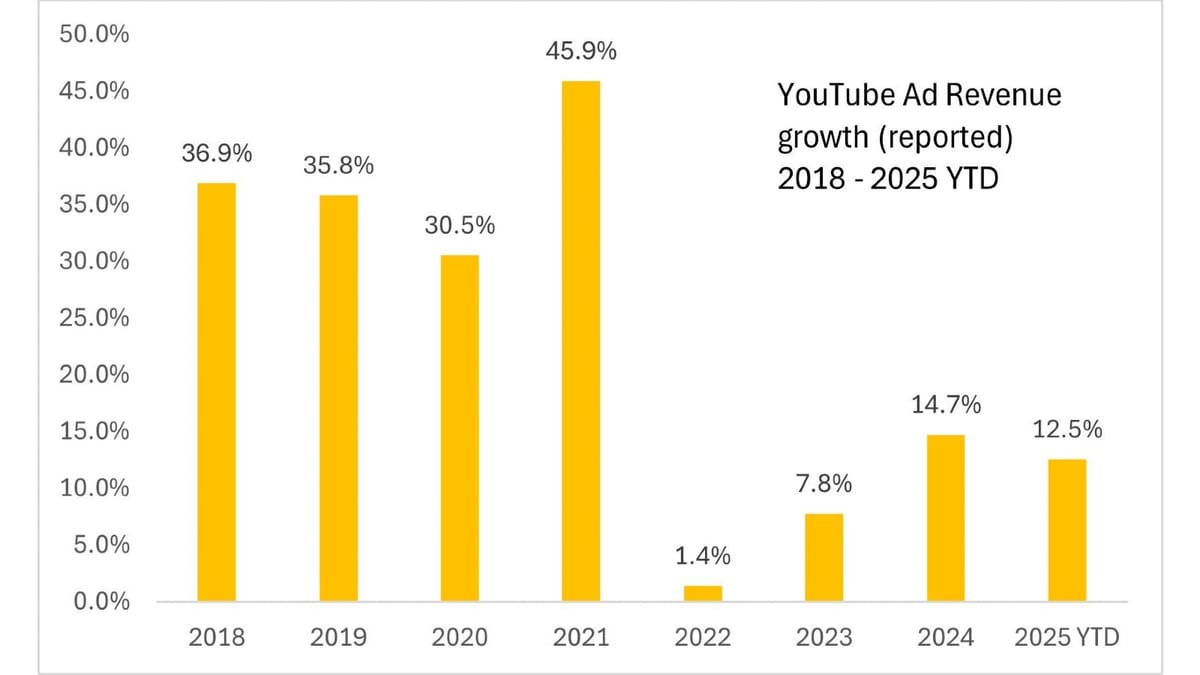
YouTube generates $36.1B annually while global TV advertising reaches $180B, yet TikTok gains momentum as YouTube's growth rate slows to 12.5% after years of decline.


YouTube generates $36.1B annually while global TV advertising reaches $180B, yet TikTok gains momentum as YouTube's growth rate slows to 12.5% after years of decline.
YouTube's advertising business has reached a scale that dwarfs most competitors, generating approximately $36.1 billion in 2024, yet this represents less than 25% of the global television advertising market estimated at roughly $180 billion, according to analysis shared by media analyst Ian Whittaker on January 6, 2026. The fundamental tension driving YouTube's positioning as "television" stems from a simple imperative: accessing the massive pool of traditional TV advertising dollars as the platform's growth rate continues its multi-year deceleration.
Whittaker, who has twice received City AM's Analyst of the Year recognition, presented three charts on LinkedIn demonstrating YouTube's strategic challenge. The first chart shows YouTube's advertising revenue growth rate declined from 45.9% in 2021 to just 12.5% year-to-date in 2025. This trajectory marks a dramatic slowdown from the pandemic-era surge, when the platform achieved its highest recorded expansion rate. Growth rates of 36.9% in 2018, 35.8% in 2019, and 30.5% in 2020 characterized YouTube's earlier momentum before the steep decline to 1.4% in 2022, followed by modest recovery to 7.8% in 2023 and 14.7% in 2024.
"Can we settle this once and for all, and just agree that the 'YouTube is TV' debate is really about YouTube wanting to take a share of the TV advertising pie?" Whittaker wrote in the January 6 post. The analysis argues that YouTube's positioning as television serves a specific commercial purpose rather than representing genuine industry consensus about platform definitions.
YouTube advertising revenues grew from $31.5 billion in 2023 to $36.1 billion in 2024, maintaining double-digit percentage increases despite the platform's maturation. However, the growth rate now approaches that of Google Search, suggesting YouTube has entered a slower expansion phase characteristic of established advertising businesses. The second chart Whittaker presented illustrated YouTube's advertising revenue scale against estimated global TV advertising market size, with YouTube capturing approximately $36.1 billion compared to roughly $180 billion for traditional television in 2024.
This comparison reveals the core economic rationale behind YouTube's television positioning. "YouTube's ultimate aim is not to maximise audience share or improve the happiness of content creators. These are merely means to an end," according to Whittaker's analysis. "The end is to convince advertisers and agencies that YouTube should be considered as part of TV budgets. Advertising budgets are still very much siloed by platform and YouTube wants desperately to be considered part of that TV pot."
TikTok's emergence as a competitive threat compounds YouTube's growth challenges. The third chart Whittaker shared projected that TikTok's advertising revenues excluding China could surpass YouTube by 2025, with TikTok reaching an estimated $57.7 billion compared to YouTube's projected $40.7 billion. In 2023, YouTube generated $31.5 billion against TikTok's estimated $24.1 billion. By 2024, YouTube reached $36.1 billion while TikTok climbed to approximately $39 billion, according to reporting from Bloomberg and The Wall Street Journal that Whittaker cited as "the gold standard along with the likes of the Financial Times" for business coverage.
"This is not to criticise YouTube - it is a fantastic business. Nor is it to criticise its business rationale for wanting TV advertising money - its priority is its own growth. However, let's focus on the true driver of this debate," Whittaker stated. The analyst emphasized that agency holding companies lack uniform standards for classifying YouTube within media budgets, with different groups treating the platform inconsistently across television versus digital video categories.
The debate over YouTube's television status extends beyond semantic arguments to substantive questions about measurement, inventory quality, and advertiser expectations. Several industry professionals responded to Whittaker's analysis by highlighting content quality variations across YouTube's massive inventory. One commenter referenced New York Times reporting with TVision data about how much YouTube watch time consists of music videos, children's programming, and ambient content rather than premium entertainment that advertisers associate with television environments.
YouTube Shorts achieved revenue parity with traditional long-form video on a per-watch-hour basis in the United States during the third quarter of 2025, demonstrating monetization efficiency across format types. The platform's advertising revenues increased 15% year-over-year to $10.3 billion in Q3 2025, driven primarily by direct response advertising followed by brand campaigns, according to Philipp Schindler, Senior Vice President and Chief Business Officer at Google.
Industry professionals debating Whittaker's post noted that viewing behavior increasingly resembles television consumption patterns, particularly among younger audiences. "When younger viewers watch YouTube on their TV, consume it as entertainment, information or whatever and it competes for the same eyeballs and attention as the channels on the same device, the categorisation becomes less clear cut," one respondent wrote. Nielsen data indicates YouTube maintained its position as the number one streaming platform in terms of watch time on TV screens in the United Statesfor 17 consecutive months as of mid-2024.
The technical infrastructure supporting YouTube's television ambitions continues expanding. Interactive advertising formats on living room screens have reached an annual revenue run rate exceeding $1 billion globally, according to statements from Google's Chief Business Officer during earnings discussions. This milestone demonstrates advertiser adoption of direct response formats within connected television environments, though the success occurs entirely within Google's ecosystem.
Buy ads on PPC Land. PPC Land has standard and native ad formats via major DSPs and ad platforms like Google Ads. Via an auction CPM, you can reach industry professionals.
Revenue distribution across YouTube's business model includes both advertising and subscription services. The platform crossed 300 million paid subscriptions across Google One, YouTube Premium, and YouTube Music during the third quarter of 2025, according to earnings data. YouTube TV has accumulated more than 8 million subscribers, while YouTube Music and Premium services surpassed 100 million subscribers including trials by early 2025.
Creator monetization extends beyond traditional advertising revenue sharing. More than 50% of channels earning five figures or more in U.S. dollars on YouTube generated revenue from sources beyond advertising and Premium subscriptions in 2024, with the platform observing a 40% increase in channel memberships over the previous year. This diversification reflects YouTube's evolution from simple video-sharing platform into comprehensive business ecosystem for content creators.
Connected television advertising investment continues accelerating, with IAB forecasts suggesting CTV advertising spending will total $26.6 billion in 2025, representing 12% increase from 2024. Industry research indicates that 72% of marketers plan to increase programmatic advertising investment, with CTV budget share projected to double from 14% in 2023 to 28% in 2025.
Platform competition in the streaming advertising market extends beyond YouTube and TikTok. Meta's internal documents projected 10% of 2024 revenue from fraudulent advertising, according to Reuters findings reviewed in November 2025, while Microsoft search advertising revenue climbed 21% year-over-year as Copilot AI integration enhanced user engagement. These developments illustrate how major technology platforms compete for advertising dollars across multiple formats and environments.
The debate about YouTube's television status matters because it influences how agencies and brands structure media plans and allocate budgets across platforms. Traditional television planning processes differ substantially from digital video buying workflows, with different measurement standards, creative requirements, and expectations around brand safety and content adjacency. YouTube's push to be classified as television rather than digital video could shift billions of dollars in advertising allocation if agencies adopt uniform classification standards.
YouTube's advertising revenues reached $9.8 billion in Q2 2025, representing 13% year-over-year growth that contrasts with Google Network advertising decline. The YouTube performance illustrated Google's strategic preference for owned inventory where the company controls both content and advertising experience. Connected TV advertising within YouTube showed particularly strong momentum, with YouTube ads viewed on CTV screens driving over one billion conversions in the 12 months preceding the July 2025 earnings call.
The retail vertical continues leading YouTube's advertising growth, with Demand Gen campaigns helping monetize shopping-related categories. Performance improvements spanning both traditional video and Shorts inventory contributed to accelerated revenue growth throughout 2025. However, the platform faces persistent challenges around content moderation and brand safety. YouTube CEO Neal Mohan defended the platform's expanding use of artificial intelligence in content moderation in December 2025, calling the technology essential for enforcement while creators reported daily instances of wrongful channel terminations by automated systems.
Content quality standards remain central to YouTube's television positioning because advertisers expect premium environments when allocating television budgets. The platform clarified its inauthentic content policy in July 2025, targeting mass-produced or repetitive content that lacks originality or viewer value. This policy enforcement operates at the channel level, meaning violations can result in complete monetization removal rather than individual video restrictions.
Measurement capabilities supporting YouTube's television claims continue evolving. The platform integrates artificial intelligence capabilities through Gemini models to drive both viewership and monetization efficiency. Recommendation systems produce watch time growth across key monetization areas including Shorts and living room viewing, according to statements from Google executives during earnings discussions. These technical improvements enable YouTube to demonstrate television-comparable performance metrics to advertisers evaluating platform effectiveness.
The analysis Whittaker presented received 90 reactions and 31 comments within the first day after posting on January 6. Industry professionals debated whether the categorization debate matters more to platforms seeking revenue versus advertisers seeking effective media allocation. Several respondents argued that focusing on audience behavior and advertising effectiveness provides more useful framework than categorical definitions of what constitutes television versus digital video.
"This is really what is at the heart of the debate," Whittaker concluded in his analysis. The commercial imperative driving YouTube's television positioning remains straightforward: accessing the massive television advertising budget pool that dwarfs even YouTube's substantial current advertising revenues. Whether agencies and advertisers accept YouTube's television framing will determine how successfully the platform captures share from traditional television budgets in coming years.
Subscribe PPC Land newsletter ✉️ for similar stories like this one
Subscribe PPC Land newsletter ✉️ for similar stories like this one
Who: Ian Whittaker, twice-awarded City AM Analyst of the Year, published the analysis on January 6, 2026, examining YouTube's strategic positioning versus TikTok competition. YouTube generated approximately $36.1 billion in advertising revenue during 2024, while TikTok reached an estimated $39 billion excluding China. Industry professionals including Philipp Schindler, Senior Vice President and Chief Business Officer at Google, and Neal Mohan, YouTube CEO, provided context through earnings statements and public commentary.
What: YouTube's advertising revenue growth rate declined from 45.9% in 2021 to 12.5% year-to-date in 2025, creating strategic imperative to capture share from the global television advertising market estimated at $180 billion. TikTok's advertising revenue trajectory shows the platform potentially surpassing YouTube by 2025, with projections reaching $57.7 billion compared to YouTube's estimated $40.7 billion. The debate centers on whether YouTube qualifies as television for budget allocation purposes, with agency holding companies maintaining inconsistent classification standards across different organizational structures.
When: Whittaker shared the analysis on January 6, 2026, presenting historical YouTube growth data from 2018 through 2025 year-to-date. YouTube advertising revenues grew from $31.5 billion in 2023 to $36.1 billion in 2024, while TikTok expanded from estimated $24.1 billion to approximately $39 billion during the same period. The third quarter of 2025 saw YouTube advertising revenues reach $10.3 billion with 15% year-over-year growth, while Shorts achieved revenue parity with traditional video on a per-watch-hour basis in the United States.
Where: The analysis focused on global advertising markets, with YouTube capturing less than 25% of the estimated $180 billion television advertising market in 2024. Nielsen data shows YouTube maintained the number one streaming platform position for watch time on TV screens in the United States for 17 consecutive months through mid-2024. Agency holding companies operating across global markets lack uniform standards for classifying YouTube within television versus digital video budget categories, with different groups treating the platform inconsistently.
Why: YouTube's growth rate deceleration from 45.9% in 2021 to 12.5% year-to-date in 2025 creates commercial pressure to access traditional television advertising budgets that dwarf the platform's current revenues. TikTok's competitive threat compounds this challenge, with projections showing the ByteDance-owned platform potentially surpassing YouTube in advertising revenue by 2025. The platform's positioning as television rather than digital video could influence how agencies and brands structure media plans and allocate billions of dollars in advertising spending across platforms. Connected television advertising investment continues accelerating, with 72% of marketers planning to increase programmatic advertising investment and CTV budget share projected to double from 14% in 2023 to 28% in 2025.