YouTube's Effect Maker is now open to all - and it builds AI videos from a prompt
YouTube Effect Maker expands to all eligible creators with new GenAI tools, AI Video generation, and brand collaboration features for YouTube Shorts effects.


YouTube Effect Maker expands to all eligible creators with new GenAI tools, AI Video generation, and brand collaboration features for YouTube Shorts effects.
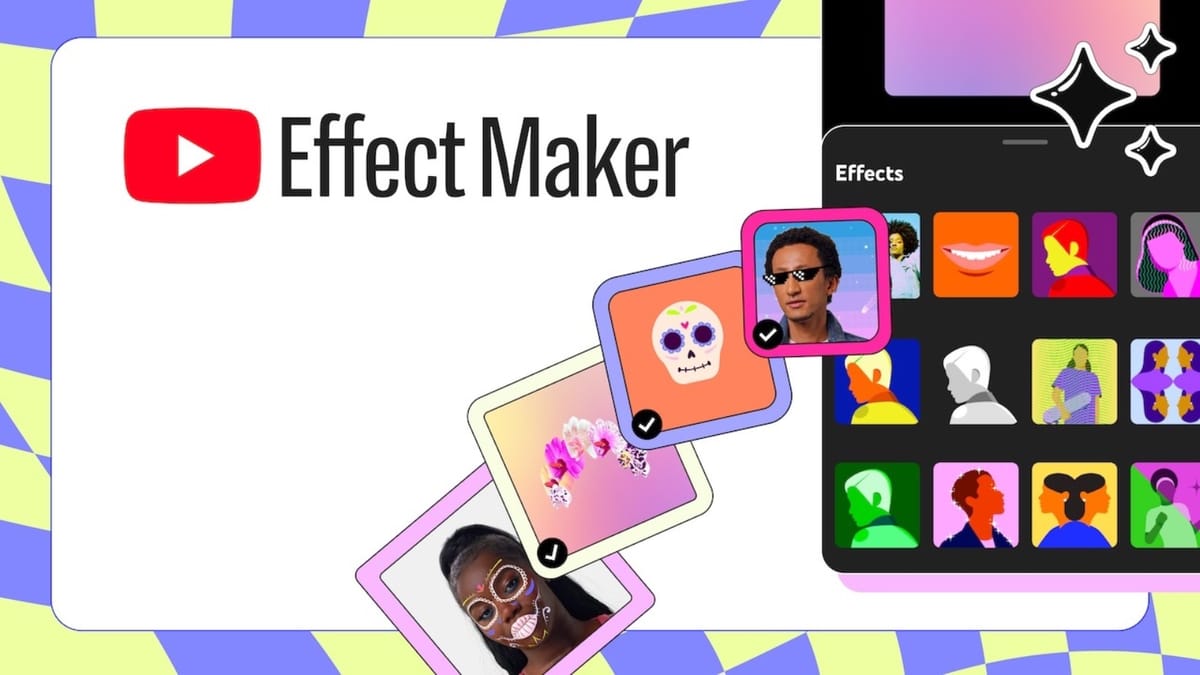
YouTube this month opened Effect Maker to all creators who meet its advanced features eligibility requirements, pairing the broader access with a set of new generative AI capabilities that allow effects to be built from text prompts rather than manual visual scripting. The announcement, posted to the YouTube Creators community channel, confirmed that the expansion applies across all of the platform's available regions - a list that spans more than 85 countries.
The move is significant not just in terms of reach. What YouTube today added alongside the access expansion reshapes how creators can approach effect production for YouTube Shorts, lowering the technical bar for tools that previously demanded familiarity with node-based scripting environments.
Effect Maker is a web-based platform, accessible at effects.youtube.com, that allows eligible creators to design, build, and publish custom visual effects directly to YouTube Shorts. According to YouTube's Help Center documentation, once an effect clears the platform's review process, "eligible creators can then use your effects when recording Shorts."
The tool runs exclusively on desktop computers. A YouTube account is required, and creators must have cleared YouTube's advanced features eligibility threshold. Mobile access is not supported, a constraint that several creators noted in response to the announcement.
The creation environment is structured around a multi-panel editor. The Objects & Assets panel manages the elements that make up an effect - images, color filters known as LUTs, and 3D models in the glb format. Separate panels handle face effects, camera and segmentation options, text entry, and a visual scripting system built around nodes and variables. The node-based scripting layer is where more complex, interactive effects - including games and gesture-triggered animations - are constructed.
Effects can incorporate a range of visual components. According to the Help Center, these include particles such as sparkles, confetti, or smoke; face paint for makeup and tattoos positioned using a face reference illustration tool; face accessories drawn from uploaded images or 3D models; and body segmentation, which isolates the subject from the background to apply effects selectively. A camera snapshot node allows users to trigger a photo capture within the effect itself.
The visual scripting system includes eight trigger node types - Start, Frame Update, Record, Tap, Drag, Head Gesture, Object Tap, and On Reset - alongside logic nodes, control flow structures, math operations, and time utility functions. That last category includes nodes for image sequence playback, list manipulation, vector operations, and AI image and video generation. The scripting layer, in other words, is not superficial. Creating more sophisticated effects requires understanding how these nodes interact.
Three new features accompany today's access expansion, and the most substantive of them is AI Video.
According to the YouTube Creators announcement, AI Video allows builders to "create effects that animate an image into an AI video using just text." No complex visual scripting is required. A creator supplies a text prompt, and the system generates animated output that can be incorporated into an effect. This is distinct from the existing AI Image feature, which transforms a static input image into a new AI-generated image based on a text description - AI Video takes that a step further by producing motion.
The AI Video node also appears within the visual scripting system's Time Utility category, meaning it can be triggered conditionally within a more complex interactive effect rather than simply running as a standalone transformation.
This development sits within a broader trajectory of AI video tooling on the Shorts platform. YouTube introduced Photo to Video powered by Veo 2 in July 2025, allowing creators to convert static photographs into 6-second dynamic clips. The Shorts Remix toolset gained an AI-powered Extend feature in September 2025, enabling AI-generated continuations of existing Shorts. More recently, YouTube added Ingredients to Video using Veo 3.1 in January 2026, letting creators combine up to three uploaded images into a single cohesive vertical video clip.
The Effect Maker's AI Video feature plugs into this infrastructure, but with a distinct purpose: it generates video within the context of an effect that other creators will then apply to their own Shorts recordings. The output is not a finished video; it is a component of a reusable creative tool.
The third announced capability is a structural one. Creators who hold Editor permissions for a brand's channel can now publish effects directly on that brand's behalf. According to the announcement, "if you have Editor permissions for a brand's channel, you can now publish effects directly on their behalf."
The Help Center elaborates on the mechanics: once a creator accepts access to another channel, they can switch their active channel within Effect Maker to view delegated roles, effect projects, and analytics for that channel. One constraint applies - creators with delegated access cannot delete effect projects for a channel they do not own.
This connects Effect Maker to a broader push by YouTube to formalize creator-brand workflows. YouTube Creator Partnerships recently consolidated BrandConnect and the Creator Partnerships Hub into a unified platform available in seven markets, streamlining how brands and creators collaborate around content and sponsorship. The new Effect Maker permission layer extends that logic into the effects ecosystem, allowing brands to commission or co-produce Shorts effects without requiring separate account infrastructure.
YouTube's Creator Essentials package, announced in May 2025, had already signaled the platform's intent to build tighter tooling around creator discovery and brand partnership management. The Effect Maker brand collaboration feature is a logical downstream extension of that direction.
Effect Maker operates under specific technical ceilings that affect what creators can build. According to the Help Center, the package size is limited to 5MB, and memory usage is capped at 50MB. These limits are in place, according to YouTube, to ensure effects function properly across as many devices as possible. Creators can check current file size and memory usage by clicking the Effect Limit icon at the top of the editor; the information updates each time the icon is clicked.
The top panel of the editor also provides project management controls: a rename field for the project title, undo and redo icons, and an automatic save function. Projects save continuously without requiring manual intervention. A submit button initiates the review process once a creator is satisfied with the effect.
Each submitted effect requires a name, a thumbnail, and compliance with YouTube's content guidelines. The review process evaluates all three elements before an effect goes live on the platform.
Analytics for published effects refresh every 24 hours and reflect the creator's local time zone. Two metrics are tracked: Views, defined as the number of times videos using an effect were viewed on YouTube, and Videos, the number of distinct videos on the platform that have used a given effect.
Text entry within effects currently supports only English letters and spaces, alongside special characters including punctuation, math symbols, currency characters, and accents. This constraint limits certain categories of text-based effects for non-English-speaking creators.
The 3D layer supports glb file format models and a Light node that can add realistic highlights, shadows, and focus effects to three-dimensional objects. The Dimension Toggle control allows switching the layout between 2D and 3D working environments.
Access to Effect Maker today covers a list of more than 85 countries and territories, including the United States, India, Japan, Brazil, Australia, South Korea, Indonesia, Mexico, Saudi Arabia, the United Arab Emirates, South Africa, Nigeria, Pakistan, and Vietnam, among many others. European markets including Switzerland are included; the announcement does not address the treatment of European Union regulatory considerations specifically, though the EU AI Act's ongoing implementation remains a consideration for AI-generated content features more broadly.
YouTube's August 2025 creator tools update had already expanded Effect Maker to a broader group of creators, describing it at the time as a tool slowly rolling out following months of limited testing. Today's announcement frames the expansion as reaching "all creators with access to advanced features" in available regions, suggesting the prior staged rollout has concluded.
The Shorts format has become an increasingly contested space. YouTube Shorts leads short-form video consumption at 56% among U.S. consumers surveyed by Media.net in November 2025, ahead of TikTok and Facebook at 50% each. Custom effects are one of the more visible differentiators in short-form content; TikTok's effect ecosystem has long been a driver of viral formats, and Instagram Reels similarly benefits from creator-built filters and visual treatments.
YouTube has been building towards this position for some time. The Shorts format itself was extended from 60 seconds to 3 minutes in October 2024, expanding the canvas for effects to operate on. YouTube changed how Shorts views are counted from March 31, 2025, moving to a method that registers a view the moment a video begins playing, which affects how creators measure the reach of effects-enhanced content.
The AI Video feature within Effect Maker is particularly relevant for advertisers and brand marketing teams. Effects that incorporate AI-generated video segments - and that are subsequently used by millions of Shorts creators - function as a form of scalable branded visual experience, provided the brand has engaged a creator with Effect Maker access to build them. The new Editor permission system makes that workflow more practical than it would have been previously.
YouTube's mandatory AI content disclosure policy, effective May 21, 2025, requires creators who use generative AI to label content that depicts significantly altered or synthetic scenarios. Effects built using AI Video in Effect Maker would fall within the scope of that framework. However, YouTube's platform-native AI tools typically handle disclosure labeling automatically - as is the case with Dream Track and Dream Screen - which reduces the compliance burden on individual creators.
The question of AI content quality also remains live. Research published by Kapwing in late 2024 found that 21% of videos shown to new YouTube Shorts users were AI-generated content of low quality, while 33% qualified as brainrot content. Expanding AI generation capabilities within Effect Maker does not directly address that broader ecosystem problem, though the review process for effects before publication provides at least one filtering layer that does not exist for standard Shorts uploads.
The announcement received over 2,600 likes and 282 comments on the YouTube Creators channel within two days of posting. Community responses were mixed. Some creators raised questions about the algorithm's content discovery patterns, others requested mobile access for the YouTube Create app, and several commented on the volume of AI-generated content appearing on the platform. The YouTube Creators account pinned a follow-up comment soliciting feature suggestions from the community.
YouTube also promoted two supporting resources alongside the announcement: a tutorial playlist on the YouTube Creators channel at goo.gle/4daajOj, and an Effect Maker Discord community at discord.gg/nkfwn3Hfhe for direct communication with the YouTube Effects team.
Who: YouTube, acting through its YouTube Creators channel, addressed the announcement to all creators with access to advanced features on the platform. Effect creators, brand marketing teams with YouTube channel Editor permissions, and Shorts viewers who encounter the resulting effects are all directly affected.
What: YouTube opened Effect Maker - its web-based desktop tool for building and publishing custom visual effects for YouTube Shorts - to all eligible creators in its available regions. Simultaneously, the platform launched three new capabilities: AI Video (which generates animated video output from a text prompt for use in effects), an expanded version of AI Image, and a brand collaboration permission that allows creators with Editor access to a brand's channel to publish effects on that brand's behalf.
When: The announcement was posted to the YouTube Creators community channel on March 28, 2026, two days before the current date of March 30, 2026.
Where: Effect Maker operates through a dedicated web platform at effects.youtube.com and is accessible on desktop computers only. The expansion covers more than 85 countries and territories listed in YouTube's available regions documentation.
Why: YouTube is expanding its short-form video creation ecosystem to compete more directly with TikTok and Instagram Reels in the area of creator-built visual effects. By lowering the technical requirements for effect creation through GenAI tools - particularly AI Video - the platform aims to grow the supply of effects available to Shorts creators. The brand collaboration feature addresses a practical gap in creator-brand workflows, enabling brands to have effects built and published on their behalf without requiring separate account infrastructure.