Adthena's 29M-query report reveals what's actually working in AI search ads
Adthena analyzed 29.1 million queries across 10+ industries to map how ads perform in Google AI Overviews and ChatGPT - here are the numbers.


Adthena analyzed 29.1 million queries across 10+ industries to map how ads perform in Google AI Overviews and ChatGPT - here are the numbers.
Adthena this week published a detailed intelligence report on AI search advertising, drawing on more than 29.1 million queries analyzed across 10 or more industries. The report, titled "AI Search Ads: The Advertiser Intelligence Report," covers auction-level data from Google's AI Overview placements and ChatGPT's nascent ad environment, spanning three markets - the US, EMEA, and APAC - and 25,000 monitored search engine results pages. It is among the most data-dense assessments of AI search ad performance published so far in 2026.
The timing matters. Competition inside AI-generated search results is no longer theoretical. It is happening at scale, measured in millions of auction entries, and the data Adthena has assembled is detailed enough to reframe several assumptions that have taken hold in the marketing industry.
According to the report, year-over-year growth in AI ad auction competition stands at 35%. The finance sector leads at a 9.9% surge in AI Overview visibility, with healthcare close behind at 8.3%. Quarter-over-quarter, the number of advertisers entering AI Overview auctions is growing at approximately 15%. These are not projections. They are drawn from Adthena's whole-market data collected between November 2025 and March 2026.
The publication of this report follows Adthena's earlier milestone: the company was the first platform to detect ads appearing inside Google AI Overview search results in November 2025, when it documented just 13 instances across 25,000 monitored SERPs at a frequency of 0.052%. That number has since grown substantially. The April 2026 report documents 0.12% of tracked queries triggering AI ad placement in the US and 0.05% in Australia.
One of the most counterintuitive findings in the report concerns query length. Conventional wisdom in the industry held that longer, more conversational queries - the kind AI systems are supposedly built for - would dominate AI ad auctions. The data contradicts this. According to the report, over 60% of all AI Overview ad appearances are concentrated on three- to four-word searches. The "conversational era," as Adthena puts it, has not yet reached the ad auction.
The raw figures make this concrete. Adthena's search term datasets from March 2026, covering the US, Australia, and APAC, show 16,381 total ad appearances for three-word queries and 12,404 for four-word queries. Drop to two words and the figure falls to 7,367. At seven words, it collapses to 1,047. By nine or ten words, it is in double digits.
This does not mean longer queries are worthless. Quite the opposite. Ad visibility scales dramatically with query length in specific verticals when measured differently. For retail advertisers, AI ad visibility reaches 84% on queries of nine or more words. For financial services, it reaches 79% at comparable lengths. Travel sees 87.5% on nine-word queries. These figures represent the share of searches in those categories where AI Overview ads appear - a different metric from total ad volume, but one that signals where serious competitive positioning is still possible.
The sector-level breakdown is granular. In automotive, ad placement above AI Overviews jumps from 21.9% on single-word queries to 74.3% on four-word searches, and climbs again to 79% at seven words. In gaming, single-word queries generate zero AI ad visibility - a complete blackout - while six- and seven-word queries reach 100%. Healthcare presents a different pattern: as queries exceed ten words, AI ad visibility above the overview drops to 0%, as Google prioritizes purely informational results for complex medical questions.
Navigational intent represents a particular dead zone. According to the report, brand-name queries rarely trigger AI ad carousels. Advertisers whose strategies rest heavily on branded terms may find themselves invisible in AI-generated results. Separately, seasonal and event-driven searches - "Black Friday deals" being the example cited - also under-index for AI placements, with evergreen, utility-focused queries dominating instead.
The report dedicates significant attention to call-to-action language as a performance variable. The finding is specific and measurable: using the word "Compare" in a CTA generates a 35% uplift in click-through rates compared to "Shop Now." A CTA reading "Get a Quote" produces a 22% uplift. The generic "Find a Store" language, by contrast, reduces performance by 20 to 40% relative to baseline in AI placement contexts.
According to the report, intent-aligned CTAs also correlate with higher carousel position. Securing rank one or two in an AI Overview carousel produces 91% more site visits than lower positions in the US market. The implication is structural: CTA language functions not just as messaging but as a factor in determining where an ad lands within the AI-generated result, and the difference between position one and position three carries a large traffic consequence.
These patterns bear directly on what Ashley Fletcher, Adthena's Chief Marketing Officer, published on LinkedIn in early April 2026 as a companion analysis of ChatGPT ad copy specifically. According to Fletcher's analysis, based on Adthena's index of 40,000 or more daily ChatGPT ad placements, the overwhelming majority of ads follow a "Brand: Benefit" formula in headlines - the brand name leading, followed immediately by a specific value proposition separated by a colon. Average headline length runs to 30 characters, with a ceiling around 36. Body copy averages 19 words, structured as two tight sentences: one proof point and one offer or nudge.
The analysis also found that high-performing ChatGPT ads anchor value with specific dollar figures rather than vague superlatives, that numerical claims dominate body copy, and that exclamation marks and question marks are nearly absent. Ads mirror ChatGPT's own calm, informational tone. Fletcher compared the current state of ChatGPT ad copy to the early days of Google AdWords, more than 15 years ago - a moment of rough formats, limited sophistication, and significant upside for anyone who pays close attention to what actually works.
The report names the top domains by vertical in AI Overview ad appearances, based on total ad impressions across the US, Australia, and APAC. In retail and shopping, zappos.com leads with 519 appearances, followed by bissell.com at 349, amazon.ca at 308, webstaurantstore.com at 306, and kogan.com at 263. In financial services, gusto.com tops the list at 445, with rippling.com at 247, surepayroll.com at 168, lightspeedhq.com at 158, and fingercheck.com at 129. For travel and automotive, carmax.com comes first at 208, followed by reliancehomecomfort.com at 149 and caranddriver.com at 146. In tech and electronics, avaya.com leads at 328, with aircall.io at 242 and selecthub.com at 215.
Retail advertisers command the highest overall AI Overview presence at 84%, and their ads appear above the overview in more than 75% of instances - the strongest defensive position of any vertical. Finance, at 79% presence, is the fastest-growing challenger. Travel sits at just 32% presence but is seeing rapid movement on informational intent queries, where AI is beginning to replace traditional comparison sites.
Across all industries, the US accounts for 94.8% of all AI ad placements tracked by Adthena. Australia represents 4.4%. Asia accounts for just 0.8%, led by retail and e-commerce. Within the US, the Home and Services sector generates the highest total volume - 10,750 ad appearances - driven by high-value research queries around water filtration and HVAC. Education follows at 8,652, reflecting natural synergy between the category and AI Overviews' tendency to summarize information.
The commercial effects are not frictionless. In saturated retail categories, paid search click-through rates have dropped by 8 to 12 percentage points as users find answers within AI summaries - a 20 to 40% relative decline. Across challenger industries, ad visibility is lost 25% of the time when an AI Overview triggers, which the report characterizes as forcing a structural shift from keyword bidding toward entity optimization.
The report's fifth chapter covers ads in ChatGPT with data drawn from Adthena's analysis of more than 300,000 daily prompts as of late March 2026. The timeline is precise. On January 16, 2026, OpenAI announced it would begin testing ads in ChatGPT's free and Go tiers, giving advertisers less than four weeks' notice. Ads went live on February 9, 2026, for free and Go tier US users only. Plus, Pro, Business, Enterprise, and Education tiers remained ad-free. Adthena documented the first confirmed placements on launch day, having analyzed more than 1,500 prompts across categories and brands. By late February, major brands were confirmed active: Best Buy, Target, AT&T, Expedia, and more than ten others.
As of late March 2026, confirmed advertisers span four broad categories. Retail and e-commerce includes Best Buy, Target, Etsy, The Home Depot, Albertsons, Williams-Sonoma, and Pottery Barn. Travel and automotive includes TripAdvisor, Mazda, Royal Caribbean, Turo, Ford, AutoTrader, and Car and Driver. Tech and telecoms includes AT&T, Qualcomm, Adobe, Xfinity, SAP, Canva, and HP. Food and lifestyle includes HelloFresh, Ticketmaster, DoorDash, and Audible. Shopify has integrated its Shop Campaigns network into the ChatGPT ad inventory, opening access to thousands of merchants simultaneously.
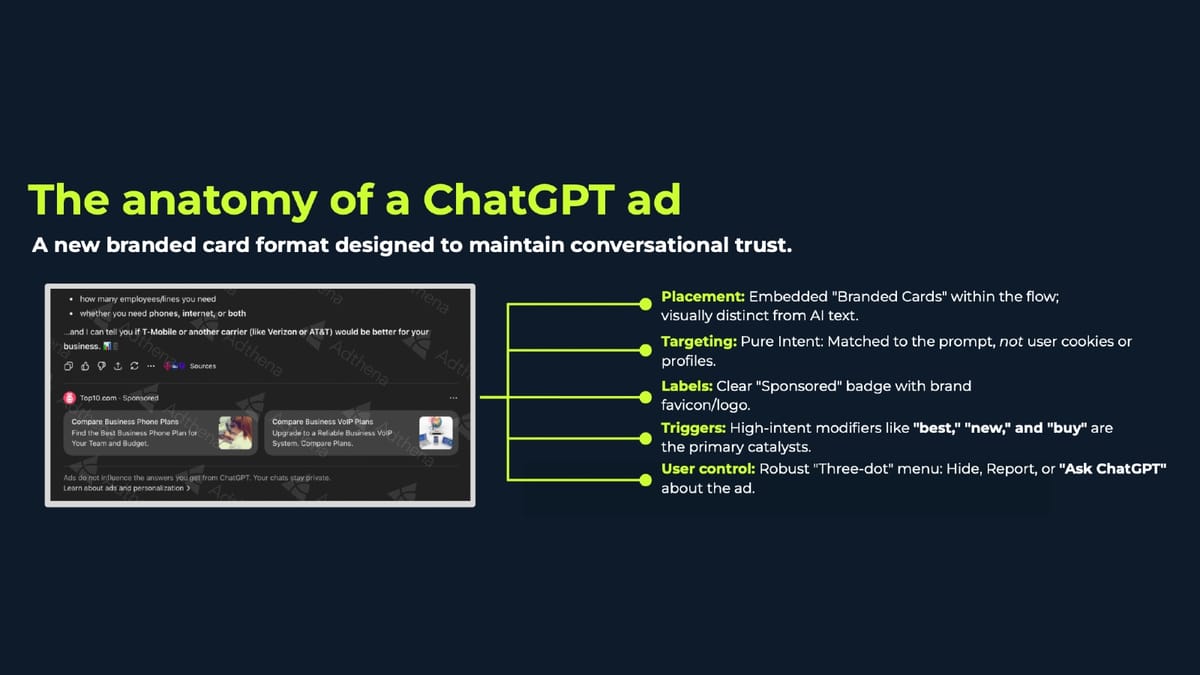
According to the report, the CPM for ChatGPT ads is approximately $60 - roughly three times Meta's average rates, and comparable to NFL broadcast inventory. The minimum spend threshold during the beta phase is $200,000. The format consists of embedded branded cards within the conversational response, clearly labeled "Sponsored," and matched to the prompt rather than user cookies or behavioral profiles. OpenAI maintains that ads do not influence the chatbot's organic answers.
Criteo became the first ad tech partner in the ChatGPT pilot in March 2026, connecting approximately 17,000 advertisers to the platform. Internal data from 500 Criteo retailers observed in February 2026 showed that users referred from LLM platforms convert at approximately 1.5 times the rate of other referral channels. By late March 2026, OpenAI disclosed that the ChatGPT ad pilot had surpassed $100 million in annualized revenue within six weeks.
The report draws a direct structural comparison between the two major AI ad environments. Google AI Overview ads use a product carousel format with images, price, and rating, matched via product feeds and AI-driven keywords, priced on a CPC basis through existing Search and Performance Max campaigns, available to all users. ChatGPT ads use a text and conversational format, matched contextually with no behavioral tracking, priced at $60 CPM with a $200,000 minimum commitment, and available only to free and Go tier US users. The two platforms target fundamentally different user states: active searchers on one side, and conversational researchers on the other.
According to the report, as of March 2026, ChatGPT advertising is live only in the US and Australia. However, the Go tier has launched in 171 countries, which the report treats as a signal for advertisers in the UK, DACH region, and APAC to prepare sooner rather than later.
The report's final chapter presents a case study from Cox Communications, documenting what it calls the "AIO squeeze" on the 'Cox Internet Plans' search term. AI Overview frequency on that query ranged from 84 to 94%. The result was a 97% increase in cost-per-click - from $2.45 to $4.82 - combined with a 34% drop in click-through rate from 68% down to 45%, and approximately $400,000 in additional spend generating diminishing returns.
The core problem, as the report frames it, was that Cox held 95% above-AIO position, and so did competitors at 91%. Both sides were bidding to stay visible above the AI-generated answer block, paying inflated prices to reach users who were reading the AI summary and not clicking through. The report describes this as paying a "vanity tax."
The response operated on two levels. First, Cox moved the keyword to a Portfolio Target CPA strategy with a hard CPC cap set at $3.75 - above the 2023 baseline of $2.45 but below the inflated average of $4.82. The cap was introduced gradually over four weeks: $4.20, then $4.00, then $3.80, then $3.75. This approach exits hyper-competitive auctions with bids of $5 to $8 or more, while still winning approximately 80% of efficient auctions. Second, the headline strategy shifted from an informational message - "Fast Home Internet Plans" - to a transactional one: "Skip the Research: Order Your Plan Here," targeting users who had scrolled past the AI Overview and demonstrated purchase intent.
The outcome: $117,000 in annualized spend reclaimed, a CPC stabilized in the $3.50 to $3.75 range, and a conversion volume variance of less than 10%.
The report sits at the intersection of several developments that have reshaped paid search over the past eighteen months. Google first introduced ads in AI Overviews for mobile US users in October 2024, and expanded to 11 additional countries in December 2025. Meanwhile, OpenAI's entry into advertising has introduced a structurally different inventory type - intent-matched, privacy-first, conversational - that does not fit into existing measurement frameworks. Reports emerged as early as late 2025 that Google had briefed advertisers on Gemini ad plans for 2026, signaling that AI ad surfaces will continue expanding across platforms.
For paid search professionals, this report addresses several practical gaps simultaneously. The 60%-plus concentration of AI Overview ad appearances on three- to four-word queries challenges the assumption that AI search is primarily a long-tail phenomenon. The 35% CTA uplift for "Compare" versus "Shop Now" provides a concrete creative variable to test without requiring new campaign infrastructure. The 9.9% year-over-year growth in finance sector AI auction competition signals which verticals are accelerating fastest and where competitive entry costs are rising. And the Cox Communications case study provides a documented, stepwise methodology for managing the bid inflation that AI Overviews can produce on high-frequency queries.
The scale of the data - 29.1 million queries, 10 industries, three markets, 25,000 SERPs - means the findings are not drawn from a narrow sample or a single vertical. They represent a broad cross-section of how AI ad auctions are actually operating in early 2026, before the majority of advertisers have fully adjusted their strategies to account for them.
Who: Adthena, an AI-powered search intelligence platform recognized as Google's first Trusted Trademark Partner, published the "AI Search Ads: The Advertiser Intelligence Report." Ashley Fletcher, Adthena's Chief Marketing Officer, published a companion LinkedIn analysis of ChatGPT ad copy patterns based on 40,000+ daily ad placements.
What: The report documents auction-level performance data for ads in Google AI Overviews and ChatGPT. Key findings include a 35% year-over-year growth in AI ad auction competition, a 9.9% surge in finance sector AI Overview visibility, more than 60% of AI Overview ad appearances concentrated on three- to four-word queries, a 35% CTA click uplift for "Compare" versus "Shop Now," a ChatGPT CPM of $60 with a $200,000 minimum commitment, and a Cox Communications case study recovering $117,000 in wasted auction spend.
When: The report was published in April 2026, based on data collected from November 2025 through March 2026. The announcement was dated April 2, 2026.
Where: Data covers three markets - the US, EMEA, and APAC - with 25,000 monitored SERPs. The US accounts for 94.8% of all tracked AI ad placements. ChatGPT advertising is currently live in the US and Australia only, though the Go tier has launched in 171 countries.
Why: AI-generated search results now sit between advertisers and users on a growing share of commercial queries. Understanding which query types trigger AI ads, which CTA language performs, how verticals differ, and what ChatGPT's ad environment costs has direct consequences for campaign budget allocation, creative strategy, and bidding decisions. The data provides a documented baseline for those decisions at a moment when both Google and OpenAI are actively expanding AI ad surfaces.