AI author warns "Gartner is dying" as research firm's stock crashes 31%
Prominent AI book author Andriy Burkov declared Gartner's business model fundamentally broken following the research firm's February 3 earnings that sent shares plunging 31 percent.
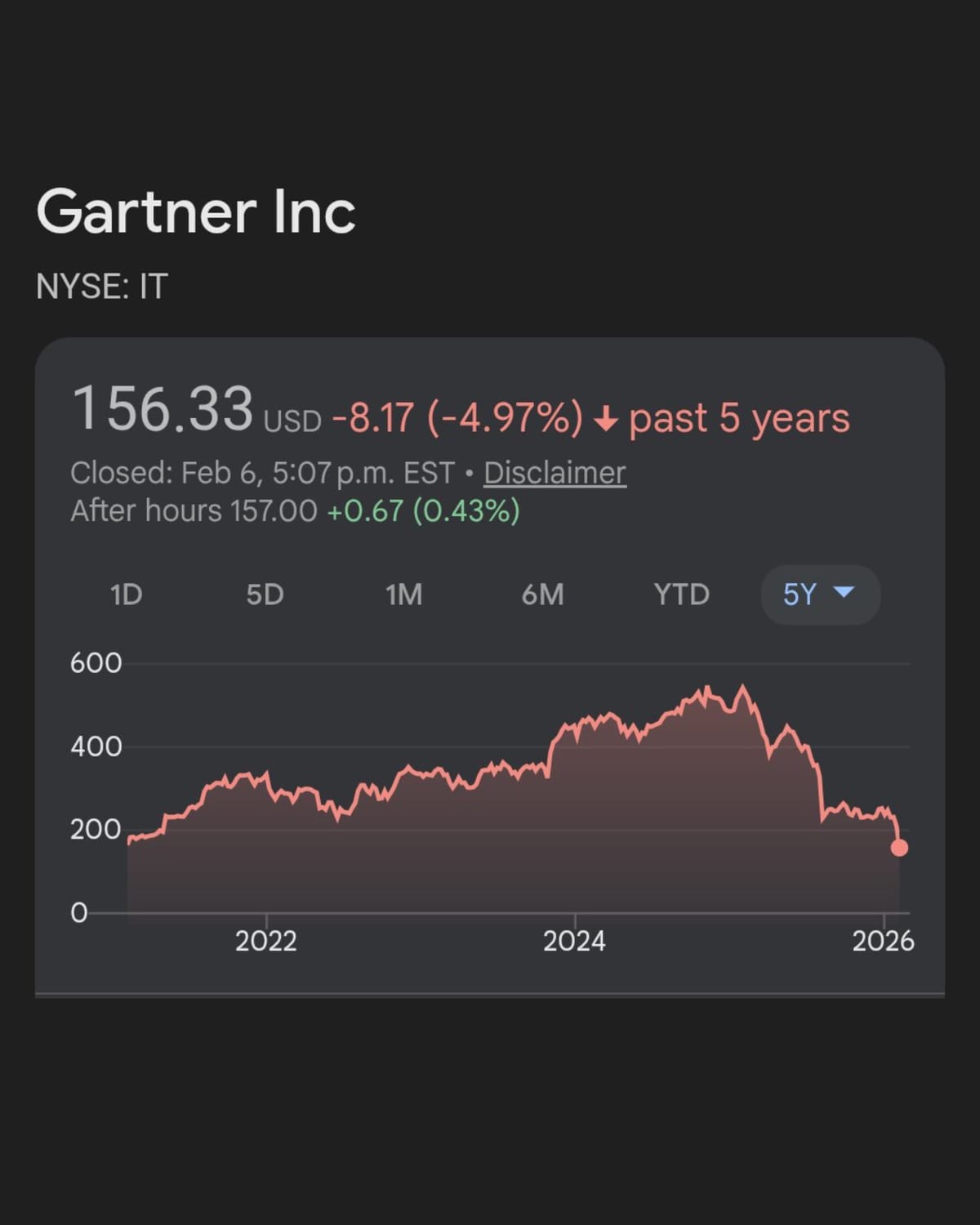
Gartner stock chart showing 5-year decline from $600 to $156, down 4.97% with sharp 2025-2026 drop.
Gartner's stock collapsed 31 percent on February 3, 2026, following fourth-quarter earnings that beat analyst expectations yet revealed deepening challenges for the technology research and advisory firm. Prominent artificial intelligence author Andriy Burkov amplified concerns about the company's viability through social media commentary questioning whether traditional market intelligence firms can survive in an AI-dominated landscape.
"Gartner is dying," Burkov wrote on X (formerly Twitter) on February 8, 2026. "Its business model of being paid by its clients for the information these same clients gave them isn't working anymore because it turns out this information was online all that time."
Gartner is dying. Its business model of being paid by its clients for the information these same clients gave them isn't working anymore because it turns out this information was online all that time. pic.twitter.com/C3yW5bj2ry
The assessment from Burkov - author of widely-read technical books including "The Hundred-Page Machine Learning Book" and "The Hundred-Page Language Models Book" - arrives as Gartner grapples with slowing growth across core business segments. His critique centers on a fundamental vulnerability: the company's practice of collecting information from corporate clients, synthesizing that data into research reports, and selling the aggregated insights back to those same companies.
Earnings beat masks deteriorating fundamentals
Gartner reported fourth-quarter revenue of $1.75 billion on February 3, 2026, representing 2.2 percent year-over-year growth that slightly exceeded the $1.75 billion analyst consensus, according to Investing.com. Adjusted earnings per share reached $3.94, surpassing the Street expectation of $3.51 by $0.43.
Despite beating Wall Street estimates, the stock plunged from approximately $205 to $141 during the trading session - a 31 percent single-day collapse. Pre-market trading showed an even steeper 22.43 percent decline to $157.01, reflecting immediate investor concerns about future growth prospects.
The dramatic sell-off stemmed from management's 2026 guidance, which projected revenue of at least $6.455 billion. This figure represents 0.6 percent contraction from full-year 2025 results of $6.5 billion. Adjusted earnings guidance of $12.30 per share for 2026 marked 6.6 percent decline from the $13.17 per share Gartner collected in 2025, according to The Motley Fool.
Analyst consensus had called for 2026 earnings of approximately $13.48 per share on revenues near $6.7 billion before the guidance revision. The substantial gap between management projections and analyst expectations triggered the morning sell-off.
Net income deteriorated more significantly than adjusted metrics suggest. Fourth-quarter net income reached $242 million, down 39 percent year-over-year. Full-year 2025 net income totaled $729 million, representing 42 percent decline from 2024 results, according to company filings reviewed by Morningstar.
Gartner's Consulting segment experienced particularly acute challenges during the fourth quarter. Revenue declined 12.8 percent year-over-year to $134 million, compared with $153 million in the prior-year period, according to CFO Craig Safian during the earnings call. Contribution margin dropped to 27.1 percent from healthier levels maintained previously.
The Consulting segment weakness stands in stark contrast to performance across other business units. The Conferences segment emerged as the standout performer with 13.9 percent year-over-year growth, generating $286 million in revenue with 51.3 percent contribution margin. Full-year conferences revenue grew 11 percent to $645 million, with FX-neutral growth at 9 percent.
The Insights segment - representing Gartner's core research business - delivered modest 2.9 percent growth, reaching $1.3 billion with robust 77.1 percent contribution margin. However, even this historically stable segment showed signs of strain.
Global Contract Value, a critical indicator of future revenue potential, grew just 0.8 percent to $5.2 billion. Management noted that CV growth excluding U.S. Federal government contracts reached 4 percent, suggesting stronger performance in commercial markets. Nevertheless, the anemic overall growth rate signals fundamental demand challenges.
"These external market forces led to increased scrutiny, elevated deal approval authority, and extended buying cycles," CEO Gene Hall stated during the earnings call, according to The Motley Fool transcript. "Over the past few years, including 2025, the rate of change and volatility in the external environment has increased significantly. Executives have responded to this by slowing and deferring everything possible. This makes for a much tougher selling environment."
CFO Safian acknowledged specific weakness in new business bookings: "GTS new business of more than $300 million was down about 5 percent the US federal government," revealing softening demand for the company's core research services.
Burkov's critique highlights AI displacement risk
Andriy Burkov's public assessment reflects broader industry concerns about artificial intelligence disrupting traditional information services. His commentary resonated across technology circles, accumulating 20,700 views and generating substantial discussion on X.
Burkov's critique addresses a fundamental tension in Gartner's business model. The company collects information from enterprise clients about their technology strategies, implementations, and challenges. Gartner analysts synthesize this collective intelligence into research reports, advisory services, and benchmarking data. Clients then pay subscription fees to access these insights - essentially purchasing aggregated versions of information they and their peers originally provided.
"They are a club with paid membership," Burkov explained in follow-up commentary. "You become a member, pay them millions for telling them how you do business, and they tell you how other members do theirs."
The critique gained additional weight from Burkov's professional background. He previously worked at a company acquired by Gartner, providing insider perspective on the firm's operations. "Not by choice," Burkov stated when asked about his Gartner experience. "They bought us and then sold."
Another user questioned whether ChatGPT usage threatens Gartner's relevance. Burkov responded bluntly: "Even the dumbest CEO asks ChatGPT what to do every 10 minutes."
The exchange captures a critical shift occurring across enterprise decision-making. Large language models now provide instant access to synthesized information from vast data sources. Chief executives and technology leaders can query AI systems for strategic guidance, competitive intelligence, and implementation best practices - capabilities that overlap substantially with services Gartner traditionally provided.
Market intelligence firms face existential challenges as AI systems democratize access to synthesized information. Research released throughout 2025 documented how generative AI platforms increasingly shape brand perception, with Gartner's own forecasts predicting 30 percent of brand perception would be AI-shaped by 2026.
The transformation extends beyond simple information access. Agentic AI systems implementing autonomous decision-making threaten to automate the strategic planning and advisory functions that constitute Gartner's highest-margin services. Ironically, Gartner's own research published June 25, 2025, predicted over 40 percent of agentic AI projects would be canceled by 2027 due to escalating costs and unclear business value - a forecast that now raises questions about whether traditional advisory firms can survive the very disruption they analyze.
Gartner's February 3 collapse represents acceleration of longer-term decline. The stock fell 47.9 percent during calendar year 2025, according to S&P Global Market Intelligence data analyzed by The Motley Fool. Shares traded near $518.40 at their 52-week high before plunging to the current $127.40 level - a 75 percent decline from peak valuations.
The extended drawdown reflects multiple compounding factors. Government spending cuts announced during 2025 led to declining renewals for Gartner's federal government services. More fundamentally, AI adoption within corporate IT departments reduced demand for traditional research and advisory services.
"The use of AI for advisory and consultancy services has led to slowing growth for Gartner's corporate consultancy business," according to Motley Fool analysis published January 15, 2026. "IT departments are being told by executives to lower spending in order to make room for AI projects, while also utilizing AI research tools instead of actual humans."
The company repurchased $2 billion worth of shares during 2025, reducing outstanding share count by 8 percent. Despite this substantial capital return, the stock continued declining as fundamental business challenges overwhelmed financial engineering.
Gartner's forward price-to-earnings ratio compressed to 17 following the February decline - well below the S&P 500 market average. The valuation compression reflects investor skepticism about whether the company can return to sustained growth as AI platforms commoditize information synthesis.
Management emphasizes transformation efforts
Company leadership attempted to frame challenges as transitional rather than existential during the earnings call. CEO Hall emphasized expanding opportunities: "The world is changing more than ever before. This represents a huge opportunity for us."
CFO Safian projected accelerating contract value growth: "We expect contract value and the contract value growth rate to accelerate over the course of 2026."
Management highlighted ongoing transformation initiatives across Business and Technology Insights operations. The company implemented AI-driven tools and process improvements, achieving 75 percent reduction in certain research production times while expanding Magic Quadrant output coverage.
Gartner processed over 500,000 AskGartner questions during 2025 - an AI-powered query system enabling clients to access research through natural language interactions. The company produced more than 6,000 AI-related documents covering 1,000+ unique use cases, conducting 200,000+ in-depth client conversations about artificial intelligence implementation.
These metrics demonstrate Gartner's attempts to incorporate AI into service delivery. However, they also illustrate the challenge: as clients gain direct access to AI-synthesized information, the value proposition for intermediary research firms diminishes.
Gartner announced a definitive agreement to divest its Digital Markets business during the earnings call. The divestiture allows management to focus resources on core research and advisory operations while updating historical financials to reflect the streamlined structure.
The company added two new board directors and rotated committee chairs, implementing what Hall described as "The changes we made in the second half of last year were more changed than we've ever done at Gartner."
Management guided 2026 EBITDA margins to 23.5 percent or higher - below the 24.8 percent achieved during 2025. The margin compression reflects "selected investments" in transformation initiatives rather than operational improvement.
Marketing technology implications
The challenges facing Gartner carry particular significance for marketing technology professionals who rely on research firms for vendor evaluations, implementation guidance, and strategic planning. Traditional "Magic Quadrant" assessments have long influenced enterprise software purchasing decisions.
Marketing automation platforms rapidly integrate agentic capabilities through interconnected AI systems performing complex tasks. These implementations eliminate traditional research-supported decision-making when autonomous agents compile information and execute strategies without human website visits or advisory consultations.
The transformation threatens established patterns across enterprise technology adoption. Research examining AI productivity claims revealed evaluation gaps that undermine growth projections - challenges that equally affect both AI vendors and the research firms analyzing them.
Industry dynamics suggest deeper structural shifts. Boston Consulting Group research published January 21, 2026, revealed 67 percent of senior marketing leaders expect high levels of AI-driven disruption to consumer behavior. This consensus extends to business-to-business contexts where Gartner traditionally operated.
Market intelligence firms occupying similar positions face comparable pressures. Forrester Research stock declined 84.12 percent over five years, trading at €5.75 as of February 6, 2026, according to market data. The parallel decline suggests industry-wide challenges rather than company-specific execution problems.
Community reactions highlight divided perspectives
Social media responses to Burkov's assessment revealed sharp divisions within technology communities. Some commenters questioned whether Gartner genuinely faced existential threats or merely cyclical challenges.
"I tend to agree with you but a lot of decision makers I work alongside still value the perceived prestige of Gartner," wrote one user. "A lot of people do not trust insights spat out by LLM's."
This perspective highlights important nuances. Enterprise decision-makers often require vendor validation beyond algorithmic recommendations. Gartner's brand carries weight in procurement processes, risk management frameworks, and due diligence procedures that extend beyond pure information content.
Other commenters emphasized that financial reports contradicted the "dying" characterization. "Are you sure? Financial reports doesn't show that Gartner is dying," one user noted, pointing to the company's continued profitability despite growth challenges.
The observation reflects legitimate questions about timelines. Companies can maintain profitability for extended periods while facing structural decline. Gartner generated $729 million in net income during 2025 despite deteriorating growth metrics - hardly the immediate collapse suggested by "dying" rhetoric.
More critical voices portrayed Gartner's model as fundamentally compromised. "One of the biggest shit companies to have ever existed. Good riddance," wrote one commenter, capturing harsh sentiment among critics.
Multiple respondents questioned the continuing relevance of advisory services in an AI-enabled environment. "Who is still using advisory services for market insights anyway?" one user asked, articulating the core challenge Gartner confronts.
Another commenter noted: "After a point, mostly their magic quadrants will be their legacy, in business school courses" - suggesting Gartner's methodologies might become historical artifacts rather than active decision-making tools.
Technical critiques focused on positioning within the Magic Quadrant framework. "True. Your position on the 'magic quadrant' was 100% correlated to how much money you spend on Gartner 'consulting,'" one commenter claimed, echoing longstanding concerns about whether vendor payments influence research independence.
Historical context and future outlook
Gartner established its market position during an era when aggregating distributed enterprise knowledge required substantial human capital and relationship networks. Corporate technology leaders lacked efficient mechanisms to share implementation experiences, benchmark performance, or evaluate vendor claims. Research firms filled this gap by systematically collecting, analyzing, and synthesizing practitioner intelligence.
The internet democratized information access but maintained human intermediation. Gartner analysts curated insights, identified patterns, and provided expert interpretation that busy executives valued despite broader information availability.
Generative AI platforms compress this value chain. Large language models trained on vast corpora already contain much of the collective wisdom Gartner traditionally aggregated. Conversational interfaces enable instant queries without subscription fees, lengthy reports, or scheduled advisory calls.
The transformation doesn't eliminate all value from human analysis. Complex strategic decisions, vendor negotiations, and implementation planning still benefit from experienced guidance. However, the addressable market shrinks as routine intelligence gathering moves to AI platforms.
Gartner's response strategy emphasizes accelerating content production, expanding format diversity, and improving user experience. The 75 percent reduction in research production times demonstrates efficiency gains. Yet faster content creation doesn't address the fundamental question: why pay for aggregated intelligence when AI systems provide comparable synthesis instantly?
The company's fate may ultimately depend on whether enterprise buyers continue valuing branded research validation or fully embrace AI-generated alternatives. Current financial performance suggests the transition is already well underway, with 2026 guidance implying continued deterioration before any potential stabilization.
Investor sentiment reflected in the 31 percent single-day decline indicates market participants believe structural challenges outweigh management's transformation narrative. Whether Burkov's "dying" characterization proves prescient or premature will become clear as 2026 results materialize and AI platform capabilities continue advancing.
February 3, 2026: Gartner reports Q4 2025 earnings showing 2.2% revenue growth, 42% net income decline, consulting revenue drop of 12.8%
February 3, 2026: Gartner stock collapses 31% in single trading session following disappointing 2026 guidance
February 8, 2026: Andriy Burkov posts X commentary declaring "Gartner is dying" due to fundamental business model challenges
Summary
Who: Gartner Inc., a technology research and advisory firm, reported fourth-quarter 2025 earnings on February 3, 2026. Andriy Burkov, author of prominent AI technical books including "The Hundred-Page Language Models Book," published critical commentary on X (formerly Twitter) on February 8, 2026. CEO Gene Hall and CFO Craig Safian led the earnings call discussion.
What: Gartner's stock plunged 31 percent on February 3, 2026, following earnings that beat analyst expectations but revealed deteriorating fundamentals. Fourth-quarter revenue reached $1.75 billion (up 2.2% year-over-year) with adjusted EPS of $3.94 (down 27.8%), while net income declined 42 percent year-over-year to $729 million for full-year 2025. Management's 2026 guidance projected revenue decline of 0.6 percent and earnings decline of 6.6 percent. Burkov declared Gartner's business model "dying" because "information was online all that time," questioning whether clients still need to pay for aggregated intelligence they originally provided.
When: Gartner reported earnings before market open on February 3, 2026, triggering immediate 22.43 percent pre-market decline followed by 31 percent single-session collapse. Burkov published his X commentary on February 8, 2026, at 2:35 AM, accumulating 20,700 views. The stock has declined 75 percent from its $518.40 52-week high reached in early 2025.
Where: Gartner, headquartered in Stamford, Connecticut, operates globally providing research and advisory services to enterprise clients. The company's consulting segment weakness appeared most acute in U.S. federal government contracts, which declined approximately 5 percent. Forrester Research, a comparable market intelligence firm, experienced similar 84.12 percent stock decline over five years, trading at €5.75 as of February 6, 2026.
Why: The collapse reflects multiple converging factors. Artificial intelligence platforms now provide instant access to synthesized information that previously required expensive research subscriptions. Enterprise clients increasingly query large language models for strategic guidance rather than purchasing traditional advisory services. Extended buying cycles, elevated deal approval authority, and client spending scrutiny reduced demand for Gartner's core offerings. The consulting segment's 12.8 percent revenue decline signals particular vulnerability to AI displacement, as autonomous systems automate advisory functions. Management's disappointing 2026 guidance confirmed these challenges represent structural deterioration rather than temporary cyclical weakness, triggering investor reassessment of the company's long-term viability in an AI-dominated landscape.
Share this article
The link has been copied!
Your link has expired. Please request a new one.
Your link has expired. Please request a new one.
Your link has expired. Please request a new one.
Great! You've successfully signed up.
Great! You've successfully signed up.
Welcome back! You've successfully signed in.
Success! You now have access to additional content.