Amazon forces resellers to abandon manufacturer barcodes in March
Amazon will require resellers to apply Amazon-specific labels on all FBA inventory starting March 31, 2026, ending manufacturer barcode eligibility


Amazon will require resellers to apply Amazon-specific labels on all FBA inventory starting March 31, 2026, ending manufacturer barcode eligibility
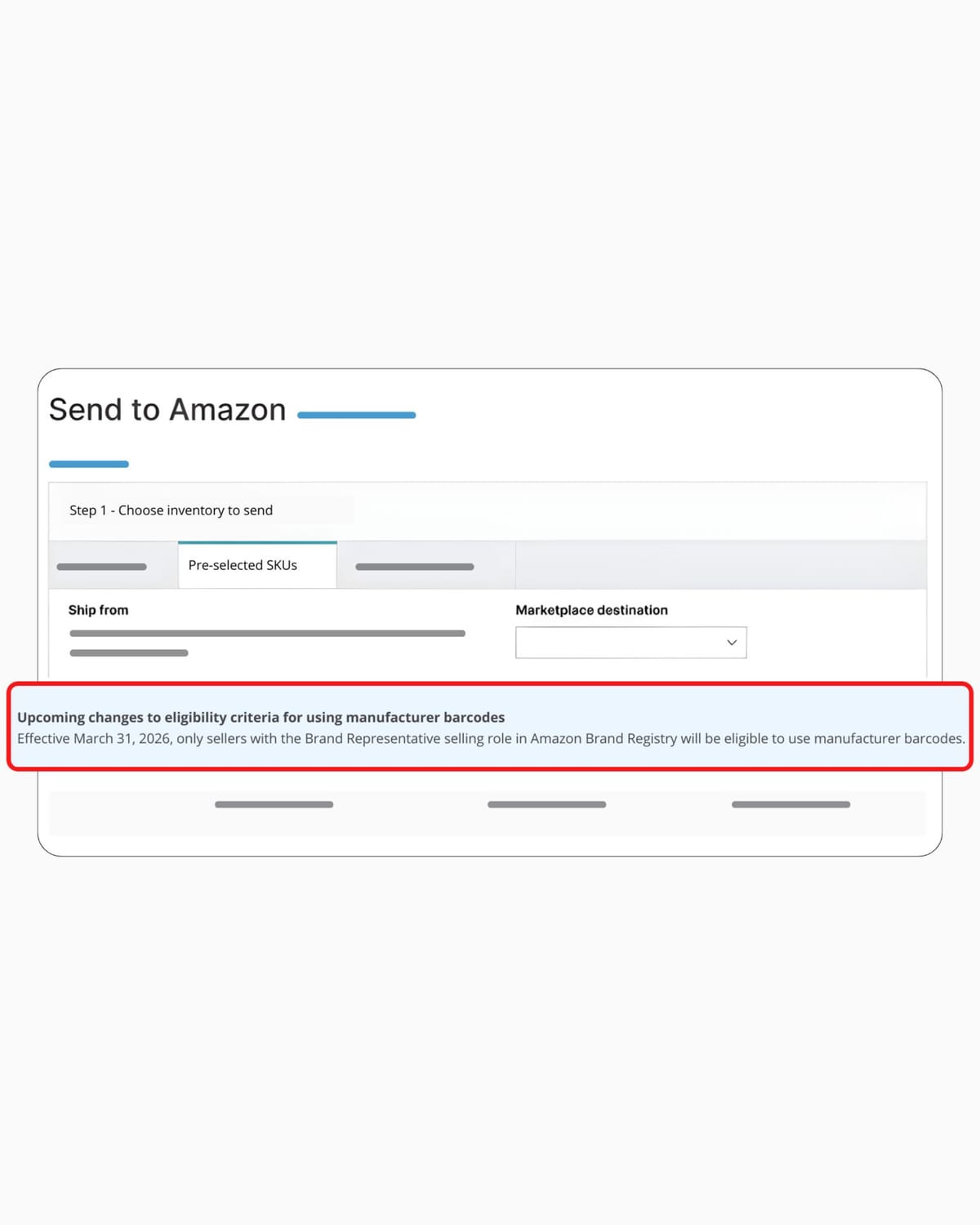
Amazon this year announced a fundamental change to barcode requirements for third-party sellers using Fulfillment by Amazon services. Starting March 31, 2026, only sellers with the Brand Representative selling role in Amazon Brand Registry will maintain eligibility to use manufacturer barcodes like ISBN, UPC, EAN, or JAN on products sent to fulfillment centers.
The policy separates brand owners from resellers in barcode application procedures. According to documentation posted on Amazon Seller Central, resellers must now apply Amazon barcodes, formally called FNSKUs (Fulfillment Network Stock Keeping Units), to products even when those items already carry manufacturer barcodes. Brand owners can continue using existing manufacturer barcodes without additional sticker application, provided they maintain Brand Representative status in Amazon Brand Registry.
Every item sent to an Amazon fulfillment center requires a barcode for tracking purposes. Products not eligible for manufacturer barcode usage must display Amazon barcodes instead. The March 2026 implementation represents a structural shift in how Amazon distinguishes between authorized brand representatives and independent marketplace resellers across its fulfillment network.
The policy modification affects the operational workflows of resellers who previously relied on existing manufacturer barcodes to streamline their inventory preparation processes. These sellers must now integrate barcode printing and label application into their FBA shipment procedures, adding steps to operations that handled manufacturer-labeled products without additional preparation requirements.
Amazon's barcode label requirements establish specific formatting parameters. Printed labels must match the Seller Central generated label format exactly. Sufficient white space of 0.25 inch on sides and 0.125 inch on top and bottom must surround both the Amazon barcode itself and the label content edges. The ASIN or FNSKU identifier must appear on the label alongside the product name and item condition designation.
Label placement standards prohibit covering Food Information Regulation data including legal descriptive names, ingredient lists, quantitative ingredient declarations, net quantity, best before dates, storage conditions, business names and addresses, country of origin, usage instructions, alcoholic strength when exceeding 1.2 percent, nutrition declarations, and allergen information specified in Article 21.
The label cannot be placed on package curves or corners. A 6mm clearance must exist between label edges and packaging edges. Each item in a case pack requires an Amazon barcode, with any case-level barcodes removed. Failure to follow placement requirements causes processing delays and may trigger unplanned prep service fees from Amazon.
Dimension requirements specify labels must measure between 25.4mm x 50.8mm and 50.8mm x 76.2mm, using formats like 25.4mm x 76.2mm or 50.8mm x 50.8mm. All Amazon barcodes require black ink on white, non-reflective labels with removable adhesive. For laser printers, the tools support multiple label sizes per page including 21, 24, 27, 30, 40, and 44 labels depending on sheet dimensions.
Products requiring Amazon barcodes that arrive without proper labels will be marked as defective. Amazon applies barcode stickers to non-compliant products and reports these defects on the Inbound Performance Dashboard in Seller Central with guidance on proper labeling procedures. The company warns that failure to comply with FBA product preparation requirements, safety requirements, and product restrictions may result in inventory refusal at fulfillment centers, disposal or return of inventory, blocking of future shipments, or charges for preparation or noncompliance.
The Brand Representative selling role serves as the distinguishing criterion between sellers who maintain manufacturer barcode eligibility and those who must apply Amazon barcodes. Amazon Brand Registry provides trademark owners with tools to manage product listings, report intellectual property violations, and access enhanced brand content features across the marketplace.
Brand Registry enrollment requires active trademark registration in eligible countries. The system verifies brand ownership through government trademark databases before granting access to Brand Registry benefits including enhanced brand content, A+ content pages, sponsored brand advertisements, and brand analytics. The Brand Representative role within this system designates sellers as authorized representatives of registered trademarks.
Resellers operating without Brand Representative status in Amazon Brand Registry face the barcode application requirement regardless of whether they source products through authorized distribution channels. The policy does not distinguish between unauthorized resellers and merchants with legitimate supplier relationships who lack Brand Registry enrollment. All non-Brand Representative sellers must apply Amazon barcodes to inventory.
The enforcement mechanism relies on seller classification within Amazon's systems rather than product-level determinations. A reseller selling brand-name products from authorized distributors faces identical barcode requirements as a merchant selling those same products through unauthorized channels. The system treats Brand Registry status as the definitive qualifier rather than evaluating distribution authorization on a case-by-case basis.
This structural approach creates operational disparities between brand owners and authorized resellers. While brand owners shipping inventory can utilize existing manufacturer barcodes, authorized resellers for those same brands must apply Amazon-specific labels to identical products. The policy thus increases operational complexity for legitimate resale operations that maintain authorized distribution relationships.
The barcode requirement change creates different operational burdens depending on seller business models. Resellers operating retail arbitrage models who source products from retail stores already apply Amazon labels to avoid commingled inventory issues. For these sellers, the policy change codifies existing practices rather than introducing new requirements.
Wholesale resellers maintaining authorized relationships with brand distributors face more significant operational adjustments. These sellers previously shipped manufacturer-labeled products directly from distributors to Amazon fulfillment centers without additional handling. The new requirement mandates intermediate processing steps where sellers receive distributor shipments, apply Amazon labels, and then forward inventory to fulfillment centers.
Private label sellers who manufacture products under their own brands but lack Brand Registry enrollment encounter identical requirements as unauthorized resellers. These sellers must apply Amazon barcodes despite controlling the manufacturing process and intellectual property rights, unless they complete Brand Registry enrollment and obtain Brand Representative status for their trademarks.
The distinction between brand owners and resellers creates bifurcated operational standards across Amazon's fulfillment network. Two sellers shipping identical products to the same fulfillment center follow different barcode procedures based on Brand Registry status rather than product characteristics. This divergence in preparation requirements reflects Amazon's prioritization of brand ownership verification over standardized processing procedures.
International sellers face compounded challenges when the policy intersects with cross-border fulfillment operations. Sellers utilizing Amazon's European Fulfillment Network or multi-country inventory programs must ensure barcode compliance across different marketplace jurisdictions while managing Brand Registry status that may vary by region.
The barcode requirement change arrives within a sequence of FBA policy modifications implemented throughout 2025 and early 2026. Amazon shifted liability to sellers with new FBA inventory policy that took effect March 31, 2025, fundamentally altering how the company handles damaged inventory within its fulfillment network.
The damaged inventory ownership program allows sellers to opt out of Amazon's damage-fault ownership evaluation process, effectively transferring responsibility for Amazon-fault damaged inventory from the platform to merchants. Sellers can choose to retain ownership of Amazon-fault damaged inventory rather than receive reimbursements and have Amazon dispose of products through various channels.
Amazon forces all sellers to use prepaid returns, ending the high-value exemption on February 8, 2026. The policy requires all US seller-fulfilled orders to use prepaid shipping programs, eliminating previous exemptions for high-value items and creating insurance coverage gaps for premium merchandise.
The company changes how sellers pay for FBA removals with per-unit billing, implementing incremental charging as units process rather than lump-sum billing at order completion. This modification affects cash flow planning for sellers managing removal operations during inventory cleanups, seasonal transitions, or aging inventory management.
These cumulative policy modifications reflect Amazon's systematic recalibration of marketplace risk allocation between platform and sellers. The barcode requirement change extends this pattern by distinguishing between brand owners and resellers in operational procedures, effectively creating different compliance frameworks based on seller classification rather than product characteristics.
The barcode application requirement introduces direct costs for label materials and indirect costs for labor and equipment. Resellers must invest in thermal or laser printers capable of producing compliant labels at 300 dots per inch resolution or greater. The documentation recommends Zebra GX430t model printers with direct thermal settings, matching the equipment used in Amazon fulfillment centers.
Label paper costs accumulate across inventory volumes. All Amazon barcodes require black ink on white, non-reflective labels with removable adhesive in specified dimension ranges. Sellers must maintain label inventory proportional to their FBA shipment volumes, with each label representing a per-unit cost that accumulates across large inventory quantities.
Processing time requirements increase operational overhead. Each product requires barcode printing, precise label application following placement specifications, and verification that all other visible barcodes except serial numbers or Transparency authentication codes are covered. For high-volume resellers processing hundreds or thousands of units per shipment, this labor requirement creates meaningful operational bottlenecks.
The costs compound for sellers operating across multiple product categories with varying inventory turnover rates. Fast-moving products require frequent reordering and relabeling, while slow-moving inventory may require label replacement if adhesive degrades during extended fulfillment center storage. Each label must remain readable and scannable for 24 months according to Amazon's specifications.
Sellers managing operations during the period of mounting financial pressure that affected Amazon's third-party seller community between May and August 2025 face additional challenges absorbing new operational costs. Many sellers experienced sales drops between 60-80% compared to previous years while simultaneously confronting increased platform fees and policy modifications.
The tools in seller accounts are optimized for thermal printers, though laser printers remain acceptable alternatives. Inkjet printers are explicitly prohibited for printing Amazon barcodes. Amazon fulfillment centers currently use Zebra GX430t model printers with direct thermal settings, establishing this specification as the reference standard.
Each label must maintain readability and scannability for 24 months from application. Achieving this durability requires printer maintenance including periodic testing of Amazon barcodes through scanning verification, using printers with print resolution of 300 dots per inch or greater, and periodically testing, cleaning, and replacing printer heads.
For laser printers, the system supports specific label sizes: 21 labels per page at 63.5mm x 38.1mm on A4 paper, 24 labels per page across multiple dimension options on A4 paper, 27 labels per page at 63.5mm x 29.6mm on A4, 30 labels per page at 1 inch x 2 5/8 inches on US letter, 40 labels per page at 52.5mm x 29.7mm on A4, and 44 labels per page at 48.5mm x 25.4mm on A4.
Printer scaling settings must be configured correctly. If printers attempt to scale the PDF print area when printing labels, scaling must be set to None or 100% to ensure dimensional accuracy. Improper scaling causes barcode scanning failures when dimensional distortions prevent fulfillment center equipment from reading codes.
Problem categories documented in shipping queues include barcode missing where items arrive without proper barcodes, unit mislabeled where items arrive with barcodes that do not match physical products, and barcode cannot be scanned where labels are smudged, smeared, placed around corners or curves, or printed on reflective surfaces making codes unscannable.
Unit and shipment preparation errors encompass items arriving with labeling, packaging and prep, or shipping requirement errors. Amazon reports these defects on the Inbound Performance Dashboard in Seller Central along with guidance on proper product labeling procedures. The system tracks defect rates across sellers and may apply performance penalties for recurring non-compliance.
Products requiring Amazon barcodes that arrive without them are marked as defective. Amazon applies barcode stickers to non-compliant products and charges sellers for this preparation service. The unplanned prep service fees add to overall FBA costs and reduce profit margins on affected units. Repeated violations can trigger blocking of future shipments to fulfillment centers.
The consequences extend beyond immediate financial penalties. Inventory delays from non-compliance affect product availability during critical selling periods. Units marked defective and requiring Amazon preparation experience extended processing times before becoming available for customer orders, potentially causing lost sales during high-demand periods or promotional events.
Sellers must balance compliance requirements against operational efficiency pressures. Amazon's critical inventory deadlines for seasonal events demand early inventory positioning, while labeling errors delay processing and jeopardize Prime badge eligibility during peak shopping periods. The interaction between tight deadlines and strict compliance standards creates operational risk.
Correct barcode placement on individual items requires attention to multiple specifications. The barcode must appear on each item rather than only on outer packaging. Case packs require barcodes on individual units with case-level barcodes removed. This unit-level tracking enables Amazon's inventory management systems to monitor products throughout the fulfillment network.
All other visible barcodes must be covered except serial number barcodes and Transparency authentication code labels. This coverage requirement prevents scanning confusion when fulfillment center equipment encounters multiple barcodes on a single product. Manufacturer UPC codes, retailer barcodes, or distributor labels must be obscured to ensure Amazon's systems scan only the designated FNSKU.
Placement must avoid curves and corners where barcode distortion prevents accurate scanning. The 6mm edge clearance prevents label damage during handling and transport. Labels placed too close to package edges risk tearing, peeling, or smearing that renders barcodes unreadable. Any prep materials like bubble wrap or protective coverings must have barcodes placed on their outside surfaces.
Food Information Regulation data cannot be covered by barcode labels. This requirement preserves consumer access to legally mandated product information including ingredients, allergens, nutritional data, and safety warnings. Label placement must accommodate existing regulatory labeling while maintaining scannable barcode positioning on package surfaces.
The placement requirements create challenges for products with complex packaging, small surface areas, or extensive existing labeling. Sellers must identify suitable placement locations that satisfy all requirements simultaneously: adequate flat surface, sufficient edge clearance, no coverage of regulatory information, and accessibility for scanning during fulfillment center processing.
The barcode requirement change reinforces the distinction between brand-building and resale business models on Amazon's platform. Brand owners who invest in trademark registration and Brand Registry enrollment gain operational advantages through simplified fulfillment procedures. Resellers operating without brand ownership face additional operational requirements that increase costs and complexity.
This divergence may accelerate marketplace consolidation toward brand-owned operations. The cumulative impact of policy changes favoring brand owners including enhanced content features, advertising access, and now operational simplifications creates structural advantages that compound over time. Resellers must evaluate whether operational disadvantages justify continuing Amazon-focused strategies.
Alternative marketplace platforms maintain different seller classification systems. eBay, Walmart Marketplace, and direct-to-consumer channels implement distinct approaches to brand verification and barcode requirements. The barcode policy change may influence seller decisions about marketplace diversification and resource allocation across sales channels.
The policy demonstrates Amazon's ongoing evolution toward a brand-centric marketplace model. Platform modifications throughout 2025 including variation review splitting and enforcement mechanisms favor brand-owned operations over independent resellers. The barcode requirement extends this pattern into fundamental fulfillment operations.
Sellers must assess whether their business models align with Amazon's strategic direction. Operations dependent on reselling branded products without Brand Registry status face accumulating operational burdens as Amazon implements policies distinguishing between brand owners and resellers. The March 2026 implementation provides a transition window for strategic evaluation and potential business model adjustments.
Germany's recent prohibition of Amazon's algorithmic price control mechanisms affecting marketplace sellers demonstrates regulatory attention to platform governance of third-party merchants. The barcode requirement operates independently of pricing control issues but reflects Amazon's broader exercise of platform authority over seller operations.
The March 31, 2026 effective date provides sellers with approximately two months from today's announcement to implement necessary operational changes. Resellers must evaluate current inventory management systems, acquire appropriate printing equipment, establish label procurement processes, and train personnel on proper barcode application procedures.
Inventory currently stored in Amazon fulfillment centers faces uncertain treatment under the new policy. The announcement does not specify whether existing manufacturer-labeled inventory from resellers will require relabeling or whether the requirement applies only to new inbound shipments. Sellers managing large FBA inventory quantities need clarification on transition procedures for products already in the fulfillment network.
The timing intersects with Amazon's seasonal inventory cycles. March 31, 2026 falls during the post-holiday period when many sellers conduct inventory planning for second-quarter operations. The implementation date requires operational changes during a period typically focused on recovering from holiday season demands and preparing for spring and summer selling periods.
Sellers utilizing Amazon's Warehousing and Distribution program for bulk storage and automatic FBA replenishment must ensure barcode compliance across their AWD inventory. Products transferred from AWD to FBA fulfillment centers must carry proper barcodes, creating labeling requirements at the initial AWD intake stage for reseller inventory.
International sellers managing multi-marketplace operations face coordination challenges. The announcement addresses policy changes but does not specify whether implementation occurs simultaneously across all Amazon marketplaces or follows regional rollout schedules. Sellers operating across North American, European, and Asian marketplaces require clarity on jurisdiction-specific timelines.
Amazon directs sellers to the FBA barcode choice and labeling FAQ for detailed information about the policy change. This documentation explains the distinction between manufacturer barcode eligibility and Amazon barcode requirements, outlining which seller classifications maintain access to manufacturer barcode usage.
The standard FBA barcode requirements page provides technical specifications for label printing, placement, and compliance verification. This resource details dimension requirements, white space specifications, printer recommendations, and common problems to avoid when preparing inventory for fulfillment center shipments.
Sellers can access barcode printing tools through the Label products page when creating shipments or at any time through Manage Inventory. The system generates barcodes in formats compatible with thermal printers or creates PDFs for laser printer usage with standard label paper. The Send to Amazon workflow includes options to print SKU labels individually or in batch for entire shipments.
The Inbound Performance Dashboard in Seller Central tracks labeling defects and provides guidance on proper product preparation. This monitoring system alerts sellers to recurring compliance issues and provides performance metrics that Amazon may use for account health evaluation and future shipment acceptance decisions.
Additional resources include video tutorials on how to label products for Fulfillment by Amazon, demonstrating proper application techniques and placement procedures. The documentation emphasizes that product manufacturers or intellectual property owners wanting to print barcodes directly onto product packaging must apply for their own GS1 standard UPC barcode rather than using Amazon's FNSKU system.
Who: Amazon announced the policy change affecting all sellers using Fulfillment by Amazon services, specifically impacting resellers without Brand Representative status in Amazon Brand Registry while maintaining manufacturer barcode eligibility for brand owners.
What: A barcode requirement modification mandating that resellers apply Amazon-specific FNSKU labels to all products sent to fulfillment centers, even when those products carry existing manufacturer barcodes like ISBN, UPC, EAN, or JAN. Brand owners with Brand Representative selling roles in Amazon Brand Registry can continue using manufacturer barcodes without additional sticker application.
When: The policy takes effect March 31, 2026, providing sellers with approximately two months from the announcement on February 14, 2026 to implement operational changes including acquiring printing equipment, establishing label procurement processes, and training personnel on proper barcode application procedures.
Where: The requirement applies across Amazon's global fulfillment network affecting sellers shipping inventory to Amazon fulfillment centers. The policy impacts operations in North America, Europe, and all other regions where Amazon operates FBA services, with documentation posted on Amazon Seller Central platforms.
Why: The policy separates brand owners from resellers in barcode application procedures, establishing Brand Registry status as the qualification mechanism for manufacturer barcode eligibility. This change reflects Amazon's strategic direction toward a brand-centric marketplace model while increasing operational complexity and costs for resale-focused business models operating without brand ownership verification.