Apple Business launches April 14 with Maps ads, MDM, and email tools
Description: Apple on March 24 announced Apple Business, a free platform for all company sizes launching April 14 in 200+ countries, with Maps ads and device management.


Description: Apple on March 24 announced Apple Business, a free platform for all company sizes launching April 14 in 200+ countries, with Maps ads and device management.
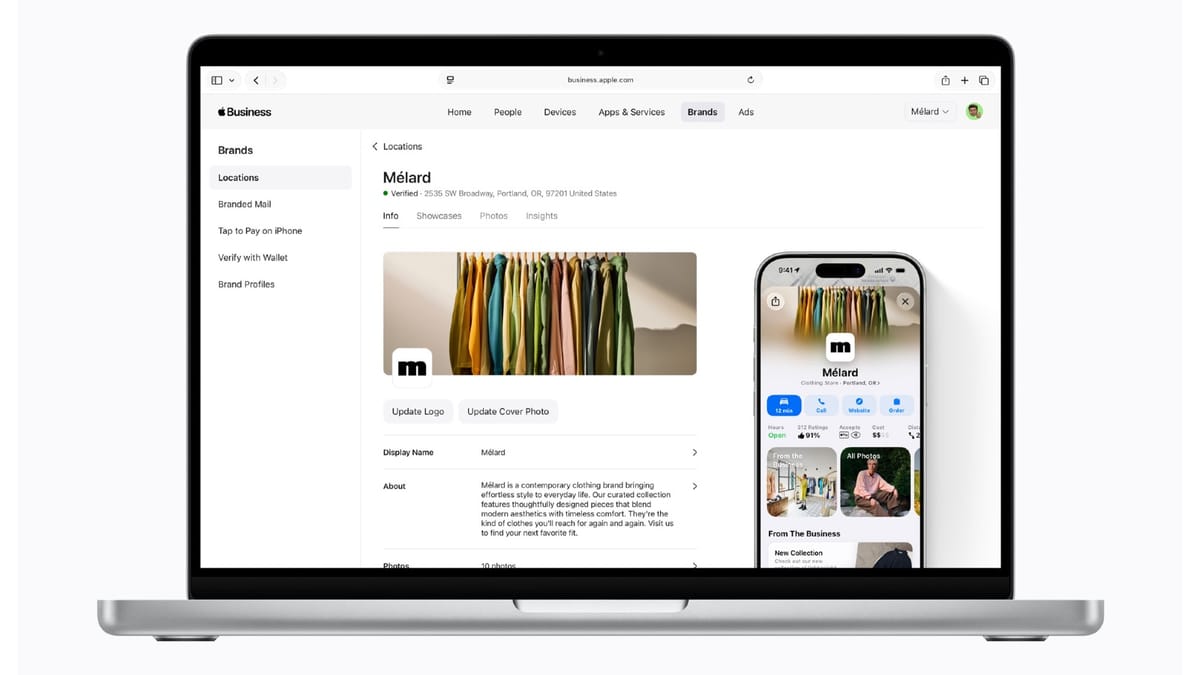
Apple on March 24, 2026 announced Apple Business, a new all-in-one platform that combines mobile device management, business email and calendar services, brand management tools, and a new advertising capability inside Apple Maps. The platform will be available starting April 14 in more than 200 countries and regions, free of charge to new and existing users of Apple Business Connect, Apple Business Essentials, and Apple Business Manager. Ads on Apple Maps will follow later, available to businesses in the United States and Canada starting this summer.
The announcement brings together several previously separate Apple products under a single interface and eliminates the separate subscription fee that Apple Business Essentials customers currently pay for device management. Once Apple Business launches on April 14, Business Essentials customers will no longer be charged their monthly service fee.
Apple Business Connect, Apple Business Essentials, and Apple Business Manager will all be discontinued once Apple Business launches. Existing Business Connect data - including claimed locations, place card information, photos, organisation information, and account details - will automatically migrate to Apple Business at launch. The consolidation signals Apple's intent to establish a single business identity layer that connects advertising, device management, brand presence, and communication tools in one authenticated relationship with the company.
According to Apple's announcement, Susan Prescott, Apple's vice president of Enterprise and Education Marketing, said: "We've unified Apple's strongest business offerings into one simple, secure platform, delivering key features for organizations in every stage and sector, including built-in device management, collaboration tools, and additional ways to reach new customers."
The device management component was previously available only as a paid subscription within Apple Business Essentials, and only in the United States. Apple Business extends that capability globally to more than 200 countries and regions at no additional cost.
The MDM layer offers a comprehensive view of an organisation's Apple devices, settings, and configurations from a single interface. A new feature called Blueprints allows IT administrators to set up devices with preconfigured settings and apps, enabling what Apple describes as zero-touch deployment - meaning new Apple products arrive ready to use without manual configuration by the employee. Zero-touch deployment is available when devices are purchased through Apple or Apple Authorised Resellers.
Additional MDM capabilities within Apple Business include Managed Apple Accounts, which use cryptographic separation to keep company data and personal employee data distinct on the same device. Automated account creation for new employees is supported through integration with identity service providers including Google Workspace and Microsoft Entra ID. Organisations can create user groups by function or team to assign apps and roles, and custom roles can be configured to manage access according to specific organisational requirements. App distribution occurs through the App Store. An Admin API provides programmatic access to device, user, audit, and MDM service data for large deployments.
A companion Apple Business app - requiring iOS 26, iPadOS 26, or macOS 26 - allows employees to install work apps, view colleague contact information, and request support while away from a desktop.
Apple Business introduces integrated email, calendar, and directory services with custom domain support. Businesses can bring an existing domain name or purchase a new one through Apple Business. The calendar component includes delegation features, and a built-in company directory makes it possible for employees to locate colleagues through user groups and personalised contact cards.
These productivity features also require iOS 26, iPadOS 26, or macOS 26. The integration of email and calendar under the same platform as device management and advertising is unusual among business platforms; most vendors separate these layers across different products and pricing tiers.
Brand management tools previously available through Apple Business Connect migrate into Apple Business and gain new capabilities. The location and brand management suite includes several distinct components.
Brand profiles allow businesses to manage a brand name, logo, and key details consistently across Apple Maps, Wallet, and other features. Rich place cards can be customised with photos, detailed location information, hours, and other details that display across Apple Maps, Safari, Spotlight, and other surfaces. Showcases and custom actions let businesses highlight deals, special offers, new products, or seasonal items on place cards in Maps, and add custom actions such as "order" or "reserve" that direct customers to a preferred website or app.
Location insights provide data on how customers discover and interact with a business on Maps, covering search, views, and taps on actions. Branded communications allow branding to appear in the Mail app and iCloud Mail, as well as with tracked orders in Wallet. Tap to Pay on iPhone support displays a brand logo and name on the payment screen when accepting payments directly on iPhone.
The advertising component of Apple Business is the element most relevant to performance marketing professionals. Beginning this summer in the US and Canada, businesses will be able to create ads on Maps through Apple Business. According to Apple's announcement, "Ads on Maps will appear when users search in Maps, and can appear at the top of a user's search results based on relevance, as well as at the top of a new Suggested Places experience in Maps, which will display recommendations based on what's trending nearby, the user's recent searches, and more."
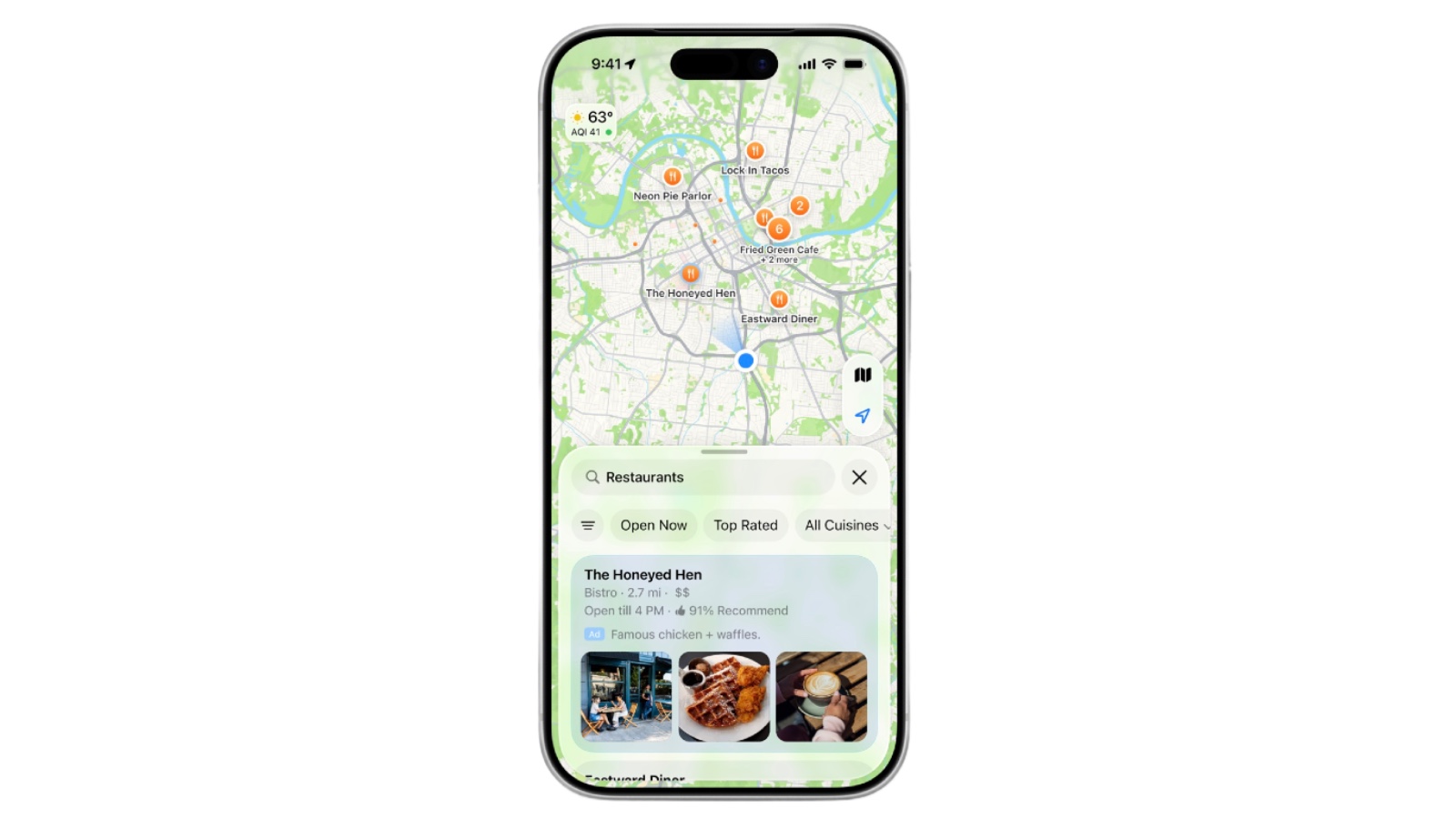
The Suggested Places surface is a new discovery feature within Maps, distinct from the standard search results page. It surfaces recommendations contextually - based on trending local activity, the user's recent search history, and proximity signals - rather than requiring an active search query. Ads appearing in Suggested Places represent a passive discovery format, while ads in search results are triggered by explicit user intent.
Ads in both placements will be clearly marked. Current Apple Ads advertisers and agencies will have the option to book through their existing Apple Ads experience, which will offer additional customisation options. All other businesses access a fully automated campaign creation flow through Apple Business.
To run ads, businesses must first claim their location on Maps through Apple Business before the Maps advertising product becomes available. The prerequisite step of claiming a location and uploading photos establishes the business identity that ads will draw on.
The privacy framework that governs Maps advertising is specific in what it excludes. A user's location and the ads they see and interact with in Maps are not associated with their Apple Account. Personal data stays on the user's device, is not collected or stored by Apple, and is not shared with third parties. Age and gender are not used for targeting. Precise location history and interaction history with Maps are also excluded. Targeting relies instead on contextual signals: search terms entered at the moment of query, a device's approximate location, and the area of the map currently on screen.
The identifier system used for ad measurement rotates multiple times per hour, preventing the construction of durable user profiles from Maps ad interactions. Longer-lived identifiers handle application performance and aggregate usage metrics only. Accounts registered to users under 13, or configured as educational Managed Apple Accounts, will not display ads at all.
The Maps advertising product enters a local search landscape already shaped by Google's multi-year investment in location-based advertising. Google operates local ads across Maps, Search, and Waze through Performance Max for store goals campaigns, which expanded to include Waze inventory in the United States in November 2025. Apple, at launch, operates only inside its own Maps environment - though that environment has expanded beyond the iPhone. Apple Maps launched a web-based beta in July 2024, extending reach to non-Apple devices for the first time.
Apple rebranded its advertising operation from Apple Search Ads to Apple Ads on April 14, 2025, a change widely interpreted as signalling intent to move beyond App Store placements. That rebrand came 18 days after French regulators imposed a €150 million fine over the App Tracking Transparency framework. The Maps initiative is the first concrete realisation of that broader ambition.
The advertising expansion since the rebrand has been methodical. Apple announced additional App Store search ad positions in December 2025, with the rollout beginning March 3, 2026 in the United Kingdom and Japan and completing across all Apple Ads markets by the end of that month. The App Store now reaches 850 million average weekly users across 175 storefronts and 44 currencies, according to Apple's January 2026 services results. Services revenue reached $27.423 billion in Apple's fiscal Q3 2025, 12 percent higher than the $24.213 billion recorded in the prior year quarter, and now accounts for more than a quarter of total Apple revenue.
The Apple Business Connect platform, first launched in January 2023 as a Google Business Profile equivalent, established the infrastructure of claimed business locations that Maps advertising now builds on. That prior investment in business location data means Apple is not starting from scratch on the identity and verification side of the advertising product.
Apple Business is free. Starting April 14, it will be available in the US and more than 200 countries and regions. Optional paid additions include iCloud storage up to 2TB per user, starting at $0.99 per user per month in the US. AppleCare+ for Business is available per device or per user, starting at $6.99 per month per device, or $13.99 per month per user for coverage of up to three devices.
Ads on Apple Maps will be available to US and Canadian businesses this summer. Geographic scope is limited to advertisers with businesses in those two countries. Ads will appear in the Maps app on iPhone and iPad.
The Apple Business companion app and the email, calendar, and directory features all require iOS 26, iPadOS 26, or macOS 26 - operating system versions that have not yet been released as of the announcement date, tying the availability of certain features to Apple's next major software release cycle. Apple's Worldwide Developers Conference is scheduled for the week of June 8, 2026, where iOS 26 is expected to be previewed.
Who: Apple Inc., targeting businesses of all sizes across more than 200 countries and regions, with Maps advertising limited to advertisers with businesses in the United States and Canada.
What: Apple announced Apple Business, a free all-in-one platform that consolidates mobile device management, business email and calendar with custom domain support, brand and location management, and a new Maps advertising product. The platform replaces Apple Business Connect, Apple Business Essentials, and Apple Business Manager. Maps advertising will use a keyword auction model with contextual targeting, no behavioural data, and identifiers that rotate multiple times per hour.
When: The announcement was made on March 24, 2026. Apple Business launches April 14, 2026 in more than 200 countries. Ads on Apple Maps are expected this summer in the US and Canada. Companion app and email, calendar, and directory features require iOS 26, iPadOS 26, or macOS 26.
Where: Apple Business is available globally in 200-plus countries and regions. Maps advertising is restricted at launch to advertisers with businesses in the United States and Canada, appearing in the Maps app on iPhone and iPad.
Why: Apple's services division accounts for more than a quarter of total company revenue and reached $27.423 billion in Q3 2025. Consolidating business products into one free platform lowers the barrier to business engagement with Apple's ecosystem, while the Maps advertising product monetises a high-intent surface that previously generated no direct advertising revenue. The move also positions Apple as a third player in local search advertising alongside Google Maps and Yelp, differentiated by a privacy-first targeting model that uses no behavioural data, location history, age, or gender.