Bad Bunny's all-Spanish halftime show draws 128.2 million, breaking barriers
Bad Bunny's Super Bowl LX halftime show attracted 128.2 million viewers, ranking fourth all-time, while setting social media records with 4 billion views and shattering Spanish-language broadcast figures.
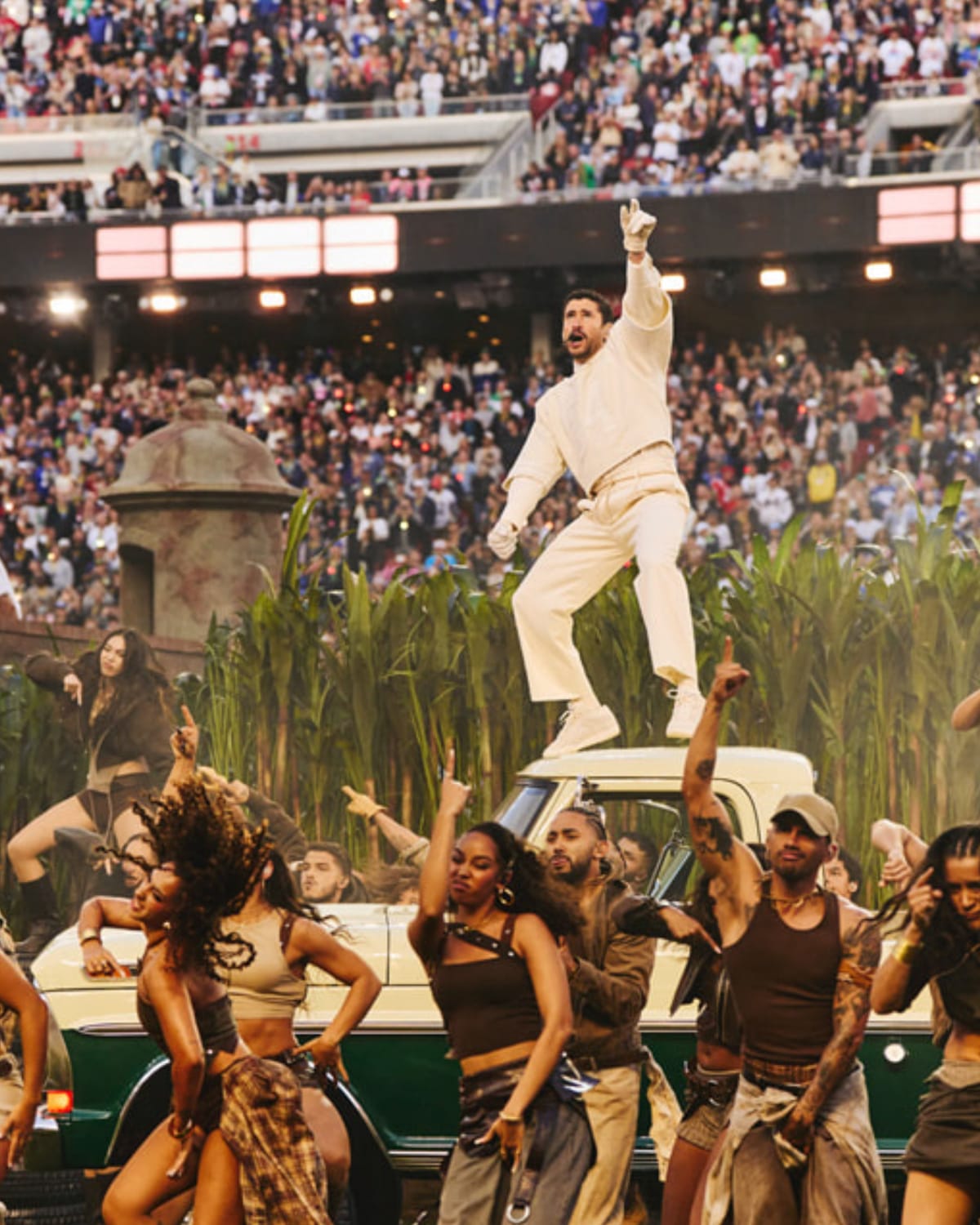
Bad Bunny performs atop vehicle during Super Bowl LX halftime show at Levi's Stadium in Santa Clara
Bad Bunny performs atop vehicle during Super Bowl LX halftime show at Levi's Stadium in Santa Clara
Bad Bunny's historic all-Spanish halftime show at Super Bowl LX drew 128.2 million viewers on February 8, 2026, placing the Puerto Rican superstar's performance fourth among the most-watched halftime spectacles in television history. The figure, announced by Nielsen on February 10, fell short of preliminary estimates suggesting 135 million viewers but demonstrated substantial audience engagement for what was the first primarily Spanish-language performance on American football's biggest stage.
The viewership marked a significant achievement for Latin music representation at the Super Bowl. Kendrick Lamar's 2025 performance at Super Bowl LIX remains the most-watched halftime show with 133.5 million viewers, narrowly edging Michael Jackson's long-standing 1993 record of 133.4 million. Usher's 2024 performance captured 123.4 million viewers for third place, positioning Bad Bunny's 128.2 million figure between these benchmarks.
Nielsen's measurement excluded YouTube live stream viewership from the official 128.2 million count. "Nielsen did not measure any of the YouTube live stream viewership for 2026's halftime show. Of the linear networks that carried the Super Bowl, the only one Nielsen measures is broadcast network," according to the measurement company's statement. This methodological limitation suggests the total audience consuming Bad Bunny's performance across all platforms exceeded the reported figure substantially.
Social media consumption shatters previous records
The halftime show generated unprecedented digital engagement despite the lower-than-expected television viewership. NBC and NBC Sports announced that social media consumption of the 2026 halftime show set a record with 4 billion views in the first 24 hours, representing a 137 percent increase over the 2025 halftime show featuring Kendrick Lamar.
The social media figures encompass fans, owned platforms, broadcast partners, and influencers. More than 55 percent of all social views originated from international markets, according to data released by the NFL. This geographic distribution reflects Bad Bunny's global fan base and the performance's appeal beyond traditional American football audiences.
The digital engagement numbers underscore a fundamental shift in how audiences consume Super Bowl entertainment. While television viewership remains the primary measurement currency for advertisers, social media amplification extends the reach and cultural impact of halftime performances well beyond the live broadcast window.
Telemundo averaged 3.3 million viewers for Super Bowl LX, establishing it as the most-watched Super Bowl Spanish-language broadcast in United States history. The Super Bowl has been televised in Spanish in the United States since 2014, when Super Bowl XLVIII included the first Spanish-language broadcast for the championship game.
The Spanish-language audience peaked during the halftime show, averaging 4.8 million viewers and setting another record as the most-watched Super Bowl halftime show in Spanish-language television history in the United States. "Bad Bunny's presence may also have increased the Spanish-language audience in the US," according to reports citing the viewership data.
This performance validates research showing that Spanish-language television advertising significantly outperforms English-language counterparts. EDO reported in October 2024 that ads aired on Spanish-language networks proved 31 percent more effective than those on English-language television, with brands incorporating Latin culture elements sometimes outperforming averages by 1,039 percent.
Advertising context and measurement significance
The viewership figures arrive during a period of intense focus on Super Bowl advertising measurement and performance. Consumer spending around the 2025 Super Bowl reached $18.6 billion across food, drinks, apparel, décor, and related items, according to National Retail Federation data. More than 127 million viewers watched Super Bowl LIX on February 9, 2025, establishing the game as advertising's largest single-day audience opportunity.
Super Bowl advertising has commanded premium pricing as marketers seek access to mass audiences in an increasingly fragmented media landscape. Contextual targeting campaigns during Super Bowl LVIII achieved 102 percent increased return on investment compared to overall averages, alongside a 136 percent increase in success rate measured through clicks and conversions, according to Integral Ad Science data released in January 2026.
The measurement challenges extend beyond simple viewership counts. Nielsen announced a pilot program using proprietary wearable devices to measure co-viewing during Super Bowl LX, addressing persistent challenges in capturing total viewership when multiple people watch the same screen. This initiative reflects ongoing efforts to provide advertisers with more accurate audience data as viewing habits fragment across platforms and devices.
Post-game media consumption patterns
International engagement with Super Bowl content demonstrated substantial growth in 2026. British readership of Super Bowl articles generated more than 4.7 million pageviews across United Kingdom publications over the three months preceding the game, according to data from Taboola. Post-match articles on Monday, February 9, generated 2.6 million article pageviews in the United Kingdom, representing a 63 percent increase compared to 1.6 million in 2025.
Articles about Bad Bunny earned 1.7 million views in the United Kingdom during the day after the game. The halftime show generated 800,000 pageviews among British readers, demonstrating the performance's appeal beyond American audiences. "The excitement of the half-time show and the famous faces involved are a big part of what makes this event so special - something UK publishers need to keep in mind when planning their reporting," David Struzzi, Communications Lead at Taboola, stated to PPC Land.
The Seattle Seahawks' victory over the New England Patriots provided another engagement driver. Articles about the Seahawks received 1 million pageviews across Sunday and Monday in the United Kingdom market.
Competitive advertising landscape intensifies
The Super Bowl advertising environment has become increasingly competitive as technology companies vie for consumer attention. Anthropic spent millions on Super Bowl commercials directly targeting OpenAI's decision to introduce advertising in ChatGPT, with two spots airing during Super Bowl LX. The San Francisco-based artificial intelligence company committed that Claude would remain advertisement-free while running commercials criticizing competitors' monetization strategies.
Yahoo returned to Super Bowl advertising after a 22-year hiatus, featuring actor Bill Murray in an interactive campaign that generated approximately 150,000 email responses within two hours of broadcast. The advertisement ranked as the fourth most-watched Super Bowl commercial on YouTube during game day.
Quick-service restaurant brands that advertised during Super Bowl LIX experienced a combined 31 percent increase in foot traffic, according to location intelligence data from Azira. Dunkin' achieved a 31 percent increase, Little Caesars led with a 35 percent increase, and Taco Bell recorded a 30 percent increase in store visits following the February 9, 2025 broadcast.
Historical context and measurement evolution
Bad Bunny's performance represented his second appearance at a Super Bowl halftime show. He previously performed as a guest during the 2020 show featuring Shakira and Jennifer Lopez at Hard Rock Stadium in Miami Gardens, Florida. That performance drew audiences during a period when Super Bowl halftime shows regularly attracted between 100 million and 120 million viewers.
The progression of halftime show viewership reflects broader changes in television consumption patterns. Nielsen transitioned from its traditional panel-only measurement system to Big Data + Panel methodology in 2025, combining data from approximately 101,000 people across 42,000 households with inputs from about 45 million households and 75 million devices. This hybrid approach addresses the fragmentation of audience attention across traditional television, streaming services, and digital platforms.
Super Bowl halftime shows have evolved from marching band performances in the 1960s and 1970s to major music productions featuring arena rock bands and contemporary artists. Michael Jackson's 1993 performance fundamentally transformed the halftime show from a stadium intermission into a global pop culture event, establishing the template for modern spectacles that command massive television audiences and generate substantial social media engagement.
The distinction between television viewership and total audience consumption has grown more pronounced as digital platforms capture increasing shares of entertainment consumption. YouTube viewership, social media clips, and streaming replays extend the reach of halftime performances beyond the live broadcast, complicating traditional measurement approaches that advertisers rely upon for campaign planning.
Performance details and cultural significance
Bad Bunny delivered an all-Spanish setlist at Levi's Stadium in Santa Clara, California, performing songs including "Tití Me Preguntó," "Yo Perreo Sola," "Safaera," and "El Apagón." Lady Gaga and Ricky Martin appeared as guest performers during the show, with Martin joining for "LO QUE LE PASÓ A HAWAii."
The performance marked the first time a primarily Spanish-language artist headlined the Super Bowl halftime show, representing a milestone for Latin music representation in American popular culture. Previous Super Bowl performances featured Spanish-language segments, including Shakira and Jennifer Lopez's 2020 show and Gloria Estefan's appearances in 1992, 1995, and 1999, but Bad Bunny's 2026 performance centered Spanish-language content as the main attraction rather than incorporating it as a component of a broader English-language show.
Latin trap's presence on the Super Bowl stage reflects broader demographic shifts in American music consumption and advertising targeting. The performance provided sponsors with access to both mainstream American audiences and specifically Hispanic viewers, who represent substantial purchasing power across multiple consumer categories.
Implications for future Super Bowl programming
The 128.2 million viewer figure positions Bad Bunny's performance as commercially viable despite falling short of the all-time record. Advertisers purchased Super Bowl LX inventory based on projected audiences exceeding 120 million viewers, making the actual viewership sufficient to justify the premium pricing that characterizes Super Bowl advertising slots.
The substantial Spanish-language viewership and international social media engagement suggest that Super Bowl organizers and broadcasters may pursue more diverse performer selections in future years. The performance demonstrated that artists whose primary audiences exist outside traditional American football demographics can generate competitive viewership while expanding the event's global reach.
Measurement methodologies will likely evolve to capture total audience consumption more comprehensively. The exclusion of YouTube streaming from Nielsen's official count understates the actual audience for the halftime show, creating discrepancies between reported viewership and total engagement that complicate advertiser decision-making.
Timeline
January 31, 1993: Michael Jackson performs at Super Bowl XXVII halftime show, drawing 133.4 million viewers and establishing the modern halftime show template
February 2, 2014: Spanish-language Super Bowl broadcasts begin with Super Bowl XLVIII
February 2, 2020: Bad Bunny appears as guest performer during Shakira and Jennifer Lopez halftime show at Super Bowl LIV
February 8, 2026: Bad Bunny performs all-Spanish halftime show at Super Bowl LX at Levi's Stadium in Santa Clara, California
February 10, 2026: Nielsen announces Super Bowl LX halftime show drew 128.2 million viewers
February 11, 2026: NBC Sports announces halftime show social media consumption reached 4 billion views in 24 hours
Summary
Who: Bad Bunny headlined the Super Bowl LX halftime show at Levi's Stadium, performing alongside guest artists Lady Gaga and Ricky Martin. Nielsen measured the viewership, while NBC, NBC Sports, and Telemundo broadcast the game and performance to American audiences.
What: The all-Spanish halftime show attracted 128.2 million viewers according to Nielsen measurements, ranking fourth among most-watched halftime performances in Super Bowl history behind Kendrick Lamar (133.5 million in 2025), Michael Jackson (133.4 million in 1993), and Usher (123.4 million in 2024). The performance generated 4 billion social media views in 24 hours and achieved record Spanish-language television viewership with Telemundo averaging 3.3 million viewers and peaking at 4.8 million during the halftime show.
When: The halftime show occurred on February 8, 2026, during Super Bowl LX. Nielsen announced viewership figures on February 10, 2026. Social media consumption data and Spanish-language broadcast records were reported on February 11, 2026.
Where: The performance took place at Levi's Stadium in Santa Clara, California. Viewership measurement covered United States audiences across broadcast networks, with Spanish-language broadcasts on Telemundo and international audiences consuming content through social media platforms. British readers generated 2.6 million article pageviews about the game on February 9, representing a 63 percent increase over 2025.
Why: The performance matters for marketing professionals because it demonstrates that diverse performer selections can generate competitive Super Bowl viewership while expanding audience reach to include substantial Spanish-language and international viewers. The 128.2 million television viewers combined with 4 billion social media views and record Spanish-language broadcast figures validate Super Bowl advertising's continued value despite increasingly fragmented media consumption patterns. The viewership data provides benchmarks for advertisers evaluating premium live event sponsorships and cultural marketing initiatives targeting Hispanic audiences, while measurement methodological gaps between television ratings and total digital consumption highlight ongoing challenges in audience quantification that affect advertising pricing and campaign planning decisions.
Share this article
The link has been copied!
Your link has expired. Please request a new one.
Your link has expired. Please request a new one.
Your link has expired. Please request a new one.
Great! You've successfully signed up.
Great! You've successfully signed up.
Welcome back! You've successfully signed in.
Success! You now have access to additional content.