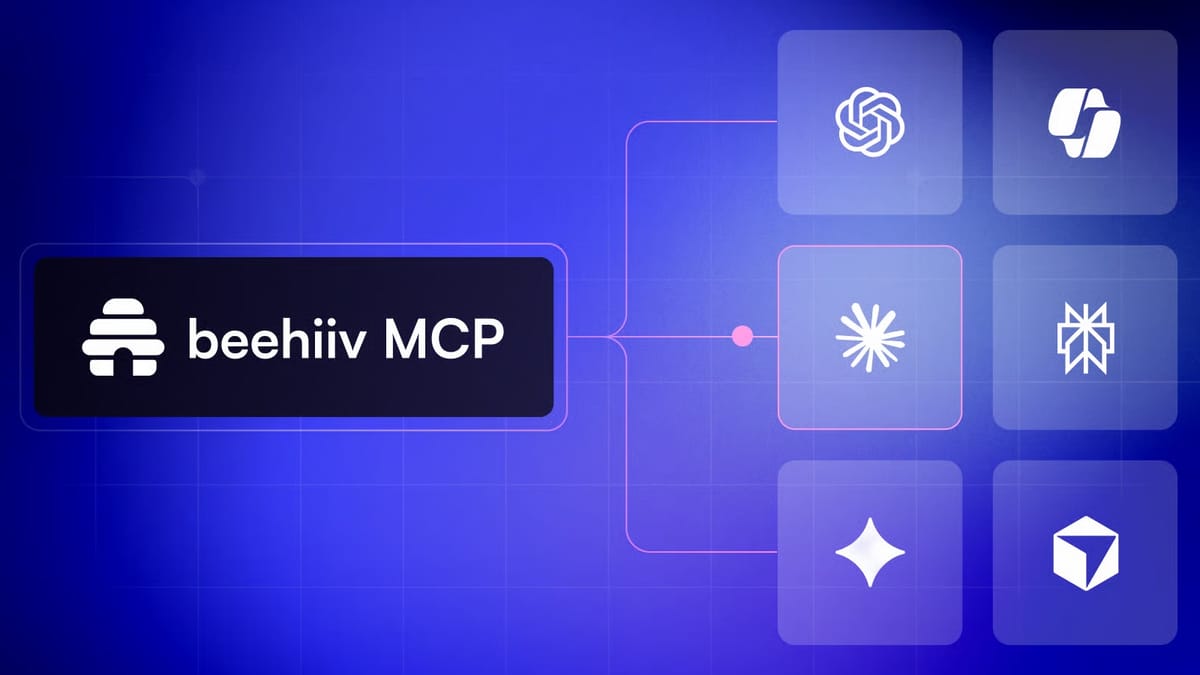
Beehiiv today launched a native Model Context Protocol (MCP) integration, making it the first newsletter platform that publishers can operate directly from inside ChatGPT, Claude, Gemini, and Perplexity. The announcement, made on March 24, 2026, by Tyler Denk, co-founder and chief executive of beehiiv, positions the company as an infrastructure layer underneath emerging AI interfaces rather than a standalone web application.
The move reflects a broader shift across the marketing technology industry. AI chat interfaces are increasingly where professionals perform analytical work, and platforms that fail to plug into them risk losing relevance as the dominant interaction layer shifts away from browser-based dashboards. Beehiiv is betting that the newsletter operator of 2026 will manage their publication the same way they already converse with Claude or ChatGPT - through natural language.
What the MCP does
MCP is an open standard - originally developed by Anthropic and subsequently donated to the Linux Foundation - that enables AI models to connect to external software systems. The protocol operates through a client-server model: a host application such as Claude Desktop or ChatGPT maintains connections to MCP servers, which expose data and functionality through standardised interfaces. According to Denk's announcement post, the beehiiv MCP "is an open standard that lets AI tools connect directly to software like beehiiv. No more copying and pasting into a chat window."
Prior to this integration, a newsletter operator wanting AI analysis of their subscriber data would need to manually export information, paste it into a chat window, and accept whatever insights the model could generate from that static snapshot. The limitation was significant: the AI could only reason over whatever fragment of data the user happened to share. The beehiiv MCP eliminates that friction entirely. Once connected, the AI accesses live account data, enabling analysis across an operator's full dataset rather than a partial export.
Version 1 of the integration launches with read-only access. According to the announcement, paid subscribers can request early access on a rolling basis. Approval triggers a confirmation email with connection instructions and an invitation to a private Slack community for early adopters.
Capabilities in v1
The read-only launch enables a range of analytical queries that go well beyond what traditional dashboards can produce. According to Denk's post, operators can ask questions such as: who are the most engaged free subscribers who have not upgraded and what do they have in common; whether there are unusual churn or unsubscribe spikes in the last 90 days and which posts or dates correlate with them; and requesting a prioritised list of SEO fixes based on the site's content and structure.
The differentiation from conventional analytics dashboards lies in the reasoning layer. A dashboard can display a spike in unsubscribes on a given date. What it cannot do is cross-reference that spike with send content, timing, and subscriber demographics simultaneously to generate a hypothesis. That kind of contextual dot-connecting is where large language models have a distinct advantage, and it is precisely what beehiiv is enabling with this integration.
Cross-platform workflows are another significant dimension of what v1 unlocks. Because MCP allows AI tools to connect to multiple external services simultaneously, beehiiv data can be routed into actions elsewhere. According to the announcement, operators can configure automations such as: pulling last week's revenue across ads, subscriptions, and digital products every Monday at 8am and posting a week-over-week summary to Slack; automatically creating or updating a HubSpot contact and enrolling them in a sales sequence when a subscriber reaches 10 or more opens and 5 or more clicks; and each Friday pulling send performance, summarising what worked, drafting a Monday editorial brief in Gmail, and creating a calendar invite for 9am. These workflows require no manual exports, no dashboard visits, and no custom code.
Version 2 and write access
Beehiiv has confirmed that development on version 2 is already underway. The next release will introduce write access, fundamentally changing what operators can accomplish through an AI interface. According to Denk's post, v2 will allow instructions such as: pulling the last five posts and generating a "greatest hits" roundup - writing it, formatting it, and saving it as a draft; building an automation for digital product purchasers with a sequence of emails on days 1, 3, and 7; and finding free subscribers who have opened 5 or more emails in the last 60 days but have not upgraded, creating a segment called "High Intent Free," and sending them a 25% discount valid for 24 hours.
Write access transforms the AI from an analyst into an operator. The distinction matters considerably for marketing professionals: read-only access produces insights, while write access produces outcomes. The timeline for v2 has not been specified.
Industry context
The MCP standard has been spreading rapidly across the marketing technology stack since mid-2025. Microsoft launched its Clarity MCP server on June 4, 2025. AppsFlyer introduced its MCP tool on July 17, 2025, for mobile measurement. Google Analytics released its own MCP server on July 22, 2025. Google's Ads API team followed with an open-source MCP server on October 7, 2025. The Ad Context Protocol launched on October 15, 2025, specifically for advertising automation across multiple platforms. In January 2026, Google embedded MCP directly into its Universal Commerce Protocol alongside Agent2Agent and Agent Payments Protocol.
Beehiiv's launch sits within this trajectory but differs in one important respect: where most MCP implementations to date have targeted developer audiences or enterprise advertising teams, the beehiiv MCP is designed for individual newsletter operators - creators managing publications ranging from small audiences to more than a million subscribers. The protocol is now reaching a significantly broader category of professional publisher.
For context, beehiiv already pays out more than $1 million monthly to publishers through its Ad Network, which connects 30,000 publishers with brands including Nike, Netflix, Google, HubSpot, Deel, and Roku. To date, creators have earned more than $35 million through platform monetisation tools. The platform sends nearly 3 billion emails monthly across tens of thousands of publications. This scale gives the MCP integration immediate practical significance: even a fraction of those 30,000 publishers adopting AI-driven workflows represents a substantial shift in how newsletter operations are managed.
Newsletter advertising adoption surged from 15 percent in 2019 to 77 percent in 2025, according to data tracked by PPC Land. That monetisation growth creates complexity - multiple revenue streams across ads, subscriptions, boosts, and digital products - that analytics dashboards handle poorly at scale. The ability to ask an AI to synthesise revenue performance across all channels simultaneously, then automatically report it via Slack, addresses a real operational gap for publishers managing multiple income sources.
The competitive dynamics are worth noting. Substack maintained 41 percent of newsletter submissions to industry tracker InboxReads in 2025, with beehiiv holding 29 percent - down slightly from 33 percent in 2024. Substack has been pursuing its own expansion, including television apps on Apple TV and Google TV launched in January 2026. The MCP integration gives beehiiv a meaningful technical differentiator in attracting publishers who are already embedded in AI tool workflows.
Access and restrictions
The beehiiv MCP is restricted to users on paid plans. Early access is being approved on a rolling basis. According to Denk's post, getting started takes less than a minute: submit the request form, receive a confirmation email upon approval, and follow the instructions to connect a beehiiv account to the AI client of choice. There is no indication of which paid tier is required at minimum.
The constraint to paid plans is consistent with beehiiv's broader positioning. The platform has built its infrastructure specifically for what it calls "serious creators and publishers" - operators for whom newsletter publishing is a business rather than a hobby. Features like the zero-commission digital products store and the expanded Ad Solutions team announced in January 2026 reinforce that orientation.
The beehiiv MCP represents a structural change in how publisher-facing tools integrate with the AI layer. Historically, AI and marketing tools were loosely connected - operators moved data between systems manually, or relied on API integrations that required developer resources to build and maintain. The MCP standard changes that architecture by enabling AI clients to become the primary interface through which data from multiple systems is accessed, analysed, and acted upon.
For marketing professionals, the practical implication is that the newsletter management workflow increasingly mirrors the AI chat workflow. Subscriber segmentation, revenue analysis, content planning, and CRM updates become conversational tasks rather than dashboard tasks. The automation potential - particularly when v2 introduces write access - means that sequences of actions currently requiring manual steps across multiple platforms could eventually be triggered through a single natural language instruction.
The Model Context Protocol's spread across the advertising ecosystem throughout 2025 and into 2026 suggests that this integration pattern will become standard rather than exceptional. Beehiiv's claim to be the first newsletter platform to implement it is notable, though what will matter more over time is the depth and reliability of the integration as v2 and subsequent versions extend its capabilities.
Timeline
- July 17, 2025 - AppsFlyer launches MCP tool for mobile marketing measurement, built on Anthropic's Model Context Protocol framework
- July 22, 2025 - Google Analytics releases experimental open-source MCP server enabling natural language data queries through AI assistants
- September 3, 2025 - Gracenote launches Video MCP Server connecting LLMs to entertainment database covering 40 million titles
- October 7, 2025 - Google releases open-source MCP server for Google Ads API, enabling natural language campaign queries
- October 15, 2025 - Ad Context Protocol (AdCP) launches with 23 participating organisations for advertising automation
- November 13, 2025 - Beehiiv expands beyond newsletters with digital products, zero-commission commerce, and AI website builder at first public release event
- December 28, 2025 - Newsletter monetisation report shows 77% of publications seeking ad partnerships; beehiiv holds 29% market share
- January 8, 2026 - Beehiiv doubles ad sales team, bringing in LiveIntent veteran Andrew MacMannis as VP of Ad Sales; platform paying out over $1 million monthly to publishers
- January 11, 2026 - Google launches Universal Commerce Protocol embedding MCP alongside Agent2Agent and Agent Payments Protocol, partnering with Shopify, Walmart, Target and others
- January 22, 2026 - Newsletter ad spending surges 40% with 30% publisher revenue growth as brands seek alternatives to walled-garden platforms
- March 24, 2026 - Beehiiv launches MCP integration, becoming the first newsletter platform operable directly from ChatGPT, Claude, Gemini, and Perplexity; v1 ships with read-only access for paid users
Summary
Who: Beehiiv, the newsletter publishing platform co-founded and led by Tyler Denk, announced the launch. The integration directly affects beehiiv's paid subscribers - newsletter operators ranging from small individual publishers to publications with more than a million subscribers across beehiiv's network of 30,000 active publishers.
What: Beehiiv launched version 1 of its Model Context Protocol integration, enabling paid users to connect their beehiiv accounts to AI clients including Claude, ChatGPT, Gemini, and Perplexity. The v1 release provides read-only access, allowing operators to query subscriber data, revenue performance, churn patterns, and site SEO through natural language. Version 2, currently in development, will add write access enabling AI-driven content creation, segmentation, and automated multi-step campaigns.
When: The announcement was made on March 24, 2026. Early access is being approved on a rolling basis from that date.
Where: The integration operates across any AI client supporting the Model Context Protocol standard - currently including Claude, ChatGPT, Gemini, and Perplexity. The beehiiv platform itself is cloud-based, serving publishers globally. Cross-platform workflows connect beehiiv data to external tools including Slack, HubSpot, Gmail, and Google Calendar.
Why: As AI interfaces replace browser dashboards as the primary workspace for knowledge workers, beehiiv's decision to embed itself into those interfaces reflects a competitive calculation that platforms must meet operators where they already work. The MCP standard enables live data access and multi-system reasoning that static dashboards cannot replicate, making AI-native workflows practically useful for the first time without requiring manual data exports or custom integrations.
Share this article
The link has been copied!