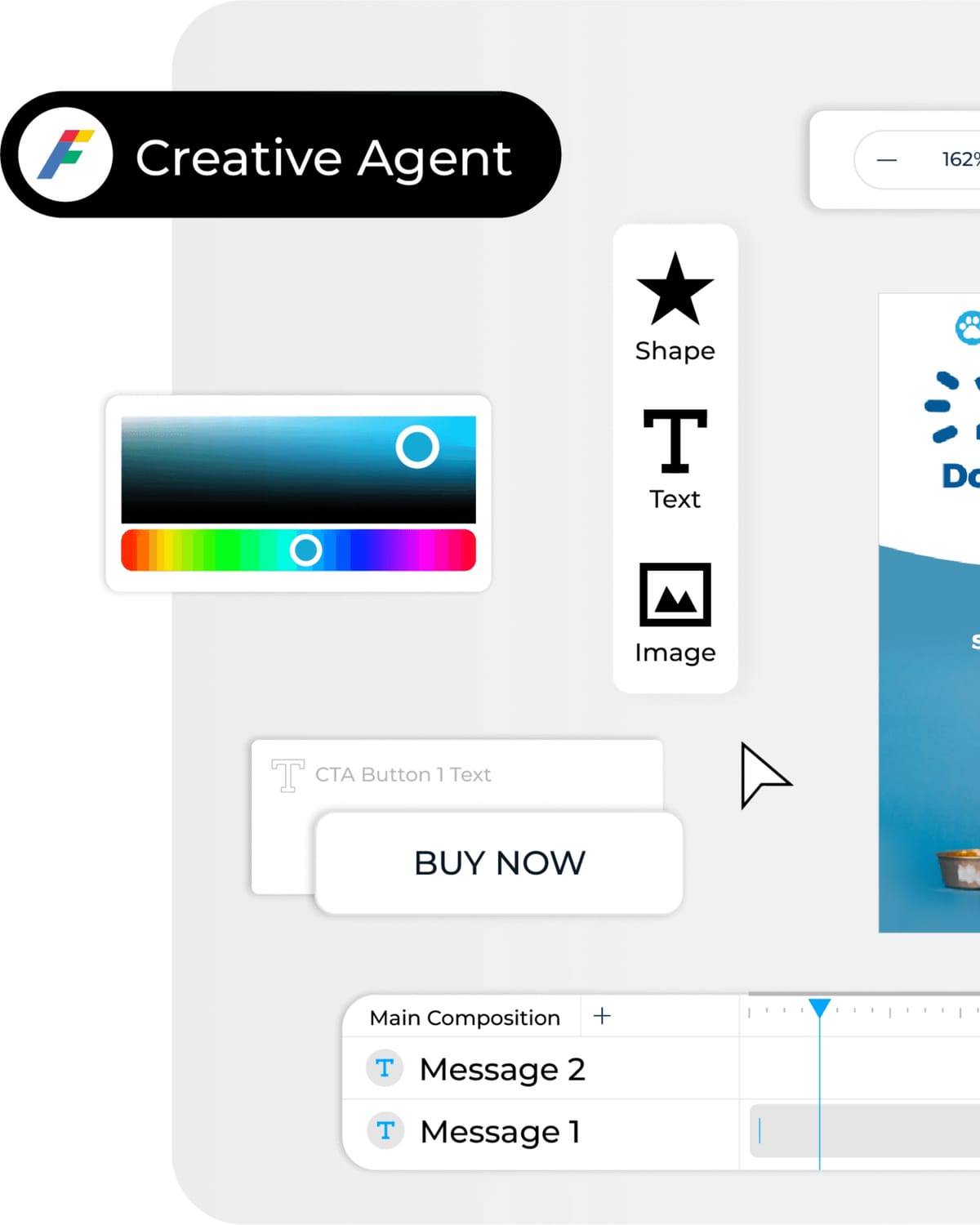
Clinch today announced the launch of its Creative Template Catalog, a new feature embedded within the AI-enabled Digital Asset Library inside Flight Control, the company's SaaS platform for omnichannel advertising. The announcement, made on February 24, 2026, introduces what the New York-based advertising technology company describes as a scalable foundation for creating and managing dynamic ad templates across multiple channels, formats, and audience segments.
The launch extends the capability of Flight Control's existing Digital Asset Management (DAM) infrastructure, adding a curated library of fully customizable dynamic templates organized by vertical and key performance indicator. Each template ships with metadata covering ad type, animation style, and format specifications, giving creative and media teams structured starting points rather than blank canvases.
The advertising technology sector has watched platform consolidation accelerate throughout 2025 and into 2026, with major vendors moving to collapse fragmented point solutions into unified environments. Innovid merged with Flashtalking under Mediaocean, combining ad delivery, creative personalization, and measurement in a single stack. Smartly announced AI-powered Creative Predictive Potential and Creative Insights in November 2025, connecting pre-campaign prediction with post-campaign analysis across social, Google, programmatic, and Connected TV. Clinch's move today fits squarely into this pattern - bringing production, asset management, and optimization under one roof.
"This represents a major step forward in redefining creative at scale by bringing fragmented creative workflows into a single content orchestration platform," said Oz Etzioni, CEO & Co-founder of Clinch. "We're consolidating multiple point solutions across production, asset management, and optimization into one centralized system where data, assets, and strategy work seamlessly together. The Creative Template Catalog gives teams a scalable foundation while enabling AI-driven optimization from the start, reducing operational complexity and freeing teams to focus on strategy and storytelling."
The statement echoes a challenge that has preoccupied media buyers and creative teams for years. Managing separate tools for production, versioning, and ad serving generates handoff friction, inconsistent brand execution, and slow time-to-market. Clinch positions the Catalog as an answer to that operational fragmentation, though how it performs at scale across client accounts remains to be measured in practice.
How the Catalog works technically
At its core, the Creative Template Catalog functions as a pre-structured framework layer sitting above Flight Control's AI-driven workflow engine. By establishing flexible creative frameworks upfront, the Catalog enables the platform's AI to generate and adapt ad variations quickly while keeping brand standards intact. According to the announcement, every creative element is automatically tagged by AI, giving teams granular visibility into performance at the asset level rather than only at the campaign or ad-set level.
This atomic asset-level intelligence is significant. Traditional reporting in digital advertising typically surfaces metrics at the ad or campaign level, making it difficult to isolate which headline, background image, logo treatment, or call-to-action button is driving or dragging performance. With AI auto-tagging applied to every component, teams can theoretically trace performance back to individual creative elements across all ad variants - a more granular feedback loop than most platforms currently offer.
The feature also introduces what Clinch calls applied historical performance indicators at the atomic level. Rather than starting creative optimization from zero on each new campaign, the system draws on prior performance signals tied to specific asset types, potentially reducing the time and budget required to identify effective creative combinations.
Templates in the Catalog support multiple formats, sizes, and channels. The announcement does not specify the exact number of templates currently available, noting instead that the library is "growing." Each entry is supported by clear descriptions and metadata, including ad type, animation style, and format specifications - practical details that matter to production teams managing complex multi-format rollouts.
A dedicated section of the Catalog addresses creator-generated content. Predefined, brand-safe layouts allow teams to combine influencer or user-generated creative with brand assets in a structured way, ready for activation at scale. This directly targets a workflow challenge that has grown as brands increase creator partnerships: the need to integrate unstructured third-party content with controlled brand systems without manual rebuilding for each format.
Early adoption: WITHIN agency
WITHIN, described as a full-service digital marketing agency uniting media, creative, and commerce, shared its experience using the Catalog ahead of the public launch. Piper Brantley, Programmatic Manager at WITHIN, said: "Clinch's Template Catalog has changed how we approach creative production. By connecting it to our product feed, we can dynamically generate thousands of variants instead of building them one by one. That kind of automation is exactly what we need to scale our campaigns more efficiently."
The reference to product feed connectivity is notable. Connecting a template library directly to a product feed enables dynamic creative optimization at scale - a technique that has attracted growing industry attention. Amazon's internal data from August 2025 showed that advertisers using dynamic creative optimization saw an 8.4% lift in paid units and a 7.9% lift in conversions compared to those without DCO enabled. Generating thousands of variants from a connected feed rather than building each one manually addresses the labor bottleneck that has historically limited DCO adoption among mid-sized teams.
The intersection of influencer content with product-feed-driven creative is a relatively new frontier. Marketers increasingly combine creator authenticity with the targeting precision of product-level data, and building that workflow inside a DAM platform rather than across separate production, feed management, and ad serving tools reduces both complexity and the margin for error.
Availability and positioning
According to the announcement, Clinch's Creative Template Catalog is available today to all Flight Control users, with no staged rollout or waitlist mentioned. The feature is positioned as part of Flight Control's existing AI-enabled Digital Asset Library, meaning current subscribers gain access without an additional licensing step, based on the information provided.
Clinch describes itself as an AI-powered advertising technology company enabling brands and agencies to deliver relevant advertising across all channels more efficiently. The company's platform, Flight Control, covers the full campaign lifecycle: creative production at scale, omnichannel ad serving, advanced DCO, and consumer intelligence. Forrester named Clinch a leader in Creative Advertising Technologies as early as Q4 2020, recognizing it for best-in-class ad building and assembly alongside Innovid, Jivox, and Flashtalking.
The broader market context matters here. Research analyzed by PPC Land on AI advertising performance showed that 86% of buyers plan to use AI for video advertisement creation, with projections suggesting AI will account for 40% of all advertisements by 2026. At the same time, a Taboola study involving 500 million impressions found that AI-generated ads matched human creative performance provided they did not visually signal their AI origins. That finding puts brand template design - the starting point for any AI-driven generation workflow - squarely in focus: the quality and authenticity of the template framework may determine whether the downstream AI output performs or underperforms.
Why this matters for marketing teams
The launch arrives as creative production timelines face pressure from multiple directions simultaneously. Media teams manage more channels than ever, while creative teams are expected to produce more variants per campaign to feed algorithmic optimization engines. Adobe's February 2026 study of 1,106 U.S. workers found that marketers lose 91 business days yearly to low-impact tasks, with 32% reporting they had quit jobs due to poor work management. The labor cost of manual creative production is measurable and substantial.
A template-first approach to creative production reduces the number of decisions that need to be made from scratch on each campaign. When templates are structured around vertical-specific and KPI-driven best practices - as Clinch describes - teams start from a foundation informed by prior performance rather than from intuition or trial and error alone. Whether the specific templates in Clinch's Catalog perform consistently across verticals and channels is something advertisers will assess in deployment.
The reduced cost and resource strain benefit cited in the announcement is particularly relevant to agencies and brand teams operating without large in-house creative departments. Building and versioning ads manually across dozens of formats requires significant designer time. Automation tools that maintain brand integrity while scaling output address a real operational gap - and the market for such tools has become increasingly competitive throughout 2024 and 2025.
PPC Land has documented a sustained push by major platforms - Google, Amazon, Meta, and independent ad tech vendors alike - toward AI-powered creative automation throughout this period. What distinguishes Clinch's approach in the current announcement is the combination of a curated template library with atomic asset-level measurement feedback, creating a loop between creative structure and performance signal at a more granular level than most platforms currently expose.
Timeline
- Q4 2020 - Forrester names Clinch a leader in Creative Advertising Technologies, recognizing the platform for best-in-class ad building and assembly
- January 28, 2023 - AdsWizz launches Dynamic Creative Optimization for audio on AudioMatic and AudioServe
- August 25, 2025 - Innovid launches AI tools to automate creative labeling and real-time optimization, citing industry projections that AI will account for 40% of all ads by 2026
- September 10, 2025 - Google announces expansion of Asset Studio, a centralized AI-powered creative production platform for advertisers
- November 12, 2025 - Amazon enhances Performance+ and Brand+ with AI improvements, with internal data showing DCO drives 8.4% lift in paid units
- November 18, 2025 - Smartly announces Creative Predictive Potential and Creative Insights, adding pre- and post-campaign AI analysis across social, Google, programmatic, and CTV
- November 25, 2025 - VuePlanner integrates Sundogs to add creative scoring across 150+ attributes for YouTube ad performance prediction
- January 10, 2026 - PPC Land analysis documents ten critical dimensions where AI advertising integration delivers versus falls short, including creative automation
- January 28, 2026 - Taboola research across 500 million impressions finds AI-generated ads match human creative performance when they do not appear AI-made
- February 24, 2026 - Clinch launches Creative Template Catalog within Flight Control's AI-enabled Digital Asset Library, introducing atomic asset-level AI optimization and creator content integration for all Flight Control users
Summary
Who: Clinch, an AI-powered advertising technology company headquartered in New York, announced the launch. The feature is available to all existing users of its Flight Control platform. WITHIN, a full-service digital marketing agency, served as an early adopter of the Catalog.
What: Clinch launched the Creative Template Catalog, a new feature within Flight Control's AI-enabled Digital Asset Library. The Catalog provides a growing library of dynamic, customizable ad templates organized by vertical and KPI, with AI auto-tagging applied to every creative component to enable atomic asset-level performance visibility. The feature also includes predefined layouts for integrating creator-generated content with brand assets.
When: The announcement was made today, February 24, 2026. The feature is available immediately to all Flight Control users.
Where: The Catalog operates within Flight Control, Clinch's SaaS platform. It is a cloud-based feature with no geographic restriction stated in the announcement.
Why: Creative production for omnichannel advertising requires scaling ad variants across multiple formats, sizes, channels, and audiences - a workflow that has historically been fragmented across separate tools for production, asset management, and optimization. Clinch positions the Creative Template Catalog as a way to consolidate those workflows, reduce production timelines, and enable AI-driven optimization from the start of a campaign rather than after initial launch, while lowering the resource burden on teams with limited in-house creative capacity.
Share this article
The link has been copied!