Delta signs Amazon Leo deal for 1 Gbps in-flight Wi-Fi starting 2028
Amazon Leo will bring 1 Gbps in-flight Wi-Fi to 500 Delta aircraft from 2028, using low Earth orbit satellites just 370 miles up - here is what that means.


Amazon Leo will bring 1 Gbps in-flight Wi-Fi to 500 Delta aircraft from 2028, using low Earth orbit satellites just 370 miles up - here is what that means.
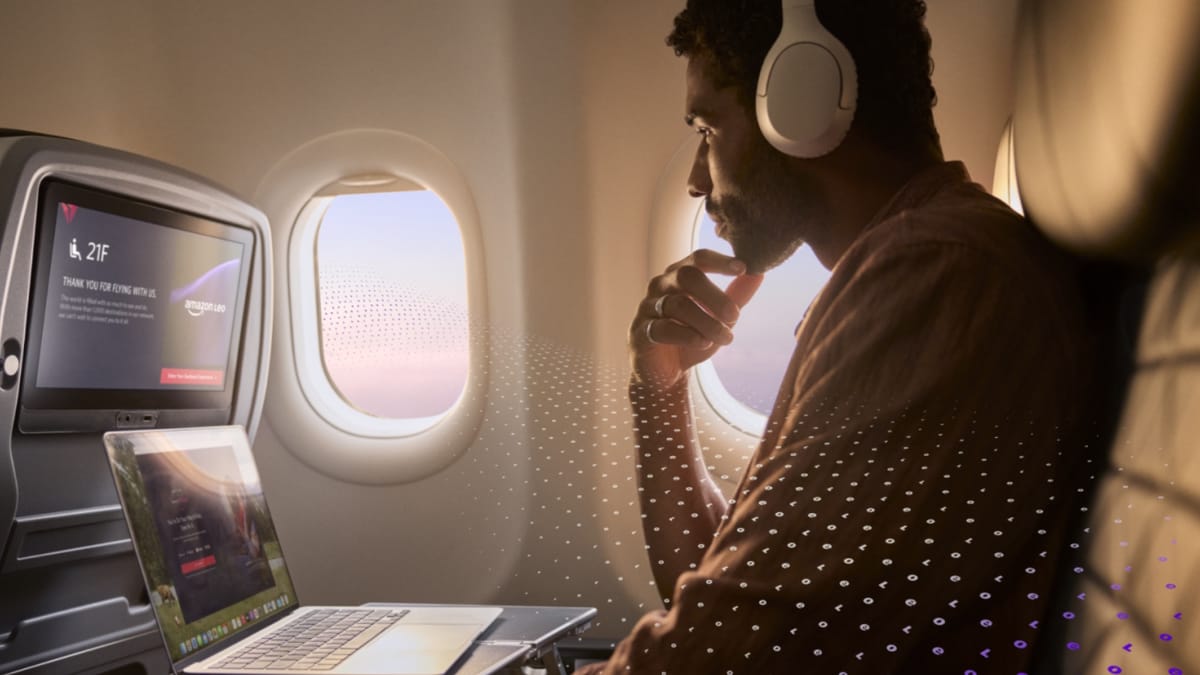
Amazon and Delta Air Lines announced on March 31, 2026, a multi-year agreement to bring Amazon Leo's satellite internet technology to hundreds of Delta aircraft, beginning with an initial rollout across 500 planes in 2028. The deal extends an already substantial relationship between Delta and Amazon Web Services and positions Leo - Amazon's commercial low Earth orbit satellite network - as the backbone of the airline's next-generation connectivity infrastructure.
The announcement matters for more than just frequent flyers. It marks a concrete step in Amazon's strategy to bundle satellite connectivity, cloud infrastructure, and artificial intelligence into a single commercial proposition, with airlines as one of the first large-scale proving grounds.
Amazon Leo operates a constellation of satellites orbiting roughly 370 miles above Earth's surface. That altitude is the central technical claim in the agreement. Traditional geostationary satellite systems, which have historically powered in-flight Wi-Fi, sit approximately 22,000 miles above the planet. The distance creates noticeable lag - latency that makes video calls choppy and real-time applications unreliable at altitude. At 370 miles, Leo's satellites are more than 50 times closer to the ground, which, according to Amazon, dramatically reduces that latency.
Each Delta aircraft under the agreement will be equipped with a single, purpose-built phased array antenna. The antenna is derived from Leo Ultra - described by Amazon as the fastest commercial phased array antenna in production - and is rated for download speeds up to 1 Gbps and upload speeds up to 400 Mbps. Those figures are comparable to many fixed broadband connections on the ground. Streaming video, uploading large files, and sustained video conferencing are all within the designed capability envelope at cruising altitude of 35,000 feet.
The antenna's design reflects a deliberate engineering choice. Phased array antennas electronically steer their beams without any moving parts, which makes them better suited for high-speed aircraft than mechanically gimballed dishes. Amazon's own documentation notes that the Leo Ultra terminal - the commercial ground product on which the aviation antenna is based - measures 51 by 76 centimetres and weighs 19.5 kilograms. The aviation-grade version has been adapted for aircraft installation, though Amazon has not disclosed its exact weight or dimensions for this deployment.
Delta flies to more than 300 locations across six continents, according to the announcement, and served more than 200 million customers last year. The initial 500-aircraft deployment in 2028 represents a significant but partial rollout - Delta's mainline fleet numbers in the hundreds of aircraft, and the full scope of the Leo integration beyond the initial tranche has not been specified in the March 31 announcement.
Wi-Fi access under the Leo agreement will remain free for all Delta SkyMiles members, consistent with Delta's existing policy for its current in-flight connectivity offering. That pricing commitment is notable: it means Amazon Leo-powered connectivity enters the cabin without a new paywall, even at the upgraded speeds.
Ed Bastian, Delta's chief executive officer, framed the deal in terms of technological ambition and global reach. "Delta's future is global," Bastian said. "This agreement gives us the best, fastest and most cost-effective technology available to better connect the world today, and it deepens our work with a global leader that shares our ambition to build what's next - creating even stronger human connection for our people and our customers for years to come."
Andy Jassy, President and CEO of Amazon, pointed to the broader addressable market that Delta represents. "We've designed Leo to provide high-speed internet to the billions of people on Earth without reliable connectivity, and this agreement with Delta is a great example of the impact and scale of the technology - bringing even faster in-flight Wi-Fi to tens of millions of passengers who fly Delta every year," Jassy said. "People increasingly want to stay connected wherever they are in the world, and Leo's speed and reliability is going to have a big impact for businesses, governments, and consumers."
The Leo deal does not exist in isolation. Delta has already migrated substantial portions of its technology infrastructure to Amazon Web Services. The airline uses AWS to power reservation systems, operational tools, and customer-facing applications. The new agreement adds a connectivity layer on top of that existing cloud relationship, and Amazon and Delta plan to work together to integrate AWS, Amazon Leo, artificial intelligence, and other Amazon technologies to enhance the customer experience across the entire travel journey.
That integration roadmap - spanning connectivity, cloud, and AI - is the element with the broadest potential implications. In-flight connectivity historically served a simple purpose: getting passengers online. The combination of Leo bandwidth, AWS compute, and AI tools opens the door to applications that were previously impractical in the air, from real-time operational analytics to personalised passenger services delivered at scale.
Amazon Leo currently has more than 200 satellites in orbit, with more than 20 full-scale missions planned over the next year, according to the March 31 announcement. The program has accelerated significantly since Amazon formally rebranded it from Project Kuiper to Amazon Leo in November 2025. At the time of the rebrand, the constellation operated more than 150 satellites following six successful launches. By the March 2026 announcement, that count had passed 200.
PPC Land covered the rebrand in detail in November 2025, noting that Amazon had simultaneously revealed its Leo Ultra terminal - the commercial phased array antenna underpinning the Delta aviation agreement. That earlier coverage also noted that JetBlue had already signed on for in-flight connectivity through Leo, making Delta the second major US carrier to commit to the network. The competitive significance is clear: Leo is signing long-term deals with large carriers before its constellation has even reached full operational density.
Amazon has also been building satellite manufacturing capacity since 2024, when it opened a 172,000-square-foot facility in Kirkland, Washington, designed to produce up to five satellites per day at peak capacity. More than 20 full-scale missions planned over the next 12 months suggest the deployment pace is accelerating considerably.
The relevance of the Delta-Leo agreement to digital advertising and marketing may not be immediately obvious, but the connections are real. In-flight connectivity has historically been too slow and intermittent to support sustained digital engagement. Passengers could check email, but streaming an ad-supported video or browsing a shopping platform with any reliability was often impractical. At 1 Gbps with low latency, that changes.
A connected aircraft with 200 or 300 passengers, all reliably online for three to eight hours, represents a new class of addressable audience. Delta's 200-million-passenger-per-year figure gives a sense of scale. These are not distracted mobile users glancing at their phones between tasks - they are, in many cases, captive audiences with extended dwell time, higher-than-average incomes, and demonstrated commercial engagement.
For advertisers, the question is whether that audience becomes accessible through addressable programmatic channels. That is not determined by this agreement, which covers connectivity infrastructure only. But the infrastructure is the precondition. Amazon's own advertising business - which reached $15.7 billion in revenue in Q2 2025, a 22% year-over-year increase - is deeply oriented toward closed-loop measurement, connecting ad exposure to purchase behaviour. A reliable, high-bandwidth in-flight connection makes that loop possible in an environment where it was previously unavailable.
Amazon's investments in connected television advertising infrastructure demonstrate a consistent pattern: the company builds audience reach through infrastructure investments, then layers advertising capabilities on top. The Roku partnership in June 2025, for example, created access to an estimated 80 million US CTV households through Amazon DSP. The Delta agreement follows a different path but reflects the same logic - extend the connected footprint, then extend the advertising potential.
The integration of Amazon DSP with premium streaming inventory from partners like Disney has also shown that Amazon treats connectivity and advertising as interlocking rather than separate businesses. Whether the Delta partnership eventually incorporates advertising dimensions - sponsored content, retail media touchpoints, or loyalty programme integrations visible through Delta's SkyMiles system - is speculative at this point, but the commercial infrastructure to support such developments would be in place by 2028.
Amazon Leo enters a satellite broadband market where SpaceX's Starlink has a substantial head start. Starlink has deployed thousands of satellites and, according to PPC Land's November 2025 coverage, serves over five million users across 125 countries. In aviation, Starlink has also moved aggressively, signing deals with carriers including United Airlines.
Amazon's approach with Delta differs in one notable respect from some Starlink aviation deployments: the agreement explicitly packages Leo with AWS and AI capabilities, rather than positioning it purely as a connectivity pipe. That bundled proposition - connectivity plus cloud plus AI - is harder for a connectivity-only competitor to replicate, and it gives Amazon a differentiated value proposition with enterprise and commercial customers who already depend on AWS.
The phased array antenna technology is also a differentiator. According to Amazon's product documentation, the Leo Ultra is the fastest commercial phased array antenna in production. The aviation-grade version derived from it would, if the specification holds, give Delta aircraft among the highest-throughput in-flight connectivity available when the 2028 rollout begins.
Who: Amazon and Delta Air Lines, with Amazon CEO Andy Jassy and Delta CEO Ed Bastian as the named executives. The deal extends an existing cloud relationship between Delta and Amazon Web Services.
What: A multi-year agreement to deploy Amazon Leo satellite internet technology across hundreds of Delta aircraft, beginning with 500 planes in 2028. The system uses low Earth orbit satellites at 370 miles altitude to deliver download speeds up to 1 Gbps and upload speeds up to 400 Mbps through a single purpose-built phased array antenna on each aircraft. Wi-Fi remains free for Delta SkyMiles members.
When: The announcement was made on March 31, 2026. The initial 500-aircraft deployment begins in 2028. Amazon Leo currently operates more than 200 satellites, with more than 20 full-scale missions planned over the next year.
Where: Delta's global fleet, serving more than 300 destinations across six continents and 200 million passengers last year. Amazon Leo's ground infrastructure is anchored to AWS data centres. Amazon's satellite manufacturing facility is in Kirkland, Washington.
Why: Delta gains higher-throughput, lower-latency in-flight connectivity than existing geostationary satellite systems can provide. Amazon gains a large-scale commercial aviation partner that validates Leo's enterprise proposition while deepening its integration of satellite connectivity, cloud computing, and AI into a single commercial offering - a bundled strategy with implications for how connected audiences are eventually reached by advertisers.