Google finally lets you set fixed budgets for Search and Shopping campaigns
Google today expanded campaign total budgets to Search, Performance Max and Shopping campaigns globally in open beta, letting advertisers set fixed spending limits for 3 to 90 days.
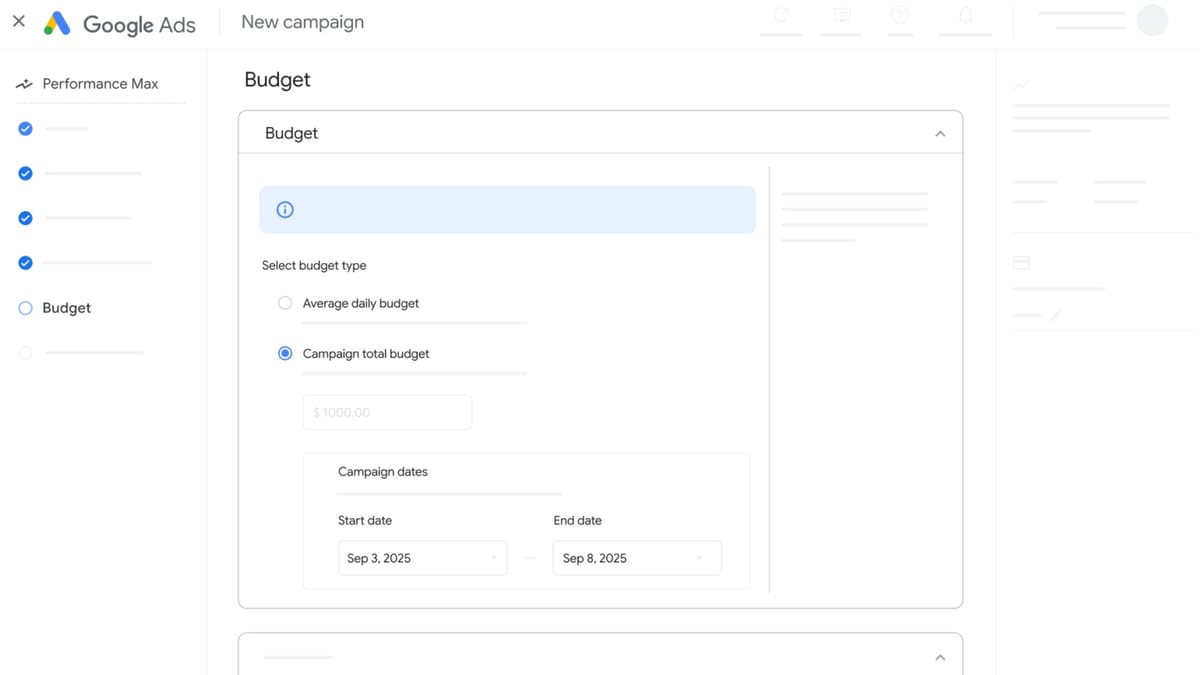
Google Ads interface showing campaign total budget option for Performance Max with date selector
Google today expanded its campaign total budgets feature to Search, Performance Max and Shopping campaigns globally, moving the capability beyond its initial limitation to Demand Gen and YouTube campaigns. According to Ginny Marvin, who holds the title of Long-time digital marketer and Ads Product Liaison at Google, the feature operates in open beta with immediate availability.
The expansion addresses a persistent advertiser request for fixed budget controls during promotional periods and seasonal campaigns. Campaign total budgets enable advertisers to establish predetermined spending limits across defined timeframes ranging from 3 to 90 days. This constraint-based approach differs fundamentally from traditional daily budget management, which requires advertisers to manually adjust spending allocations or accept potential overspend during high-traffic periods.
Marvin's announcement on January 15, 2026, specified three primary use cases that the feature targets: fixed budgets for short-term promotions, seasonal marketing pushes, and time-bounded campaign initiatives requiring strict financial controls. The feature appears within the Budget section when creating new campaigns, according to the LinkedIn post documentation.
PPC Land Newsletter
Subscribe PPC Land newsletter ✉️ for similar stories like this one
The system employs what Google characterizes as "smart adjustment based on demand" for budget pacing. This differs materially from what Marvin described as "forced 'burst' spending at the start or end of the campaign." The distinction matters because previous budget management approaches often resulted in front-loaded spending that exhausted allocated resources before campaign completion or artificial spending acceleration at campaign endpoints.
According to Google's official documentation, campaign total budgets operate with no daily spending limits while guaranteeing advertisers never exceed their predetermined total allocation. The system "takes into account how much has been spent so far and adjusts spending daily to attempt to spend the total budget in the remaining days," establishing dynamic pacing that responds to campaign performance rather than enforcing uniform daily expenditure.
Traditional daily budgets permitted Google's systems to spend up to twice the daily allocation on high-traffic days, with monthly spending capped at the daily budget multiplied by 30.4 times the average daily budget. This variability created planning complications for advertisers managing strict promotional budgets or coordinating spending across multiple channels.
The documentation specifies that campaign total budgets remain available exclusively for new campaign creation. Existing campaigns operating with average daily budgets cannot convert to total budget structures, requiring advertisers to create replacement campaigns if they wish to implement fixed budget controls on ongoing initiatives.
Campaign total budgets appeared first within Demand Gen campaigns alongside YouTube campaigns earlier in the platform's development cycle. The expansion to Search, Performance Max and Shopping represents significant inventory coverage given these campaign types account for the majority of Google advertising spend across retailers and direct-response advertisers.
Bidding strategy compatibility varies by campaign type under the total budget framework. Performance Max campaigns support Target ROAS, Maximize Conversion Value, Target CPA and Maximize Conversions strategies. Search campaigns offer the broadest strategy selection including Target ROAS, Maximize Conversion Value, Target CPA, Maximize Conversions, Maximize Clicks, Target impression share and Manual CPC. Shopping campaigns operate with Target ROAS, Maximize Clicks and Manual CPC options.
Demand Gen campaigns under total budgets accommodate Maximize Conversions, Target CPA, Maximize Conversion Value, Target ROAS, Maximize Clicks and Manual CPC strategies. YouTube campaigns support tCPM, tCPV Auction and Fixed CPM Reserve bidding approaches. This strategy availability ensures advertisers maintain optimization flexibility regardless of budget type selection.
The 3-to-90-day duration window establishes operational boundaries for Search, Performance Max and Shopping campaigns. Demand Gen and YouTube campaigns received extended timeframes permitting campaign durations up to one year, though Marvin's announcement focused specifically on the three-month maximum for newly supported campaign types.
The timing of the global beta launch positions the feature for implementation during Q1 promotional cycles and spring shopping events. Retailers managing Presidents' Day promotions, Valentine's Day campaigns, or early spring clearance events gain immediate access to fixed budget controls during these commercially significant periods.
Google's documentation emphasized that the system aims to "maximize your performance and utilize your budget when it sees customer demand is at its peak." This language suggests the pacing algorithms prioritize conversion opportunities over even daily spending distribution, concentrating budget allocation during periods of demonstrated purchase intent.
Google's best practices guidance recommends minimizing frequent campaign edits during active budget periods. According to the documentation, "sudden changes like changing the end date, increasing budget could lead to uneven spend and shifts in performance as the system optimizes to the new goals." This constraint suggests advertisers should establish budget parameters carefully before campaign launch rather than making reactive adjustments during execution.
The documentation specifically addresses target-constrained campaigns, noting that "if the campaign is limited by target, the spend will still be limited." Google recommends relaxing targets through Maximize Clicks, Maximize Conversions or Maximize Conversion Value strategies, or lowering Target ROAS settings "to maximize performance and utilization if campaigns are constrained by targets."
Campaign overlap presents another optimization consideration. Google advises reducing campaign overlap and product feed overlap between campaigns, particularly relevant for retailers running simultaneous promotional campaigns targeting overlapping product inventories. The documentation also recommends adding promotions to all product feeds targeted by promotional campaigns "to maximize performance and user value."
The feature's application extends beyond holiday retail into other vertically-specific scenarios. According to an earlier announcement from Jyotika Prasad, Senior Director of Retail Ads at Google, published September 11, 2025, consumer shopping behavior has fundamentally changed. The announcement noted that "U.S. impulse buys dropped from 30% to 26% last year as consumers did more research to make every dollar count."
This shift toward deliberate purchasing behavior creates opportunities for advertisers to capture demand during specific promotional windows when consumers actively compare options. Campaign total budgets enable precise spending alignment with these concentrated shopping periods rather than maintaining consistent daily budgets across periods of varying purchase intent.
Performance Max campaigns received particular attention in the September retail guidance. The automated campaign type consolidated previous Smart Shopping campaigns and now operates across Search, YouTube, Display, Discover, Gmail, Maps and recently added Waze inventory for store goals campaigns. Total budget controls provide additional management capabilities for this otherwise highly automated campaign format.
Shopping campaigns, which previously competed with Performance Max through automatic prioritization mechanics, gained equal auction treatment in October 2024. Google eliminated Performance Max automatic priority over Standard Shopping campaigns, instead determining ad serving through Ad Rank calculations. Total budget controls now apply uniformly across both campaign types.
Budget management evolution across Google's advertising platform
The campaign total budgets expansion represents the latest development in Google's ongoing budget management product evolution. The company previously introduced AI-powered budget recommendations through the Google Ads API in October 2024, enabling advertisers to receive machine learning-generated budget suggestions during campaign creation.
That feature operated through the RecommendationService's GenerateRecommendations method, requiring advertisers to supply campaign-specific inputs including conversion goals, budget amounts, and targeting parameters. The system then leveraged Google's machine learning models to analyze provided data and generate optimized budget recommendations.
Budget management considerations intersect with conversion attribution timing, which impacts performance evaluation during budget scaling decisions. A Google Account Executive identified in July 2025 that conversion lag patterns create significant challenges for advertisers making budget adjustments based on incomplete data.
According to that analysis, campaigns showing deteriorating metrics after budget increases often reflect attribution delays rather than actual performance decline. The documented conversion lag patterns can extend 7 to 21 days depending on business type and conversion complexity, meaning immediate performance metrics during campaign total budget periods may not reflect final outcomes.
The intersection between fixed budget controls and automated bidding strategies creates additional complexity. AI Max for Search campaigns, launched May 6, 2025, require minimum $50 daily budgets and mandate that campaigns not be limited by budget before upgrading to the AI Max feature suite. Campaign total budgets that result in budget limitations could potentially conflict with AI Max implementation requirements.
Campaign total budget implementation benefits from a significant operational advantage: campaigns using account goal settings avoid new learning periods when launching with total budgets. According to Google's documentation, "Smart Bidding will learn across all conversion actions reported in the 'Conversions' column, even if they're targeting different goals or use different bidding strategy types." This cross-campaign learning enables faster optimization compared to isolated campaign launches.
Advertise on ppc land
Buy ads on PPC Land. PPC Land has standard and native ad formats via major DSPs and ad platforms like Google Ads. Via an auction CPM, you can reach industry professionals.
Google's introduction of campaign total budgets occurs against a backdrop of rising advertising costs across the platform. Average cost per click increased 12.88% across all industries in 2025, with LocaliQ's benchmark data showing CPC reaching $5.26. The study examined over 16,000 search advertising campaigns running from April 2024 through March 2025.
Fixed budget controls become particularly valuable when costs rise because they prevent budget overruns during high-competition periods. Advertisers can now allocate specific dollar amounts to promotional campaigns with certainty that spending will not exceed predetermined limits regardless of competitive auction dynamics.
The cost environment varies significantly by campaign type and optimization approach. According to Katia Hausman, Vice President of Product at LocaliQ, "The rate of CPC increases varies depending on optimization type, but we've seen sharper increases on campaigns with smart bidding." This observation suggests that automated bidding strategies, which now integrate with campaign total budgets, may experience different cost trajectories compared to manual bidding approaches.
Facebook advertising showed divergent performance trends during comparable periods, with lead generation campaigns experiencing 21% cost per lead increases to $27.66 while traffic campaigns improved efficiency. The data from WordStream LocaliQ examined over 1,000 Facebook campaigns between April 2024 and June 2025, providing competitive context for Google's budget management developments.
Budget allocation decisions between platforms require consideration of these cost dynamics. Campaign total budgets enable more precise cross-platform spending coordination by establishing fixed Google Ads allocations that can be balanced against budgets in other advertising channels.
Implementation considerations and limitations
Sarah Stemen, identified as a Google Ads 'In-Housing' Consultant, responded to Marvin's announcement with appreciation for the feature's utility in agency environments. "Oh my gosh, when I was working at a big agency, I would've loved this. My media planners would've loved this," according to the LinkedIn exchange.
The comment highlights operational benefits for marketing teams managing multiple client accounts or coordinating spending across complex organizational structures. Media planners working with predetermined client budgets can now configure campaigns that automatically respect spending limits without requiring daily monitoring and manual adjustments.
Implementation follows straightforward procedures within Google Ads interface. Advertisers navigate to Campaigns within the Campaigns menu, click the plus button to create new campaigns, then proceed through bidding configuration and campaign settings before selecting "Campaign total budget" under the Budget section. The system requires entering the campaign total budget amount along with start and end dates during this initial setup process.
A critical implementation constraint exists: budget type selection becomes permanent after campaign creation. According to Google's documentation, "you can't change the budget type after a campaign is created." This irreversibility means advertisers who select campaign total budgets cannot later switch to average daily budgets without creating replacement campaigns, and conversely, existing daily budget campaigns cannot adopt total budget controls.
End date flexibility provides some operational adjustment capability. Google permits extending campaign end dates after initial configuration, enabling advertisers to prolong campaign duration while maintaining total budget frameworks. However, the documentation cautions that such changes may disrupt optimization algorithms and create uneven spending patterns.
The feature's effectiveness depends on campaign learning phases and optimization algorithms having sufficient conversion data. Demand Gen value-based bidding requirements established that campaigns must accumulate at least 50 conversions within 35 days before accessing maximize conversion value or target ROAS bidding options, with 10 conversions required within the past week.
Campaign total budgets operating with insufficient conversion history may limit automated bidding effectiveness. New campaigns or those with low conversion volumes could experience suboptimal budget pacing if optimization algorithms lack adequate performance signals during the designated budget period.
The September retail guidance emphasized the importance of AI-powered tools in modern advertising strategies. According to that announcement, Google introduced new AI-powered insights in Google Merchant Center providing actionable recommendations to help retailers anticipate demand shifts. The system examines product performance data to identify marketing opportunities based on historical analysis and predictive modeling.
Campaign total budgets complement these insight-driven approaches by enabling advertisers to quickly allocate specific resources to opportunities identified through AI-powered recommendations. When Merchant Center flags upcoming holidays or trending product categories, advertisers can immediately deploy fixed-budget campaigns targeting those opportunities without disrupting broader account budget allocations.
Creative and asset considerations
The September announcement detailed extensive creative tool developments alongside budget management features. Google expanded Product Studio capabilities within Merchant Center to generate videos based on product images, swap product scenes at scale, change images to engaging video, and proactively suggest campaign concepts.
These generative AI features, powered by models including Veo and Imagen, enable rapid creative production to support campaigns operating within fixed budget periods. Advertisers can generate multiple asset variations during campaign total budget windows to maximize creative testing without extending campaign durations beyond allocated timeframes.
The announcement also referenced Asset Studio availability "in the coming weeks" with asset generation in Performance Max and Demand Gen "soon to be powered by Imagen 4." This latest image generation model offers improved quality and advertising-specific optimization compared to previous versions.
Demand Gen campaigns gained four new capabilities in November 2025, including asset experiments, video enhancements, brand suitability controls, and AI image automation. These features enable more sophisticated creative optimization within the visual advertising surfaces spanning YouTube, Discover and Gmail.
Campaign total budgets create structured timeframes for testing these creative enhancements. Advertisers can allocate specific budgets to experimental campaigns testing new Asset Studio-generated creative, measuring performance against control campaigns using traditional creative assets within identical budget and duration parameters.
YouTube and video advertising integration
The September guidance highlighted YouTube integration as central to Google's retail advertising strategy. The platform announced Creator partnerships hub making it "easy to manage collaborations with YouTube creators directly inside Google Ads" with integrated reporting for both organic and paid creator content performance.
YouTube Masthead, characterized as "our most prominent ad placement," became shoppable according to the announcement. This development enables advertisers to "showcase the exact products that align with your business goals" within YouTube's most visible advertising position.
Campaign total budgets enable precise spending allocation for these premium placements. Advertisers can dedicate fixed budgets to YouTube Masthead campaigns during specific promotional periods, ensuring spending remains within predetermined limits even when securing highly competitive inventory.
The September announcement also detailed omnichannel offerings in Demand Gen campaigns optimizing for total salesonline, in-app and in-store. Local offers showcase in-store promotions to nearby shoppers, connecting digital advertising to physical retail locations.
These omnichannel capabilities intersect with campaign total budgets by enabling advertisers to allocate specific spending to store traffic generation versus online conversion objectives. Retailers can configure separate campaigns with distinct total budgets optimizing for different conversion endpoints within coordinated promotional strategies.
Merchant Center and product feed management
The retail guidance emphasized Merchant Center as foundational infrastructure for Shopping and Performance Max campaigns. According to the September announcement, Google introduced "new AI-powered insights in Google Merchant Center will provide you with actionable tips to help retailers stay ahead of shifts in demand."
Product Studio functionality has expanded to 30 countries globally, enabling merchants to generate product imagery, enhance resolution, and create scene-based product photography. The tool processes ten languages including Dutch, English, French, German, Italian, Japanese, Polish, Portuguese, Russian and Spanish.
Campaign total budgets support rapid response to Merchant Center insights. When the system identifies trending products or upcoming promotional opportunities, advertisers can immediately deploy fixed-budget campaigns specifically targeting those products without requiring complex daily budget calculations or ongoing monitoring.
The integration between Merchant Center product data and campaign budgeting creates streamlined workflows. Advertisers managing large product catalogs can allocate total budgets to specific product categories or seasonal merchandise, with Google's systems automatically optimizing spending across eligible products within those categories.
Loyalty and customer retention features
The September announcement introduced "new loyalty offerings that allow you to showcase member-only pricing, shipping benefits, and set a retention goal in loyalty mode for Performance Max or Standard Shopping campaigns." These features specifically target repeat purchase behavior rather than new customer acquisition.
Campaign total budgets enable distinct spending allocations between customer acquisition and retention objectives. Advertisers can configure separate campaigns with different total budgets optimizing for new customer acquisition versus existing customer retention, each operating within fixed spending parameters aligned with customer lifetime value economics.
The announcement cited Sephora as seeing "success" with loyalty features, though specific performance metrics were not disclosed. Retailers operating subscription programs, membership tiers, or loyalty rewards can now coordinate advertising spending with these retention initiatives through budget-controlled campaigns.
The September guidance positioned these developments within broader consumer behavior changes. "Today's shoppers are more deliberate than ever," according to the announcement, with research-driven purchasing decisions replacing impulse buying patterns. This behavioral shift creates opportunities for loyalty-focused advertising that reinforces existing customer relationships during consideration phases.
Looking forward
Campaign total budgets represent incremental evolution rather than fundamental platform transformation. The feature extends existing budget management capabilities to additional campaign types while maintaining compatibility with Google's automated bidding and optimization systems.
The three-month maximum duration accommodates most promotional cycles and seasonal campaigns while preventing the feature from serving as permanent budget management infrastructure. Google's continued emphasis on automated optimization suggests preference for dynamic budget allocation over fixed spending constraints across longer timeframes.
The feature's utility will largely depend on pacing algorithm effectiveness during actual campaign execution. Advertisers will evaluate whether "smart adjustment based on demand" delivers superior performance compared to manual daily budget management or whether fixed budgets create artificial constraints that limit optimization effectiveness.
The expansion to Search, Performance Max and Shopping campaigns provides feature parity across Google's primary direct-response advertising formats. Display campaigns, video campaigns outside YouTube-specific formats, and other specialized campaign types continue operating under traditional daily budget approaches unless Google extends the feature further.
For retail advertisers managing Q1 2026 promotional calendars, the immediate availability provides options for budget-controlled campaign deployment during Valentine's Day, Presidents' Day, and early spring shopping periods. The effectiveness of these implementations will inform adoption rates for subsequent seasonal campaigns throughout the year.
PPC Land Newsletter
Subscribe PPC Land newsletter ✉️ for similar stories like this one
Who: Google announced the expansion affecting digital advertisers managing Search, Performance Max and Shopping campaigns globally. Ginny Marvin, Ads Product Liaison at Google, shared the update via LinkedIn. The development impacts retailers, e-commerce merchants and direct-response advertisers using Google's advertising platform.
What: Campaign total budgets expanded from Demand Gen and YouTube campaigns to include Search, Performance Max and Shopping campaigns in global open beta. The feature enables advertisers to set fixed spending limits for campaigns operating between 3 and 90 days. The system uses "smart adjustment based on demand" for budget pacing rather than forced burst spending at campaign start or end points.
When: Google announced the expansion on January 15, 2026, with immediate availability in open beta. The feature appears in the Budget section when creating new campaigns. Duration parameters range from 3 days minimum to 90 days maximum per campaign.
Where: The feature operates globally across all markets where Search, Performance Max and Shopping campaigns are available. Implementation occurs within the Google Ads interface during campaign creation through the Budget configuration section. The campaigns serve across Google's advertising network including Search results, Shopping surfaces, YouTube, Display, Discover, Gmail and Maps inventory.
Why: The expansion addresses advertiser requests for fixed budget controls during promotional periods and seasonal campaigns. Retailers managing time-bounded initiatives with predetermined spending limits can now configure campaigns that automatically respect budget constraints without manual daily adjustments. The feature accommodates the shift toward deliberate consumer purchasing behavior and extended holiday shopping periods requiring precise spending coordination.
Share this article
The link has been copied!
Your link has expired. Please request a new one.
Your link has expired. Please request a new one.
Your link has expired. Please request a new one.
Great! You've successfully signed up.
Great! You've successfully signed up.
Welcome back! You've successfully signed in.
Success! You now have access to additional content.