


Google today used its annual Google Marketing Live event to announce a set of updates to Demand Gen campaigns that extend the format's reach into new inventory, new verticals, and new markets. The announcements, made on May 20, 2026, cover Google Maps as an ad surface, the expansion of product feeds to the automotive category, AI-assisted campaign creation that draws on existing Performance Max data, nine additional countries for checkout links, and a new set of measurement tools including Campaign Type Attribution and Uplift Experiments.
The package represents the most substantial update to Demand Gen since the format absorbed YouTube Video Action campaigns in early 2025. Demand Gen campaigns currently run across YouTube in-stream, YouTube in-feed, YouTube Shorts, Discover, and Gmail. Google now adds Google Maps as a placement, describing the move as connecting brands with people who are actively exploring local areas.
Demand Gen comes to Google Maps
The addition of Google Maps inventory to Demand Gen is a notable expansion. Until today, Maps had not been part of the format's available surfaces. The placement targets users mid-navigation or during place discovery, a context that differs from the passive browsing behaviour typical of Discover and Gmail, and from the lean-back viewing characteristic of YouTube.
What Google has not detailed publicly is whether Maps ads within Demand Gen will use the same creative specifications as other placements - image aspect ratios of 1.91:1 landscape, 1:1 square, and 4:5 portrait - or whether Maps will require dedicated vertical creative. The global open beta designation means the placement is available immediately to all advertisers running Demand Gen campaigns, though behaviour will likely vary by device and query type.
Product feeds expand to automotive
According to Google, product feeds in Demand Gen campaigns have now been extended to more surfaces and verticals, with automotive specifically named among the new additions. The automotive extension matters because vehicle advertising has historically relied on formats outside Google's self-serve ecosystem or on Search campaigns tied to high-intent queries. Demand Gen with product feeds creates a different opportunity: reaching car buyers who are not yet actively searching, but who are browsing YouTube or Discover and can be served dynamic inventory tied to a dealership or manufacturer's live stock data.
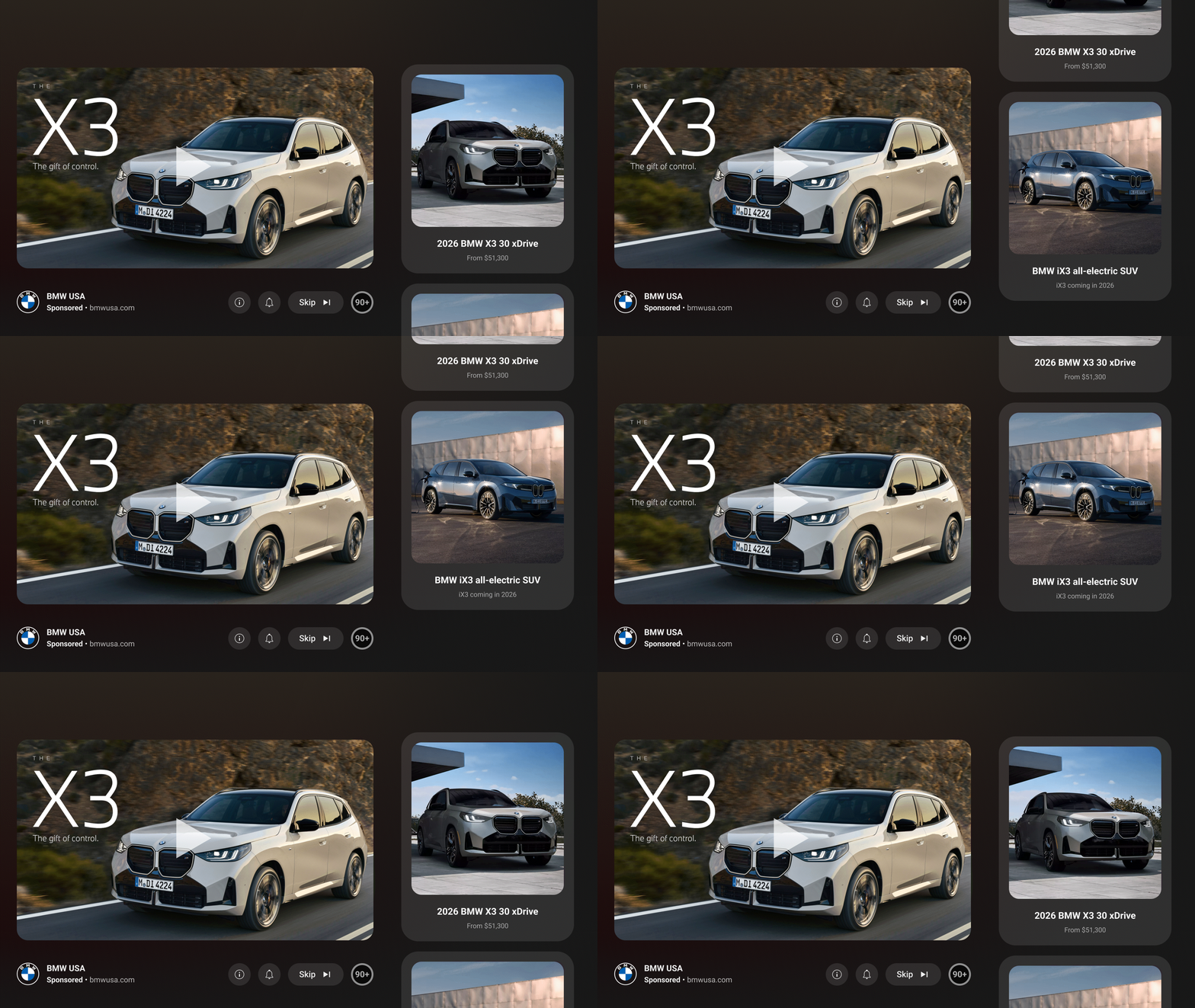
The performance case for this expansion rests on a data point Google disclosed today. According to internal Google data from May to June 2025, advertisers with large product selections - defined as campaigns active since Q1 2024 with more than 50 products in their merchant feed - typically see a 33% increase in conversions when adopting product feeds in their Demand Gen campaigns. That figure had been cited in Google's retail advertising briefings in the months before GML 2026, and was confirmed in detailed discussion on PPC Land's retail ad playbook coverage from April 2026. For automotive advertisers, who frequently maintain inventory feeds of hundreds or thousands of individual vehicle listings, the structural parallel to retail product feeds is direct.
The mechanics work as follows: advertisers upload videos to Google Merchant Center, and those videos are then dynamically distributed across Demand Gen campaigns based on real-time user interest signals. This shifts the creative workflow for automotive advertisers, who no longer need to manually assign videos to specific ad groups or placements - the system draws from the Merchant Center inventory and routes assets based on the signals available at the moment of auction.

AI-assisted Demand Gen campaign creation
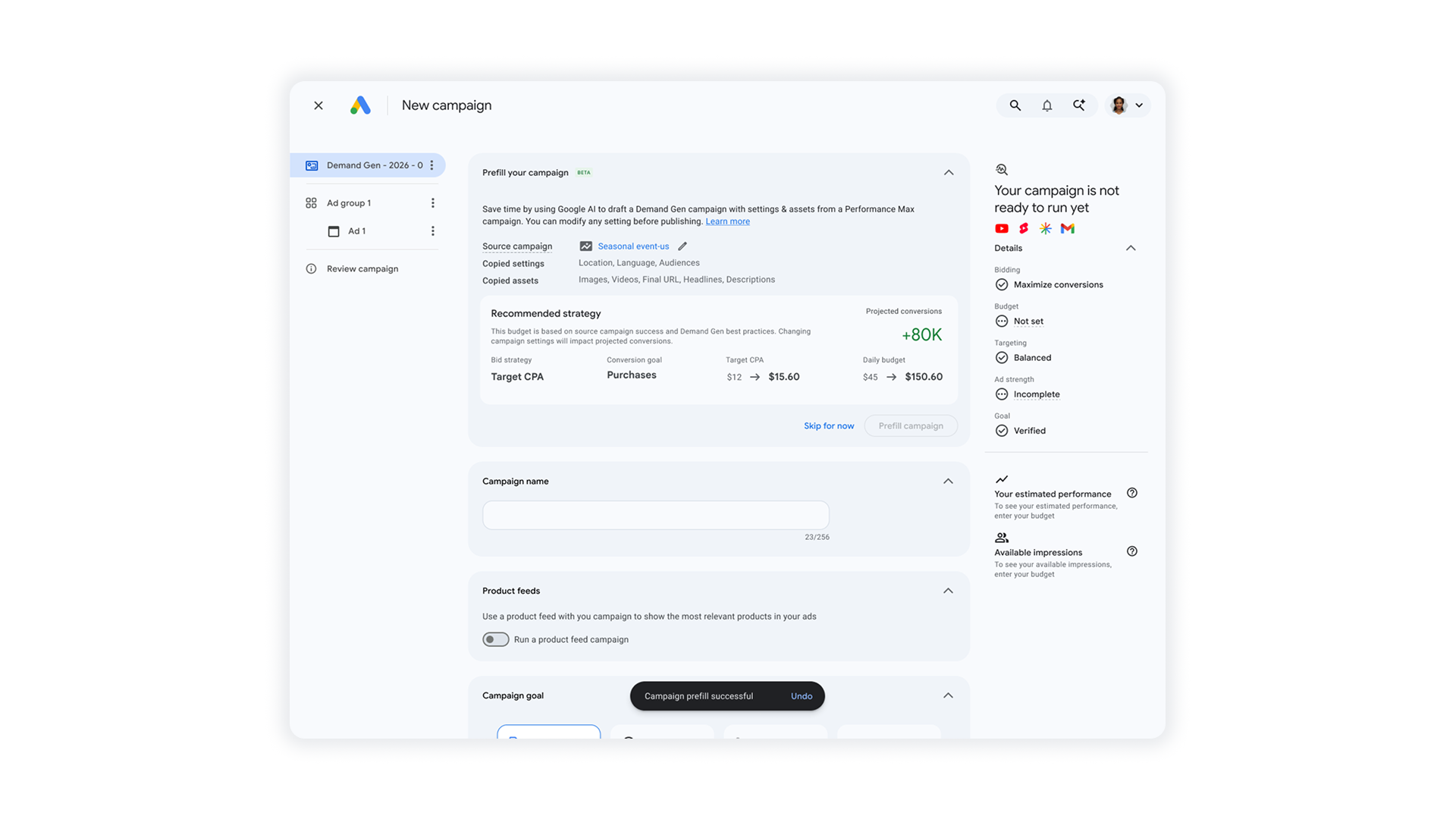
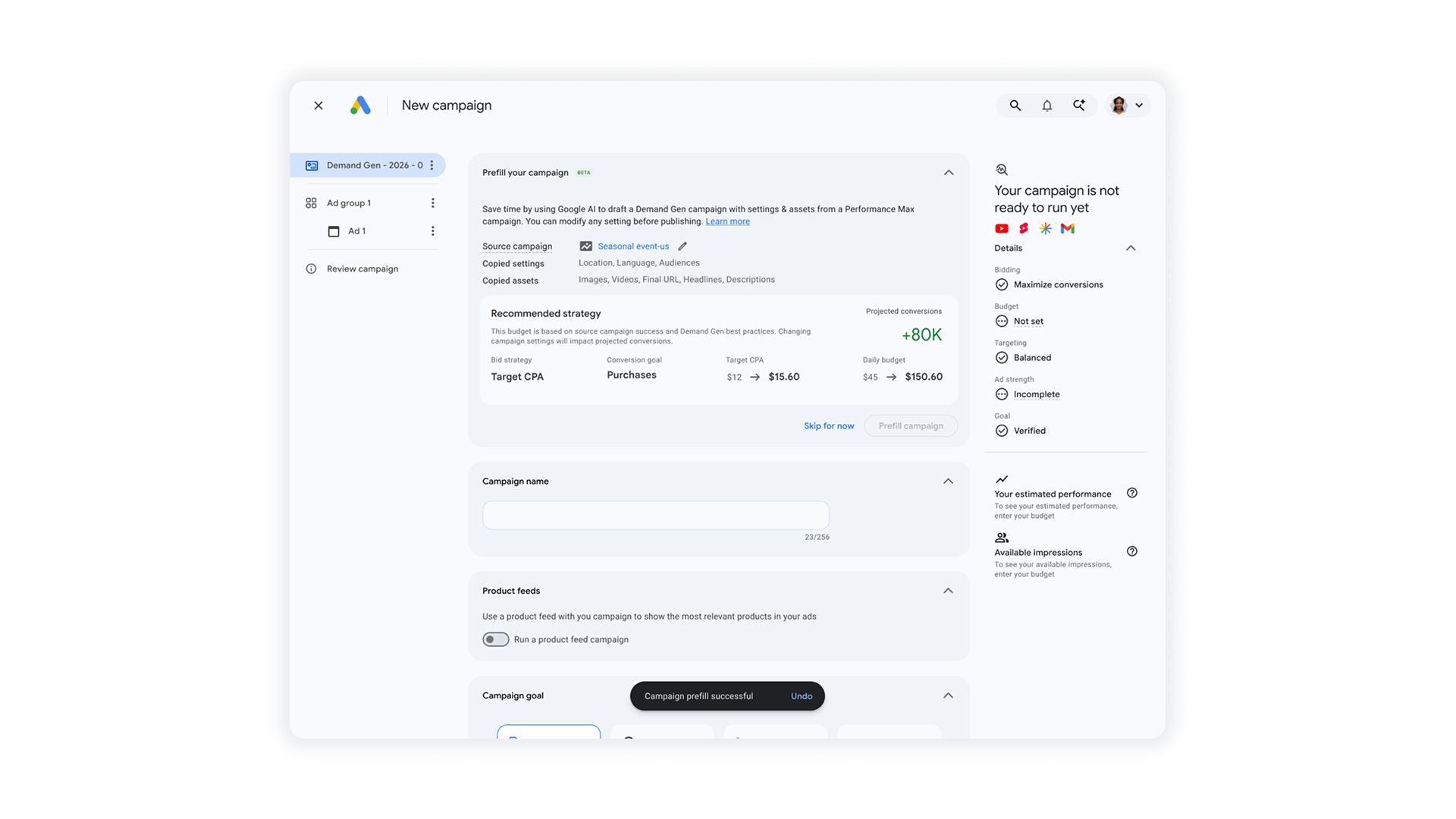
A second major announcement concerns the campaign creation flow. Google today introduced AI-assisted Demand Gen campaign creation, which allows advertisers to build a new Demand Gen campaign by pulling settings from an existing Performance Max campaign. The interface, shown in screenshots accompanying today's materials, presents a "Prefill your campaign" option in beta. When activated, it copies settings including location, language, and audiences, and also copies creative assets such as images, videos, final URLs, headlines, and descriptions.
The interface displays a "Recommended strategy" panel that uses the source campaign's historical performance to project conversion outcomes if the suggested configuration is adopted. In the screenshot provided by Google, this panel shows a recommendation to shift from a Target CPA of $12 to $15.60, with a daily budget increase from $45 to $150.60, with a projected uplift of more than 80,000 conversions. This is presented as a data-driven recommendation, not an automatic change - the advertiser retains the ability to modify any setting before publishing.
The campaign source selector also distinguishes between "Recommended campaigns" - those Google's system identifies as closest in goal and audience alignment to the new Demand Gen campaign - and "Other available campaigns," which lists additional options an advertiser may draw from.
This workflow addresses a practical friction point. Advertisers running Performance Max for direct response and Demand Gen for upper-funnel activity have traditionally had to build each campaign independently. The prefill approach effectively uses Performance Max as a source of structured, high-quality inputs for a Demand Gen setup, rather than starting from a blank configuration. PPC Land's coverage of the Google Power Pack strategy from September 2025documented how Google began formally positioning this Performance Max and Demand Gen combination as a recommended portfolio architecture, and today's campaign creation update is a direct tooling manifestation of that positioning.
Checkout links expand to nine new markets
Beyond inventory and creative, Google today announced the expansion of checkout links within Demand Gen to nine new markets. The original accelerated checkout experience for Demand Gen, which launched for US advertisers in April 2025, allows advertisers to redirect users from a product ad to a checkout page, bypassing intermediate browsing stages. According to Google's internal data from February 2025, advertisers providing checkout URLs saw an average 11% increase in conversion value at similar CPA.
The nine additional markets were not individually named in today's announcement materials, but the expansion follows the Universal Commerce Protocol rollout pattern, which is targeting Canada and Australia first, then the UK, in the coming months. The checkout link expansion is distinct from UCP-powered native checkout - it operates through URL redirects rather than through an embedded checkout experience - but the two features serve adjacent goals: reducing the number of steps between ad exposure and completed purchase.
Creator video boosting enters the asset picker
A smaller but practically significant feature announced today concerns creator partnership content. Advertisers can now boost authentic creator partnership videos directly within the asset picker during Demand Gen campaign setup, rather than having to first publish the video through a separate channel or asset upload process. This brings influencer and creator content into the core campaign workflow rather than treating it as an exceptional asset type.
The integration connects to Google's broader positioning of YouTube creators as a growth lever for brands. According to YouTube internal data from December 2025 covering 63 brands in the US, users who viewed an organic brand video were 13 times more likely to conduct a branded search and 5 times more likely to make a purchase, though Google notes this was observational traffic data and does not indicate a causal relationship.
New measurement capabilities
Three measurement additions round out the Demand Gen announcements. Campaign Type Attribution allows advertisers to isolate all conversions attributed to Demand Gen, enabling performance comparisons against paid social channels on a like-for-like basis. This is a recurring request from practitioners who have struggled to justify Demand Gen budgets against Meta or TikTok benchmarks using blended attribution that spreads conversion credit across campaign types.
Uplift Experiments offer a more structured approach to measuring how Demand Gen activity complements Performance Max. Rather than a simple holdout, Uplift Experiments measure incremental lift from Demand Gen within an account that is already running Performance Max, which addresses the concern that Demand Gen and Performance Max may cannibalize each other's attributed conversions when they operate in parallel.
Third, Google announced expanded integrations with privacy-safe third-party partners, naming TransUnion specifically. The TransUnion integration allows advertisers to connect YouTube ad exposure to business outcomes across their full media mix, not just outcomes directly attributable to a click or a view-through conversion within Google's system. This kind of external linkage addresses measurement gaps that arise when a significant portion of a brand's customer base watches YouTube on television, where standard conversion tracking does not apply.
Multimodal video creation in Asset Studio
Demand Gen campaigns will also benefit from an Asset Studio update announced separately at GML 2026. Asset Studio now integrates Gemini Omni, described by Google as a new multimodal model. Advertisers can use text prompts to generate video assets directly within Asset Studio, rather than uploading pre-produced video files. The output can then be refined with additional prompts, and tested using 1-Click Creative Testing, which evaluates asset variants against each other based on performance goals.
The multimodal video creation feature is rolling out globally in English in summer 2026. For Demand Gen specifically, the integration means that advertisers who previously lacked video production resources can now generate YouTube-eligible video assets directly within Google Ads, reducing a barrier that historically favoured large advertisers with production budgets.
Context and market significance
Demand Gen has been central to Google's visual advertising strategy since it replaced YouTube Video Action campaigns. Google phased out YouTube Video Action ads for Demand Gen across Display & Video 360 beginning in early 2025, completing a transition that began in late 2024. The format now reaches more than 3 billion monthly users across its surfaces, according to Google's own figures, though that number aggregates across YouTube, Discover, Gmail, and - as of today - Maps.
The second half of 2025 produced a 30% increase in conversions or conversion value for Demand Gen advertisers on average, according to an internal Google experiment covering H2 2025 campaign data globally. That improvement was attributed to hundreds of incremental product improvements introduced during the period. Today's updates extend that trajectory into new verticals and markets, and introduce tooling that reduces the effort required to launch and measure campaigns correctly.
For the marketing community, the practical import of today's announcements falls into three areas. First, automotive advertisers now have a product feed pathway into Demand Gen that mirrors what retail advertisers have used since the format launched. Second, the AI-assisted campaign creation lowers the setup barrier for advertisers who have existing Performance Max campaigns and want to extend into upper-funnel YouTube and Discover placements without rebuilding their audience and asset configuration from scratch. Third, the new measurement tools - Campaign Type Attribution and Uplift Experiments - give practitioners cleaner data to evaluate Demand Gen's contribution to business outcomes, which has been a persistent challenge for a format that spans both brand-building and conversion objectives.
The November 2025 Demand Gen holiday features update introduced inventory type controls and brand safety parameters that gave advertisers more placement transparency. Today's GML 2026 package builds on that layer by adding new surfaces, new verticals, and measurement infrastructure designed to make Demand Gen easier to evaluate alongside both Google-native and off-platform media investments.
Timeline
- August 2024 - PPC Land documents Demand Gen ad specifications and placement mechanics as the format matures on Google Ads
- September 2024 - Google expands Demand Gen campaigns to Display & Video 360 with October 2024 rollout
- February 2025 - Google clarifies distinct roles of Performance Max and Demand Gen, establishing separate optimization models for each campaign type
- February 2025 - Channel placement controls arrive for Demand Gen campaigns, with granular YouTube, Discover, and Gmail controls
- March 2025 - DV360 introduces granular inventory source controls for Demand Gen line items at ad group level
- April 2025 - Google phases out YouTube Video Action campaigns; Demand Gen becomes the primary visual campaign type in DV360
- April 2025 - Google launches accelerated checkout for US Demand Gen campaigns, producing 11% conversion value lift
- June 2025 - YouTube follow-on views optimization launches in Demand Gen campaigns
- September 2025 - Google announces Power Pack strategy combining AI Max, Performance Max, and Demand Gen
- November 2025 - Google launches four new Demand Gen features for the holiday campaign season, including inventory type controls and brand safety parameters
- April 2026 - Google's 2026 retail ad playbook documents product feed integration and 33% conversion uplift from feeds
- May 20, 2026 - Google Marketing Live 2026: Google announces Demand Gen expansion to Google Maps, product feeds for automotive, AI-assisted campaign creation from Performance Max, checkout links in nine new markets, Campaign Type Attribution, Uplift Experiments, and TransUnion integration
Summary
Who: Google, through its Google Ads and Commerce team led by VP/GM Vidhya Srinivasan, announced the updates. The features affect all advertisers globally running Demand Gen campaigns, with certain features - checkout link expansion, automotive product feeds, AI-assisted campaign creation - relevant to specific verticals and account configurations.
What: A package of Demand Gen updates announced at Google Marketing Live 2026 on May 20, 2026. The updates include: Google Maps as a new ad inventory surface within Demand Gen; product feed expansion to automotive; AI-assisted campaign creation that copies settings and assets from an existing Performance Max campaign; checkout links expanded to nine new markets; creator video boosting within the asset picker; Multimodal video creation via Gemini Omni in Asset Studio; and new measurement tools including Campaign Type Attribution, Uplift Experiments, and a TransUnion integration for cross-channel outcome measurement.
When: The announcement was made on May 20, 2026 at Google Marketing Live 2026. The Google Maps inventory surface and AI-assisted campaign creation are rolling out as part of a global open beta. Asset Studio multimodal video creation is rolling out globally in English in summer 2026.
Where: The features apply to Demand Gen campaigns within Google Ads globally, with some features - including checkout link expansion and certain measurement integrations - rolling out in specific markets in phases.
Why: Google's updates respond to two persistent gaps in Demand Gen's position in the market. First, the format's reach has been limited compared to social platforms by the absence of certain high-value inventory surfaces; the Maps addition and automotive feed support address specific vertical and placement gaps. Second, the measurement challenges that have made it difficult to compare Demand Gen performance to paid social on a like-for-like basis are partially addressed by Campaign Type Attribution and Uplift Experiments, which provide cleaner attribution at the campaign type level. The AI-assisted campaign creation reduces setup friction for advertisers who have already built Performance Max configurations and want to extend into Demand Gen without duplicating asset and audience work.


Discussion