Google's Merchant Center for Agencies goes live in the US and Canada
Google launched Merchant Center for Agencies on March 11, 2026, giving digital marketing firms a single dashboard to manage all client accounts, diagnostics, and ad opportunities.


Google launched Merchant Center for Agencies on March 11, 2026, giving digital marketing firms a single dashboard to manage all client accounts, diagnostics, and ad opportunities.
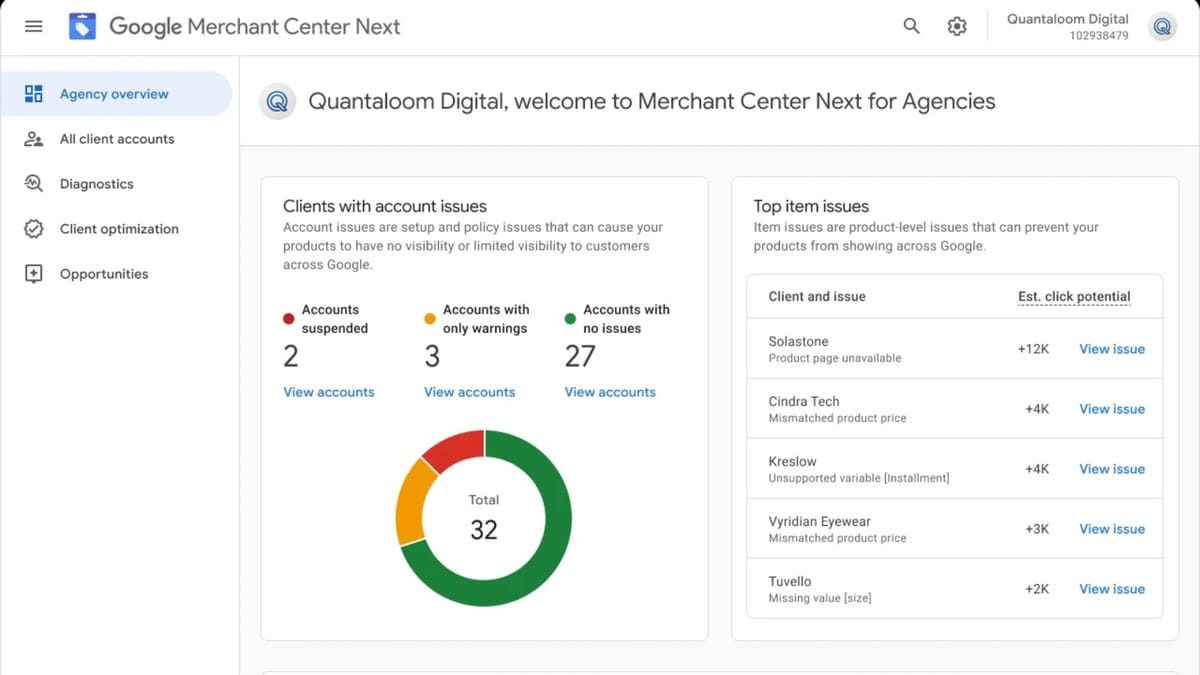
Google this week made Merchant Center for Agencies generally available in the United States and Canada, giving digital marketing firms a dedicated interface to oversee multiple client product accounts from a single login. The announcement, dated March 11, 2026, was published in the Google Merchant Center Help Center and confirmed the same day by the Google Ads Liaison account on Bluesky at 16:37 UTC.
The launch marks a shift from the existing model where agencies relied on Multi-Client Accounts (MCA) - a structure documented in the Merchant Center Next glossary published in December 2024 - to manage product data across several clients. That system, while functional, placed the burden of account navigation and issue tracking on individual users moving between accounts manually. The new platform consolidates that workflow into a purpose-built environment.
According to Google's official announcement, "Merchant Center for Agencies is now generally available in the U.S. and Canada" as of March 2026, with a pilot program running globally for agencies outside those two markets. Agencies that do not currently hold an agency account must contact Google directly to request access. Existing agency account holders can access the interface at merchants.google.com, where the agency view becomes the default.
The architecture of Merchant Center for Agencies centers on four functional areas: an agency overview page, a diagnostics page, a client optimization page, and an ads opportunities page. Each serves a distinct operational purpose, and their combination is what differentiates this interface from standard multi-account access.
The agency overview page provides a portfolio-level snapshot. According to Google's documentation, it surfaces summary statistics on account statuses, issues, and diagnostics, alongside a quick view of up to five "starred" accounts. Starred accounts can be flagged for priority access - a feature designed to reduce time spent navigating to frequently monitored clients. The overview also flags accounts showing significant changes in key metrics, including clicks and disapprovals, allowing teams to identify movement without opening each account individually.
The diagnostics page goes deeper. It surfaces specific problems across all client accounts simultaneously and allows filtering by client, country, or marketing method. Critically, it introduces a metric called "click potential" - an estimate of how many additional clicks could be recovered by resolving a given issue. This is not a new concept within Merchant Center; earlier coverage of Merchant Center's AI-powered search filters from May 2025 noted that click potential was already being used at the product level to help merchants prioritize fixes. Merchant Center for Agencies extends that logic to the agency tier, enabling teams to rank issues across their entire portfolio by estimated traffic impact rather than treating all warnings as equal.
The client optimization page handles a different category of operational need. It allows agency teams to create and monitor promotions by filtering for specific merchants and organizing those promotions by approval status - whether approved, under review, or not approved. The page also monitors out-of-stock products across the merchant portfolio, with a "Share report" feature that allows teams to notify individual clients directly about restocking needs. Store quality scores and shipping and return settings can be reviewed from the same interface. This is particularly relevant given the mandatory product ID changes that took effect in March 2026, requiring separate identifiers for online and in-store versions of the same product - a technical change that adds complexity to managing client product data at scale.
The fourth component - the ads opportunities page - is the most technically involved. It targets what Google calls "Low Traffic Products": products in client catalogs that are not receiving ad clicks. The page aggregates these product lists across all clients and allows filtering by criteria such as "Low price" or "Trending brand." According to Google's documentation, the goal is to identify inventory with high growth potential that is currently absent from campaign reach.
The page includes a campaign integration via labeling feature. This workflow allows agencies to act on low-traffic product data directly within their clients' Google Ads campaigns, without needing to manually export and reformat data. The process begins when the agency selects a client row, accesses the low traffic products page, and chooses to label either all products or a specific subset. Selecting "Label" triggers the creation of a new supplemental source - a spreadsheet-based data source that is automatically created and linked to the client's selected primary source. The system applies custom label values to the targeted products, which then appear in both Merchant Center and Google Ads. In Google Ads, those labeled products become filterable when setting up or modifying Shopping campaigns.
This labeling mechanism connects to the advanced data management tools introduced in July 2024, which first brought supplemental data sources and attribute rules into Merchant Center Next as part of a broader push toward programmatic product data management. Agencies using the new labeling workflow are, in effect, using that supplemental source infrastructure to push campaign targeting logic without leaving the agency interface.
After the labeling workflow completes, the supplemental source and its associated spreadsheet are visible in the client's Merchant Center under Settings > Data Sources > Supplemental Sources tab. The default rule in the primary source - accessible under Settings > Data Sources > Primary Sources > Attribute Rules > All Other Attributes - automatically reflects the new supplemental source connection. Google's documentation notes that additional changes to the exported products and custom labels can be made by modifying the exported spreadsheet directly.
According to Google's documentation, Merchant Center for Agencies is available exclusively to agencies that manage Google Merchant Center accounts for other businesses. It is not intended for individual merchants managing their own accounts. New users must request an agency account by contacting Google. There is no self-serve sign-up pathway described in the current documentation. Product support requests also go through Google's contact process.
The geographic scope at general availability is limited to the United States and Canada. The global pilot exists but its terms - which markets are included, how many agencies have access, and what functionality is available in pilot regions - are not specified in the current documentation.
The timing of this launch carries some significance. March 2026 has been a dense month for Merchant Center-related developments. On March 2, 2026, Google published its UCP checkout help page, providing the first detailed technical documentation on how merchants can integrate with Universal Commerce Protocol-powered checkout in AI Mode and Gemini. Days later, on March 6, 2026, a documented incident involving an agency closure wiped a client's Merchant Center account entirely - a case that illustrated the structural risks in how agencies interact with client accounts under the existing access model.
That incident, documented by Emmanuel Flossie of FeedArmy, exposed a gap in the current Multi-Client Account structure: an agency that had retained super admin privileges on a client account from six years prior was able to close the account simply by closing its own. The resulting data loss affected feeds, Google Ads links, and the entire product data foundation for the client's Shopping campaigns. The case prompted immediate calls for better access control hygiene. Merchant Center for Agencies does not directly address the super admin vulnerability Flossie described - that remains an issue in the underlying account permission model - but it does offer agencies a structured operational environment that is separate from the administrative chaos that can emerge in shared-access MCA setups.
The Merchant Center Next rollout, completed in August 2024, set the technical foundation on which this agency layer is built. The transition replaced "Feeds" with "Data Sources," renamed "Diagnostics" to "Needs Attention," and consolidated analytics into a single Performance tab. Merchant Center for Agencies sits on top of that infrastructure, adding the portfolio view and the cross-account diagnostics that individual Merchant Center accounts lack.
The Merchant API launched in August 2025 signaled Google's direction: programmatic access to Merchant Center data at scale, with a shutdown date of August 18, 2026 for the Content API for Shopping. Agencies building internal tools on top of Merchant Center data will eventually need to migrate to the Merchant API. The new agency interface addresses operational workflows at the human level; the API addresses them at the automation level. Both are part of the same platform consolidation.
Feed reliability also remains a live concern. A January 2026 analysis documented a nine-day gap between Google's stated 24-hour automatic import refresh cycle and actual update behavior - a discrepancy with direct consequences for remarketing campaigns. The diagnostics page in Merchant Center for Agencies, which surfaces item-level issues across all client accounts, could help agency teams identify feed staleness problems faster than navigating individual accounts. Whether it catches refresh delays specifically is not detailed in the current documentation.
The launch comes at a moment when multi-account management tooling is expanding across the advertising ecosystem. Google released an open-source Model Context Protocol server for the Ads API in October 2025, enabling AI tools to query advertising campaign data through natural language interfaces - a development with clear implications for agencies managing large numbers of accounts. Cross-account bid strategies have been available in Google Ads since 2021 for Search and Shopping. The agency layer in Merchant Center represents Google extending the same multi-account logic to the product data side of the advertising equation.
For agencies operating at scale - managing dozens or hundreds of client Merchant Center accounts - the practical value lies in the diagnostics and opportunities pages. The ability to filter issues by click potential across the entire portfolio, rather than opening each account to check its Needs Attention tab, reduces the manual overhead of account health monitoring. The ads opportunities workflow, which connects low-traffic product identification to supplemental source creation and Google Ads campaign setup, closes a loop that previously required exporting data, reformatting it, and uploading it manually.
Whether the platform delivers on its stated operational efficiency gains will depend on adoption rates and how agencies integrate it into existing workflows. The general availability in the US and Canada provides the largest agency markets access to the system first. The global pilot extends reach, but without clarity on which markets are included, agencies outside North America cannot yet plan implementation timelines.
Who: Google, digital marketing agencies operating in the United States and Canada, and their retail clients using Google Merchant Center.
What: Google launched Merchant Center for Agencies, a dedicated interface that consolidates account management, diagnostics, client optimization, and advertising opportunity identification across an agency's entire client portfolio into a single login. Key features include a portfolio-level overview page, a cross-account diagnostics tool with click potential prioritization, a client optimization page for promotions and stock monitoring, and an ads opportunities workflow that connects low-traffic product identification to Google Ads campaign labeling via supplemental sources.
When: March 11, 2026. The platform is generally available in the US and Canada as of this date, with a global pilot running simultaneously.
Where: Accessible at merchants.google.com for existing agency account holders. New agencies must request account creation through Google's contact process. The general availability is limited to the US and Canada; a global pilot extends access to other markets on unspecified terms.
Why: Agencies managing multiple Merchant Center accounts previously relied on Multi-Client Account structures requiring manual navigation between individual accounts to monitor health, resolve issues, and identify campaign opportunities. The new platform centralizes those tasks, reducing the operational overhead of account management at scale and introducing cross-account prioritization tools - such as click potential ranking - that were previously available only at the individual account level.