Google today expanded beta access to text guidelines for all advertisers globally across AI Max for Search and Performance Max campaigns, removing the previous restricted rollout that had limited the feature to a subset of accounts since its initial introduction in September 2025.
The announcement came from Rushil Grover, Group Product Manager at Google Ads, in a post published February 26, 2026 on the Google Ads and Commerce Blog. The update brings with it full language and vertical support, meaning advertisers outside English-speaking markets can now apply the controls to campaigns running in any language available within the Google Ads interface.
What text guidelines actually do
At its core, text guidelines is a campaign-level feature designed to constrain what Google's AI generates when text customization is switched on. Without it, AI-generated headlines and descriptions reflect whatever the system determines is likely to perform best - which is not always aligned with what a brand wants to say, or how it wants to say it.
According to Google's official documentation, the feature offers two distinct mechanisms. The first is term exclusions: exact words or phrases that must not appear in any AI-generated asset. Term exclusions are not case sensitive. Advertisers can add up to 25 per campaign. Examples cited in the documentation include single words like "Cheap" or "Unlimited," as well as longer phrases such as "Cheapest in Paris" or "A better choice than Competitor."
The second mechanism is messaging restrictions, a more flexible tool that accepts natural language instructions about tone, style, or content themes. Up to 40 restrictions can be added per campaign. According to the documentation, effective examples include directives like "Don't imply our products are discounted" and "Always include 'T&C apply' if mentioning a promo." The feature interprets intent rather than performing literal string matching, meaning a restriction about avoiding "discounted" language will also suppress related terms like "cheap" and "bargain."
There is an important distinction between how these two mechanisms handle multiple languages. Term exclusions are language-specific - excluding the English word "Cheap" will not prevent its Japanese equivalent from appearing if the campaign runs in Japanese. Messaging restrictions, however, cross language boundaries. According to the documentation, a restriction written in English applies to German and Dutch assets within the same campaign.
Hard limits matter here
Several constraints shape what the feature can and cannot do. Term exclusions cannot prevent assets with prices from being generated. Excluding the "$" symbol will not stop an asset reading "Shoes for less than $50" from appearing. For price-related controls, the documentation directs advertisers toward messaging restrictions instead, specifically the instruction "Don't generate assets with prices."
Restrictions that contain multiple separate instructions bundled into a single entry are flagged as ineffective. Breaking requirements into separate guidelines produces better results. The documentation also warns against vague or subjective instructions - "My ads should bring joy" is cited as an example of a restriction unlikely to produce consistent outcomes. Audience or keyword targeting guidance - such as "Don't target purely informational queries" - falls outside what the feature supports, since it governs asset generation, not campaign targeting.
There is also a performance risk to bear in mind. According to the documentation, "Adding inefficient or counterintuitive guidelines may cause removal of a large number of good text customization assets, and lead to drop in campaign performance." Existing Google-optimized text assets that do not comply with newly added guidelines will stop serving and be marked as removed.
BYD numbers cited as early evidence
In the February 26 blog post, Grover cited the electric vehicle manufacturer BYD as an early adopter. According to the announcement, BYD used text guidelines controls in AI Max and "increased leads by 24% at a 26% lower cost." The post does not specify the time period over which those results were measured or provide information about the control conditions used for comparison.
How to enable it in each campaign type
The setup process differs between Performance Max and Search campaigns with AI Max.
For Performance Max, text guidelines sit within the brand guidelines section of campaign settings, under "Brand identity." Advertisers who have not yet enabled brand guidelines at the campaign level must first complete that step - either by following the upgrade path described in Google's documentation or by contacting a Google representative. Text guidelines can also be reached through the asset optimization panel in the asset group step when creating a new campaign.
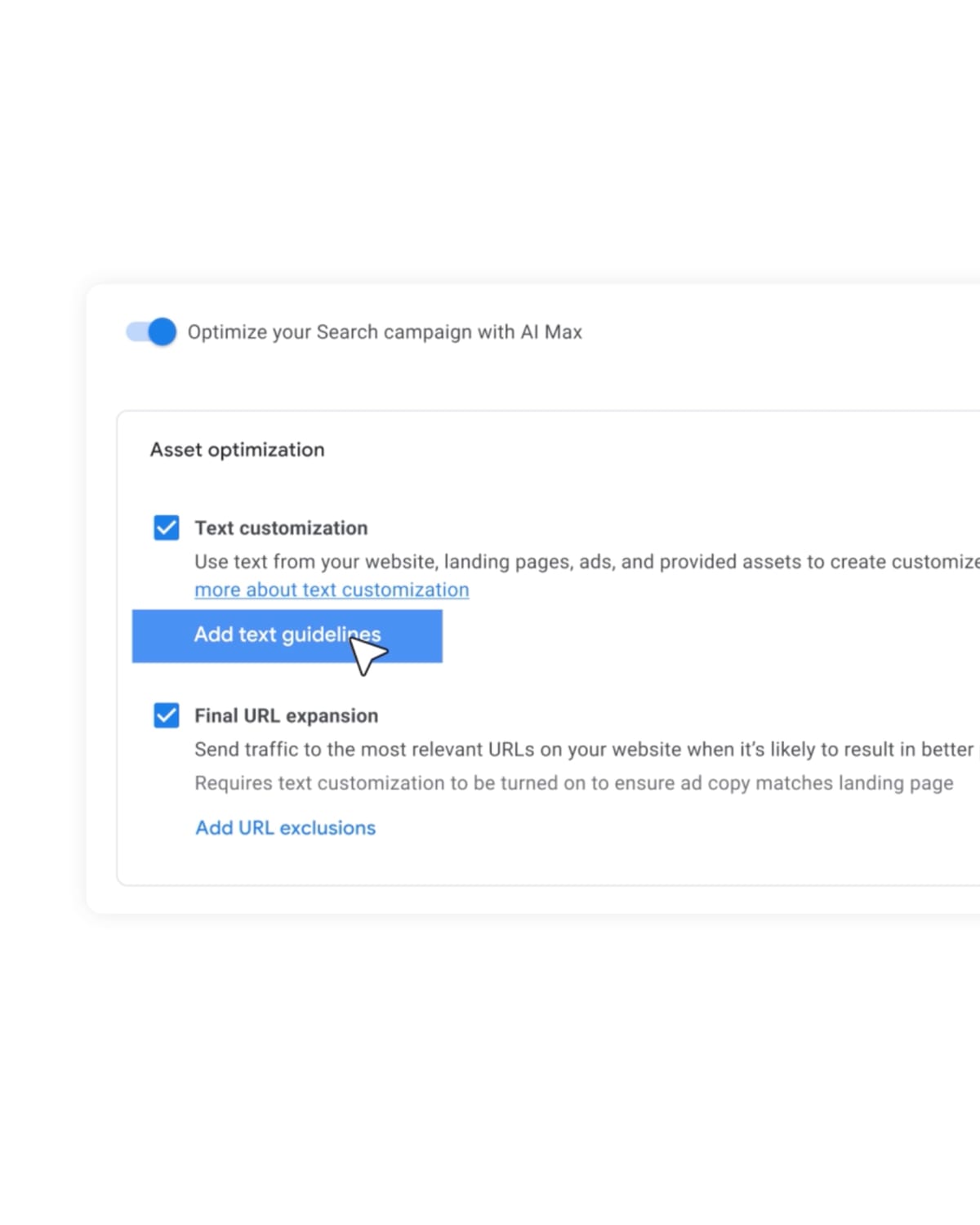
For Search campaigns, the prerequisite is opting in to AI Max. Once AI Max is toggled on, text customization is enabled by default. The text guidelines option then appears beneath the asset optimization panel. Both new and existing campaigns can be configured this way. To verify that guidelines are correctly applied, the documentation points advertisers to asset reporting - specifically the Google-optimized text assets review process described for each campaign type.
The expansion follows a progression of brand control features Google has layered onto its automated campaign formats over the past two years. The Performance Max brand guidelines rollout completed in July 2025, shifting business name and logo management from the asset group level to the campaign level. Text guidelines were first announced at Think Week 2025 in September, when Google also launched Asset Studio and expanded AI Max availability. Before that, Google Ads Editor 2.10 introduced AI Max to the desktop application in July 2025, and the Google Ads API v21 added programmatic AI Max support in August 2025.
Each of these steps has addressed a recurring complaint from advertising professionals: that automated campaign types generate output that is difficult to predict and harder to constrain. Independent testing published in November 2025 found that AI Max delivered conversions at approximately 35% lower return on ad spend than traditional match types in an analysis covering more than 250 retail campaigns. Concerns about attribution transparency have also surfaced. Google clarified in December 2025 that AI Max determines relevance through inferred user intent rather than raw text matching, following questions raised by advertising professional Brad Geddes about search term reporting anomalies.
Text guidelines address a narrower problem than those broader performance and attribution questions. The feature controls what language appears in AI-generated ad copy - it does not govern where ads serve, which queries trigger them, or how the system attributes conversions. For advertisers whose primary concern is brand voice and language consistency, the global expansion is meaningful. For those still evaluating whether AI Max or Performance Max meets performance benchmarks, the control layer does not change the underlying optimization mechanics.
The Power Pack strategy announced in September 2025 frames AI Max, Performance Max, and Demand Gen as complementary parts of a single approach. Text guidelines fit within that framing as the mechanism through which brand safety standards are maintained while automation handles targeting and bidding decisions. The question for many advertisers remains whether tighter creative controls produce measurably better outcomes, or whether the performance of AI-generated assets is primarily a function of training signals rather than language restrictions.
Google's documentation is clear that this is still a beta. The company notes that "text guidelines is an experimental beta" and that "there may be some limitations to its capabilities." The global expansion removes the previous access restriction, but the experimental classification suggests that the feature's behavior and capabilities may continue to change.
Timeline
- January 20, 2025 - Google begins requiring brand guidelines for new Performance Max campaigns created through the UI
- May 6, 2025 - Google announces AI Max for Search campaigns, entering global open beta
- July 8, 2025 - Google Ads Editor 2.10 released with AI Max features and campaign-level negative keywords for Performance Max
- July 14, 2025 - Google completes Performance Max brand guidelines rollout for all new UI campaigns
- August 6, 2025 - Google Ads API v21 introduces AI Max support and campaign transparency tools
- August 7, 2025 - Google wraps up 2025 Performance Max feature rollouts
- September 10, 2025 - Text guidelines introduced for AI Max and Performance Max campaigns at Think Week 2025
- September 16, 2025 - Google announces Power Pack strategy combining AI Max, Performance Max, and Demand Gen
- November 8, 2025 - Independent tests across 250+ campaigns show AI Max delivering 35% lower ROAS than traditional match types
- December 13, 2025 - Google clarifies AI Max attribution discrepancies following advertiser concerns over search term reporting
- January 14, 2026 - Google enables account-level placement exclusions across Performance Max, Demand Gen, YouTube, and Display
- January 28, 2026 - Google Ads API v23 introduces channel-level reporting for Performance Max
- February 26, 2026 - Google expands text guidelines beta to all advertisers globally, with full language and vertical support for AI Max and Performance Max campaigns
Summary
Who: Google, announced by Rushil Grover, Group Product Manager at Google Ads, via the Google Ads and Commerce Blog. Ginny Marvin, Ads Product Liaison at Google, amplified the announcement on LinkedIn. All advertisers globally using AI Max for Search and Performance Max campaigns are affected.
What: Google expanded beta access to text guidelines - a campaign-level feature offering two controls over AI-generated ad copy: term exclusions (up to 25 per campaign) and messaging restrictions (up to 40 per campaign). The update adds full language and vertical support, removing previous limitations in the restricted rollout.
When: The global expansion was announced on February 26, 2026. The feature was originally introduced for a limited set of advertisers in September 2025 following its announcement at Think Week 2025.
Where: The feature is available within the Google Ads interface for Performance Max campaigns, accessible through brand guidelines in campaign settings, and for Search campaigns through the AI Max settings panel. It applies globally across all languages supported by Google Ads.
Why: The expansion addresses advertiser demand for greater control over AI-generated ad copy in automated campaign types. As Google has pushed AI Max and Performance Max as its primary growth products, brand safety and language consistency concerns have grown among marketing professionals. Text guidelines allow advertisers to define what language must not appear in generated assets, without requiring them to manually create every headline and description.
Share this article
The link has been copied!