How Google's AI agent will change search forever
Marie Haynes explains how Google is becoming an AI agent, not a search engine—and what this fundamental shift means for SEO professionals and marketers.


Marie Haynes explains how Google is becoming an AI agent, not a search engine—and what this fundamental shift means for SEO professionals and marketers.
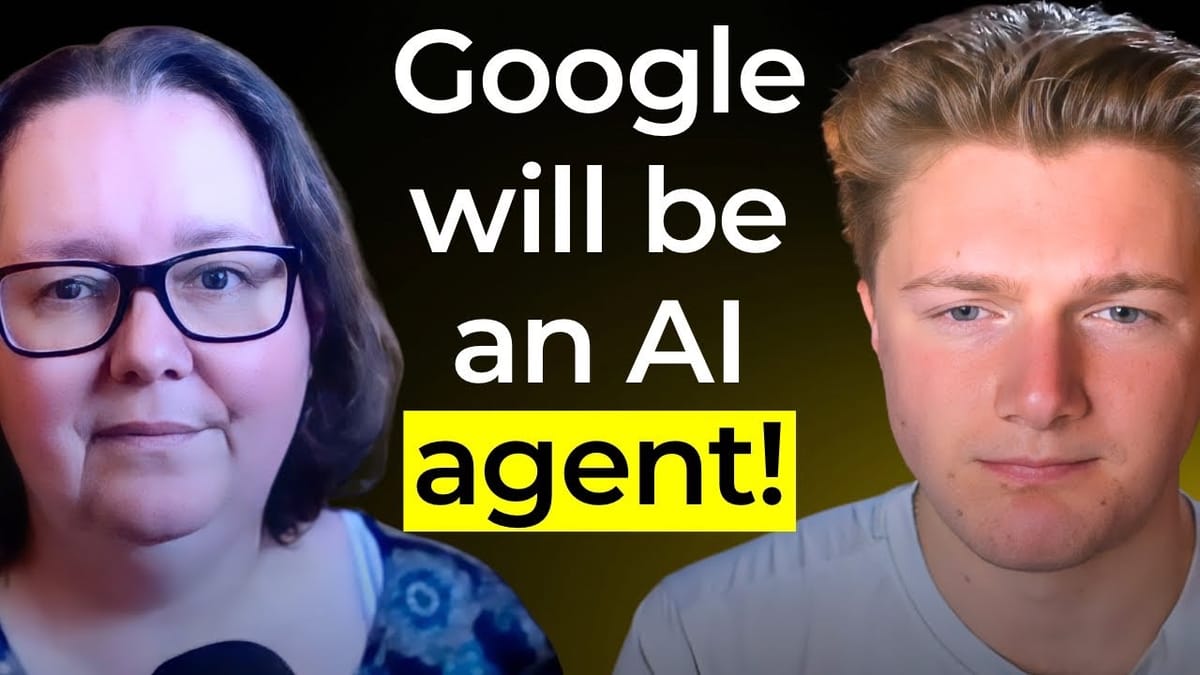
Google is no longer just a search engine. Marie Haynes, one of the most respected voices in search engine optimization, explained in a December 2025 interview how the company is fundamentally transforming into an AI agent that makes decisions on behalf of users rather than simply presenting ranked links.
Haynes has spent more than 16 years studying Google's algorithms. She began as a veterinarian before pivoting to SEO consulting following the Penguin algorithm update on April 24, 2012. Her career trajectory changed dramatically when Danny Sullivan, then Google's Public Search Liaison, reached out to her and a small group of experts in 2022 to discuss a new algorithmic approach that would become the Helpful Content system.
That conversation marked the beginning of Haynes' intensive focus on artificial intelligence's role in search. The Helpful Content system, launched in August 2022, represented Google's explicit use of machine learning to evaluate website quality. By March 2024, Google had absorbed those signals directly into its core ranking algorithms, eliminating the separate system entirely.
The shift toward AI-powered ranking began earlier than most SEO professionals realized. According to Haynes, the transformation started in February 2017 with an undocumented algorithm change that affected primarily "your money or your life" content—websites covering health, finance, and other topics with significant real-world impact.
"Around that time we had just gotten access to Google's quality raters guidelines," Haynes explained, referencing the internal documentation that Google uses to train human evaluators who assess search result quality. The guidelines emphasized expertise, authoritativeness, and trustworthiness—concepts that would later evolve into the E-E-A-T framework (Experience, Expertise, Authoritativeness, and Trustworthiness).
The February 2017 change preceded the August 2018 "Medic" update by more than a year. That widely-discussed update amplified patterns Haynes had already identified: websites demonstrating clear expertise in sensitive topics gained visibility, while sites lacking demonstrated authority lost rankings dramatically.
"This is my opinion. I can't point to something from Google to say this, but this is when Google said they started going AI first when none of us really were talking about AI," Haynes stated. She noted that Google had been incorporating AI components since 2015, when the company announced RankBrain, a machine learning system that processes user queries to determine relevance.
The Department of Justice versus Google antitrust trial revealed significant technical details about these systems. Testimony from Google witnesses described how AI systems continuously learn from every search interaction, similar to how a person learns to look both ways before crossing any street after almost being hit by a car on their own street.
Google stores every search query and the actions users take after clicking results. This data populates a system called NavBoost, which has existed since before modern AI became widespread. NavBoost tracks whether users click on results, how long they stay on pages, and whether they return to search results to try another option.
"Every single search that you do on Google, Google stores the search query and they store the actions of the users," Haynes explained. The leaked API documentation that surfaced in 2024 confirmed NavBoost signals include clicks, long clicks, and longest last clicks—metrics indicating user satisfaction.
These signals now matter more for rankings than traditional factors like backlinks. "If I had to ask you to come up with a rubric of which website satisfies is more likely to satisfy the user and you had access to user signals, what's more important that it has links pointing to it or that there were signals showing that the user was satisfied?" Haynes posed. "Clearly it's the latter."
The Helpful Content system, introduced in 2022 and retired in 2024, specifically used user signals to train Google's AI on what constitutes helpful content. When Google incorporated those learnings into core ranking systems, user satisfaction became embedded in fundamental ranking evaluation.
This shift explains why click-through rate manipulation tactics often produce only temporary results. While some practitioners succeed with artificial click generation in the short term, Google's spam brain AI system—designed to identify manipulation patterns—typically labels sites engaging in such behavior as spam. Every site in Google's index carries a spam score, according to DOJ trial documents, though the exact scoring methodology remains undisclosed.
Buy ads on PPC Land. PPC Land has standard and native ad formats via major DSPs and ad platforms like Google Ads. Via an auction CPM, you can reach industry professionals.
Google employs approximately 14,000 to 16,000 contract quality raters who evaluate search results. These evaluators receive two sets of results: current rankings and proposed changes from algorithmic modifications or AI system adjustments. Using the quality rater guidelines as their rubric, these contractors determine which result set better serves user needs.
"I never understood like 16 or 14,000 people for like a couple of engineers making changes seems like a lot right," Haynes reflected. The scale makes sense when considering that AI systems, not just human engineers, generate ranking proposals. Google's AI continuously tests modifications to ranking weights, with quality raters providing feedback that fine-tunes the systems.
"Two things fine-tune the systems. One is the quality rater rankings, and then the other is the actions of users," Haynes explained. This dual-feedback mechanism—combining human evaluation with behavioral signals—allows Google's AI to learn what satisfies searchers without requiring manual intervention for every query variation.
Importantly, quality rater visits to specific websites don't directly impact those sites' rankings. The raters assess overall search result quality, not individual page quality. Their evaluations inform whether algorithmic changes improve or degrade result sets across millions of queries.
Recent updates to quality rater guidelines often precede algorithm changes by several months. When Google added extensive guidance about demonstrating real-world experience in 2022, subsequent core updates rewarded websites showing firsthand knowledge in their content.
Google's transformation extends beyond improved ranking algorithms. The company is actively developing agent capabilities that perform tasks on users' behalf rather than simply presenting information.
AI Mode, which Google began testing more aggressively throughout 2025, represents this evolution. The feature allows multi-turn conversations where users refine queries through dialogue. Google tested seamless transitions from AI Overviews into AI Mode on December 1, 2025, positioning an "Ask Anything" button at the bottom of expanded AI summaries.
More significantly, Google introduced price tracking and purchasing capabilities. "They released a price tracking feature where you can keep an eye on a product and if the price comes down below this, then go ahead and buy it for me," Haynes described. The system asks permission via text message or email, then executes purchases without users visiting the merchant's website.
This agent functionality fundamentally changes the web's role. "I never went to visit that website," Haynes noted about the automated purchasing process. "The web the way we know it—I think the web had to exist for like Google's been around for what 25 years or so. I think that we've been working for Google in populating content so that AI could learn. And now we're reaching another age where AI is not just learning stuff but doing stuff for us."
Browser agents will extend these capabilities further. Google's head of search, Liz Reid, discussed how AI Overviews increase query volume while maintaining advertising revenue stability. Reid characterized AI's impact as "the most profound" transformation in her career at Google, surpassing even the mobile computing transition.
Traditional SEO tactics targeting old ranking systems no longer deliver results proportional to effort invested. "A lot of what we do in the name of SEO is trying to rank for these old systems that don't even exist anymore," Haynes stated. She emphasized that Google's ranking systems now predict what searchers will find helpful using AI, similar to how language models predict the next word in a sentence.
Creating genuinely helpful content that demonstrates experience and expertise has become essential. This extends beyond adding author biographies or credentials to web pages. "It wasn't about the author bio. It was about the level of expertise that really was exhibited," Haynes explained regarding a client case where hiring actual doctors to write medical content led to recovery from ranking losses.
E-E-A-T represents what others say about a website or business, not self-promotional claims. "E-E-A-T is what others say about you, not necessarily links," Haynes clarified. She described ranking first for "SEO and AI expert" the day after appearing on a podcast labeled with that description, despite no direct backlinks from the interview.
Building authentic authority requires associations with recognized experts, media mentions, and creating original research that advances industry knowledge. "If you get known as somebody who can improve the body of knowledge on your topic, then that contributes to E-E-A-T as well," Haynes noted.
For local businesses, this means genuine community involvement matters more than technical optimization tricks. Haynes recounted a real estate client who organized instrument donations for a school after a fire destroyed the music room. The resulting press mentions and community goodwill contributed to the business's perceived authority.
Website metrics that matter now include user engagement duration, form completion rates, and conversion achievement rather than keyword rankings. Google's September 2025 admission that all search engines depend on website labeling accuracy rather than independent content analysis underscored this relationship.
Subscribe PPC Land newsletter ✉️ for similar stories like this one
Agent technology will define the next phase of search and business operations. Google released Project Astra at its developer conference, demonstrating AI agents capable of visual understanding, multi-turn conversation, and task execution. The company published blog posts stating "every enterprise will soon rely on multiple agents."
Haynes has been building agents using Google's Agent Development Kit (ADK), a Python-based framework for creating AI workflows. "I'm building this in anti-gravity without like I haven't touched a line of code and it's actually working," she explained, referencing Google's new coding assistant that enables non-programmers to build functional applications through natural language instructions.
Her agent project analyzes website performance after Google algorithm updates. Multiple specialized agents examine content from different perspectives—original research presence, freshness indicators, user intent matching—then synthesize patterns and provide optimization guidelines. Additional agents will connect with Search Console and Google Analytics to optimize for user engagement signals.
These agents can be published to Google's agent marketplace, where other users can access them through Google's Agent Payment Protocol. "You might not buy a SaaS tool from me, but you might buy use of my agents," Haynes suggested. The payment system negotiates compensation between agents automatically, potentially creating new business models for specialized expertise.
Adobe's November 2025 acquisition of Semrush for $1.9 billion reflected this agent-centric direction. Adobe already offers multiple AI agents that optimize websites, analyze performance, and handle customer service conversations using brand information.
Websites must optimize for both traditional search rankings and inclusion in AI-generated summaries. This requires information-dense content focused on education and comprehensive analysis rather than click-optimized material designed for old algorithms.
Original content creation becomes even more critical. "If you publish content that is essentially the same as what everybody else has already published, you're sending signals to say that your site is not that important," Haynes warned. She suggested conducting customer surveys and publishing findings—even simple statistics like "90% of people using pest control have these concerns."
Building audiences outside search provides user signals that indicate legitimacy. Email lists, social media followings, and direct traffic from local community members all generate engagement data that Google's systems can evaluate. "A legitimate business that is not just a site you spun up for affiliate sales—you're going to have email clicks, you're going to have maybe if you're local, you're going to have local people that are trying to find your business," Haynes explained.
For service businesses particularly, visual AI presents opportunities. Haynes mentioned pest identification as a potential use case where AI could analyze images and provide recommendations. Google Lens already demonstrates similar capabilities for visual search queries.
Technical implementation details matter less than strategic positioning. Websites should focus on answering complex queries requiring detailed information or specialized expertise that AI summaries cannot adequately address. Content that demonstrates comprehensive coverage, firsthand experience, and excellent user experience performed best in the June 2025 core update according to Haynes' analysis.
Haynes expects AI-powered glasses will become mainstream within several years. Amazon already deployed glasses for delivery drivers that provide navigation, address confirmation, and package photography without requiring phone interaction.
Google demonstrated Gemini-powered glasses at its developer conference that overlay information in users' field of vision. "I focused my eyes down to the bottom right corner and clear as day there was the time and the weather," Haynes described after testing the prototype. She could tap the glasses to ask questions about art in the room and receive contextual information.
The technology faces social acceptance challenges. "When I was at Google I/O, I was talking to somebody doing a demo and I noticed he had like a little thing in his glasses and I was like, 'You're wearing AI glasses.' And immediately I felt this visceral—I didn't like it," Haynes admitted. Privacy concerns about recording and data collection may slow adoption despite technical readiness.
Brain-computer interfaces represent an even more distant possibility. Companies like Neuralink have enabled paralyzed individuals to control computers and play video games using neural implants. "Every piece of knowledge that's in the world you could just bring to your mind at any time," Haynes speculated about potential advantages, though she acknowledged significant adoption barriers.
More immediately, Google's stated goal involves becoming a personal assistant rather than remaining a search engine. Demis Hassabis, CEO of Google DeepMind, discussed how the company's 3D virtual worlds will train robots for real-world tasks. "We will at some point have whether it's Google whether it's Optimus robots figure robots I don't know but we'll have robots in our homes that do many of the things for us of which search is a component," Haynes predicted.
Haynes emphasized finding joy in technological change rather than resisting inevitable evolution. "There's so much negativity and there's so much fear because we're going through change," she observed. Google CEO Sundar Pichai's statement that "AI is more profound for civilization than fire or electricity" reflects the transformation's scope.
Learning to communicate effectively with language models has become essential. "Spend time every day with a language model. Your goal is not to go off and make money with it. It's to develop the skill of communicating with AI," Haynes advised. She recommended using AI to augment human capabilities rather than replace human thinking entirely.
The resistance to AI adoption creates competitive disadvantages. "The people who know how to use AI will have such huge advantage over those who do not," Haynes stated. She compared refusing to learn AI tools to attempting business operations without internet access—technically possible but increasingly impractical.
For marketing professionals specifically, the shift requires reconceptualizing the role from technical optimization to business consulting. "Our goals as professionals that advise businesses on what to do is to advise them on best business practices, which is not SEO, but on just really being the satisfying choice for users," Haynes explained.
Success metrics should emphasize user engagement, form completions, and conversions rather than keyword rankings or traffic volume. As Google integrates AI features more deeply, traditional metrics become less predictive of business outcomes.
Businesses should audit their content for genuine helpfulness rather than search optimization tricks. If material simply restates information available elsewhere without adding unique perspective or expertise, it likely harms rather than helps visibility.
Developing relationships with industry publications, podcasts, and expert communities builds the associations that Google's AI systems recognize as authority signals. A single authoritative mention creates connections that language models understand when evaluating topical expertise.
Publishing books, even short ones, establishes credibility that extends beyond direct sales numbers. Haynes wrote and published a book about using Google's Bard AI in a single day, using the AI itself to assist with formatting and technical publishing requirements. "Just have it out there," she advised regarding books as authority indicators.
Testing AI tools through hands-on experimentation develops critical skills for the coming years. Google's AI Studio allows users to build entire websites through natural language descriptions without coding knowledge. Notebook LM can generate customized podcast episodes explaining any topic at appropriate expertise levels.
For local businesses, implementing AI-powered customer service could provide competitive advantages. "If I was in pest control, I'd be trying to make some type of an app that uses my knowledge base to answer questions for people," Haynes suggested, envisioning video chat interfaces where AI provides pest identification and treatment recommendations.
Most importantly, businesses must recognize that Google's evolution toward agent functionality will continue regardless of individual preferences or resistance. Industry analysis documented that websites experiencing ranking improvements in traditional results often gain visibility in AI Overviews and other enhanced features, while declining sites lose presence across all Google surfaces.
The multiplication effect means algorithm changes now impact traffic more severely than in previous years. Businesses cannot afford to ignore these shifts while waiting for clarity or stability that may never materialize under the current pace of AI development.
Subscribe PPC Land newsletter ✉️ for similar stories like this one
April 24, 2012 – Google launches Penguin algorithm targeting web spam and manipulative link building practices, fundamentally changing SEO industry
February 2017 – Undocumented algorithm change begins prioritizing sites with demonstrated expertise for "your money or your life" content
August 2018 – Medic update amplifies expertise, authoritativeness, and trustworthiness signals for health and financial websites
2022 – Danny Sullivan and Google team consult Marie Haynes and select SEO experts about upcoming Helpful Content system development
August 2022 – Google launches Helpful Content system using machine learning to evaluate content quality and user satisfaction signals
March 2024 – Google retires standalone Helpful Content system, incorporating learned signals directly into core ranking algorithms
June 28-July 17, 2025 – June 2025 core update demonstrates significant ranking shifts favoring comprehensive, experience-based content
July 2025 – Google expands AI Overviews globally with Circle to Search integration reaching 300+ million Android devices
August 30, 2025 – Danny Sullivan presents at WordCamp US 2025 explaining Google processes 15% new queries daily before transitioning from liaison role
September 6, 2025 – Google admits search algorithms depend on website labeling accuracy amid growing publisher concerns over traffic declines
October 10, 2025 – Liz Reid discusses AI transformation in Wall Street Journal interview, characterizing AI as most profound shift in her Google career
December 1, 2025 – Google tests seamless AI Mode integration allowing users to transition from AI Overviews into conversational interface without separate navigation
December 16, 2025 – Google announces December 2025 core update, third major algorithm adjustment of year amid continued AI feature expansion
December 22, 2025 – Marie Haynes interview published explaining Google's evolution from search engine to AI agent performing tasks on users' behalf
Subscribe PPC Land newsletter ✉️ for similar stories like this one
Who: Marie Haynes, SEO expert and consultant who has studied Google's algorithms since 2008, discussed search engine evolution with Danny Leibrandt on the Local Marketing Secrets podcast. Haynes consults with select clients on AI strategy and maintains a newsletter educating marketing professionals about algorithm changes. Google engineers, quality raters, and AI systems collectively determine search rankings through continuous learning processes.
What: Google has fundamentally transformed from a traditional search engine that ranks web pages into an AI agent system that predicts user satisfaction, performs tasks on behalf of searchers, and makes purchasing decisions without users visiting websites. The shift involves machine learning systems that continuously learn from user behavior signals, quality rater evaluations, and content characteristics to determine rankings. Traditional SEO tactics targeting links and keywords have become less effective as AI systems prioritize demonstrated expertise, original research, and genuine user satisfaction over technical optimization tricks.
When: The transformation began in February 2017 with undocumented algorithm changes emphasizing expertise for sensitive topics, accelerated with the August 2022 Helpful Content system launch, and reached new phases throughout 2025 with AI Overview expansion, AI Mode testing, and agent functionality introduction including automated purchasing capabilities announced in late 2025.
Where: Changes affect Google search results globally across all devices, languages, and geographic regions, impacting traditional web search, AI Overviews, AI Mode conversational interfaces, Google Lens visual search, and emerging agent functionality that executes tasks without users visiting websites. The transformation influences publisher traffic, advertising revenue models, and content optimization strategies across the entire digital marketing ecosystem.
Why: Google's evolution reflects advancing artificial intelligence capabilities that enable more accurate prediction of user satisfaction compared to traditional ranking factors like backlinks and keyword matching. The company aims to become a personal assistant that completes tasks rather than merely providing information, responding to competitive pressure from ChatGPT, Perplexity, and other AI systems while defending market position amid antitrust scrutiny. The changes align with Google's stated goal of surfacing helpful, reliable content from all site types while reducing low-quality material that fails to satisfy searchers.