IAB Tech Lab names its agentic ad initiative AAMP to end market confusion
IAB Tech Lab formally named its umbrella agentic advertising initiative AAMP on February 26, clarifying three pillars: execution, protocols, and an Agent Registry launching imminently.
IAB Tech Lab AAMP agentic AI control room with autonomous agents and data streams.
IAB Tech Lab formally named its umbrella agentic advertising initiative the Agentic Advertising Management Protocols - or AAMP - on February 26, 2026, in a post authored by Anthony Katsur, chief executive officer of the organization. The announcement was timed to coincide with the Beet.TV Beet Retreat event, where a full unveiling of the initiative took place after a preview at the organization's Agentic Bootcamp earlier that week. The move is designed to resolve what Katsur described as "confusion in the market" - specifically, the tendency among industry participants to conflate two distinct components of IAB Tech Lab's agentic work with the entire program.
That confusion has real consequences. Since November 2025, when the organization released the Agentic Real-Time Framework (ARTF) for public comment, observers and practitioners have repeatedly treated ARTF and the Agentic Audiences Framework - formerly known as the User Context Protocol - as the sum total of the organization's agentic efforts. According to the February 26 document, "that is not accurate." Both are components of a substantially larger initiative that now has a formal name, a defined roadmap, a three-pillar architecture, and active task forces working across buyer, seller, and audience domains.
Clearing the air
The need for clarification reflects how fast the space has moved. LiveRamp donated the User Context Protocol to IAB Tech Lab on November 3, 2025, establishing an open standard for how AI agents exchange identity, contextual, and reinforcement signals. The Agentic Advertising Initiative itself was announced in January 2026, accompanied by multiple technical specifications and open-source frameworks, including Buyer and Seller Agent SDKs built on existing IAB Tech Lab standards such as AdCOM and OpenDirect. A further donation from CloudX followed, supporting agentic workflows specifically within the mobile app ecosystem.
Each of these developments generated coverage and industry discussion in isolation. None of them was consistently understood as part of a coordinated whole. AAMP is the name for that whole.
According to the February 26 post, AAMP "is the umbrella initiative under which all this work is developed in partnership with the advertising ecosystem." It has three defined task forces - one focused on buyers, one on sellers, and one on agentic audiences - operating through the Agentic Task Forces at IAB Tech Lab. The initiative's scope extends beyond digital advertising into linear television, radio, and out-of-home, areas the organization says it is already working on internally.
The architecture: three pillars explained
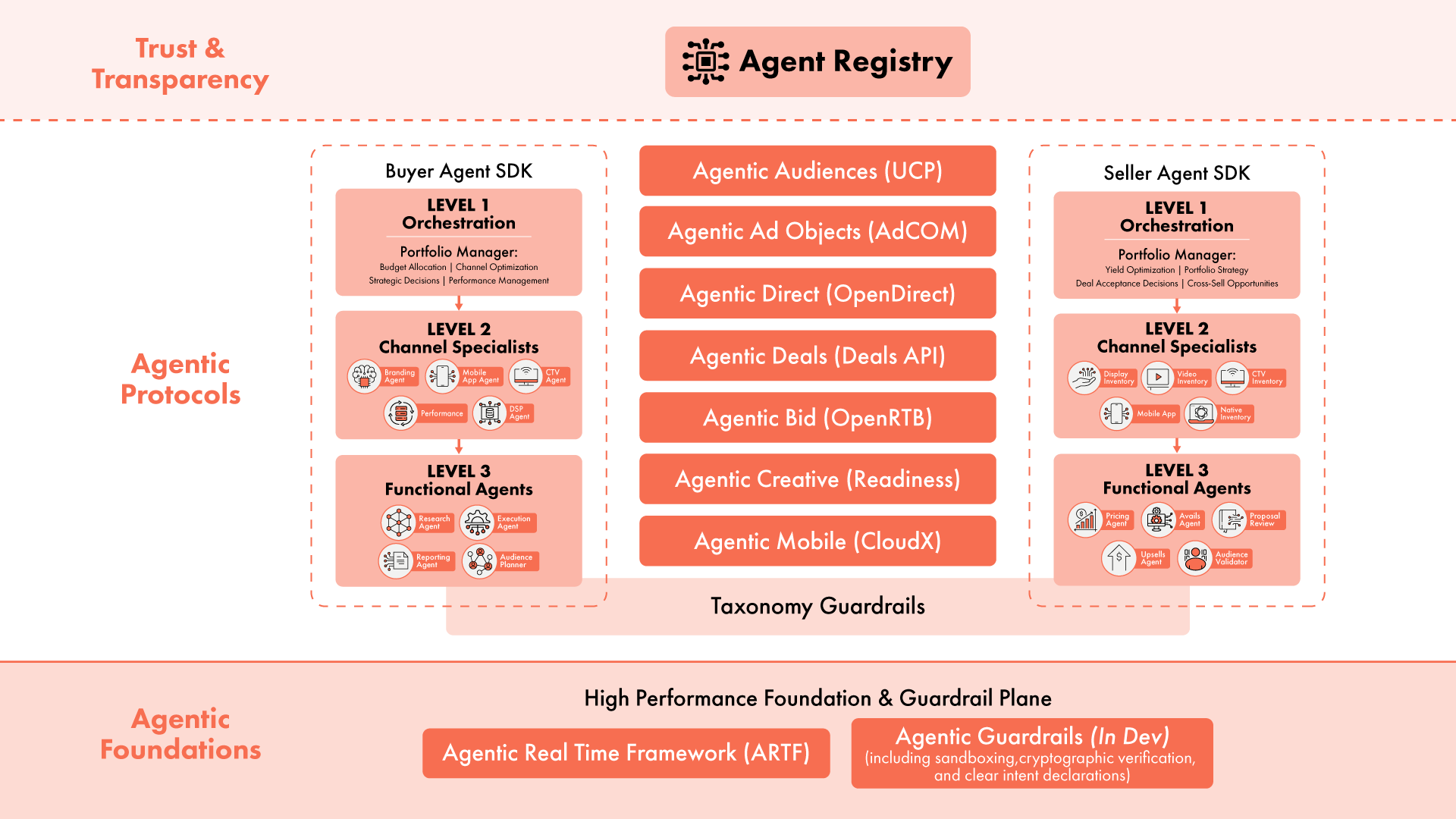
The diagram released alongside the February 26 announcement maps AAMP's architecture with unusual specificity, dividing the initiative into three horizontal bands: Agentic Foundations at the base, Agentic Protocols in the middle, and Trust and Transparency at the top. Understanding each layer - and the agent hierarchies within them - matters for any technology provider or media buyer planning 2026 infrastructure.
Pillar one - Agentic Foundations
The lowest layer is what IAB Tech Lab calls the "High Performance Foundation and Guardrail Plane." Two components live here. The first is the Agentic Real-Time Framework (ARTF), already released. The second is Agentic Guardrails, listed in the diagram as still in development, and described as including sandboxing, cryptographic verification, and clear intent declarations.
ARTF defines how agent services can safely and deterministically operate within advertising systems, including real-time bidding environments. According to the February 26 document, it cuts latency by 90% and improves agentic real-time decisioning for quality and trust. The framework's MCP interface is built directly into the specification. Its primary function is execution - making the outputs of agentic systems viable in production environments where auction decisions must complete in under 100 milliseconds.
When ARTF was released for public comment in November 2025, the technical specifications were already detailed. The framework uses gRPC with protobuf serialization, which provides substantially more space and time efficiency than JSON formats. Containers must follow Open Container Initiative compliance, manageable through Kubernetes, Docker Compose, or cloud-based systems including Amazon's Elastic Container Service. Security architecture prohibits external network access entirely - all network ingress and egress is prohibited except for service communications with the orchestrating entity. Each agent must declare specific intents and any auction changes, allowing orchestrating entities to accept or reject modifications before they take effect. The Container Project Working Group that developed the specification included participants from Amazon Ads, Index Exchange, OpenX, The Trade Desk, Netflix, Yahoo, Paramount, Optable, HUMAN Security, Magnite, PubMatic, WPP Media, and Basis Technologies.
Agentic Guardrails, still in development, will extend this foundation by adding explicit sandboxing and cryptographic verification layers. The inclusion of "clear intent declarations" in the diagram's description is significant - it mirrors a concern Katsur raised on the AdTechGod podcast on December 29, 2025 about what happens when an agent for one company interacts with an agent for another company and inadvertently violates a privacy law. Guardrails are intended to make agent behavior auditable before problems occur rather than after.
Pillar two - Agentic Protocols
The middle layer is the most architecturally complex. The diagram divides it into three vertical tracks: a Buyer Agent SDK on the left, a Seller Agent SDK on the right, and a central column of shared protocol components connecting both sides.
Both the Buyer and Seller SDKs share an identical three-level agent hierarchy. At Level 1, an Orchestration layer sits at the top - specifically a Portfolio Manager. For buyers, this manager handles budget allocation, channel optimization, strategic decisions, and performance management. For sellers, it handles yield optimization, portfolio strategy, deal acceptance decisions, and cross-sell opportunities. These are not real-time functions. They are strategic, portfolio-level decisions that govern how lower-level agents operate.
Level 2 contains Channel Specialists. On the buyer side, the diagram identifies a Branding Agent, a Mobile App Agent, a CTV Agent, a Performance Agent, and a DSP Agent. These specialists translate portfolio-level strategy into channel-specific execution. On the seller side, the equivalent agents cover Display Inventory, Video Inventory, CTV Inventory, Mobile App, and Native Inventory. The channel specialist layer is where decisions move from strategy to medium-specific tactics.
Level 3 holds Functional Agents - the most granular operational tier. For buyers, the diagram lists a Research Agent, an Execution Agent, a Reporting Agent, and an Audience Planner. For sellers, the equivalent functional agents are a Pricing Agent, an Avails Agent, a Proposal Review agent, an Upsells Agent, and an Audience Validator. These are the agents performing specific, bounded tasks: pulling inventory avails, validating audience segments, reviewing proposal terms, or generating reports. They operate under the governance of Channel Specialists, which in turn operate under the Portfolio Manager.
Both the buyer and seller hierarchies are enclosed within a single band labeled Taxonomy Guardrails - a constraint layer sitting beneath Level 3 and above the Agentic Foundations. Taxonomy guardrails ensure that agents at any level use standardized vocabularies rather than platform-proprietary definitions, which is essential for buyer and seller agents to understand each other without ambiguity. IAB Tech Lab's existing taxonomy infrastructure - covering ad products, content, audiences, and privacy - underpins this layer.
Connecting the buyer and seller stacks, the central column of the diagram lists seven specific Agentic Protocol components, each mapped to an existing IAB Tech Lab standard:
Agentic Audiences (UCP) - built on the User Context Protocol donated by LiveRamp, handling embedding-based audience signal exchange between agents. UCP uses dense vector representations of 256 to 1,024 dimensions to compress identity, contextual, and reinforcement signals into formats fast enough for real-time inference.
Agentic Ad Objects (AdCOM) - derived from the Advertising Common Object Model, providing standardized definitions of ad objects across contexts so buyer and seller agents share a common vocabulary.
Agentic Direct (OpenDirect) - extends the existing OpenDirect specification for direct programmatic buying, enabling agents to negotiate and transact direct deals without human intervention in each transaction step.
Agentic Deals (Deals API) - built on the Deals API specification released December 5, 2025, which addresses manual entry and transparency gaps in curated programmatic deals. Within AAMP, this component lets agents discover, evaluate, and activate deals autonomously.
Agentic Bid (OpenRTB) - extends OpenRTB for agent-driven real-time bidding, enabling autonomous bid decisions within the existing auction infrastructure that processes billions of transactions daily.
Agentic Creative (Readiness) - addresses creative asset readiness for automated delivery pipelines, ensuring agents can assess and activate creative assets without manual trafficking steps.
Agentic Mobile (CloudX) - supported by the CloudX donation, covering agentic workflows specific to mobile app advertising environments.
The architecture is deliberately built on foundations that already exist. As PPC Land documented in January 2026, the January roadmap announced that IAB Tech Lab would extend OpenRTB, AdCOM, OpenDirect, VAST, and the Deals API with modern protocols including Model Context Protocol, Agent2Agent, and gRPC - rather than replacing them. AAMP is the formalization of that strategy at the initiative level. According to the February 26 document, advertising "already has deeply defined object models, taxonomies, and transaction semantics," and AAMP builds on that foundation "so agents can act with repeatable accuracy instead of probabilistic guesswork."
Alison Levin, IAB Board Chair and President of Advertising and Partnerships at NBCUniversal, stated at the IAB Annual Leadership Meeting: "just because you design a new car, doesn't mean you need to build a new track."
Pillar three - Trust and Transparency via the Agent Registry
The top layer of the AAMP diagram contains a single component: the Agent Registry. According to the February 26 document, the Tech Lab Agent Registry was set to launch "next week" - placing the expected date at approximately the first week of March 2026. It provides agent-neutral transparency and accountability across the ecosystem, establishing a framework for agent identity, verification, and disclosure so that participants understand who or what they are transacting with at any given moment.
The registry addresses a structural problem that neither ARTF nor the protocol layer can resolve on its own. In a programmatic environment where buyer agents negotiate with seller agents autonomously, it becomes impossible to verify the legitimacy, capabilities, or behavior patterns of counterparties without an independent record of who those agents are. The registry serves as that record - neutral by design, accessible to all participants, and separate from any individual buyer or seller's proprietary systems.
AAMP's naming and framing also carry competitive implications. When the Ad Context Protocol launched in October 2025 with six founding companies - Scope3, Yahoo, PubMatic, Swivel, Triton, and Optable - Katsur publicly questioned whether another industry body was necessary. The AAMP architecture implicitly answers that question by demonstrating the breadth of what IAB Tech Lab was already building. Where AdCP provides nine core tasks built on Anthropic's Model Context Protocol, AAMP provides an entire three-tier agent hierarchy for both buyers and sellers, with seven specific protocol components each mapped to existing industry standards.
Prebid.org's recent stewardship of the open-source Sales Agent shows that multiple parallel efforts are advancing simultaneously, operating under different governance structures. None of AAMP's components attempts to replace OpenRTB, and none of the competing initiatives does either. But the question of which frameworks achieve sufficient adoption to become genuine infrastructure - rather than experiments - remains open. AAMP now has a formal name, a diagram, three active task forces, and an imminent Agent Registry launch. That is a more concrete set of deliverables than most competing initiatives can point to.
What the three-tier hierarchy means in practice
For agencies and brands seeking to understand how agentic systems might affect campaign management, the three-tier buyer hierarchy in AAMP's diagram is instructive. A Level 1 Portfolio Manager agent would handle strategic budget allocation across channels and set performance targets. It would not place individual bids. Level 2 Channel Specialists would interpret those targets for specific media environments - deciding, for instance, how to approach CTV inventory differently from mobile app inventory, since those channels have distinct pricing dynamics, audience measurement methods, and deal structures. Level 3 Functional Agents would then execute specific bounded tasks: an Audience Planner agent segments audiences, a Research Agent pulls market data, an Execution Agent manages bid submissions, and a Reporting Agent surfaces performance data back up the hierarchy.
This cascade structure matters because it separates strategic decisions from operational ones. A Portfolio Manager agent running on a large language model can handle the ambiguity and trade-offs inherent in budget allocation. A Functional Agent handling bid submissions does not need that generality - it needs speed, determinism, and compliance with OpenRTB specifications. ARTF at the foundation layer provides the high-performance infrastructure that makes Level 3 functional agents viable in production. Without it, latency constraints would prevent agentic systems from participating meaningfully in real-time auctions. The 90% latency reduction that ARTF provides is not a marketing claim - it is a technical prerequisite for the entire stack to function.
On the seller side, the hierarchy is structurally identical but operationally different. A Seller-side Level 1 Portfolio Manager optimizes yield rather than spend, managing portfolio strategy and deal acceptance decisions. Level 2 Channel Specialists handle inventory across display, video, CTV, mobile, and native environments. Level 3 Functional Agents include a Pricing Agent, an Avails Agent that checks inventory availability, a Proposal Review agent that evaluates incoming deal proposals, an Upsells Agent that identifies cross-sell opportunities, and an Audience Validator that verifies audience data quality before it enters the bidstream.
Why this matters for the marketing community
Two-thirds of advertisers now focus on agentic AI for ad buying and campaign execution, according to IAB research released in January 2026. That share is striking against a backdrop where many organizations still lack the internal infrastructure to evaluate competing agentic protocols, let alone determine which initiatives deserve integration priority.
AAMP's formal naming and detailed architecture matters precisely because of that gap. Without a clear umbrella term and published diagram, buyers and sellers in the programmatic ecosystem face a fragmented set of specifications - ARTF, UCP, Buyer Agent SDKs, Seller Agent SDKs, Agentic Direct, Agentic Deals - with no obvious organizing logic. AAMP provides that logic. It tells practitioners that ARTF is the execution foundation, that the seven Agentic Protocol components handle the management layer at three levels of agent granularity, and that the Agent Registry handles trust. Those are distinct problems requiring distinct technical solutions.
The fragmentation risk remains real. As PPC Land documented in November 2025, the industry produced at least three agentic standards in under a month during that period alone. Each generated engineering attention and industry debate without a coherent map showing how the pieces connected. AAMP provides that map. Whether the task forces and the forthcoming Agent Registry can consolidate that energy into a shared production-ready infrastructure is a question 2026 will answer.
December 29, 2025 - Katsur warns on the AdTechGod podcast that the industry must resolve transparency and privacy fundamentals before scaling agentic systems; previews agent guardrail requirements
February 26, 2026 - IAB Tech Lab formally names initiative AAMP, publishes three-pillar architecture diagram with seven protocol components and three-tier agent hierarchies for buyers and sellers; Agent Registry announced as launching imminently
~Early March 2026 (expected) - Tech Lab Agent Registry scheduled to launch, providing identity verification and disclosure infrastructure for all AAMP-compliant agentic systems
Summary
Who: IAB Tech Lab, led by CEO Anthony Katsur, with Alison Levin (IAB Board Chair, President of Advertising and Partnerships at NBCUniversal) and ecosystem contributors including LiveRamp (User Context Protocol), CloudX (mobile agentic workflows), and the participating companies across Buyer Agent, Seller Agent, and Agentic Audiences task forces.
What: IAB Tech Lab formally named and publicly framed its umbrella agentic advertising initiative as AAMP - Agentic Advertising Management Protocols - and published a detailed architecture diagram showing three pillars: Agentic Foundations (ARTF plus Agentic Guardrails in development), Agentic Protocols (seven protocol components connecting three-tier buyer and seller agent hierarchies), and Trust and Transparency (Agent Registry launching imminently). The diagram revealed that both Buyer Agent and Seller Agent SDKs follow a three-level hierarchy: Level 1 Orchestration (Portfolio Manager), Level 2 Channel Specialists, and Level 3 Functional Agents, all governed by Taxonomy Guardrails.
When: The formal AAMP announcement was published on February 26, 2026, with a full unveiling at the Beet.TV Beet Retreat. The initiative consolidates work begun in November 2025 with ARTF and the LiveRamp UCP donation, and accelerated through the January 2026 roadmap announcement.
Where: The announcement was published on the IAB Tech Lab website. Task forces operate through the organization's working group structure. The initiative applies globally to digital advertising, with future extension planned into linear television, radio, and out-of-home channels.
Why: Market confusion led industry participants to treat individual components - ARTF, Agentic Audiences - as the entirety of IAB Tech Lab's agentic program. AAMP provides a coherent public architecture, enabling agencies, brands, publishers, and adtech providers to understand how execution infrastructure, management protocols, and trust mechanisms fit together - particularly urgent as two-thirds of advertisers now prioritize agentic AI for campaign execution and multiple competing protocol initiatives risk fragmenting the ecosystem before standards can consolidate.
Share this article
The link has been copied!
Your link has expired. Please request a new one.
Your link has expired. Please request a new one.
Your link has expired. Please request a new one.
Great! You've successfully signed up.
Great! You've successfully signed up.
Welcome back! You've successfully signed in.
Success! You now have access to additional content.