India news sites plummet in Google's December update as Discover traffic collapses
Major India news publishers lost up to 70% visibility in Google's December core update as Wall Street Journal SEO editor flags dramatic drops in U.S. search results.


Major India news publishers lost up to 70% visibility in Google's December core update as Wall Street Journal SEO editor flags dramatic drops in U.S. search results.
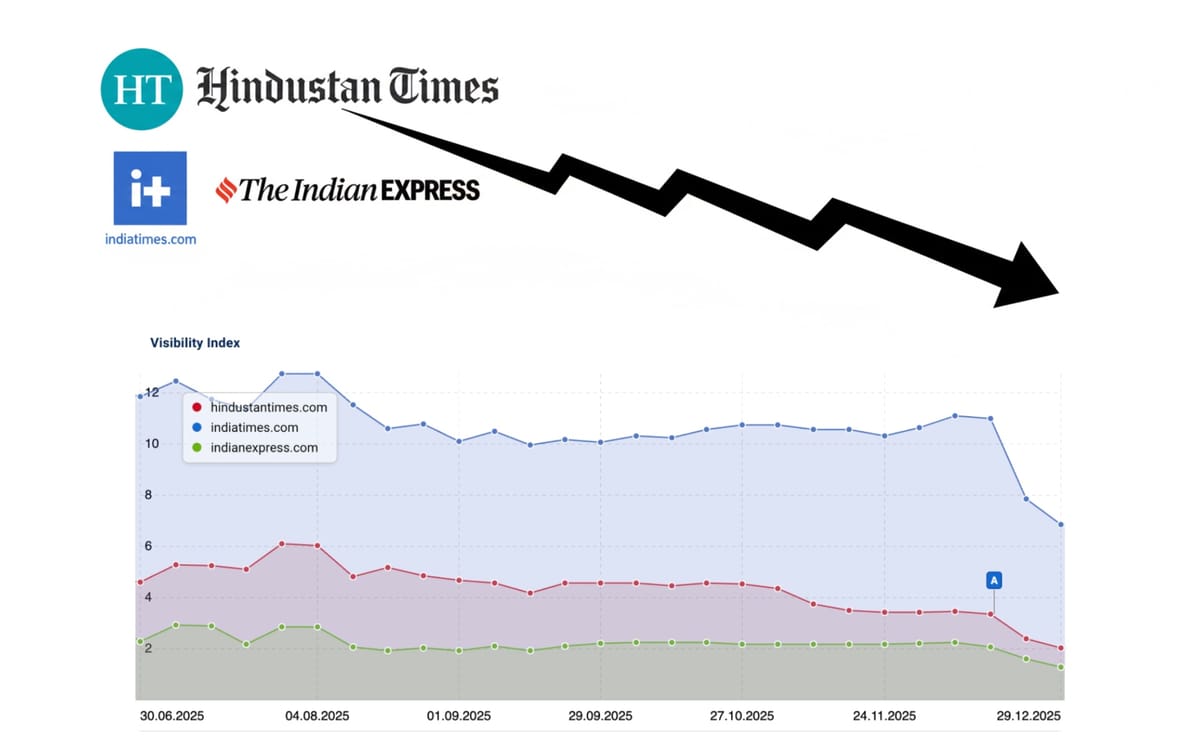
Google's December 2025 core update delivered particularly harsh consequences for India-based news publishers on U.S. search results, according to SISTRIX visibility data shared by Will Flannigan, Senior SEO Editor for The Wall Street Journal. Spotted first by Search Engine Roundtable. The analysis revealed dramatic traffic declines concentrated among major Indian publications, occurring within the broader context of what became the third major algorithm adjustment of 2025. Spotted by Search Engine Roundtable.
Flannigan posted visibility index comparisons on LinkedIn showing hindustantimes.com, indiatimes.com, and indianexpress.com experiencing substantial drops throughout the December update rollout. The SISTRIX data tracked declining visibility from June 2025 through late December, with the steepest declines appearing after Google announced the core update on December 11 at 9:25 AM Pacific Time. The visual data demonstrated hindustantimes.com falling from visibility index levels above 6 points to below 2 points by late December.
"The latest Google Core Algorithm Update walloped India-based news publishers on U.S. SERPS, according to Sistrix visibility data," Flannigan wrote on LinkedIn on January 2, 2026. The comment accompanied charts showing consistent downward trajectories for the three major publications throughout the second half of 2025, with acceleration during the December update period.
The geographic concentration of impacts drew immediate attention from algorithm analysts. Glenn Gabe, President of G-Squared Interactive LLC, responded to Flannigan's post noting that the volatility extended far beyond India-based publishers. "There was a ton of volatility with news publishers with the December broad core update. And it's not just India-based publishers... it's news publishers across many countries (including a number of large publishers here in the US dropping or surging heavily)," Gabe wrote on January 2.
Gabe had documented extensive news publisher impact beginning December 19, 2025, approximately eight days into the update rollout. "I'm seeing a number of news publishers with heavy impact. I have also had several publishers reach out over the past few days explaining the volatility they are seeing (and across surfaces like Discover, Google News, Top Stories, and the News tab in Search)," Gabe posted on X on December 19. His analysis emphasized that impacts manifested across multiple Google surfaces simultaneously rather than solely affecting traditional web search rankings.
The December update affected news organizations across diverse geographic markets. Gabe shared traffic charts demonstrating both substantial increases and decreases for various unnamed publishers throughout the rollout period. Some publications experienced visibility surges while others faced severe ranking collapses, indicating the update's discriminatory impact rather than uniform effects across the news publishing vertical.
The timing proved particularly consequential for publishers dependent on December advertising revenue. Seasonal advertising rates typically peak during December as brands increase spending for holiday campaigns, yet the core update created traffic disruptions during what should have been publishers' most lucrative period. Publishers reported severe impacts within 48 hours of the announcement, with some experiencing 70-85% declines in daily visitor counts.
Google Discover traffic demonstrated particularly acute volatility during the December update. Multiple publishers reported complete cessation of Discover traffic within 24 hours of the update announcement, according to industry documentation. The Discover impact carried special significance because research published in August 2025 found that Google Discover had become the dominant traffic source for news and media websites, accounting for two-thirds of Google referrals. This concentration made the December decline particularly devastating for publishers heavily dependent on Discover distribution.
"And the Discover impact is interesting just based on what Google explained recently about 'minimal overlap with Search'. Not sure that's always the case based on what I'm seeing... Some news and media publishers have been nuked from Discover with this update," Gabe wrote on X on December 19. His comment referenced Google's statements about separation between Search and Discover systems while observing that core update impacts appeared to affect both surfaces simultaneously.
The update began rolling out on December 11 at 9:25 AM Pacific Time, according to the Google Search Status Dashboard. Google stated through its official dashboard that the update represented "a regular update designed to better surface relevant, satisfying content for searchers from all types of sites." The company indicated the rollout "may take up to 3 weeks to complete," placing expected conclusion around January 1, 2026.
The actual implementation required 18 days, completing on December 29, 2025, according to the Google Search Status Dashboard. This timeline exceeded the typical 14-16 day implementation period observed in recent core updates. Search Engine Land documented that the most noticeable volatility struck on December 13, approximately two days after Google's announcement. A second wave of ranking fluctuations hit on December 20, suggesting the algorithm continued adjusting systems throughout the three-week window.
Industry tracking tools detected significant impact almost immediately after the announcement. SISTRIX's Update Radar measured a volatility index of 3.54 on December 11, indicating "increased SERP fluctuation" though not reaching the 6.0 threshold typical of major confirmed updates. The radar system tracks both the extent of changes across domains and the strength of those shifts to calculate an index value scaled against the previous 90-day average.
The December 2025 core update represented Google's third confirmed core algorithm modification of 2025. Google previously deployed the March 2025 core update on March 13, which concluded after 14 days on March 27. The June 2025 core update launched on June 30 and required 16 days to complete, finishing on July 17. This December deployment arrived approximately five months after the June update, breaking from typical quarterly patterns. Historical data shows Google generally releases core updates every three to four months, though the company maintains no fixed schedule for these algorithmic adjustments.
The concentration of impacts on news publishers distinguished the December update from previous algorithm adjustments. Gabe's analysis indicated he was "seeing a number of news publishers with heavy impact," suggesting the update's quality evaluation systems particularly affected news and media properties. Publishers reached out explaining volatility across surfaces like Discover, Google News, Top Stories, and the News tab in Search, according to Gabe's December 19 social media posts.
Buy ads on PPC Land. PPC Land has standard and native ad formats via major DSPs and ad platforms like Google Ads. Via an auction CPM, you can reach industry professionals.
Nick Beijerinck, SEO Consultant & Strategist for News Publishers, engaged with Flannigan's LinkedIn post suggesting broader analysis. "Maybe you can share one comparing with a US publisher as well to show both ends. This way you can make an even more encouraging case," Beijerinck commented on January 2. Flannigan responded that "usatoday and indiatimes have about the same graph. Which is unfortunately not so encouraging."
The comparison to USA Today traffic patterns suggested the December update affected both India-based publishers accessing U.S. search results and established U.S. news organizations. This geographic breadth indicated the update's quality evaluation systems operated across diverse publisher types rather than targeting specific regional news sources.
The December update arrived amid broader structural shifts in how Google distributes traffic to news publishers. Analysis of over 400 news publishers worldwide by NewzDash confirmed that Google Web Search traffic declined from 51% to 27% between 2023 and the fourth quarter of 2025, while Discover feed climbed to 68%. This fundamental redistribution means publishers now depend primarily on Discover's personalized recommendation algorithms rather than traditional search optimization.
The concentration of news traffic in Discover created particular vulnerability during core updates. Google Discover operates on the same core ranking systems affected by broad core updates, according to previous explanations from Google representatives. When core updates modify fundamental content evaluation systems, the impacts manifest simultaneously across both traditional search results and Discover distribution.
Forum discussions revealed patterns of established sites losing rankings despite years of stable performance. "Consistently ranked top 1-3 on most of my relevant keywords for 2-3 years, now i'm on the 2nd page all of a sudden. Feels like a bad joke by Google," one WebmasterWorld participant commented, according to industry documentation. Another described dropping from top three positions maintained for four years to the fourth page within days.
Some websites experienced complete disappearances from search results during the rollout. "Lost all ranking overnight," wrote one forum participant whose site exceeded 10 years in age and had never utilized artificial intelligence for content generation. Such dramatic visibility losses during core update deployments can reflect either temporary testing phases or more permanent algorithmic reassessments of site quality.
The ranking fluctuations demonstrated unusual severity compared to recent core updates. "My website dropped to 4th page after being in top 3 for like 4 years, I have seen many updates but 4 years of content designed for user experience is nothing to google but a Google site with an image and a silly link to an ad seems to be better than mine," according to a Black Hat World forum comment documented by industry sources.
Technical instability extended beyond position tracking. Publishers reported unusual behavior where newly published articles failed to appear in Discover despite meeting all documented requirements. "New articles aren't showing up in Discover, but that's been happening all the time lately," one news publisher noted, suggesting ongoing issues with content discovery systems beyond the core update itself.
The multi-surface impacts demonstrated how core updates affect Google's entire search ecosystem rather than isolated ranking components. "Broad core updates can impact all Google surfaces, including web search, image search, video search, Google News, top stories, the News tab in Search, and Google Discover," Gabe explained in previous algorithm analysis. AI Overviews and AI Mode function within Google's "Web Search" framework and rely on the same core quality systems affected by broad updates.

Recovery patterns from previous core updates suggest variable outcomes for affected publishers. The June 2025 core update enabled partial recoveries for websites previously impacted by the September 2023 Helpful Content Update, though many sites experienced mixed results. Some publishers saw partial recoveries like 20% increases or 80% increases, while very rare cases achieved actual full recoveries. For the most part, those that saw recoveries received boosts in current rankings and traffic overall.
The December timing raised questions about whether subsequent tremors or adjustments might alter the initial impact patterns. "But who knows if these publishers will bounce back on some level in the following weeks of more tremors?" Search Engine Roundtable's Barry Schwartz wrote on January 2, 2026, acknowledging the possibility of continued volatility even after the official completion announcement.
Historical data from the June 2025 update demonstrated this pattern. "It doesn't seem like this core update is fully done yet. The tools themselves are still pretty heated," Schwartz observed after the official completion announcement on July 17, 2025. Rankings continued demonstrating instability throughout the initial deployment phase, with different results appearing on mobile versus desktop devices for the same queries.
The concentration of severe impacts on news publishers during the December update occurred as Google simultaneously expanded advertising capabilities within AI-powered search features. The company quietly rolled out ads in AI Overviews to 11 additional countries on December 19, extending beyond the United States to Australia, Canada, India, Indonesia, Kenya, Malaysia, New Zealand, Nigeria, Pakistan, Philippines, and Singapore. The expansion occurred through documentation updates rather than formal announcements.
Research into Google's relationship with news publishers revealed asymmetric dependency dynamics. Publishers cannot predict which articles will receive Discover distribution, making traffic forecasting and revenue planning increasingly difficult. This contrasts with traditional search, where optimization practices could improve rankings through established techniques.
An experiment Google conducted removing news content from search results in eight EU countries found that Search Daily Active Users declined by only 0.77% when news content was removed, while Search ad revenue showed no statistically significant change. The findings indicated that Google could potentially abandon news content entirely without significant business impact, strengthening the company's negotiating position regarding compensation for news content.
The December update's impact on India-based publishers accessing U.S. search results raised questions about geographic targeting within Google's quality evaluation systems. Whether the algorithm specifically assessed publisher origin or applied quality signals that disproportionately affected certain geographic markets remained unclear from available data.
Gabe's analysis suggested evaluating recovery potential for sites impacted by the December update. "You want to get clearly out of the gray area from a quality perspective," Gabe explained regarding long-term ranking stability in previous algorithm analysis. "If not, then you can see surges and drops with every core update." Sites remaining in algorithmic gray areas face continued volatility as Google adjusts system parameters.
The evaluation process incorporates Navboost, Google's system tracking 13 months of user interaction signals. This technology enables Google to distinguish between satisfied and dissatisfied users based on behavioral patterns rather than content analysis alone. When search engineers modify ranking dial settings, websites with ambiguous quality signals can experience significant movement in either direction.
The news publisher impacts demonstrated during the December update highlighted vulnerabilities created by concentration of traffic in algorithmic distribution systems like Discover. NewzDash CEO John Shehata noted that "Google Discover's share has nearly doubled in two years, climbing from 37.03% in 2023 to 67.51% today," while "Traditional Web Search has plummeted from 51.10% to just 27.42% over the same period".
This fundamental shift meant that core update impacts on Discover distribution carried proportionally greater consequences than equivalent search ranking changes would have produced in previous years. Publishers experiencing Discover traffic elimination during the December update lost access to their primary Google referral source rather than one of several traffic channels.
The December 2025 core update joined a series of algorithm adjustments throughout 2025 that collectively reshaped news publisher traffic patterns. Each update demonstrated Google's continued refinement of quality evaluation systems, with varying impacts on different publisher categories and geographic markets. The consistency of news publisher volatility across multiple 2025 core updates suggested ongoing recalibration of how Google's systems assess news content quality.
Subscribe PPC Land newsletter ✉️ for similar stories like this one
Subscribe PPC Land newsletter ✉️ for similar stories like this one
Who: Google implemented the December 2025 core update affecting India-based news publishers hindustantimes.com, indiatimes.com, and indianexpress.com on U.S. search results, along with news organizations globally. Will Flannigan, Senior SEO Editor for The Wall Street Journal, documented the impacts using SISTRIX visibility data. Glenn Gabe, President of G-Squared Interactive LLC, tracked extensive news publisher volatility across multiple countries.
What: The December 2025 core update caused dramatic visibility declines for major India news publishers accessing U.S. search results, according to SISTRIX tracking data. The update triggered severe Google Discover traffic collapse within 48 hours, with some publishers reporting complete elimination of impressions. Hindustantimes.com visibility dropped from above 6 points to below 2 points on the SISTRIX index. The update affected news publishers across multiple countries, causing both substantial increases and decreases for various publications throughout the 18-day rollout period.
When: Google announced the December 2025 core update on December 11, 2025, at 9:25 AM Pacific Time. The most noticeable volatility occurred December 13, with a second wave hitting December 20. The update completed on December 29, 2025, after an 18-day implementation period. Flannigan shared the India publisher visibility data on January 2, 2026, while Gabe documented news publisher impacts beginning December 19, 2025.
Where: The algorithmic changes affected search results globally, with particular concentration on India-based news publishers accessing U.S. search results. Impacts manifested across multiple Google surfaces including web search, Google Discover, Google News, Top Stories, the News tab in Search, image search, and video search. SISTRIX tracked visibility declines throughout the second half of 2025, with acceleration during the December update period.
Why: Google stated the update aimed to "better surface relevant, satisfying content for searchers from all types of sites." The company implements core updates to refine fundamental content evaluation systems rather than targeting specific issues or websites. The update modified core ranking systems that affect all Google surfaces simultaneously, including Discover which had become the dominant traffic source for news publishers accounting for 68% of Google referrals by late 2025. The timing during peak December advertising season created particularly harsh consequences for publishers dependent on seasonal revenue.