LinkedIn ranks #2 in AI citations - what 89K URLs reveal about B2B visibility
Semrush analyzed 89,000 LinkedIn URLs cited by ChatGPT, Google AI Mode, and Perplexity to find what drives AI search visibility for B2B brands.


Semrush analyzed 89,000 LinkedIn URLs cited by ChatGPT, Google AI Mode, and Perplexity to find what drives AI search visibility for B2B brands.
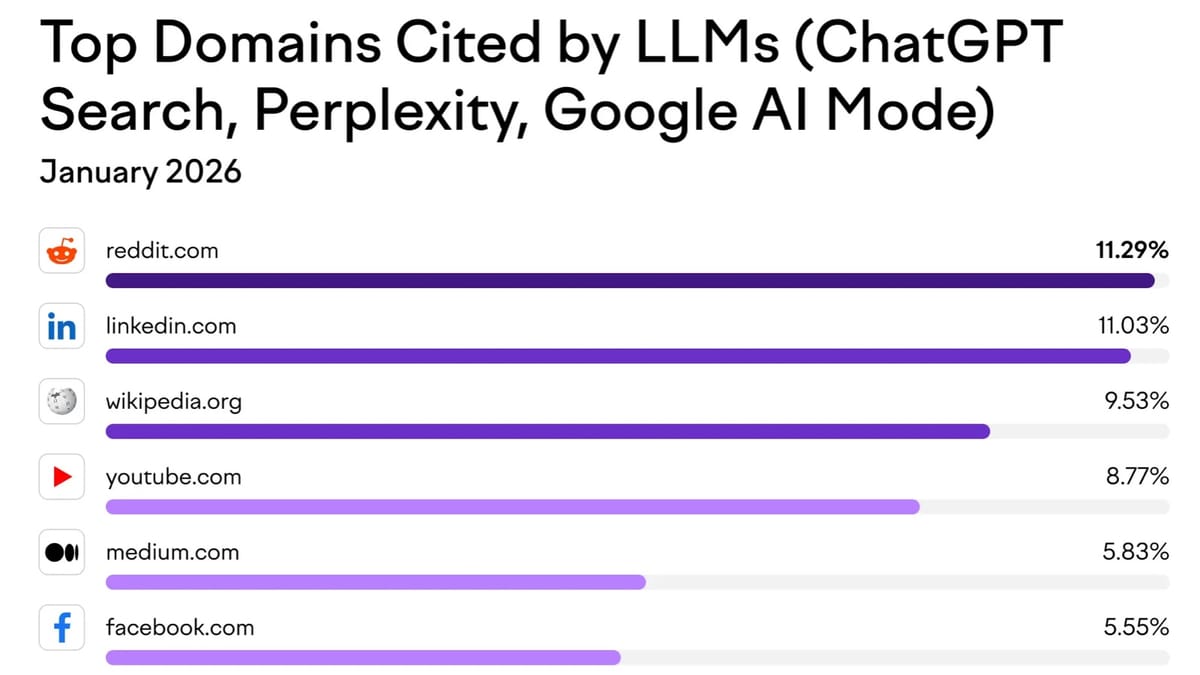
Semrush today published research analyzing 89,000 unique LinkedIn URLs cited across three major AI search platforms, revealing that the professional network ranks second among all cited domains globally - a finding with direct implications for how B2B marketers approach content strategy in an environment where AI-generated answers increasingly mediate brand discovery.
The study, released on March 10, 2026 and authored by Margarita Loktionova, examined 325,000 unique prompts submitted between January and February 2026 to ChatGPT Search, Google AI Mode, and Perplexity. The research was conducted in collaboration with LinkedIn itself, which provided deeper data for each of the 89,000 URLs identified in AI-generated responses. The scope covers 12 major industry categories, with a concentration in technology, business services, finance, and industrial sectors.
According to the study, LinkedIn appears in 11% of AI responses on average across the three platforms analyzed. That figure places it ahead of Wikipedia, YouTube, and every major news publisher in Semrush's dataset. The citation rate varies significantly by platform. Perplexity cites LinkedIn in only 5.3% of responses, while Google AI Mode references it in 13.5% and ChatGPT Search in 14.3%.
The gap between Perplexity and the other two models is notable. It suggests that each AI platform operates with distinct source preferences rather than a single unified citation logic - a detail that matters for marketers attempting to optimize content for multiple AI discovery channels simultaneously.
This finding lands at a moment when the broader shift toward AI-mediated search is already reshaping how website traffic is distributed. As documented on PPC Land, Ahrefs published research in February 2026 showing Google's AI Overviews now correlate with a 58% reduction in click-through rates for top-ranking pages. That context makes LinkedIn's position in AI citation rankings a commercially meaningful variable, not merely an academic curiosity.
One of the more technically significant findings concerns semantic similarity - a measure of how closely AI-generated responses match the original content they cite. For LinkedIn, that score sits between 0.57 and 0.60 across the models studied.
For comparison, Semrush's previous research on other platforms found scores of 0.53–0.54 for Reddit posts and 0.435 for Quora answers. The higher LinkedIn scores indicate that when AI systems pull from the platform, they reproduce the meaning of the original content with relatively high fidelity rather than heavily paraphrasing it. In practical terms, a brand publishing on LinkedIn has a stronger chance of having its core message reflected accurately in AI-generated answers than if that same message appeared on Reddit or Quora.
The implication runs in both directions. Precise, well-structured LinkedIn content is more likely to be reproduced faithfully. Vague or loosely worded positioning, by contrast, carries greater risk of being misrepresented when an AI system paraphrases it for a user query.
The content format breakdown in Semrush's data reveals a clear hierarchy. LinkedIn articles - defined as long-form content published through the platform's native article tool - account for 50–66% of cited LinkedIn content across all three AI models. Feed posts represent a smaller but still significant 15–28% of citations, depending on the platform.
The explanation, according to the study, relates to how AI retrieval systems work. Articles are longer, more structured, and fully indexable, making them easier for AI tools to parse, extract key ideas from, and reference. They meet the structural requirements that AI systems apply when evaluating whether a source can adequately answer a complex question.
Length matters within both categories. Articles ranging from 500 to 2,000 words attract the most citations, a range that is comprehensive enough to answer detailed questions without sprawling beyond usefulness. For feed posts, mid-length content of 50–299 words accounts for the largest share of AI citations. Posts under 50 words are rarely cited; very long posts show diminishing returns relative to the article format.
Originality is as important as length. According to the study, approximately 95% of cited posts across all three models are original content. Reshares account for only 5% of citations. The data makes a clear case: AI systems show little interest in content that aggregates or redistributes existing material without adding analysis or perspective.
The research found that 54–64% of cited LinkedIn posts focus on sharing knowledge or practical advice. For Google AI Mode specifically, this rises to nearly two-thirds of citations. Promotional content - posts marketing a product or service - holds a secondary position in citations, appearing in AI responses less frequently than educational content.
This pattern reflects a structural dynamic in AI retrieval. Systems like ChatGPT Search and Perplexity are designed to answer questions. Content that directly addresses specific questions, explains how something works, or documents concrete results aligns naturally with that retrieval goal. Promotional language, by contrast, is designed to persuade rather than inform, and AI systems appear to treat that distinction as consequential when selecting which sources to cite.
The finding connects directly to a pattern PPC Land tracked in November 2025: Semrush itself documented that content structured as direct answers - particularly listicles and data-driven posts - achieved faster AI citation gains than general brand promotion. The company reported moving its non-brand AI visibility from 40% to 50% within a single month by applying that principle systematically.
The research identifies a significant divergence in how AI models treat company-published content versus content from individual LinkedIn members. Perplexity favors Company Pages, which account for 59% of its LinkedIn citations. ChatGPT Search and Google AI Mode take the opposite position: individual members make up 59% of citations on each.
This platform-level split has practical consequences for B2B marketing teams deciding how to allocate content production resources. A strategy focused exclusively on the company page performs differently depending on which AI platform a brand's target audience uses. A strategy that combines consistent company publishing with individual thought leadership from employees and subject matter experts covers more ground across all three systems.
This analysis sits alongside what LinkedIn's own research has been communicating for some time. As covered on PPC Land in December 2025, LinkedIn's B2B Institute argued that brands should invest in "owned prominence" built through thought leadership and organic presence rather than relying exclusively on paid placements - a thesis that the Semrush citation data supports empirically.
About three-quarters of cited LinkedIn post authors are frequent posters, defined as individuals who published more than five posts in the previous four weeks. For long-form articles, the figure is slightly lower, with around 60% of cited authors falling into the frequent posting category.
The study's findings on follower counts complicate standard assumptions about influence. Nearly half of cited LinkedIn post authors have more than 2,000 followers, suggesting that an established audience increases citation probability. However, the data also shows that individuals with fewer than 500 followers are cited as frequently - or more frequently - than those with more than 500 followers. The implication is that AI citation systems do not weight raw follower counts the way engagement-driven social algorithms do. Authority and relevance appear to carry more weight than audience size.
For B2B marketing teams, this data point carries a specific operational meaning. Subject matter experts with smaller audiences can generate AI citations if their content is sufficiently specific, well-structured, and published consistently. The barrier to AI visibility is not audience scale - it is content quality and publishing cadence.
Perhaps the most counterintuitive data point in the study concerns engagement. The median cited LinkedIn post has 15–25 reactions and no more than one comment. These are modest figures by social media standards, far below what most platform algorithms would classify as viral or high-performing content.
The pattern parallels what Semrush observed in prior research on Reddit. The threads AI tools cited most frequently were not the ones with thousands of upvotes. They tended to be older, less prominent discussions with clear, direct answers to specific questions. The research reinforces a point that Similarweb's AI citation framework documented in November 2025: AI search engines operate differently from social recommendation engines. Citation worthiness is distinct from virality. Content is selected for factual accuracy, structural clarity, and topical relevance - not for social proof signals.
For marketing teams accustomed to measuring LinkedIn content performance through engagement metrics, this finding suggests that internal reporting frameworks may be underselling content that performs well in AI retrieval contexts.
The Semrush study arrives as LinkedIn's position in B2B marketing continues to strengthen on multiple fronts. Dreamdata's 2026 LinkedIn Ads Benchmarks report, also published today, shows LinkedIn Ads delivering 121% ROAS for B2B marketers - up from 113% in 2024 - with B2B buyer journeys now averaging 272 days. Within that extended journey, organic content on LinkedIn increasingly plays a role in how buyers form impressions before they engage with paid advertising.
The average B2B deal now involves 10 stakeholders across 88 total touchpoints. AI-mediated discovery adds a layer to that journey: buyers who use ChatGPT or Perplexity to research a category or vendor may encounter LinkedIn content before they ever visit a company's website. The Semrush data quantifies, for the first time at this scale, which types of LinkedIn content reach that discovery layer and which do not.
For context, PPC Land's coverage of AI citation volatility has previously noted that citation sets change substantially month over month - one study found that 40–60% of sources cited by large language models turn over within a single month. That volatility makes consistent, high-frequency publishing more valuable than sporadic campaigns, a pattern consistent with the Semrush finding that frequent posters dominate citations.
The research also touches on how LinkedIn's data practices around AI training - announced in September 2025 - interact with AI search systems. LinkedIn collects profile data, posts, articles, and engagement signals for its own generative AI features. The relationship between what LinkedIn trains its internal AI on and what external AI search tools like ChatGPT retrieve and cite is not addressed directly in the Semrush study, but the parallel is structurally relevant for anyone considering how the platform's data flows intersect with AI search.
The study examined 325,000 prompts spanning 12 industry categories. For each of the 89,000 LinkedIn URLs identified in AI responses, Semrush measured citation frequency and position, content type, author signals including follower count and posting frequency, engagement signals, and content signals including length, media format, intent, and originality. The semantic similarity ratio was calculated on a 0–1 scale, where 0 indicates no shared context between the AI response and the original source and 1 means the phrasing is nearly identical.
The research was conducted in January and February 2026. LinkedIn collaborated on the project by providing additional data for URLs identified in AI citations, enabling a deeper analysis of author characteristics than would otherwise be possible through external observation alone.
Who: Semrush, the SEO and digital marketing analytics platform (now in the process of being acquired by Adobe for $1.9 billion), conducted the research in collaboration with LinkedIn. The study was authored by Margarita Loktionova and targets B2B marketers, content strategists, and SEO professionals managing brand visibility across AI search platforms.
What: An analysis of 89,000 unique LinkedIn URLs cited by ChatGPT Search, Google AI Mode, and Perplexity, drawn from 325,000 AI prompts across 12 industry categories. The research quantified citation rates, content format preferences, author characteristics, engagement thresholds, and semantic similarity between AI responses and original LinkedIn content.
When: The fieldwork was conducted between January and February 2026. The findings were published on March 10, 2026.
Where: The research spans three AI search platforms - ChatGPT Search, Google AI Mode, and Perplexity - covering queries across a broad set of professional and business topics. LinkedIn provided supplementary data on each cited URL. The study was published on the Semrush blog.
Why: As AI search platforms increasingly mediate brand discovery, marketers face a structural gap between traditional content performance metrics - clicks, impressions, follower counts - and AI citation behavior. The Semrush research attempts to close that gap by identifying, at scale, which types of LinkedIn content AI systems actually select when generating answers to user queries. The findings matter because AI-cited content shapes how brands are described and evaluated before users ever visit a company's website.