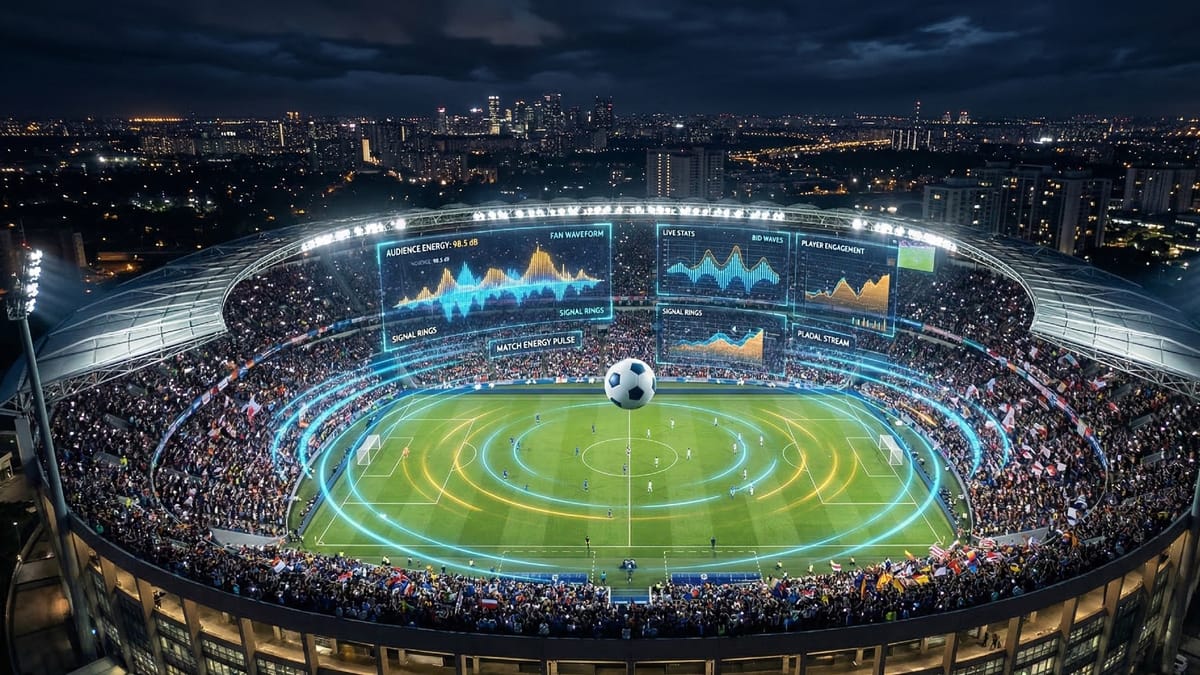
Magnite yesterday published a technical guide aimed at advertisers and media owners preparing for the 2026 FIFA World Cup, outlining how programmatic infrastructure must be configured before the tournament kicks off on June 11. The report, published March 9, 2026, addresses the operational complexity of live streaming at scale - an environment where audience spikes, latency, and bid failures can erode campaign performance within seconds.
The upcoming tournament runs through July 19, expanding to 48 nations and 104 matches played across the United States. For advertisers, the scale alone sets it apart from almost any other live streaming context. According to Magnite, the 2022 edition of the tournament averaged 175 million viewers per match, with 1.42 billion people tuning in for the final.
It will be the first time the tournament has been hosted in the United States since 1994.
Why live is different from always-on streaming
The core argument in Magnite's report is straightforward: live events require a fundamentally different technical setup than on-demand or always-on streaming. Where traditional campaigns can be paced evenly throughout the week, live broadcasts create sudden, concentrated demand that challenges bidding infrastructure, ad delivery systems, and campaign pacing alike.
According to the report, viewers no longer watch from a single screen in a single location. The 104 matches will be played across the US but streamed globally, with audiences distributed across connected televisions, mobile devices, and traditional broadcast. That fragmentation means campaigns need to reach fans across publishers, broadcasters, and FAST channels simultaneously - not sequentially.
This is not a new challenge for the industry. Disney launched its live advertising certification program in January 2025, becoming the first major broadcaster to enable real-time bidding for live streaming inventory across both sports and entertainment. That initiative involved Google Display & Video 360, The Trade Desk, Yahoo DSP, and Magnite as launch partners. The technical architecture at the time introduced bid density management that allowed platforms to handle increased volumes of bid requests during peak viewership moments.
Magnite's March 2026 report builds on those foundations, applying them specifically to the demands of a 104-match global football tournament.
Live Stream Acceleration: managing the spike
One of the most technically detailed sections of the report concerns Magnite's Live Stream Acceleration (LSA) technology. According to Magnite, LSA was built specifically for high-demand live streaming environments. It manages surges in ad requests during audience spikes, reducing timeouts and improving the consistency of bid opportunities.
The mechanism works by initiating ad requests slightly ahead of scheduled breaks and distributing them more evenly across the auction window. During the knockout stages of a tournament - where extra time and penalty shootouts can extend a match unpredictably - impression volume and bidding activity can spike without warning. According to the report, when infrastructure struggles under that pressure, advertisers risk missed bids and lost reach at the most valuable moments of the tournament.
LSA attempts to smooth those dynamics. Rather than allowing infrastructure to absorb the full force of a sudden spike, the system pre-empts it by spreading requests more evenly - supporting what Magnite describes as smoother auction dynamics.
This technology has been in development for some time. By Q1 2025, nearly 20 partners were using Magnite's live stream acceleration technology, with NCAA basketball contributing significantly to growth in that quarter. The company subsequently reported continued CTV momentum, with CTV contribution ex-TAC reaching $75.8 million in Q3 2025, up 18% year-over-year - and 32% growth excluding political in Q4 2025, a significant step up that the company described as an inflection point.
Live Scheduler: structured event data for buyers and sellers
The second major technical tool highlighted in the report is Magnite's Live Scheduler, which was introduced on November 18, 2025. The tool operates within the company's SpringServe platform and creates a standardized format for organizing live event details - including match information, expected audience levels, broadcast timing, and concurrency estimates.
According to Magnite, this structure makes it easier for buyers and sellers to activate campaigns around specific games and measure performance at the event level. It reduces reliance on manual processes and allows teams to respond more quickly when viewership surges. Demand-side platforms, including Amazon DSP, gain clearer visibility into upcoming live inventory through the system.
When Magnite launched Live Scheduler in November 2025, the company described it as an industry-first tool establishing a standardized framework for how media owners and advertisers transact on live streaming content. The solution addressed operational challenges that had complicated live event monetization across fragmented streaming environments. For a tournament with 104 matches spread over more than five weeks, that kind of advance scheduling infrastructure has direct operational value.
Deal structures: PG and PMP in live environments
Magnite's report places significant emphasis on deal structure as a precondition for effective live event advertising. According to the document, Programmatic Guaranteed (PG) and Private Marketplace (PMP) deals offer secure placements in live streaming environments, with greater transparency into where ads run and how they perform.
The report also addresses a persistent challenge in live event targeting: while buyers can target specific live events and reach viewers in contextually relevant moments, targeting specific audiences within live events has historically been difficult. Magnite proposes one solution: layering curated, first-party data segments - specifically, a product it calls Magnite Audiences - via Programmatic Guaranteed deals. With this approach, a pre-identified segment such as "sports fan" is matched to an ad slot instantly, maximizing delivery during high-value moments of peak engagement.
This approach intersects with broader industry conversations about targeting without third-party identifiers. The elimination of third-party cookies has pushed advertisers toward first-party data solutions in programmatic CTV, and the live sports environment - where audience intent is high but dwell time per impression is short - makes that precision especially consequential.
Magnite has been expanding its data and targeting infrastructure in parallel. Sky New Zealand tapped Magnite for streaming sports advertising in January 2025, a partnership that, according to Nielsen CMI data covering Q1-Q4 2023, made it the first time advertisers could programmatically access Sky Sport Now's 51.3 million annual streams across approximately 35 sporting codes. The company later partnered with Anoki in June 2025 to enable scene-level contextual targeting within CTV using multimodal AI analysis, providing an additional layer of precision that does not depend on individual user identification.
The competitive context: programmatic live sports is intensifying
Magnite is not alone in positioning for the 2026 tournament. The broader programmatic live sports infrastructure has developed substantially over the past 18 months.
PubMatic launched its AI-powered Live Sports Marketplace in July 2025, enabling advertisers to target specific game moments across streaming platforms in real time through proprietary AI technology that analyzes live game data. According to eMarketer data cited in that announcement, 114.1 million people are projected to watch live sports digitally in 2025, compared to 82.0 million via traditional TV - a crossover that took place the prior year. PubMatic also noted that its platform had monetized CTV inventory for the FIFA Club World Cup, which ran from June 19 to July 17, 2025.
Google opened NBCUniversal's Winter Olympics inventory to programmatic advertising in January 2026, introducing unified reach and personalization capabilities that combine Google's audience signals with live sports CTV inventory. That announcement was positioned explicitly as preparation for the subsequent major live events on the 2026 calendar - which includes the soccer tournament beginning June 11.
TCL and PubMatic announced a partnership in January 2025 specifically targeting live sports advertising, connecting TCL's premium streaming inventory - which includes content from the NFL Channel, CBS Sports, Fox Sports, and FIFA - with PubMatic's platform. The partnership was structured to help advertisers reach viewers watching live sporting events on connected TV devices.
Meanwhile, Magnite's machine learning-powered ad podding technology, announced in October 2025, addresses a related challenge: the efficiency of commercial break construction in CTV. The SpringServe system analyzes performance data to determine when fewer bid requests can achieve sufficient fill rates, reducing infrastructure costs. Programmatic transactions account for three-quarters of all CTV advertising activity according to Magnite's own analysis - making the operational efficiency of auction mechanics a direct factor in campaign outcomes.
Standards and fragmentation
Live event advertising at global scale also runs into a fragmentation problem that the industry has been working to address. IAB Tech Lab's CTV Ad Ops Workshop in August 2025 identified six critical technical barriers preventing connected television advertising from reaching its full programmatic potential, including inconsistent format specifications and fragmented creative ID systems. That workshop brought together operations professionals from Paramount, NBC, DirecTV, Samsung, Fox, Disney, and Yahoo.
In December 2025, IAB Tech Lab published standardized guidelines for six CTV ad formats, including pause ads, menu ads, squeezeback formats, overlay ads, in-scene insertions, and screensaver ads. The public comment period closed January 31, 2026. Magnite was among the companies involved in developing these specifications alongside Disney, Google, Freewheel, Fubo, Tubi, and others.
The OpenRTB 2.6 specification, which introduces native support for multi-ad podding and enhanced communication of pod structure between buyers and sellers, is also moving toward broader adoption - a development Magnite highlighted in its October 2025 ad podding announcement as formalizing efficiency improvements across programmatic CTV transactions.
Magnite's market position
Magnite enters the 2026 tournament advertising cycle from a position of significant market coverage. According to the Jounce Media Supply Path Benchmarking Report released in March 2025, the company covers 99% of the CTV supply market, maintaining a 24% lead over its closest competitor, and commands 96% of overall omnichannel supply coverage. The company has secured preferred integrations with more than 90% of its CTV supply partners.
The SpringServe platform - which combines Magnite's streaming ad server with supply-side platform capabilities - reached general availability in July 2025 following an April 2025 unveiling. The platform underpins Live Scheduler, the ad podding technology, and Magnite's ClearLine curation and activation product, creating a unified stack for publishers managing live event inventory.
Best Buy Ads selected Magnite as its exclusive SSP and curation partner in September 2025. The retail media partnership leverages SpringServe technology to enable programmatic access to curated inventory through deal IDs - an illustration of how the same infrastructure powering live sports advertising also underpins broader programmatic CTV capabilities.
For Q1 2026, Magnite guided CTV contribution ex-TAC in the range of $76 million to $78 million. For the full year, the company set an expectation of at least 11% growth in total contribution ex-TAC, with CTV described as its biggest growth driver. The 2026 FIFA World Cup, running from June 11 to July 19, falls precisely within that growth window.
What the tournament demands from infrastructure
Magnite's March 2026 report concludes by framing the technical requirements in strategic terms. Global tournaments of this scale, according to the document, demand resilient infrastructure, flexible deal structures, and event-level transparency. The combination of 104 matches, multiple time zones, localized streams, and simultaneous global viewership creates a stress test for any programmatic system attempting to deliver at that scale.
The report's specific recommendations - configuring PG and PMP deals before kickoff, leveraging LSA for spike management, and using Live Scheduler for event-level planning - reflect lessons from prior live events rather than theoretical proposals. The FIFA Club World Cup in summer 2025 provided one data point. NCAA basketball, the NFL playoffs, and the 2026 Winter Olympics, which began in February 2026, provided others.
Whether that infrastructure holds under the pressure of a 1.42 billion-viewer global final remains to be seen. But the gap between the technical requirements of live streaming at scale and the capabilities of programmatic systems has clearly narrowed - and the 2026 tournament will be one of the most visible tests of how far that narrowing has gone.
Timeline
- January 22, 2025 - TCL and PubMatic announce live sports advertising partnership, connecting TCL's premium streaming inventory with PubMatic's programmatic platform
- January 30, 2025 - Sky New Zealand taps Magnite for streaming sports advertising, opening 51.3 million annual streams across 35 sporting codes to programmatic buyers for the first time
- March 9, 2025 - Magnite's Jounce Media report confirms 99% CTV supply market coverage, with a 24% lead over the nearest competitor
- May 7, 2025 - Magnite reports Q1 2025 CTV growth of 15% year-over-year, with nearly 20 partners using live stream acceleration technology
- June 7, 2025 - Magnite partners with Anoki to enable scene-level contextual targeting in CTV via ContextIQ multimodal AI integration within SpringServe
- July 2, 2025 - Groupe M6 secures exclusive FIFA Women's World Cup 2027 broadcasting rights, covering multiple FIFA tournaments through RTL Group's European media infrastructure
- July 17, 2025 - PubMatic launches AI-powered Live Sports Marketplace, reporting that live sports activity tripled in H1 2025 compared to H1 2024
- September 9, 2025 - Magnite acquires streamr.ai to bring AI-powered CTV ad creation to small businesses
- September 19, 2025 - Best Buy Ads selects Magnite as exclusive SSP and curation partner
- October 3, 2025 - Magnite unifies curation and activation within ClearLine platform, integrating AI tools from streamr.ai acquisition
- October 24, 2025 - Magnite announces machine learning-powered ad podding within SpringServe, reducing redundant bid requests in CTV commercial breaks
- November 5, 2025 - Magnite reports Q3 2025 results with CTV contribution ex-TAC of $75.8 million, up 18%
- November 18, 2025 - Magnite introduces Live Scheduler, establishing a standardized framework for live event advertising across streaming platforms
- December 11, 2025 - IAB Tech Lab publishes CTV Ad Portfolio with six standardized formats, including Magnite among contributing companies
- January 8, 2026 - DIRECTV makes its live TV network available for programmatic DOOH buying
- January 12, 2026 - Google opens NBCUniversal's Winter Olympics inventory to programmatic advertisingthrough Display & Video 360
- February 25, 2026 - Magnite reports Q4 2025 CTV growth of 32% excluding political, with CTV crossing 50% of total business by Q1 2026
- March 9, 2026 - Magnite publishes programmatic guide for 2026 FIFA World Cup live streaming, covering Live Stream Acceleration, Live Scheduler, and PG/PMP deal structures ahead of June 11 kickoff
Summary
Who: Magnite, a supply-side platform and programmatic advertising company listed on NASDAQ under the ticker MGNI, targeting advertisers, media owners, and demand-side platforms preparing campaigns for the 2026 FIFA World Cup.
What: Magnite published a technical and strategic report on March 9, 2026, outlining how programmatic advertising infrastructure - specifically its Live Stream Acceleration technology, Live Scheduler tool, and Programmatic Guaranteed and Private Marketplace deal structures - must be configured to handle the demands of live soccer streaming at scale. The report addresses audience spikes, bid timeouts, first-party data targeting within live environments, and event-level campaign planning.
When: The report was published on March 9, 2026, approximately 14 weeks before the tournament begins on June 11, 2026. The tournament runs through July 19, 2026.
Where: The 2026 FIFA World Cup will be played across the United States, with matches streamed globally across connected TVs, mobile devices, and broadcast platforms spanning multiple time zones.
Why: The tournament represents one of the largest live streaming events in advertising history - 104 matches, an expanded field of 48 nations, and an audience that reached 1.42 billion for the 2022 final. For marketing professionals, the report matters because it addresses a structural gap between the scale of demand during live events and the operational readiness of programmatic systems. Live streaming advertising requires specific technical configurations - deal structures, infrastructure, and scheduling tools - that differ materially from always-on programmatic campaigns, and the consequences of under-preparation are measured in missed bids and lost impressions during the highest-attention moments.
Share this article
The link has been copied!