Manus AI lands inside Meta Ads Manager, changing how advertisers work
Meta integrates Manus AI into Ads Manager after its December 2025 acquisition, giving advertisers autonomous agent tools for audience research, reporting, and campaign analysis.


Meta integrates Manus AI into Ads Manager after its December 2025 acquisition, giving advertisers autonomous agent tools for audience research, reporting, and campaign analysis.
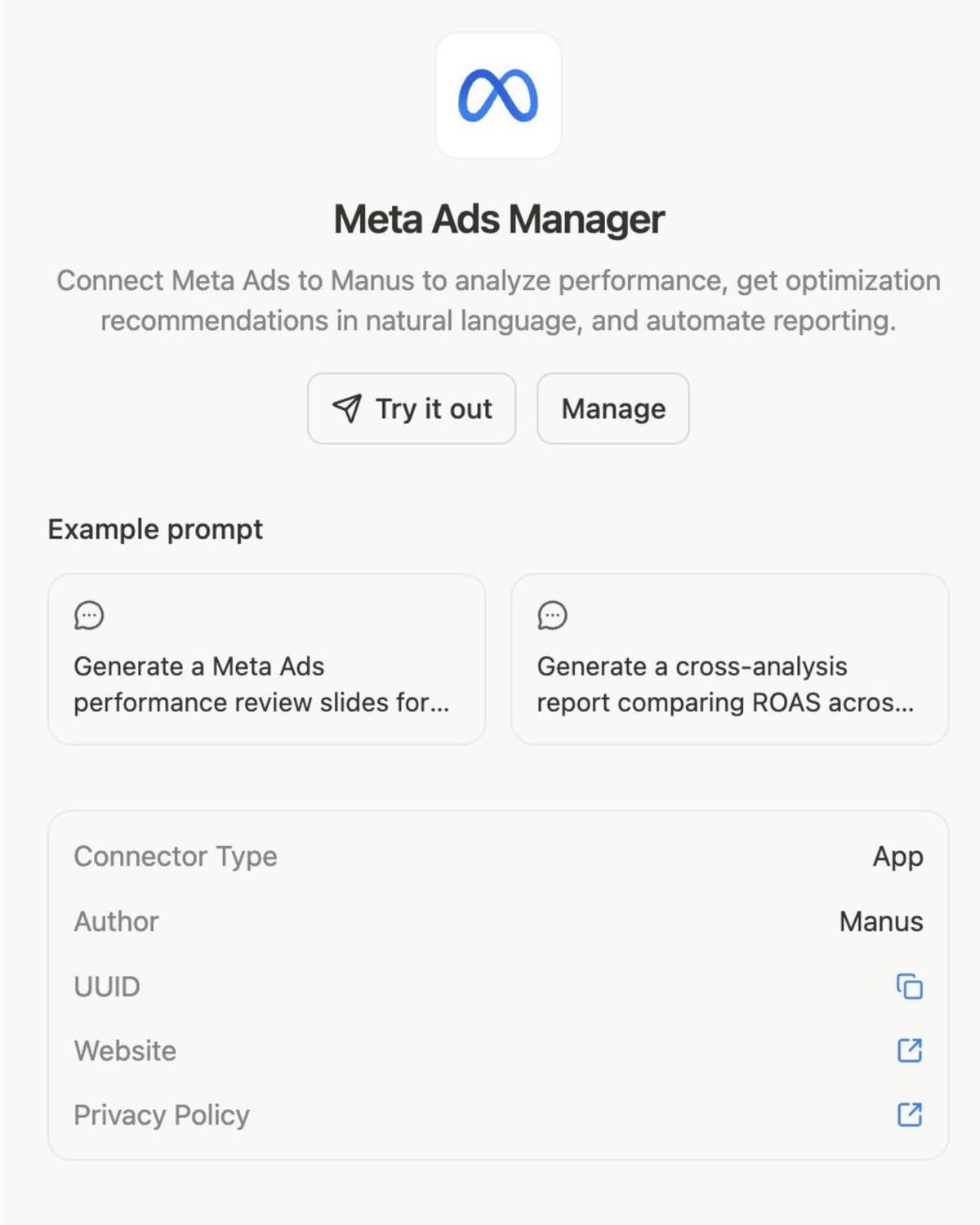
Meta this week added Manus AI to the navigation menu of Ads Manager, marking the first visible sign of the company putting its December 2025 acquisition to practical advertising use. The integration, spotted by users on February 21, 2026, places a dedicated Manus AI shortcut under the "Manage" section of the Ads Manager tools flyout - sitting between Instant Forms and Media Library in the interface hierarchy.
The placement is deliberate. Ads Manager is where millions of businesses - from small shops to Fortune 500 brands - execute their daily advertising operations. Embedding Manus directly into that workflow, rather than as a standalone product, signals Meta's intent to make the agent technology part of the standard operational toolkit rather than a separate add-on.
Manus was, until late 2025, an independent Singapore-based company building what it described as a general-purpose autonomous AI agent. The product launched its first agent earlier in 2025 and, according to Meta's announcement on December 29, 2025, had by that point processed more than 147 trillion tokens and powered the creation of over 80 million virtual computers. Those figures point to meaningful deployment at scale before the acquisition closed.
The company's technology focuses on agentic execution - not just answering questions but completing multi-step tasks independently. According to Meta's December 29 announcement, Manus "has built one of the leading autonomous general-purpose agents that can independently execute complex tasks like market research, coding, and data analysis."
In a statement accompanying the acquisition, Xiao Hong, CEO of Manus, said: "Joining Meta allows us to build on a stronger, more sustainable foundation without changing how Manus works or how decisions are made. We're excited about what the future holds with Meta and Manus working together and we will continue to iterate the product and serve users that have defined Manus from the beginning."
Meta, for its part, framed the deal as an opportunity to bring agent technology to a far larger audience. According to the company's December 29 announcement: "We are excited to announce that Manus is joining Meta to bring a leading agent to billions of people and unlock opportunities for businesses across our products."
The Manus team joined Meta's workforce, though the company continues to operate from Singapore and maintains its subscription product for existing users. Meta confirmed it would continue to sell and operate the Manus service while simultaneously integrating it across its platforms, including in Meta AI.
The February 21 integration makes Manus accessible via a shortcut in the Ads Manager navigation panel - the same panel where advertisers navigate between Campaigns, Audiences, Billing and Events Manager. Screenshots circulating on social platforms show the Manus AI entry appearing under the "Manage" group in the tools flyout, alongside Instant Forms and Media Library, with a link pointing to manus.im/programs/meta/mkt2/ with campaign tracking parameters indicating it routes through the Ads Manager web interface.
According to Search Engine Land's February 17 report, some advertisers had already been seeing in-stream prompts to activate Manus AI inside Ads Manager before the shortcut appeared. Manus was made available to all advertisers via the Tools menu, and select users were receiving pop-up alerts encouraging in-workflow adoption. The shortcut visible today represents a further consolidation of that rollout.
The agent is designed to handle tasks that advertising teams typically perform manually or through custom API integrations: report building, audience research, and campaign analysis. Rather than requiring users to pull data through the Marketing API and build their own scripts or dashboards, Manus is positioned as a conversational layer that can execute those processes on request.
The practical implications are notable for agencies and in-house teams that spend significant time on reporting infrastructure. Marketers who currently build custom attribution reports, cross-campaign performance summaries, or audience segment analyses through the API could, in principle, delegate those tasks to the agent.
Early practitioner responses, as reflected in social media commentary on February 21, were mixed but pointed toward genuine interest. Austen Allred, founder of an AI training platform, wrote on X: "I didn't realize when Meta bought Manus that they would turn it into a much better agent for Meta ads. As someone who spent the last 6 months battling with ads APIs, all I can say is thanks heavens."
That comment drew 13,300 views and a thread of replies that illustrated both the appeal and the skepticism surrounding the tool. One user noted that Manus "doesn't do anything more than you can get through the API," while others described years of frustration with Meta's advertising API infrastructure. A comment from one practitioner captured a common sentiment: "I was literally cursing the API docs at 2am last month trying to pull custom attribution data without it erroring out for the 47th time."
John Goldman, replying in the same thread, raised a concern that will be familiar to anyone who has tested AI tools against live campaign data: "I've been running that Manus app on Ads Manager the last couple days, and it comes up with some really crazy shit. Like, it thinks that people are calling us from the ad, even though there's no phone number in the ad. And it suggests we optimize" - the reply cut off there, but the underlying concern about hallucination in ad data contexts is a recurring issue with AI systems operating on campaign performance information.
Those concerns are not trivial. When an agent misreads attribution data or makes incorrect assumptions about creative elements, the suggestions it produces can mislead campaign decisions in ways that are difficult to detect without manual verification.
The Manus integration does not arrive in a vacuum. Meta has spent the past two years systematically expanding AI automation across its advertising stack, and the company reported $58.1 billion in advertising revenue for Q4 2025, with 24% year-over-year growth that management attributed substantially to AI improvements across ranking systems and campaign automation.
The Advantage+ suite has gradually become the default structure for sales, leads, and app objectives, and the Marketing API was restructured in 2025 to reflect that shift toward automation-first campaign creation. Legacy campaign APIs were deprecated in October 2025 to push advertisers toward the unified Advantage+ structure. Each of those changes reduced manual control while expanding machine learning decision-making. Manus represents a different layer: rather than removing advertiser decisions, it aims to assist with executing them more quickly.
Meta is under sustained pressure from investors to show that its AI capital expenditure - $22.1 billion in infrastructure spending in Q4 2025 alone - translates into business value. Advertising remains by far the company's largest revenue stream. Embedding Manus into Ads Manager creates a direct connection between the acquisition and the company's core monetization mechanism.
That logic has been visible in the marketing of the integration. According to Search Engine Land, Meta is currently "prioritizing tying AI investment to measurable ad performance, giving advertisers new ways to optimize campaigns." Whether those efficiency claims hold under real-world conditions is a question advertisers will be testing in the weeks ahead.
The Manus integration arrives against a backdrop of genuine debate about whether Meta's AI advertising tools deliver on their stated benefits. Analysis published by PPC Land in January 2026 documented cases where Advantage+ Shopping Campaigns generated only 17% of conversions reported by Meta's own attribution - a significant discrepancy suggesting the system captures existing demand rather than creating new demand. Cost-per-thousand impressions inflated 10x for some advertisers during the February 2024 Valentine's Day period, and budget depletion incidents have been documented repeatedly.
Meta's AI automation has drawn skepticism from advertisers despite the company's consistent claims of 22% return-on-ad-spend improvements for Advantage+ users. The "black box" problem - insufficient transparency into how algorithmic decisions are made - has been a persistent criticism, and Manus operating as an agent layer on top of existing campaign data does not resolve that underlying opacity.
What Manus does change is the interface layer. Instead of navigating Ads Reporting tabs and building custom breakdowns manually, advertisers can, in theory, request analysis in plain language. For practitioners who have spent years wrestling with the Ads Manager's reporting infrastructure, that accessibility has real value - provided the agent's outputs are accurate.
The accuracy question is not a minor one. Campaign decisions based on AI-generated analysis that contains errors - incorrect attribution assumptions, misread creative performance, fabricated trends - can compound quickly across active budgets. The February 21 social media thread included multiple accounts of the tool producing unexpected or incorrect outputs in early testing.
To understand why Meta views Manus as strategically significant, the scale numbers from the December 2025 announcement are worth examining directly. According to Meta's announcement, Manus had processed more than 147 trillion tokens by the time of the acquisition - a figure that reflects the computational volume required to power general-purpose agentic systems across millions of users. The 80 million virtual computers figure describes the number of isolated compute environments the agent had spun up to execute tasks.
Those numbers indicate that Manus, even as an independent company, had reached meaningful deployment scale. Meta's bet is that integrating that technology into an advertising platform used by millions of businesses daily will produce compounding value - both for advertisers using the tools and for Meta's own revenue story.
The company stated in December that it plans "to scale this service to many more businesses" and described the Manus team's talent as central to delivering "general-purpose agents across our consumer and business products, including in Meta AI." The Ads Manager integration appears to be the first concrete product step in that stated direction.
The acquisition did not immediately change the experience for users of the standalone Manus product. According to the company's December 29 announcement, the subscription service continues through the Manus app and website, the Singapore operational base remains intact, and the product roadmap continues as before. The company emphasized: "Our top priority is ensuring that this change won't be disruptive for our customers."
That commitment to continuity is relevant for businesses that adopted Manus before the Meta acquisition. Those users are now, effectively, operating on infrastructure owned by one of the world's largest advertising platforms - a fact that may have data and competitive implications worth examining, particularly for businesses that used Manus for competitive research or proprietary workflow automation.
Who: Meta Platforms, following its acquisition of Manus AI (founded by CEO Xiao Hong, operating from Singapore), is rolling out the Manus agent to advertisers through Meta Ads Manager. The integration affects all Meta advertisers globally.
What: A dedicated Manus AI shortcut has appeared in the Ads Manager navigation panel under the "Manage" section, giving advertisers access to an autonomous AI agent capable of handling report building, audience research, and campaign analysis tasks. Some advertisers had been receiving in-stream prompts and pop-up alerts since at least February 17, 2026.
When: The acquisition was announced December 29, 2025. Broader Ads Manager rollout was reported February 17, 2026, with the navigation shortcut confirmed today, February 21, 2026.
Where: The integration is live inside Meta Ads Manager, accessible through the tools flyout navigation panel. Manus's standalone subscription service continues to operate through its app and website, with the company's operational base remaining in Singapore.
Why: Meta is embedding Manus to demonstrate measurable returns on its aggressive AI infrastructure spending - $22.1 billion in Q4 2025 alone - by connecting agent technology directly to its primary revenue source, advertising. The company also aims to reduce friction for advertisers around reporting and analysis tasks that currently require API expertise or manual workflows, potentially expanding advertiser productivity on the platform.