
Marketers drown in data yet struggle to measure campaign impact, report finds
Funnel research reveals 86% of in-house marketers cannot determine channel impact, while cultural resistance and AI preparation gaps threaten effectiveness.

Funnel research reveals 86% of in-house marketers cannot determine channel impact, while cultural resistance and AI preparation gaps threaten effectiveness.
Marketing professionals face a contradiction. Data flows from hundreds of platforms while actionable insights remain elusive, according to research released December 2, 2025, by marketing intelligence platform Funnel and market insights firm Ravn Research.
The quantitative and qualitative study of 238 in-house and agency marketing leaders exposes critical disconnects between data availability and strategic clarity. According to Funnel, 86% of in-house marketers and 79% of agency marketers struggle to determine the impact of each marketing channel on overall performance despite unprecedented access to analytics tools and measurement infrastructure.
These findings align with broader measurement challenges documented throughout 2025, where 54.1% of marketing professionals reported no change in measurement confidence year-over-year while 14.3% said confidence actually declined. The pattern reveals that more technology has not translated into greater clarity about what drives business results.
Subscribe PPC Land newsletter ✉️ for similar stories like this one
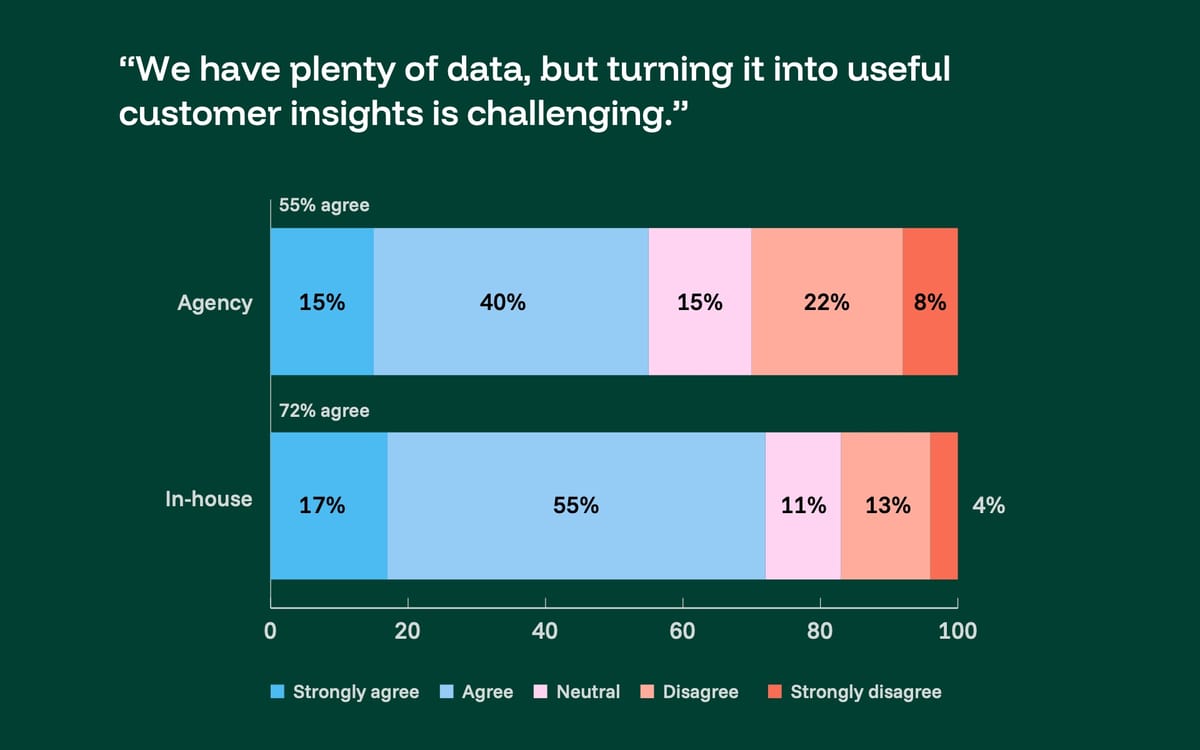
The research identifies several interconnected problems affecting marketing effectiveness. While 72% of in-house marketers and 55% of agency marketers report having mountains of data, they struggle to extract meaningful intelligence from this information. Many teams cannot identify what performs effectively across fragmented channels, touchpoints, and devices.
According to Funnel, which processes over 10% of global digital advertising spend through more than 600 platform integrations, marketers are "inundated with data across thousands of sources and can't marshal insights on how their campaigns reach customers and deliver returns on investment." The platform serves brands including Uber, Adidas, and Sony.
The complexity of modern marketing infrastructure prevents teams from maintaining current visibility into campaign performance. Research released September 5, 2025, by Adverity found that 45% of marketing data is inaccurate, with Gartner estimating inadequate data quality costs organizations an average of $12.9 million annually through misleading insights and wasted resources.
Tom Roach, VP Brand Strategy at Jellyfish, stated: "Data analysts are very good at reporting on what happened. But to interrogate why something happened requires additional skills, including a broader understanding of how communications work, how campaigns are supposed to work, how brand growth works... and the myriad ways things can go wrong. That's less about data analysis and more about detective work."
Many teams pursue vanity metrics like clicks, followers, and impressions that disconnect from actual business impact. Just 13% of marketers communicate very well with finance departments that track business outcomes and allocate budgets based on demonstrated returns. This communication gap creates misalignment between marketing activities and organizational expectations for demonstrable revenue impact.
A strategic gap separates prediction from preparation. The research shows 64% of marketers expect customers will use traditional search engines less often within the next two to three years as AI-powered platforms like ChatGPT, Perplexity, and Gemini reshape discovery behaviors. Despite this widespread recognition, only 52% of in-house marketers create content optimized for AI and conversational search.
Training deficiencies compound preparation challenges. Just 44% of organizations train teams for AI-driven search and visibility practices, while fewer than 30% use automations for content optimization. This preparation deficit occurs as fundamental shifts transform search behaviors from traditional blue links toward conversational experiences and AI-generated summaries.
According to external research cited in the Funnel study, 93% of marketers say AI helps generate content faster. However, substantial numbers express concerns about AI tools producing repetitive, generic campaigns lacking resonance, distinctiveness, and emotional impact required for effective marketing. Some 54% of marketers use AI to enhance creativity on teams, but 39% of agency marketers and 23% of in-house marketers report AI creates repetitive, generic campaigns.
The shift from search engine optimization to what professionals term "generative engine optimization" represents more than terminology changes. Marketing consultant Madhav Mistry announced a four-layer SEO framework on June 27, 2025, addressing Answer Engine Optimization, Generative Engine Optimization, AI Integration Optimization, and Search Experience Optimization, though Google's John Mueller warned that aggressive promotion of these acronyms may indicate spam tactics.
Cultural dynamics create substantial barriers to adaptation despite technological capabilities. The research reveals 64% of in-house marketers and 53% of agency marketers report more than three months have passed since they launched campaigns deviating from typical practices. This suggests organizations use potentially transformative technology to achieve mediocre results through cautious execution.
Roach stated: "Playing it safe is actually the riskiest long-term strategy, as it leads to stagnation. Brands can make bolder moves by adopting a test-and-learn mindset and ring-fencing a small innovation budget. I like the 70/20/10 approach: 10% devoted to trying new things, 20% to optimising what works and 70% to basic foundations."
Risk-averse organizational cultures prevent teams from leveraging capabilities effectively. The study found 41% of in-house marketers do not feel fully comfortable raising concerns or challenging existing strategies. This problem affects Gen Z marketers nearly four times more severely than their oldest colleagues, with younger professionals significantly less likely to voice strategic concerns.
Only 13% of marketing organizations embed continuous review and refinement in their culture. One survey respondent explained: "People are afraid to change old habits for fear it will be unsuccessful, which would put a target on their back."
Thijs Bongertman, chief data officer at SPAIK, explained: "Unfortunately, a lot of marketers, especially in bigger companies, are preoccupied with meetings, senior executives and creating presentations explaining what they're doing, not necessarily working. If marketers had more mental capacity to really dive deep into data, they could create those insights themselves."
Recent research showing measurement confidence stalling despite data growth found 60.2% of marketers say internal stakeholders question their metrics at least sometimes, while 20.4% remain uncertain whether non-marketing stakeholders trust performance reporting. Budget consequences follow measurement doubts, with 28.6% of marketers reporting that 11% to 20% of marketing budgets have been reallocated or put at risk due to uncertain metrics.
Few marketing teams have developed sophisticated measurement capabilities distinguishing high-performing organizations from struggling competitors. Only 8% of in-house teams and 21% of agency marketers possess advanced analytics skills using methods like market mix modeling, incrementality testing, and attribution modeling.
The capabilities gap creates measurable performance implications. Among teams using advanced analytics, 76% feel empowered to experiment with new marketing approaches. Just 36% of those with limited or no advanced analytics capabilities report similar empowerment levels.
Specific skill deficiencies include market mix modeling at 15% adoption, incrementality testing at 18%, and attribution modeling at 27%. Despite low adoption rates, 70% of marketers say they want to improve data analysis skills on teams, particularly by developing marketing mix modeling capabilities.
Traditional attribution methods face mounting challenges. Platform changes have complicated measurement efforts, with Meta restricting attribution windows and data retention in its Ads Insights API, eliminating longer view-through measurement options advertisers relied upon. These modifications compound existing measurement difficulties across advertising ecosystems.
LinkedIn launched enhanced revenue attribution capabilities on July 28, 2025, introducing company-level attribution and campaign-level revenue measurement directly within Campaign Manager. The platform's Company Intelligence API, launched September 23, 2025, enables B2B marketers to track entire organizations through attribution partners, addressing critical gaps where traditional lead-level tracking fails to capture modern buying behaviors involving committees averaging six to ten people.
Research indicates analytics maturity functions as both cultural and performance differentiator. Organizations with sophisticated measurement capabilities demonstrate superior results across multiple dimensions compared to peers relying on basic reporting tools and limited analytical approaches.
Modern marketing infrastructure spans hundreds of platforms, data sources, and touchpoints across devices and channels. This technical complexity prevents teams from maintaining current visibility into campaign performance, let alone extracting strategic insights informing budget allocation and tactical adjustments.
Data volume creates paralysis rather than empowerment. Marketing teams struggle to distinguish signal from noise, identify meaningful patterns, and connect advertising activities to business outcomes across fragmented measurement systems. Sixty-eight percent of in-house marketers and 52% of agency marketers say they lack up-to-date visibility into campaign performance across channels.
According to the research, disconnects between data availability and insight generation reflect fundamental challenges in marketing operations rather than simple technological deficiencies. Organizations require integrated systems, specialized analytical expertise, and cultures supporting data-driven decision-making alongside creative excellence.
The measurement crisis extends beyond individual organizations to industry-wide standards. The Interactive Advertising Bureau released measurement framework for commerce media campaigns on November 3, 2025, defining incrementality as "the causal impact of marketing by identifying the additional business outcomes directly driven by a campaign or tactic, compared to what would have occurred in the absence of marketing activity."
When asked which measurement challenges are most pressing, 67.4% of marketers identified proving incremental ROI to justify spend as highest priority, followed by aligning marketing metrics to business outcomes at 66.3% and improving cross-channel attribution accuracy at 55.1%, according to TransUnion and EMARKETER research released October 21, 2025.
Buy ads on PPC Land. PPC Land has standard and native ad formats via major DSPs and ad platforms like Google Ads. Via an auction CPM, you can reach industry professionals.
As third-party cookies disappear and privacy regulations tighten, first-party data has shifted from optional to essential infrastructure. Yet just 20% of in-house marketers say collecting and using first-party data is a top priority in overall marketing strategy. Agencies report fewer than half (47%) of clients have clear strategies for collecting and using first-party data.
The December 2 release follows expanding concerns about data quality across digital advertising platforms, with research showing 63% of energy leaders identified poor data quality as top barrier to drawing insights while 51% pointed to siloed or inaccessible data as major challenge.
Funnel and Ravn Research emphasize that measurement challenges extend beyond technical capabilities to organizational structures, team skills, leadership support, and cultural norms around experimentation and risk-taking. Addressing these multifaceted issues requires coordinated efforts across technology implementation, skill development, process refinement, and cultural transformation.
Subscribe PPC Land newsletter ✉️ for similar stories like this one
Subscribe PPC Land newsletter ✉️ for similar stories like this one
Who: Marketing intelligence platform Funnel and market insights company Ravn Research conducted the study of 238 in-house and agency marketing leaders and professionals. Funnel processes over 10% of global digital advertising spend through 600+ platform integrations for brands including Uber, Adidas, and Sony.
What: The research reveals 86% of in-house marketers and 79% of agency marketers cannot determine the impact of each marketing channel on overall performance. Additional findings show 64% predict customers will use traditional search engines less often within two to three years, yet fewer than half train teams for AI-driven search. Leadership resistance prevents 64% of in-house and 53% of agency teams from launching campaigns deviating from typical practices in over three months. Only 8% of in-house teams and 21% of agency marketers possess advanced analytics skills.
When: Funnel and Ravn Research released the report December 2, 2025, based on quantitative and qualitative research conducted from July through September 2025.
Where: The research examines marketing teams globally across in-house departments and agency environments, focusing on measurement challenges spanning digital advertising platforms, analytics tools, and campaign management systems across North America, Europe, Australia, and other markets.
Why: The report addresses critical disconnects between data availability and actionable insights as marketing teams face fragmented measurement systems, shifting consumer behavior toward AI-powered search, organizational resistance to innovation, significant gaps in advanced analytics capabilities, and inadequate first-party data strategies required for effective campaign optimization and budget allocation in privacy-focused advertising environments.