Meta's value rules might actually cost more than they're worth
Meta's new value rules feature lets advertisers adjust bids by demographics and placement, but industry experts warn against rushing adoption without clear data.


Meta's new value rules feature lets advertisers adjust bids by demographics and placement, but industry experts warn against rushing adoption without clear data.
Performance marketing professionals face a new decision point in Meta's advertising ecosystem. Value rules, a bidding adjustment feature that Meta quietly expanded across its advertising platform in 2025, allow advertisers to increase or decrease bids based on audience demographics, device types, locations, and placements without fragmenting campaigns into multiple ad sets.
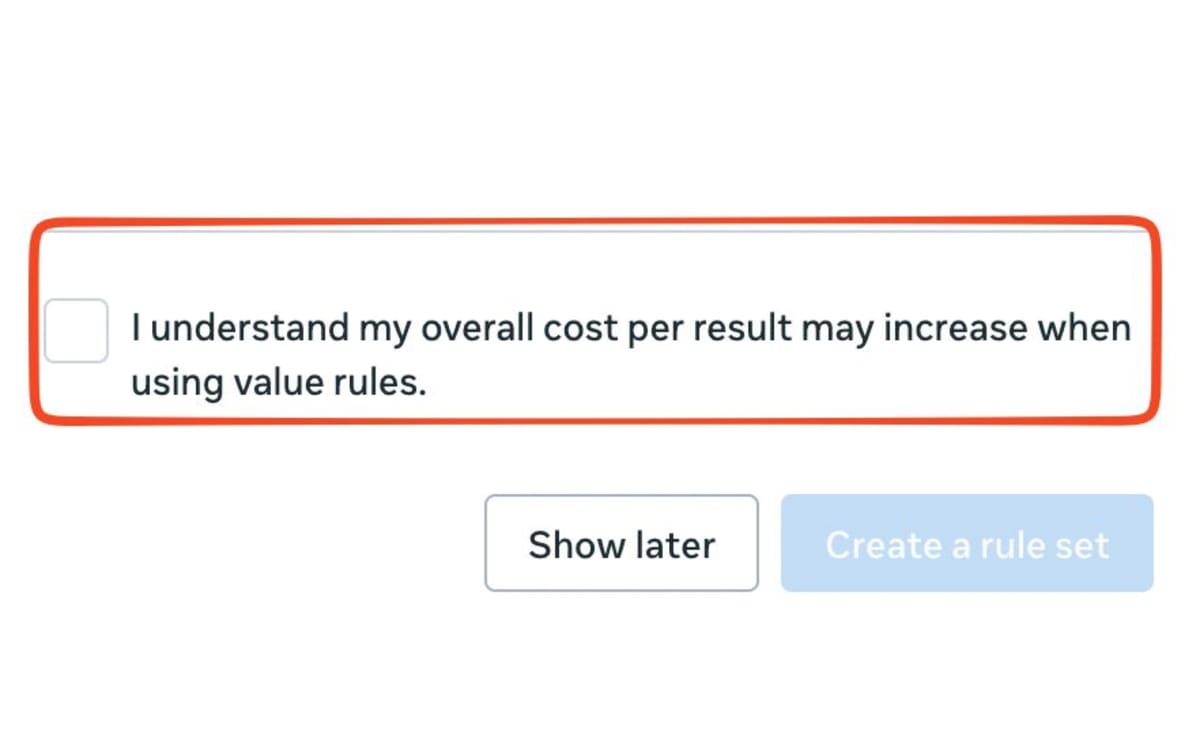
The feature launched with a warning that many advertisers appear to have overlooked. According to Meta's official documentation, "your overall cost per result may increase when using value rules." This acknowledgment appears during the value rules setup process, requiring advertisers to check a box confirming they understand potential cost increases before proceeding.
Pleurat Breznica, a paid media strategist at ProfitMetrics.io who has managed over €1.5 million in advertising spend, published a detailed analysis on December 15, 2025, outlining why he avoids using value rules in most accounts. "Short answer from me: I wouldn't," Breznica stated in a LinkedIn post that garnered significant attention from digital marketing professionals.
According to Breznica's analysis, value rules instruct Meta "which users are 'worth more' (country, device, age, etc.)" and the platform "then bids more aggressively for them." His primary concern centers on the explicit cost warning from Meta: "Meta literally warns you: 'your overall cost per result may increase when using value rules.'"
Value rules operate at the ad set level within Meta Ads Manager. Advertisers create rule sets containing up to 10 individual rules, each using up to two criteria from available options including age ranges, gender, mobile operating system, geographic location, device platform, and ad placement. Each rule specifies a bid adjustment percentage, ranging from a 1,000% increase to a 90% decrease.
The system applies rules through a prioritized hierarchy. When a user qualifies for multiple rules, Meta applies only the first matching rule in the sequence. This priority structure requires careful rule ordering, as a woman aged 35 in California using an iOS device might qualify for separate rules targeting women, California residents, iOS users, and the 35-44 age range. Only the highest-priority applicable rule adjusts the bid for that impression opportunity.
Jon Loomer, a digital marketing expert who published an extensive analysis of value rules on January 2, 2026, explained that the feature addresses situations where "Meta will bid for you to maximize the number of website leads you get. However, you know that women between the ages of 35 and 44 represent the highest value leads."
According to Jon Loomer Digital's analysis, value rules allow advertisers to "bid more than usual based on the demographics of your audience" without creating separate ad sets for different segments. "One of the benefits of using Value Rules is that it allows you to consolidate your ad sets," Loomer wrote.
Meta's requirements for value rules have evolved since initial rollout. The feature works with sales and app promotion campaign objectives when using website or app conversion locations. Value rules do not support campaigns already using return on ad spend goals, bid caps, or maximize value of conversions performance goals. The feature remains unavailable for Special Ad Categories including housing, employment, and financial services campaigns.
Buy ads on PPC Land. PPC Land has standard and native ad formats via major DSPs and ad platforms like Google Ads. Via an auction CPM, you can reach industry professionals.
Breznica's critique focuses on his existing optimization approach. "My focus is already on profit / POAS from the backend, not just cheap CPAs," he stated. His methodology prioritizes tracking post-conversion profitability rather than surface-level cost per acquisition metrics.
According to Breznica, most ecommerce setups contain "bigger levers to fix first: tracking, offers, creatives, landing pages – before we start pre-deciding who Meta should pay extra for." This perspective challenges the assumption that bidding adjustments represent the most effective optimization strategy available to advertisers.
The paid media strategist identified limited scenarios where value rules might deliver results. "When they might make sense," Breznica wrote, occurs when advertisers "have very clear data that one segment has much higher LTV / profit" and when "Tracking and POAS are stable enough that you can actually see if value rules help, instead of just inflating CPR."
CustomerLabs, a marketing technology company specializing in first-party data operations, published guidance on December 15, 2025, acknowledging both applications and limitations. According to their analysis, value rules prove "effective when reliable post-conversion or downstream data is available" and "value differences between segments are consistent."
The company identified situations where value rules underperform. They are "less effective when assumptions about value are untested, conversion volume is too low to validate results," or when "they are used to compensate for poor funnel quality," according to CustomerLabs' documentation.

Meta provides a specialized breakdown view within Ads Manager reporting for campaigns using value rules. This breakdown allows advertisers to "view performance segmented by applied Value Rules, understand how bid adjustments influence delivery," and "compare costs and outcome quality across rules," according to Jon Loomer Digital's technical documentation.
The value rules breakdown appears at the bottom of the Ads Manager dropdown menu, available only for campaigns where rule sets have been applied. Meta has not disclosed the specific metrics included in this breakdown view, though the company states advertisers "will be able to see outcomes, such as conversions, for each value rule in your value rules set."
The reporting component addresses a critical gap in value rules implementation. "Without it, bid adjustments become assumptions embedded in the system without validation," CustomerLabs noted in their analysis. "With proper reporting, advertisers can refine, reorder, or remove rules based on real results."
Value rules became available for placement-specific bidding control in July 2025, expanding the feature beyond demographic targeting. Digital marketing specialist Bram Van der Hallen documented that advertisers can now "set bid rules for your preferred audiences" across 25 distinct placements including Instagram feed, Facebook feed, Stories, Reels, and Marketplace.
Subscribe PPC Land newsletter ✉️ for similar stories like this one
Jon Loomer's analysis frames value rules as addressing inherent weaknesses in Meta's optimization algorithms. "I find it interesting that Meta is making Value Rules available because it seems to make an admission that there are some inherent weaknesses in Meta's optimization," he wrote.
His longstanding complaint about Meta's algorithm centers on value blindness. "The algorithm does not care about the value of your results (leads, clicks, engagement, etc.)," Loomer explained. "Its only focus is on getting you as many of that action as possible, and that can lead to low-quality results and waste."
Loomer documented specific scenarios where algorithmic optimization produces undesirable spending patterns. When running lead generation campaigns without age restrictions, he found Meta "will spend a high percentage of my budget on people over the age of 65." This concentration occurs "because Meta's able to get me cheap leads there," resulting in "low-quality leads" that cost less but convert poorly.
Prior to value rules availability, Loomer addressed this problem by "turning off audience suggestions by age group and set an age limit of 54." While acknowledging this approach as imperfect—"I don't want to cut off leads at that age"—it represented "the best way to prevent Meta from wasting my money on cheap and low-quality leads."
Value rules offer an alternative approach: lowering bids on people over 54 while "continue targeting these people while spending less on them." This preserves audience reach while reducing budget allocation to lower-performing segments.
Geographic targeting presents similar challenges. Loomer documented experiments targeting multiple country groups for lead generation, finding that while the United States, United Kingdom, Canada, and Australia maintained "similar cost and lead quality," other countries "generated very cheap and often low-quality leads."
The algorithm's indifference to lead quality meant it "would spend most of my money getting me the cheapest leads possible if given the choice." His previous solution involved "creating multiple ad sets to group countries by CPM and adjust my budget accordingly." Value rules enable consolidating these country groups into a single ad set with differentiated bidding.
Loomer emphasized that increased costs should not automatically disqualify value rules usage. "The end result of increasing your bid for certain demographics may be that you will spend more per conversion when using Value Rules," he wrote. "However, the expectation is that you will get higher value conversions this way."
This calculation requires sophisticated measurement infrastructure. Advertisers must evaluate "what your most valuable customer by lifetime value looks like by your available demographic segments," according to Loomer's methodology. This analysis occurs "within your CRM or external reporting, rather than in Ads Manager."
The second evaluation component examines "the value of your ad-generated results by segment." Loomer stressed that "adequate tracking in place so that you can evaluate the quality of your leads and app installs that are generated by ads" becomes essential before implementing value rules.
The final diagnostic step involves analyzing how Meta currently allocates budget. Using demographic breakdowns within Ads Manager, advertisers should determine whether "money wasted on groups that you've determined to be low-value" or if "not enough spent on those you consider your highest value customers."
Breznica's critique emphasizes this measurement gap. "Until those conditions are true, I wouldn't rush into value rules," he stated. "Clean events + strong creative + solid offer will usually get you further than another bid tweak."
CustomerLabs outlined the fundamental principle governing value rules effectiveness: "Value Rules amplify your assumptions about value. If those assumptions are incorrect, costs can increase without meaningful improvement."
Meta announced on June 4, 2025, an expansion of value optimization capabilities that positioned value rules within a larger product suite. According to Fred Leach, Meta's vice president of product management, "Some conversions are more valuable than others, and marketers want to focus on conversions that generate the specific business results they care about."
The announcement introduced value optimization for profit margins, incremental attribution global rollout, and custom attribution features enabling multitouch attribution integration. These tools addressed advertiser feedback about "needing more sophisticated ways to optimize for business outcomes beyond conversion volume," according to Meta's official statements.
The value optimization expansion reflected industry trends away from volume-based metrics. Meta's advertising revenue reached $41.39 billion in Q1 2025, representing 16% growth compared to the previous year, driven partly by AI-powered advertising tools adoption.
Meta expanded advertising features with universal value rules availability in August 2025, marking "a substantial expansion from previous limited availability," according to documentation from the platform. The feature now works "across all ad accounts and campaign objectives," providing broader access than initial testing phases.
The introduction of value rules arrives during a broader industry discussion about automation versus manual control in digital advertising. Meta's trajectory has consistently moved toward automated optimization, with Advantage+ campaigns and AI-powered creative tools reducing advertiser input requirements.
Value rules represent a countertrend, returning granular control to advertisers for specific bidding decisions. This combination of automated delivery with manual steering capabilities creates what Meta describes as campaigns that "adjust delivery towards criteria and outcomes that you value more highly."
Loomer expressed surprise at value rules becoming widely available. "Particularly since we're moving to less and less control, this feels like a feature that would be offered as an exception to a small group of advertisers," he wrote. "If it's encouraged, it will surely lead to misuse."
His concern centers on advertisers assuming customization necessity regardless of actual campaign needs. "Do not assume that Value Rules are required," Loomer emphasized. "Particularly when maximizing the number of conversions where the conversion event is a purchase, the algorithm rarely wastes your money on segments that won't lead to that action."
Meta's own positioning acknowledges this tension. According to official documentation, the platform's AI-powered delivery continues improving but "retains major flaws." Value rules provide "potential solution to a problem," but advertisers should "first have a problem that needs to be solved. Otherwise, using Value Rules may only increase your costs without doing much of anything to the value of results."
Breznica's LinkedIn post received engagement from industry professionals sharing similar perspectives. Naveen Gundu, a growth and marketing professional, suggested value rules might enable reducing "bidding costs on a few user cohorts where we know they don't add much value." Travis Moh, who works with seven and eight-figure course creators, noted that "simple things often work better than clever things for longer than people think."
Jon Loomer Digital's comprehensive guide outlines specific implementation scenarios where value rules address documented optimization failures. The first example involves lead quality by age group, where unrestricted targeting results in Meta spending "a high percentage of my budget on people over the age of 65" because "Meta's able to get me cheap leads there."
The second scenario addresses lead quality by country. Loomer documented an experiment grouping countries by cost per thousand impressions and adjusting budgets through multiple ad sets. Value rules enable consolidating these country groups while maintaining differentiated bidding strategies.
CustomerLabs provided two practical scenarios illustrating effective value rules application. An ecommerce brand selling products ranging from $20 to $150 discovered that "users aged 30–45 consistently generate higher average order values and repeat purchases, while younger users primarily purchase entry-level products."
Instead of "splitting ad sets by age, the brand uses a single ad set" and "applies a Value Rule to increase bids for users aged 30–45." This approach "allows Meta to prioritize auctions for higher-value customers while preserving campaign learning," according to CustomerLabs' analysis.
A B2B lead generation example demonstrated geographic value differentiation. Sales data indicated that "leads from major metropolitan areas convert into revenue at a much higher rate than leads from smaller markets." Using value rules, the advertiser "increases bids for high-performing locations" and "decreases bids for regions with low qualification rates."
The result aligned "ad delivery more closely with downstream sales performance rather than raw lead volume," according to the case study documentation.
All guidance sources emphasize measurement infrastructure requirements before value rules implementation. Loomer's evaluation framework requires answering three questions: what the most valuable customer looks like by demographic segments, the value of ad-generated results by segment, and how Meta currently spends advertising budgets.
Breznica's skepticism focuses on this foundation. His methodology prioritizes "profit / POAS from the backend" tracking before considering bidding adjustments. "In most ecom setups, there are bigger levers to fix first: tracking, offers, creatives, landing pages," he stated.
CustomerLabs reinforced this perspective with their guiding principle: "Value Rules amplify your assumptions about value. If those assumptions are incorrect, costs can increase without meaningful improvement." The technology company specified that value rules work effectively "when reliable post-conversion or downstream data is available" and "value differences between segments are consistent."
The feature requires advertisers to understand not just immediate conversion metrics but downstream business outcomes. A customer who converts at low cost but never makes repeat purchases represents different value than a higher-cost acquisition with strong lifetime value potential. Value rules enable expressing these differences to Meta's optimization algorithms, but only if the advertiser possesses accurate data quantifying these distinctions.
Meta's expansion to include placement-specific value rules in July 2025 increased complexity further. Advertisers must now evaluate whether specific placements like Instagram feed, Reels, or Audience Network deliver different value profiles beyond simple performance metrics.
The platform's approach differs from its limited spend option for excluded placements, which automatically allocates up to 5% of budget to placements advertisers have explicitly excluded. Value rules require active decision-making rather than default opt-in configurations.
Jon Loomer's analysis concluded with a critical perspective on adoption patterns. "Maybe this is a complexity that very few advertisers will bother with," he wrote. "It should be viewed as an exception, rather than as a rule."
This positioning frames value rules as a sophisticated tool for specific optimization challenges rather than a standard feature every campaign requires. The evaluation methodology Loomer outlined—examining customer value by segment, measuring result quality by demographic, and analyzing current spending patterns—represents significant analytical work before determining whether value rules address actual problems.
CustomerLabs similarly positioned value rules as addressing specific structural issues. The feature enables advertisers to "influence bidding behavior so higher-value users, locations, or placements receive greater priority in the auction without fragmenting campaigns or disrupting the learning process," according to their December 15 documentation.
Breznica's perspective emphasized prioritization. "Clean events + strong creative + solid offer will usually get you further than another bid tweak," he wrote, suggesting value rules represent optimization layer seven or eight rather than foundational campaign elements.
His final position acknowledged limited applications: "When they might make sense" occurs when advertisers "have very clear data that one segment has much higher LTV / profit" and when "Tracking and POAS are stable enough that you can actually see if value rules help, instead of just inflating CPR."
The feature's availability across Meta's advertising platform means millions of advertisers now have access to value rules configuration. Whether widespread adoption occurs, or whether the feature remains a specialized tool for sophisticated advertisers with comprehensive measurement systems, will likely become clear throughout 2026 as more performance data emerges from real-world implementations.
Subscribe PPC Land newsletter ✉️ for similar stories like this one
Subscribe PPC Land newsletter ✉️ for similar stories like this one
Who: Meta Technologies introduced value rules to advertisers globally, with industry experts including Pleurat Breznica (ProfitMetrics.io), Jon Loomer (Jon Loomer Digital), and CustomerLabs publishing implementation guidance.
What: Value rules allow advertisers to increase or decrease bids by up to 1,000% or 90% respectively based on demographic criteria (age, gender, location, mobile operating system, device platform) and ad placements without creating separate ad sets, though Meta explicitly warns that overall cost per result may increase.
When: Meta announced value optimization expansion on June 4, 2025, with placement-specific value rules becoming available July 25, 2025, and universal availability across all ad accounts achieved by August 20, 2025.
Where: The feature operates within Meta Ads Manager at the ad set level, working with sales and app promotion campaign objectives when using website or app conversion locations across Facebook, Instagram, Messenger, and Meta Audience Network placements.
Why: Meta developed value rules to address advertiser feedback about needing more sophisticated ways to optimize for business outcomes beyond conversion volume, enabling campaigns to prioritize higher-value customers based on lifetime value or profit metrics without fragmenting campaign learning across multiple ad sets, though industry experts caution against adoption without clear data demonstrating segment value differences.