

Microsoft Advertising today published its June 2026 product roundup, announcing two features aimed at retailers and advertisers managing compliance requirements: a new catalog management tool called Product explorer inside Merchant Center, and an updated disclaimer framework covering Responsive Search Ads, Performance Max, and Audience campaigns. The announcements were authored by Bhuvesh Arora, Senior Program Manager at Microsoft Advertising.
The June update arrives during a dense week for the platform. Earlier this month, Microsoft disclosed a suite of AI-focused tools at Cannes Lions 2026, including Web IQ grounding APIs, Clarity citation reporting, and an expanding Model Context Protocol server. Today's roundup focuses on operational mechanics - how retailers diagnose catalog performance and how regulated advertisers manage fine print without sacrificing ad copy space.
Product explorer: a unified view of the product catalog
For retailers running shopping campaigns, product data has historically been fragmented. Individual SKU status, serving eligibility, and performance metrics have lived across different interfaces, making it time-consuming to identify why specific products stop serving or fail to become eligible in the first place.
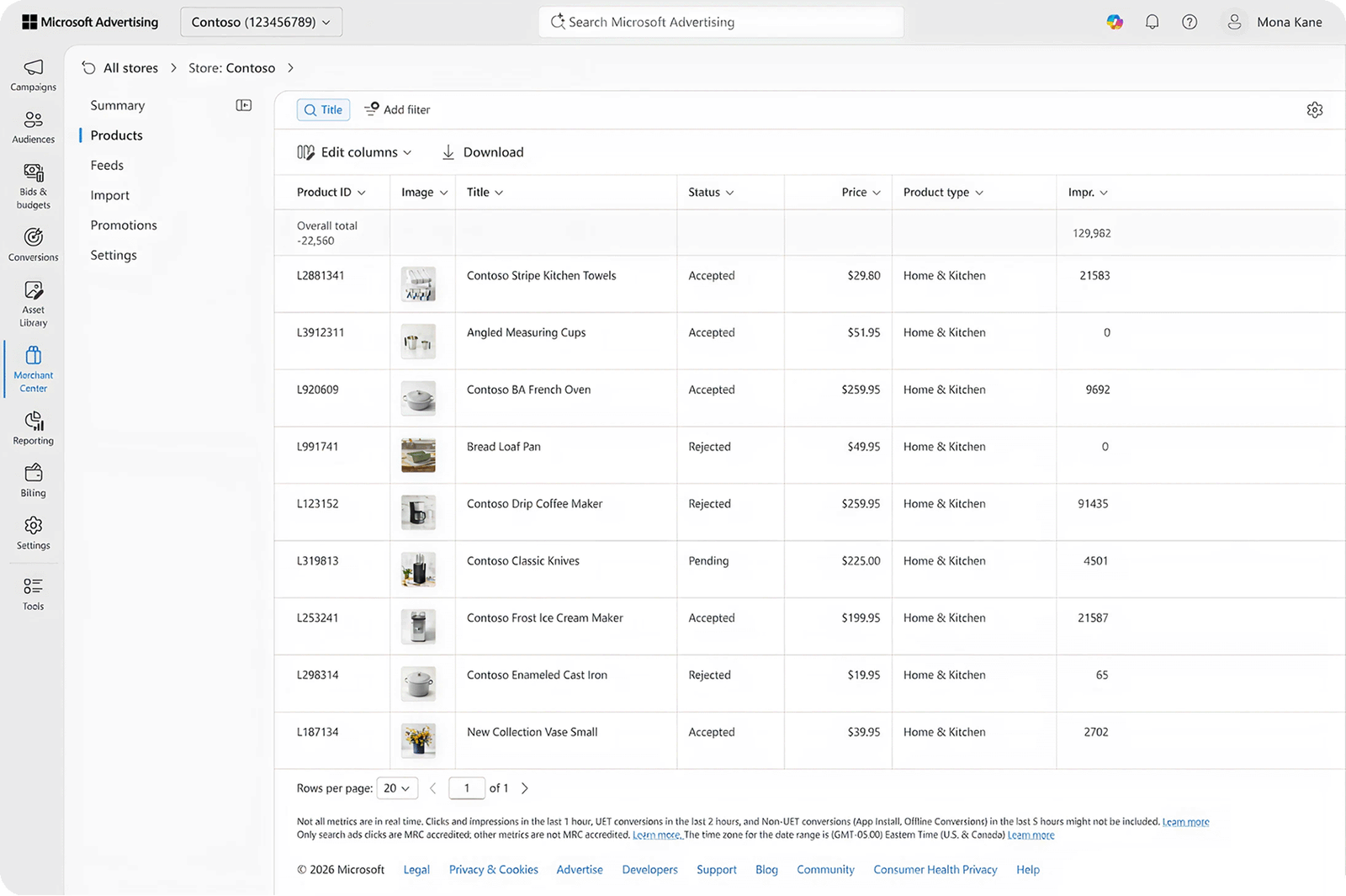
Product explorer addresses this by consolidating the entire product catalog into a single, searchable interface within Merchant Center. According to Microsoft Advertising, the tool provides "a unified, searchable view of your entire product catalog" that helps advertisers "quickly understand which products are active, serving, and performing."
The feature is available today - but with a significant constraint. Access is limited to advertisers with fewer than 100,000 SKUs (stock keeping units). Those accounts will see a "Products" section in Merchant Center. Advertisers exceeding that threshold will not see the section at all. The ceiling is operationally meaningful: mid-market and smaller direct-to-consumer retailers fall comfortably within it, while larger enterprise accounts managing broad assortments remain outside the current scope.
What Product explorer can do
The tool supports two primary filtering categories. The first is attribute-based filtering. Advertisers can search and filter across fields including title, status, product ID, price, languages, feed label, brand, GTIN (Global Trade Item Number), MPN (Manufacturer Part Number), SKU, product type, category, condition, availability, and custom label. The title field includes granular string-matching options: whether a title contains a string, does not contain it, starts with it, ends with it, matches it exactly, or does not match it.
The second filtering category is performance-based. This lets advertisers cross-reference product attributes against actual campaign delivery and conversion behaviour, giving a product-level view that campaign-level or ad-group-level data cannot provide on its own. Campaign-level metrics aggregate across many products, which can obscure wide variation at the individual SKU level.
The tool also includes a Recommended Actions tab, which surfaces suggestions intended to help products that have stopped serving get back into delivery. This connects to a broader pattern at Microsoft Advertising: the platform introduced actionable recommendations for search, shopping, and Performance Max campaigns in October 2024, adding status updates that flag when campaigns are limited by budget or bidding targets. Product explorer extends that recommendation logic to the individual product level.
Filtered product lists can be exported for offline analysis. The export function is available through the standard Merchant Center product listing interface.
Context: how Product explorer fits into Microsoft's catalog tooling
Product explorer is not the first step in Microsoft's work on feed management infrastructure. In September 2025, Microsoft launched supplemental feeds for Merchant Center globally, giving merchants the ability to update specific product attributes - titles, descriptions, custom labels, size, colour, and promotion IDs - without reuploading entire catalogs. Before that feature, any modification to even a single product field required a full catalog reupload, a cumbersome process for large catalogs or fast-moving inventory.
The two tools address different layers of the same operational challenge. Supplemental feeds handle the data management side - updating attributes efficiently at scale. Product explorer handles the diagnostic side - identifying which products have problems and whether those problems are attribute-related or performance-related.
Feed labels, visible as a filter inside Product explorer, were introduced by Microsoft Advertising in March 2024 to let retailers group products across multiple feeds based on shared characteristics like language, market, or product category. Custom labels, also filterable in the new tool, are entirely self-defined by the advertiser to reflect internal segmentation logic such as margin tier, seasonality, or promotional eligibility. Because custom labels carry no platform-enforced structure, errors in labelling propagate silently until an advertiser manually checks them - exactly the kind of issue Product explorer is positioned to surface.
The 100,000 SKU ceiling is the sharpest practical constraint as of today. Whether Microsoft plans to extend the limit, and on what timeline, has not been stated publicly. The tool also appears limited to US accounts at launch. Microsoft Advertising operates across dozens of global markets, and the feed management challenges Product explorer addresses are not unique to US advertisers.
This development fits a pattern PPC Land has tracked across recent Microsoft Advertising updates: the platform has been adding reporting depth and diagnostic tooling across its suite for the past year, complementing the automation push in Performance Max and other campaign types.
Product-level data in the context of Performance Max
Product explorer arrives at a moment when performance advertisers increasingly run shopping inventory through Performance Max campaigns. Microsoft launched Performance Max globally in March 2024 and has steadily added to its capabilities since - expanding search theme limits, adding customer acquisition targeting in January 2026, and publishing first performance comparisons.
According to Microsoft data covering June to August 2024, Performance Max product ads in Copilot experienced a fivefold increase in impressions compared to standard ads, with conversion rates running 63% higher than traditional search ads. Those figures are attributed to Microsoft and based on internal data. The aggregated campaign-level view those numbers represent is precisely the kind of reporting that Product explorer is intended to complement with product-level detail.
When a Performance Max campaign shows a healthy blended conversion rate, it may contain a small set of products generating the majority of conversions alongside a long tail of items consuming budget without converting. Identifying that pattern at the SKU level has required manual cross-referencing before now. Product explorer does not yet surface pattern-level recommendations - systematic insight into groups of products consistently underperforming on specific query types - but the Recommended Actions tab begins to approximate that.
Disclaimer layouts: compliance without sacrificing ad copy
The second announcement in today's roundup addresses a problem familiar to advertisers operating in regulated industries. Legal disclosures, promotional terms, safety information, and regulatory fine print must appear in ads - but every character spent on disclaimers is a character not spent on commercial messaging.
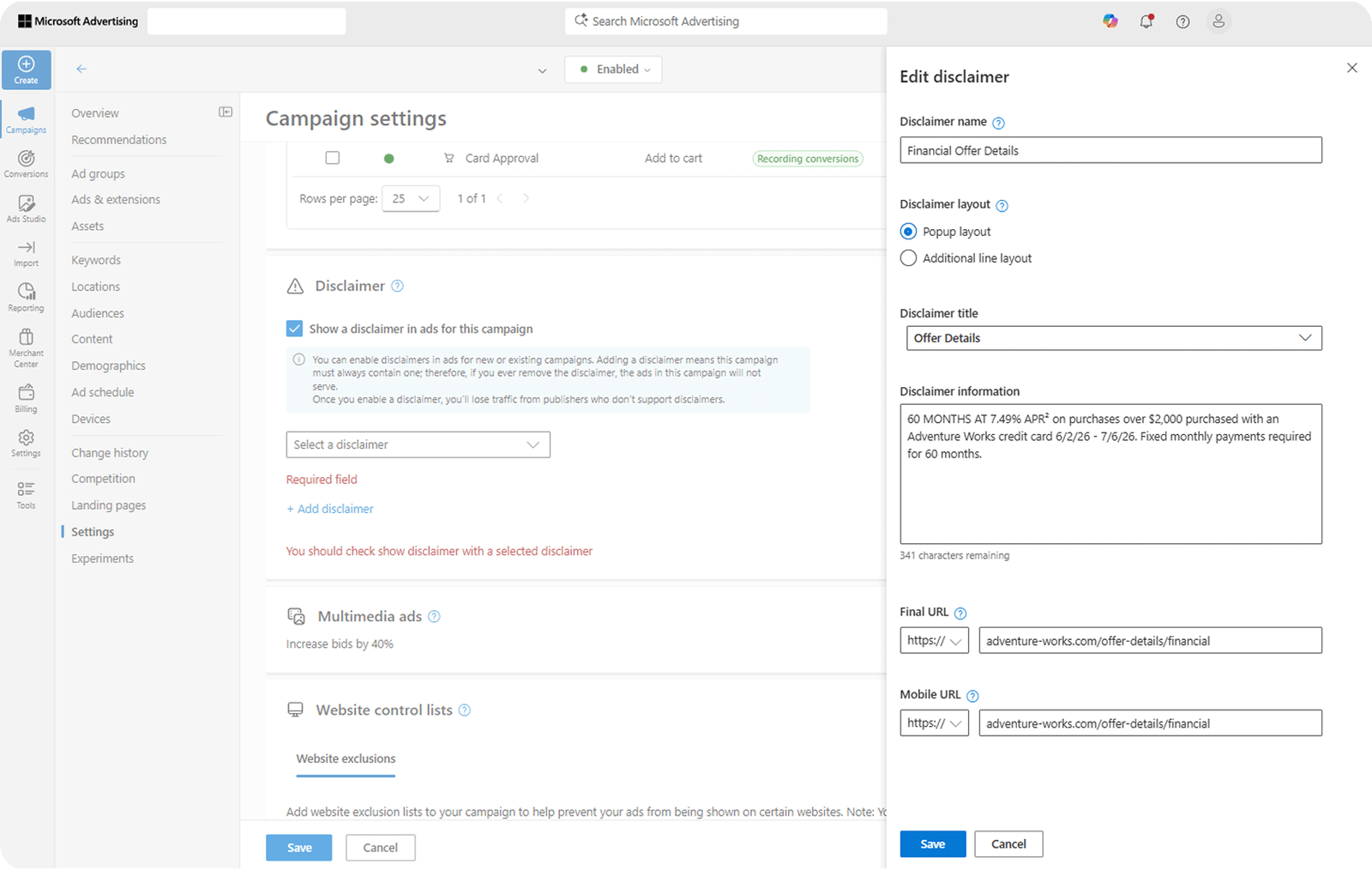
Microsoft Advertising's disclaimer feature applies to Responsive Search Ads, Performance Max, and Audience adsacross search and native placements. According to Microsoft Advertising, the feature "lets you surface the legal, regulatory, or promotional fine print your business requires - without sacrificing characters from your marketing messaging that helps drive clicks and conversions."
Two distinct layouts are available, each suited to different disclosure requirements.
The popup layout
The first option is the popup layout, available for Native ads. This layout is designed for situations where advertisers need to preserve every character of their ad copy. The popup layout supports up to 500 characters of disclaimer content. Advertisers select a clickable link label from a predefined set: "Disclaimer," "Disclosure," "Offer Details," "Safety Information," "Terms Apply," and additional options. When a user clicks that link, a pop-up window opens displaying the full disclosure text. The label itself appears as the clickable link copy in the ad.
The 500-character limit is generous. It is sufficient for most standard terms-and-conditions disclosures, regulatory risk warnings, or promotional fine print that would otherwise be impractical to surface inside ad copy itself.
The additional line layout
The second option is the additional line layout, which renders the disclaimer as a visible extra line beneath the ad body, with a link to further information. This layout carries an 80-character limit - a much tighter constraint, better suited to short, direct disclosures where transparency needs to be immediately visible rather than a click away. The layout keeps the disclaimer in the primary field of view rather than behind an interaction.
The two layouts are mutually exclusive in their mechanics and target use cases, but both are configured in the same workflow: during campaign creation from advanced settings, or post-launch from campaign settings. Disclaimers can be edited, removed, or swapped at any time. According to Microsoft Advertising, once a disclaimer is approved, it "is guaranteed to serve across every eligible ad in the campaign." That guarantee removes the uncertainty about whether a disclaimer actually appears on any given impression.
Who the disclaimer feature is designed for
Microsoft Advertising identifies the primary audience as advertisers with promotions, terms, safety details, legal requirements, or other regulatory information to communicate. Finance, pharmaceutical, insurance, alcohol, and gambling advertisers face jurisdiction-specific disclosure requirements that can be extensive.
This connects to a broader compliance infrastructure that Microsoft has been developing across the platform. In June 2026, Microsoft opened its Audience Network to cryptocurrency exchange advertisers globally, and that policy update explicitly required crypto advertisers to include risk warnings - either in the ad itself or on the landing page. The disclaimer feature provides a structural way to fulfil such requirements at the campaign level rather than rebuilding individual ads.
The practical implication for advertisers in regulated categories is a cleaner separation between commercial messaging - the copy that drives click-through - and legal or regulatory content. The popup layout handles extensive disclosures; the additional line handles short, front-and-centre ones. Neither requires that disclosure text occupy the main character limit of the ad itself.
Placement of today's updates in a broader sequence
These two features - Product explorer and the disclaimer framework - are operational, process-focused additions. They do not involve generative AI or automated campaign creation. That distinguishes them from most Microsoft Advertising announcements over the past year, which have leaned heavily on AI-powered asset generation, automated bidding, and conversational AI surfaces.
The timing is worth noting. Microsoft's search advertising revenue grew 12% year-over-year in Q3 FY26, reported in late April, a deceleration from the 21% growth recorded a year earlier. The AI business overall hit a $37 billion annual run rate in the same quarter. Within that context, tooling that helps advertisers - particularly retailers and regulated advertisers - manage their catalog quality and compliance exposure is consistent with platform efforts to reduce friction and increase the value of inventory already running.
The June product roundup closes with a note that Microsoft will publish another recap in July 2026, with additional updates described as forthcoming.
Timeline
- March 2024 - Microsoft Advertising launches Feed Labels, allowing retailers to group products from multiple feeds using shared attributes like language, market, or product category.
- March 2024 - Performance Max launches globally across Microsoft Advertising, marking the beginning of the platform's multi-channel automated campaign type.
- July 2024 - Microsoft publishes first Performance Max results, citing a 32% decrease in cost-per-acquisition and threefold increase in ROAS on average when combining PMax with search campaigns.
- August 2024 - Microsoft Advertising announces major Performance Max and ad tool updates, including brand exclusions, AI-powered video recommendations, and inline editing for Responsive Search Ads.
- October 2024 - Microsoft Advertising adds Performance Max recommendations and search term insights, along with actionable status updates for campaigns limited by budget or bidding targets.
- September 17, 2025 - Microsoft Advertising launches supplemental feeds globally for Merchant Center, enabling attribute-level updates without full catalog reuploads.
- November 17, 2025 - Microsoft adds Image Animation and Performance Comparison tools to Copilot in the Microsoft Advertising Platform.
- December 18, 2025 - Microsoft clarifies exact match keyword priority over all campaign types including Performance Max in ad auctions.
- January 9, 2026 - Microsoft doubles Performance Max search theme limit to 50 per campaign.
- January 15, 2026 - Microsoft Advertising adds customer acquisition goals to Performance Max and launches autogenerated assets for Responsive Search Ads.
- April 29, 2026 - Microsoft reports Q3 FY26 results: search advertising revenue up 12% year-over-year; AI business at a $37 billion annual run rate.
- June 6, 2026 - Microsoft Advertising opens Audience Network to cryptocurrency exchange advertisers globally, ending a four-year restriction.
- June 16, 2026 - Microsoft Advertising launches Product explorer for US advertisers with fewer than 100,000 SKUs, as first reported by PPC Land.
- June 17, 2026 - Microsoft announces Web IQ, Clarity citation reporting, and MCP server expansion ahead of Cannes Lions 2026.
- June 22, 2026 - Microsoft Advertising publishes June 2026 product roundup confirming Product explorer's general availability for sub-100,000 SKU accounts and formally documenting the popup and additional line disclaimer layouts.
Summary
Who: Microsoft Advertising, with the June 2026 product roundup authored by Bhuvesh Arora, Senior Program Manager at Microsoft Advertising. The announcements affect retailers using Merchant Center and advertisers running Responsive Search Ads, Performance Max, or Audience campaigns with legal, regulatory, or promotional disclosure requirements.
What: Two feature announcements. First, Product explorer - a unified, searchable catalog management interface inside Merchant Center that lets advertisers filter products by 15 attributes and review performance data, with a Recommended Actions tab for products that have stopped serving and an export function for offline analysis. Second, a documented disclaimer framework offering two layouts: a popup layout (500-character limit, for Native ads, with clickable disclosure links) and an additional line layout (80-character limit, rendered visibly beneath the ad with a link to further detail).
When: The roundup was published on June 22, 2026. Product explorer was made available today for qualifying US accounts. The disclaimer feature appears to have been available prior to this roundup, which serves as its formal documentation.
Where: Product explorer is available inside Merchant Center under the "Products" section for US Microsoft Advertising accounts managing fewer than 100,000 SKUs. The disclaimer feature applies to Responsive Search Ads, Performance Max, and Audience ads across search and native placements, configurable during campaign creation or post-launch from campaign settings.
Why: Retailers have historically lacked a single interface for diagnosing which products are serving, which have eligibility gaps, and which attributes might be causing problems - a friction point that Product explorer directly addresses. Advertisers in regulated industries face disclosure requirements that consume ad copy character limits, reducing space for commercial messaging; the disclaimer layouts separate compliance content from persuasive copy without requiring workarounds.


Discussion