Microsoft CEO admits Copilot integrations "don't really work" as adoption falters
Satya Nadella told managers Copilot's Gmail and Outlook connections "don't really work" and are "not smart" while taking hands-on role to fix AI assistant problems.


Satya Nadella told managers Copilot's Gmail and Outlook connections "don't really work" and are "not smart" while taking hands-on role to fix AI assistant problems.
Microsoft CEO Satya Nadella has sharply criticized the company's own AI assistant in internal communications, stating that integrations connecting Copilot with Gmail and Outlook "don't really work" for the most part and are "not smart," according to a December 28, 2025 report from The Information.
The frank assessment reveals growing concerns within Microsoft about Copilot's technical execution and market performance, despite the company's public positioning of AI as central to its growth strategy. Nadella has assumed an unusually hands-on role in fixing the struggling product, essentially becoming what sources describe as the company's top product manager.
In September 2025, Nadella announced he would delegate some responsibilities to focus on AI product development. He handed off many business functions to Head of Sales Judson Althoff, who received the new title "Commercial CEO." The organizational shift reflected internal urgency around Copilot's performance challenges.
Nadella is now deeply involved in technical work, according to The Information. He maintains active participation in an internal Teams channel with about 100 top engineers, posting detailed critiques when AI products fall short. In weekly hour-long meetings, he questions employees about their work and issues specific instructions, like consolidating post-training processes across teams.
The CEO reportedly sent bug reports directly to product groups working on the consumer chatbot. Over the summer, he vented frustration in a Teams channel that Microsoft hadn't shipped new features for complex Excel functions like financial models fast enough.
A few weeks ago, Nadella emailed engineering managers working on the consumer version of Copilot. According to The Information, he didn't mince words about the integrations connecting Copilot with Gmail and Outlook. A Microsoft manager on the email thread noted that Google's Gemini chatbot had recently gotten better at connecting with Google Drive for tasks like summarizing the contents of photos stored in folders.
Nadella and his deputies, including Executive Vice President Rajesh Jha, worry that AI in Office 365 isn't delivering on its promise to meaningfully automate work, The Information reports. Microsoft has positioned Copilot subscriptions as functioning as "digital workers" handling tasks like those of administrative assistants.
The goal centers on meaningful automation, but technical execution hasn't matched the vision. AI agents being sold to businesses as labor replacements are failing to complete real world office tasks 70% of the time, according to researchers at Carnegie Mellon University. These failure rates directly undermine Microsoft's value proposition for enterprise customers evaluating return on investment.
To close the technical gaps, Nadella is personally investing in recruiting. He calls potential hires himself and approves unusually high salaries to poach top talent from OpenAI and Google DeepMind. He's also more involved in partnerships with AI developers like Anthropic, whose technology could improve Microsoft products.
Internally, Nadella reminds employees of Microsoft's past strategic blunders: stumbling in internet search and squandering its lead in smartphones and tablets. The message emphasizes this is a pivotal moment that could determine the company's future.
Buy ads on PPC Land. PPC Land has standard and native ad formats via major DSPs and ad platforms like Google Ads. Via an auction CPM, you can reach industry professionals.
Copilot currently holds 14% AI market share, with Google's Gemini less than 1% behind, according to recent industry analysis. The close competition represents a significant concern for a company that has invested billions in AI development and OpenAI partnership.
Microsoft defended Copilot in response to The Information story, claiming the report inaccurately combines the concepts of growth and sales quotas. The company stated that aggregate sales quotas for AI products have not been lowered, though it did not address the specific technical criticisms detailed in Nadella's internal communications.
Signs of dissatisfaction with Copilot have been visible for months. The company has been vague about business metrics, and Copilot's actual contribution to the bottom line remains unclear. Microsoft's advertising revenue surpassed $20 billion annually by April 2025, with search and news advertising revenue climbing 21% in the most recent quarter, suggesting stronger performance in advertising applications than productivity tools.
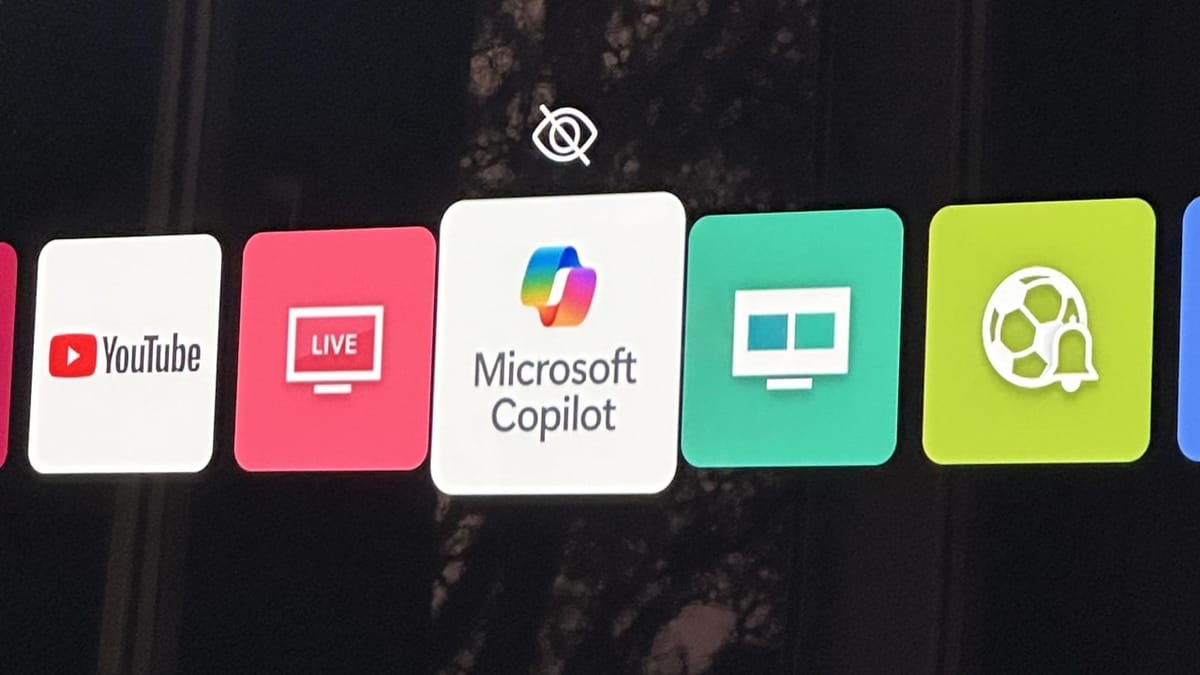
LG announced on December 18, 2025 that it will let users delete the Microsoft Copilot shortcut it installed on newer TVs after several reports highlighted the unremovable icon. LG spokesperson Chris De Maria stated the company "respects consumer choice and will take steps to allow users to delete the shortcut icon if they wish."
A user on the r/mildlyinfuriating subreddit posted an image of the Microsoft Copilot icon in their lineup of apps on an LG TV, with no option to delete it. The post garnered more than 36,000 upvotes as people grow more frustrated with AI popping up just about everywhere.
Both LG and Samsung announced plans to add Microsoft's Copilot AI assistant to their TVs in January, but it appears to be popping up on LG TVs following a recent update to webOS. De Maria clarified that the icon is a "shortcut" to the Microsoft Copilot web app that opens in the TV's web browser, rather than "an application-based service embedded in the TV." He also noted that "features such as microphone input are activated only with the customer's explicit consent."
Asked when LG will start letting users delete the Copilot icon, De Maria said there's no "definitive timing" yet. The forced installation without deletion options exemplifies the disconnect between Microsoft's AI integration strategy and consumer preferences.
Microsoft announced on November 24, 2025 that Copilot will no longer be available on WhatsApp or other messaging apps starting January 15, 2026. The change results from recent updates to WhatsApp's platform policies prohibiting all LLM chatbots from the platform effective January 15.
Since launching in late 2024, Copilot on WhatsApp has helped millions of people connect with their AI companion in a familiar, everyday setting. However, the discontinuation forces users to transition to Microsoft's own surfaces including the Copilot mobile app, website, or desktop applications.
Copilot on WhatsApp will remain available through January 15, 2026. After that date, the service will no longer function. This timing also applies to Copilot on other messaging platforms where it has been available.
Users who hit platform limits are prompted to subscribe to Meta Verified if they wish to share additional external links or access expanded features. The trend toward subscription requirements and platform restrictions reflects broader challenges in sustaining consumer AI products without clear monetization models.
Dutch education IT cooperative SURF announced on September 11, 2025 that it has downgraded two of the four previously identified high privacy risks for Microsoft 365 Copilot to medium status. The update followed extensive negotiations between SURF, the Dutch government's Strategic Supplier Management, and Microsoft to address data protection concerns.
According to SURF's updated guidance, "Due to the privacy improvements in Microsoft 365 Copilot, from which all users benefit, SURF no longer advises against its use entirely. However, given the remaining risks, we recommend that educational and research institutions adopt a cautious approach to using Copilot and carefully weigh the risks for each type of use."
Privacy Company performed an update Data Protection Impact Assessment for SURF on Microsoft 365 Copilot. The update shows that Microsoft has taken measures to reduce the four previously identified high data protection risks, but does not get the green light for all concerns. Educational institutions must now develop comprehensive AI usage policies that address both privacy protections and accuracy verification.
Microsoft reported 75% enterprise AI adoption with $3.7x ROI across Fortune 500 firms at its November 2024 Ignite event. The company claimed 85% of Fortune 500 companies now use Microsoft AI solutions, with 70% specifically implementing Microsoft 365 Copilot.
These adoption figures don't reveal the extent to which customers use Copilot features regularly or find them valuable for productivity gains. The gap between installation and meaningful utilization has become a key concern for Microsoft's leadership as Nadella works to address fundamental integration issues.
Australian regulators alleged in October 2025 that Microsoft misled approximately 2.7 million customers about subscription options following Copilot's integration into Microsoft 365 Personal and Family plans. The Australian Competition and Consumer Commission claimed Microsoft deliberately concealed an alternative subscription tier to push consumers toward more expensive AI-integrated offerings.
Microsoft Copilot achieved 73% higher click-through rates in advertising compared to traditional search advertising, according to research published August 6, 2025. The study encompassed data from November 2024 through May 2025, demonstrating that Copilot generates 16% stronger conversion rates and 33% shorter customer journeys.
This advertising performance contrasts sharply with productivity application struggles that Nadella highlighted in his internal communications. The disparity suggests Microsoft's AI technology performs better in contexts with clear optimization metrics and commercial intent signals than in complex knowledge work requiring nuanced judgment.
Microsoft added image animation and performance tracking to Copilot AI tools on November 17, 2025, introducing capabilities for video creation and expanded API access. The enhancements address growing demand for motion content as Americans spend an average of 4 hours and 14 minutes daily consuming digital videos.
Microsoft's Copilot challenges reflect broader industry tensions around AI productivity promises. Research published by McKinsey in July 2025 identified that organizations face scaling challenges due to surging demand for compute-intensive workloads, particularly from generative AI applications.
While 88% of organizations report regular AI use in at least one business function, only one-third have progressed beyond pilot or experimental phases to enterprise-wide scaling. McKinsey's research identifies significant gaps between adoption rates and financial impact, with only 39% of organizations attributing any EBIT impact to AI use.
Gartner predicted in June 2025 that over 40% of agentic AI projects will be canceled by the end of 2027 due to escalating costs, unclear business value, and inadequate risk controls. These industry-wide projections suggest Microsoft's struggles represent systemic challenges rather than company-specific execution failures.
Microsoft's internal turmoil around Copilot carries significant implications for marketing professionals evaluating AI integration strategies. The gap between enterprise AI adoption statistics and actual productivity gains suggests organizations should approach vendor claims with appropriate skepticism.
Marketing teams considering Microsoft 365 Copilot deployment should implement comprehensive testing protocols before enterprise-wide rollout. The technical integration issues Nadella identified suggest even basic cross-platform functionality requires validation rather than assumption.
The Carnegie Mellon research showing 70% task failure rates for AI agents positions current AI assistants as augmentation tools rather than replacement workers. Marketing organizations should structure AI implementations around this reality, maintaining human oversight and judgment for critical workflows.
Microsoft's willingness to approve unusually high salaries for AI talent from competitors indicates the technical complexity of building functional AI products exceeds initial expectations. This talent competition will likely drive continued investment in AI capabilities while extending timelines for delivering reliable enterprise features.
Subscribe PPC Land newsletter ✉️ for similar stories like this one
Subscribe PPC Land newsletter ✉️ for similar stories like this one
Who: Microsoft CEO Satya Nadella sent critical emails to engineering managers working on Copilot's consumer version, while assuming hands-on product management role and delegating business functions to Judson Althoff as Commercial CEO.
What: Nadella stated that Microsoft programs connecting Copilot with Gmail and Outlook "for the most part don't really work" and are "not smart," while conducting weekly meetings with top engineers, sending bug reports directly to product teams, and personally recruiting AI talent from OpenAI and Google DeepMind.
When: The Information obtained internal emails on December 28, 2025, detailing communications sent within recent weeks following Nadella's September 2025 announcement of organizational changes to focus on AI product development.
Where: The criticisms focus on Copilot's consumer version integration failures with Gmail and Outlook email services, with broader concerns about Office 365 AI automation and enterprise productivity applications across Microsoft's product ecosystem.
Why: AI agents fail to complete real world office tasks 70% of the time according to Carnegie Mellon University researchers, Copilot subscriptions aren't delivering meaningful automation as "digital workers," and competitive pressure from Google's Gemini threatens Microsoft's 14% AI market share while the company attempts to justify billions in AI infrastructure investments.