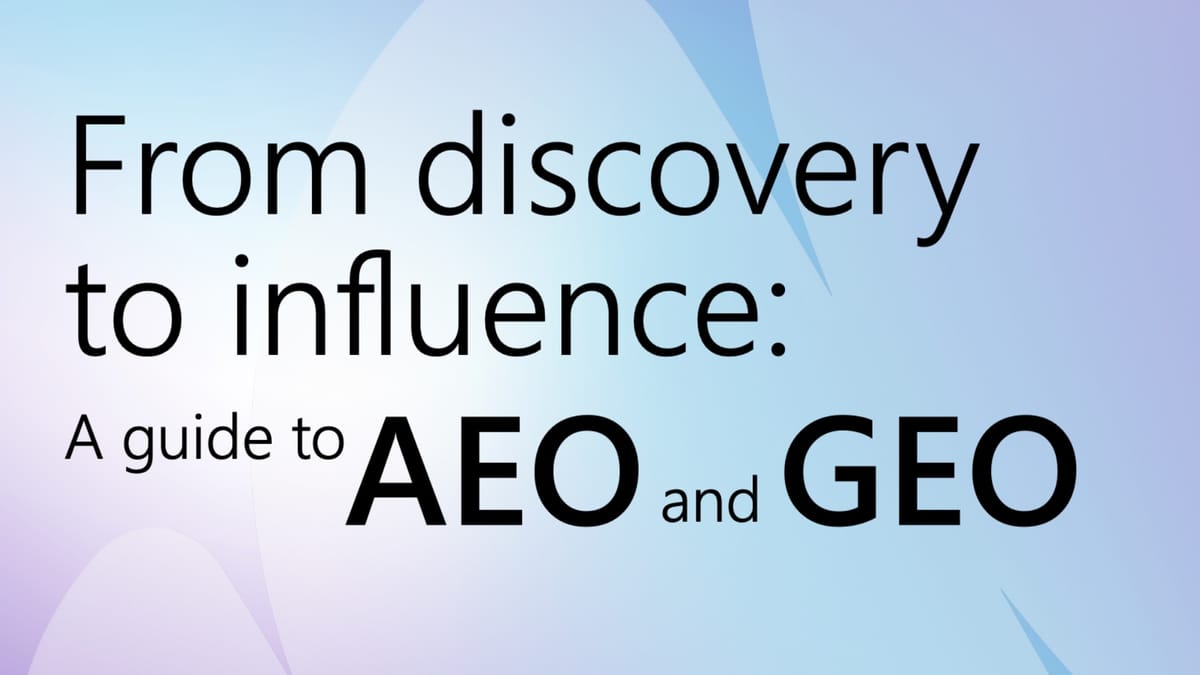
Microsoft's AEO and GEO guide transforms product discovery from traffic generation to AI influence strategies
Microsoft Advertising this month published a detailed technical playbook addressing how retailers can optimize product visibility across AI-powered search environments including assistants, browsers, and autonomous agents. The guide, released on January 6, 2026, introduces systematic approaches to Answer Engine Optimization and Generative Engine Optimization—two disciplines that Microsoft positions as essential successors to traditional search engine optimization as artificial intelligence transforms product discovery patterns.
According to the document, "The goal is no longer traffic. It's influence." The framework acknowledges that AI systems now evaluate and interpret product data in ways that differ fundamentally from traditional search algorithms, determining whether brands merit recommendation based on data completeness, currency, and contextual richness rather than keyword optimization alone.
Jennifer Myers, Principal Product Manager for Microsoft Shopping and Copilot, and Paul Longo, General Manager of AI in Ads at Microsoft Advertising, outlined how AI assistants like Copilot and ChatGPT, browsers with built-in intelligence such as Edge and Chrome, and autonomous agents capable of completing purchases end-to-end represent overlapping capabilities rather than separate systems. "A browser may include an assistant; an assistant may include agent behaviors; an agent may rely on an assistant's reasoning," the guide states.
Microsoft's framework identifies three distinct data pathways through which retailers must establish presence. First, crawled data encompasses information AI systems learned during training and retrieve from indexed web pages, shaping baseline brand perception and providing grounding for AI responses. Second, product feeds and APIs represent structured data retailers actively push to AI platforms, enabling control over product representation in comparisons and recommendations. Third, live website data includes real-time information AI agents observe when visiting actual sites, from rich media and customer reviews to dynamic pricing and transaction capabilities.
"Most brands already have the data AI needs. It's just buried," according to key insights highlighted in the playbook. The document emphasizes that completeness surpasses cleverness in determining rankings, noting "products with more filled-in fields rank higher, period."
The technical distinction between AEO and GEO centers on their respective optimization targets. AEO drives clarity through accurate, real-time data that AI systems can interpret effectively. The methodology optimizes content for AI agents and assistants, ensuring they can find, understand, and present answers. GEO establishes credibility by positioning brands as authoritative sources within generative AI search environments, making content discoverable, trustworthy, and citation-worthy.
Microsoft illustrates these differences through concrete product examples. Traditional SEO might describe a product simply as "waterproof rain jacket." AEO expands this to "lightweight, packable waterproof rain jacket with stuff pocket, ventilated seams and reflective piping." GEO adds authoritative signals: "best-rated waterproof jacket by Outdoor magazine, no-hassle returns allowed for 180 days, three year warranty, 4.8 star rating."
When users ask Copilot for recommendations—such as "What's a good waterproof jacket for a three day hike?"—the system enters what Microsoft describes as a reasoning phase. Natural language understanding parses the query while freshness mechanisms ensure current information. The platform breaks down requests, evaluates text relevance, assesses commercial signals, and determines contextual relevance using multiple data sources simultaneously.
Crawled web data provides general knowledge about brand reputations, category understanding regarding product requirements, and brand positioning within specific markets. Product feeds supply current prices, real-time availability status, and key technical specifications. AI systems then synthesize this information to make recommendation decisions.
According to the playbook's detailed example, if a retailer's rain jacket costs $179 while competitors charge $199, and the retailer maintains in-stock status while competitors face backorders, the product achieves top three recommendation status based on competitive pricing and availability advantages reflected in feed data.
The process extends beyond initial recommendations. When users click through to merchant websites, AI agents observe additional context: detailed customer reviews mentioning specific use cases, video demonstrations showing product performance, current promotional offers, and real-time delivery estimates. "Without your live site working properly, the sale fails even if your feed and crawled data were perfect," the document warns.
Microsoft describes a five-step autonomous transaction process for AI agents: adding items to cart, applying promotional codes, calculating shipping, completing purchases with saved payment methods, and providing order confirmation with tracking. Each step requires functional e-commerce infrastructure that agents can navigate successfully.
Three strategic implementation areas
The playbook outlines three comprehensive implementation strategies. First, data structure optimization focuses on making catalogs machine-readable through specific schema implementations. Microsoft recommends deploying Product, Offer, AggregateRating, Review, Brand, ItemList, and FAQ schema types. Product feeds should include dynamic fields for price, availability, color, size, SKU, GTIN, and dateModified attributes.
Real-time synchronization becomes critical for maintaining consistency. The guide instructs retailers to sync price and inventory between product feeds and on-site schema continuously, expose dateModified and availability attributes in structured data, and include explicit start and end dates for promotions. "Ensure rendered DOM contains the same facts consumers see—never serve different HTML to bots," the implementation instructions specify.
Second, content enrichment addresses intent and context matching. Microsoft advises front-loading product descriptions with benefits that answer who products serve, what problems they solve, and what differentiates them from alternatives. Descriptions should incorporate clear use-case context AI systems can match to queries, such as "best for day hikes above 40 degrees."
Multi-modal signals expand beyond text. The framework recommends detailed alt text and ImageObject schema describing visuals precisely—"green jacket with reinforced zipper and extended hood" rather than generic descriptions. Video transcripts should parse feature explanations, while Q&A blocks provide information AI systems can reason over and cite when answering queries about size selection or energy efficiency.
Third, trust signals establish authority and credibility through verified content. Microsoft emphasizes including verified reviews marked with Review and AggregateRating schema, highlighting review volume and verified purchase ratios, and surfacing review sentiment enabling natural-language recommendations about comfort and fit characteristics.
Authoritative brand identity requires adding brand identifiers and official social or retailer links in structured data, linking to expert reviews and articles featuring products, and surfacing certifications, sustainability badges, and partnerships as factual entities. Content integrity demands avoiding exaggerated or unverifiable claims while maintaining consistent brand voice and providing structured FAQ content grounding conversational answers.
Advertise on ppc land
Buy ads on PPC Land. PPC Land has standard and native ad formats via major DSPs and ad platforms like Google Ads. Via an auction CPM, you can reach industry professionals.
The Microsoft framework arrives amid significant industry discourse about AI search optimization terminology. On June 27, 2025, marketing consultant Madhav Mistry announced a comprehensive four-layer SEO framework addressing AEO, GEO, AI Integration Optimization, and Search Experience Optimization. The framework emphasized that AI systems break content into chunks for analysis rather than evaluating entire pages, requiring content creators to optimize individual sections as standalone information units.
However, Google's John Mueller issued a stark warning on August 14, 2025, suggesting that aggressive promotion of new AI search optimization acronyms may indicate spam activities. "The higher the urgency, and the stronger the push of new acronyms, the more likely they're just making spam and scamming," Mueller stated on Bluesky. The comment represented the most direct criticism from a Google representative regarding the industry's shift toward AI-focused optimization frameworks.
SparkToro co-founder Rand Fishkin published direct criticism of search marketing industry acronym proliferation on May 29, 2025, advocating against replacing SEO with alternatives like AIO, GEO, and LLMEO. Fishkin supported "Search Everywhere Optimization" terminology instead, arguing professionals already have a solution maintaining the familiar three-letter format.
HubSpot acquired XFunnel on October 31, 2025, an answer engine optimization platform strengthening its marketing automation capabilities. According to HubSpot's announcement, AI-driven leads convert three times better than traditional search leads. The acquisition included AEO Grader for analyzing and improving answer engine optimization performance.
Aleyda Solis, an SEO consultant, released a comprehensive AI Search Content Optimization Checklist on June 16, 2025, outlining eight distinct optimization areas. According to the checklist, AI search engines break content into chunks for synthesis rather than ranking individual pages, requiring different technical approaches for content visibility.
Agentic commerce infrastructure development
The Microsoft guide's emphasis on operational e-commerce infrastructure for AI agents reflects broader industry developments in agentic commerce. Microsoft launched Copilot Checkout on January 8, enabling shoppers to complete purchases entirely within the Copilot interface without redirecting to merchant websites. The implementation arrived alongside Brand Agents, AI-powered shopping assistants merchants can deploy on their own websites.
According to Microsoft's internal data, journeys including Copilot led to 53% more purchases within 30 minutes of interaction compared to journeys without the AI assistant. When shopping intent is present, conversions reach 194% more likely than sessions lacking Copilot engagement.
PayPal partnered with Microsoft on January 8 to power Copilot Checkout, handling merchant inventory surfacing, branded checkout functionality, guest checkout options, and credit card payment processing. The integration launched on Copilot.com with plans to expand across additional devices and channels.
Google launched the Universal Commerce Protocol on January 11, establishing open-source technical standards for AI agents to execute purchases across different retail platforms. The company co-developed UCP with Shopify, Etsy, Wayfair, Target, and Walmart, with endorsements from more than 20 companies including Visa, Mastercard, Best Buy, and The Home Depot.
Visa positioned itself at the forefront of agentic commerce infrastructure, developing payment protocols allowing AI agents to make purchases on behalf of consumers while maintaining security standards. Rubail Birwadker, Visa's Senior Vice President and Global Head of Growth Products and Strategic Partnerships, detailed the company's approach during September 2025 podcast appearances.
Mastercard introduced Agent Pay infrastructure at the National Retail Federation conference on January 11, citing PYMNTS Intelligence data showing 39% of U.S. consumers have used generative AI for online shopping, with 53% planning to do so during 2025. Adobe Analytics documented traffic to U.S. retail websites from generative AI sources jumping 1,200% during the first quarter of 2025.
McKinsey research projects agentic commerce could orchestrate between $900 billion and $1 trillion in U.S. B2C retail revenue by 2030. Research published on November 25, 2025, showed 85% of UK consumers planning AI-assisted holiday shopping would trust autonomous agents to place orders and execute payments.
Amazon deployed comprehensive AI shopping features on November 18, 2025, reporting 250 million users for its Rufus conversational shopping assistant. However, Amazon simultaneously blocked competing AI agents from accessing its marketplace, implementing restrictions against OpenAI, Anthropic, Meta, and other platforms to protect its $56 billion annual advertising revenue.
Critical implementation reminders
Microsoft emphasizes that retailers don't need to start from scratch. SEO and catalog investments built foundations to expand upon in LLM-based search environments. The base remains consistent: up-to-date product feeds and clear, crawlable, structured content. However, retailers must now treat entire catalogs and site architecture as content, ensuring every product detail, benefit, and price signal is machine-readable, current, and context-rich.
"AI doesn't just read your site. It acts on it. A broken live experience means a lost sale," the playbook warns. The document notes that agentic commerce remains early in development, meaning most brands haven't determined optimal approaches. Early movers won't just achieve discoverability when AI-mediated shopping scales—they'll establish benchmarks others pursue.
Most brands currently treat product data as feeds to maintain rather than strategic assets. Early adopters are auditing catalogs for AI readability, filling context gaps, and building systems to keep data fresh across all three pathways: crawled data, product feeds, and live website information.
The playbook directs retailers to Microsoft Merchant Center feed schema for detailed implementation specifications. The guide concludes by emphasizing that retailers already hold most data signals influencing Copilot and Bing ranking—signals simply remain unsurfaced in product feeds currently. By enriching feeds and content assets with attributes and trust-based data, retailers enable AI systems to understand not just what products are, but why users prefer them and when they perform best.
"This is the foundation of AI ranking readiness—a data discipline that directly impacts discoverability in the age of conversational commerce," according to the playbook's conclusion.
PPC Land Newsletter
Subscribe PPC Land newsletter ✉️ for similar stories like this one
Who: Microsoft Advertising, through Principal Product Manager Jennifer Myers and General Manager Paul Longo, released the playbook addressing retailers, chief marketing officers, growth leaders, digital commerce leaders, chief technology officers, and data analytics leaders across the e-commerce industry.
What: A comprehensive technical playbook establishing practical data strategies for Answer Engine Optimization and Generative Engine Optimization, defining how retailers should structure product feeds, implement schema markup, and maintain live website functionality to ensure visibility across AI assistants, browsers, and autonomous agents. The framework distinguishes between AEO's focus on clarity through enriched real-time data and GEO's emphasis on credibility through authoritative content positioning.
When: Microsoft published the playbook on January 6, 2026, positioning the guidance as essential for early-stage agentic commerce adoption before competitive patterns solidify. The timing coincides with Microsoft's advertising revenue exceeding $20 billion annually and Copilot demonstrating 73% higher click-through rates compared to traditional search advertising.
Where: The framework applies across Microsoft's AI assistant ecosystem including Copilot on Bing, Edge browser, MSN, and standalone Copilot applications, though principles extend to other AI-powered discovery platforms including ChatGPT, Gemini, and competing systems. Implementation requirements affect retailer product feeds, website infrastructure, and structured data markup across all digital commerce touchpoints.
Why: AI assistants, browsers, and agents evaluate product data through reasoning processes fundamentally different from traditional keyword-based search algorithms, determining recommendations based on data completeness, currency, contextual richness, and authoritative signals rather than SEO metrics alone. Retailers treating product data as maintenance requirements rather than strategic assets risk exclusion from AI-generated recommendations as conversational commerce adoption accelerates, with industry projections suggesting agentic systems could orchestrate $900 billion to $1 trillion in U.S. retail revenue by 2030.
Share this article
The link has been copied!
Your link has expired. Please request a new one.
Your link has expired. Please request a new one.
Your link has expired. Please request a new one.
Great! You've successfully signed up.
Great! You've successfully signed up.
Welcome back! You've successfully signed in.
Success! You now have access to additional content.