
OpenAI's ads manager is live - and the barrier to entry just dropped
OpenAI has quietly rolled out an ads manager for ChatGPT, cutting the minimum spend threshold from $250,000 to $50,000 as it races toward a planned IPO this year.

OpenAI has quietly rolled out an ads manager for ChatGPT, cutting the minimum spend threshold from $250,000 to $50,000 as it races toward a planned IPO this year.
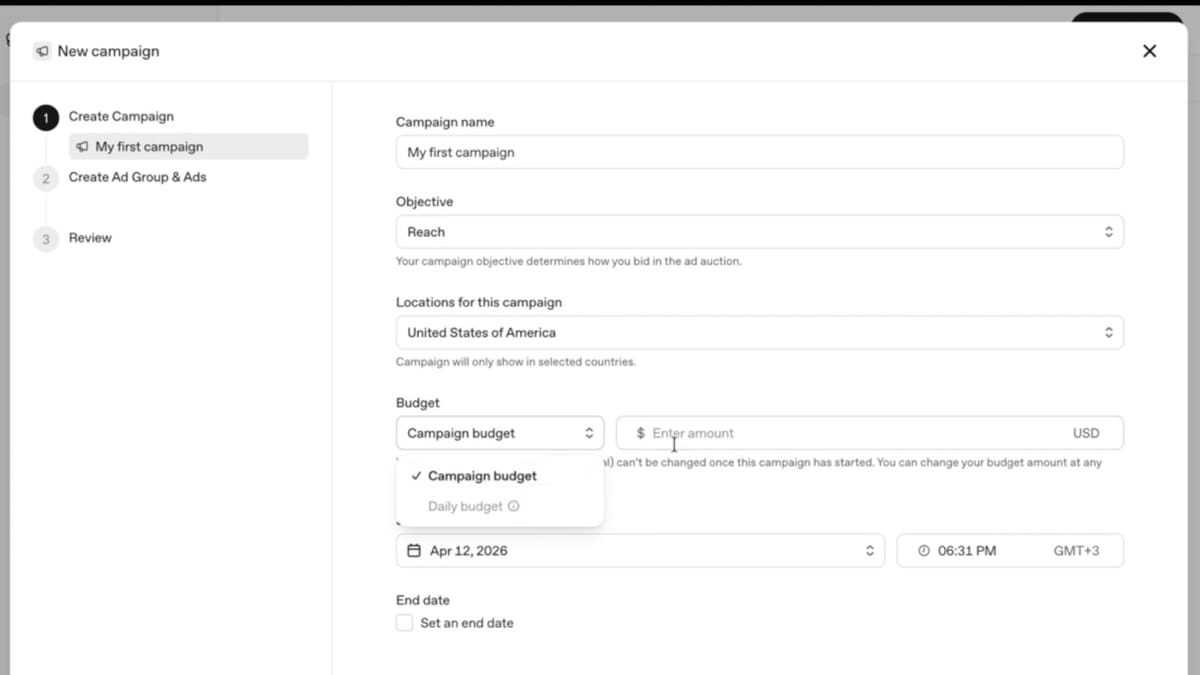
OpenAI this month launched a self-serveads manager for ChatGPT, making the tool available to a small group of advertisers for the first time and simultaneously lowering the minimum entry threshold from as high as $250,000 to $50,000 - a move that could bring a wider pool of buyers into a pilot that has already crossed $100 million in annualized revenue.
The development, first reported by Digiday on April 10, 2026, marks a significant operational shift for OpenAI's nascent advertising business. Until now, brands inside the pilot had to work through OpenAI directly or via agency intermediaries to track performance. The new tool changes that. According to Digiday, advertisers with access can now monitor impressions and clicks in real time and optimize campaigns without routing requests back to OpenAI or a third party.
The platform is described by those who have tested it as broadly similar in layout to Google Ads - serviceable, functional, and clearly built for speed rather than sophistication. That is by design. This is infrastructure assembled in months, not years.
The structure of the platform has been partially documented through early access accounts. According to Juozas Kaziukenas, an entrepreneur who published observations from a hands-on session via LinkedIn, campaigns follow a familiar three-tier hierarchy: Campaigns, Ad Groups, and Ads. Each ad unit consists of a headline, a short description, and an optional square image. Video formats and alternative placements are not yet available.
Targeting works differently from most established platforms. Rather than audience segments built from demographic or behavioral data, OpenAI's system relies on what it calls context hints. According to Kaziukenas, context hints allow advertisers to provide "plain-language guidance on when your ad should appear," describing the types of queries for which the ad would be relevant - or pasting a set of keywords if preferred. The only additional targeting parameter currently active is country-level geographic targeting.
Three campaign objectives are offered: reach, clicks, and conversions. Only reach - priced on a CPM basis - is currently functional. Clicks and conversions are marked as coming soon. Daily budget controls are also listed as a forthcoming feature, though campaigns can be set with specific start and end dates. Reporting tracks impressions and clicks.
According to an OpenAI spokesperson quoted by Digiday, the platform has not been fully rolled out. "As part of the pilot, a subset of advertisers are beginning to test an early version of an ads manager platform. This is still an early phase, and we're using it to gather feedback as we continue refining the tools."
When the ChatGPT advertising pilot launched in January 2026, the minimum commitment was set at $250,000. That figure was a deliberate filtering mechanism - a way to ensure only committed, well-resourced advertisers entered a test with limited inventory and no pixel-based attribution. Some agencies were told the floor was as high as $250,000; OpenAI confirmed $200,000 to Adweek. Either number represented a significant barrier for all but the largest brand advertisers.
That has now changed. According to an advertising executive quoted in the Digiday report who has clients already in the pilot, OpenAI "recently lowered the minimum threshold to participate in the pilot to $50,000," with the change confirmed toward the end of the week of April 7. The executive described this as a significant drop - and a clear signal that OpenAI is trying to widen the funnel.
Debra Aho Williamson, founder and chief analyst at Sonata Insights, framed the shift in historical terms. "OpenAI needs to move quickly to establish itself as a legitimate player in the ads business, so launching an ad manager early is an important step," she said, as quoted in the Digiday report. "For example, Facebook began allowing advertisers to buy ads via a self-serve ad platform in 2007, and that wasn't long after it started selling ads."
The comparison to Facebook's early self-serve rollout is instructive. Self-serve tools are not just operational conveniences - they are the mechanism by which advertising platforms scale from controlled experiments to open markets. Google, Meta, and Amazon each made that transition through self-serve. OpenAI appears to be following a compressed version of the same path.
At $50,000, advertisers are also only charged for inventory that is actually bought. That pay-for-what-you-get pricing structure matters in a pilot where, as the executive acknowledged, "performance volume is still limited." The implicit offer is entry at lower risk.
One figure has remained fixed through the threshold reduction: the CPM rate sits at $60. That number has been consistent since the pilot began accepting advertisers in February 2026, and it positions ChatGPT advertising well above the rates typically available on Meta - where CPMs frequently fall below $20 - and roughly in line with premium streaming and NFL broadcast inventory.
The justification OpenAI offers internally is rooted in user intent. The argument is that ChatGPT users encountering an ad are already in an active decision-making state - closer in mindset to a high-intent search query than to passive social browsing. That framing supports a premium price. Whether it holds at scale, once the pilot opens further, remains an open question.
According to the advertising executive quoted by Digiday, the rate needs to stay fixed for the duration of the test: "If they change the CPM partway through the test, it would mess up how they're looking at it." That is a calibration argument - changing the rate mid-experiment contaminates the data OpenAI needs to understand what the inventory is actually worth.
Internal Criteo data from a sample of 500 US retailers observed in February 2026 offers early evidence in OpenAI's favor: users referred from LLM platforms like ChatGPT were found to convert at approximately 1.5 times the rate of other referral channels. The sample is narrow - a single month from one ad tech partner - but the directional finding matters for justifying the premium CPM.
The urgency behind OpenAI's advertising buildout is not difficult to explain. The company is projected to lose $14 billion in 2026 by its own internal estimates, according to Karsten Weide, principal and chief analyst at W Media Research, who told Digiday that OpenAI is "desperate for money." A planned IPO, expected later in 2026, creates additional pressure to demonstrate revenue traction.
The advertising pilot crossed $100 million in annualized revenue within six weeks of formally launching on February 9, 2026, according to Reuters citing company figures disclosed on March 26. At that same point, more than 600 advertisers had joined the program, and OpenAI announced geographic expansion into Canada, Australia, and New Zealand. The $100 million figure was annualized - meaning the actual revenue over six weeks was roughly $11.5 million - but the trajectory demonstrated genuine advertiser demand.
The longer-term target is considerably more ambitious. According to reporting by The Information, OpenAI has projected that advertising could generate $102 billion by 2030. That figure requires scale that cannot be achieved through managed placements and high minimum thresholds. It requires the kind of self-serve infrastructure that the ads manager now represents, even in this early form.
The ads manager does not exist in isolation. It is one piece of a stack OpenAI has been assembling rapidly since confirming advertising plans on January 16, 2026, following months of internal delays and a December 2025 "code red" directive that had paused advertising development entirely.
Criteo became the first formal ad tech partner in the ChatGPT pilot on March 2, 2026, giving OpenAI access to approximately 17,000 advertiser clients through an established commerce media platform. The partnership gave OpenAI programmatic infrastructure it did not yet have internally - a deliberate shortcut while the company builds its own stack from the ground up. Smartly, the New York-based AI advertising platform managing over $7 billion in global ad spend, has also been working with OpenAI as the pilot expanded.
The hire of David Dugan, a former Meta advertising executive, to lead OpenAI's global advertising solutions team - announced on March 26 alongside the $100 million milestone - brought direct platform-scale experience into OpenAI's leadership. Dugan's appointment alongside Asad Awan, who leads monetization and outlined the longer-term advertising vision in a February 9 podcast, gives the advertising function more senior leadership density than it had even a month ago.
The pilot testing period was originally planned to run until the end of March 2026. It has already been extended through the end of April. According to agency buyers cited in the Digiday report, a further extension is considered possible. The lower minimum threshold and the arrival of the ads manager may accelerate demand in ways that require more time to properly evaluate.
According to OpenAI's official help documentation, ads in ChatGPT are currently only being tested in the United States and may change as testing expands. The test formally began on February 9, 2026. Ads appear for users on the Free and Go subscription plans. Plus, Pro, Business, Enterprise, and Edu accounts do not receive ads. During the test, OpenAI does not show ads in accounts where the user indicates or is predicted to be under 18.
The placement is specific: ads can appear below the end of a response, clearly labeled as sponsored and visually separated from ChatGPT's output. According to the help documentation, ads do not appear in Temporary Chats, when users are logged out, after image generation, or in the ChatGPT Atlas browser. Advertisers in sensitive or regulated verticals - including dating, health, financial services, and politics - are excluded from the current test entirely.
Ad targeting begins with the content of the current conversation. OpenAI matches the topic of the chat to advertiser submissions. For users who enable personalized ads, the system can also draw on past chats, memory, and previous ad interactions. According to the documentation, advertisers receive only aggregated, non-identifying performance data such as total views or clicks. Individual conversations, chat history, memories, and personal details are not shared with advertisers.
Users retain meaningful controls. They can turn off ad personalization, dismiss individual ads, report ads as misleading or inappropriate, and view the reason a specific ad was served. Ad data is retained for up to 30 days and can be deleted at any time, though full removal from OpenAI's servers may take the full 30-day period after deletion.
Users who prefer not to see ads have two options: switch to a paid plan (Plus or Pro), or choose an ads-free version of the Free plan - which removes ads but reduces message limits and restricts access to tools including image generation and deep research.
The arrival of a self-serve ads manager changes the practical accessibility of the ChatGPT pilot. Before this week, buying into the test required either direct engagement with OpenAI's sales team or a relationship with a partner like Criteo. That meant the pilot was effectively limited to large brands, major holding companies, and advertisers with sufficient budget to meet six-figure minimums.
At $50,000, the entry point now overlaps with mid-market advertisers who routinely allocate five-figure monthly budgets across Google, Meta, and programmatic channels. Those advertisers were watching ChatGPT's advertising rollout from a distance. The tools and the pricing threshold now make participation more plausible.
There are real limitations that matter for any advertiser evaluating the platform. Attribution remains underdeveloped - ChatGPT does not yet offer impression-level measurement or the outcome tracking that performance marketers expect from established channels. The reach objective is the only live campaign type; clicks and conversions are pending. Performance volume, by the advertising executive's own account, remains limited.
These are not unusual characteristics for a platform at this stage. Google's early AdWords offered limited targeting and basic reporting. Facebook's 2007 self-serve launch preceded the conversion tracking and pixel infrastructure that defined its eventual dominance. What matters for the marketing community is whether ChatGPT advertising delivers measurable outcomes at a frequency and cost that justifies the CPM. The next phase of the pilot - with more advertisers, lower minimums, and a functioning self-serve interface - will start to answer that.
Who: OpenAI, the artificial intelligence company behind ChatGPT, along with its advertising pilot participants including early brands such as Target, Ford, Mrs. Meyer's, and Adobe; ad tech partners Criteo and Smartly; holding companies WPP Media, Omnicom, and Dentsu; and newly appointed global advertising solutions head David Dugan.
What: OpenAI has quietly launched a self-serve ads manager for ChatGPT, giving a subset of pilot advertisers the ability to monitor impressions and clicks in real time and manage campaigns directly for the first time. Simultaneously, OpenAI lowered the minimum spend threshold to participate in the pilot from $200,000 to $250,000 down to $50,000. The platform uses context-hint targeting, supports a Campaigns - Ad Groups - Ads hierarchy, and currently offers only CPM-based reach objectives, with clicks and conversions listed as coming soon.
When: The ads manager was confirmed to be in testing as of the week of April 7, 2026, with Digiday reporting the development on April 10, 2026. The wider ChatGPT advertising pilot began formally on February 9, 2026.
Where: The ChatGPT advertising pilot is currently active in the United States, with expansion announced to Canada, Australia, and New Zealand on March 26, 2026. The ads manager is currently accessible only to a subset of pilot advertisers.
Why: OpenAI is projected to lose $14 billion in 2026 and is targeting $102 billion in advertising revenue by 2030, according to internal projections. The company is building self-serve advertising infrastructure as foundational infrastructure for scaling its ad business ahead of a planned IPO expected later in 2026. Self-serve tools are how Google, Meta, and Amazon each transitioned from controlled experiments to dominant advertising platforms, and OpenAI's moves suggest the company is attempting a compressed version of the same path.