Pinterest's new in-platform tool could end spreadsheet planning hell
Pinterest Media Planner streamlines upper-funnel campaign planning with audience insights and budget estimates directly in Ads Manager as of January 23, 2026.


Pinterest Media Planner streamlines upper-funnel campaign planning with audience insights and budget estimates directly in Ads Manager as of January 23, 2026.
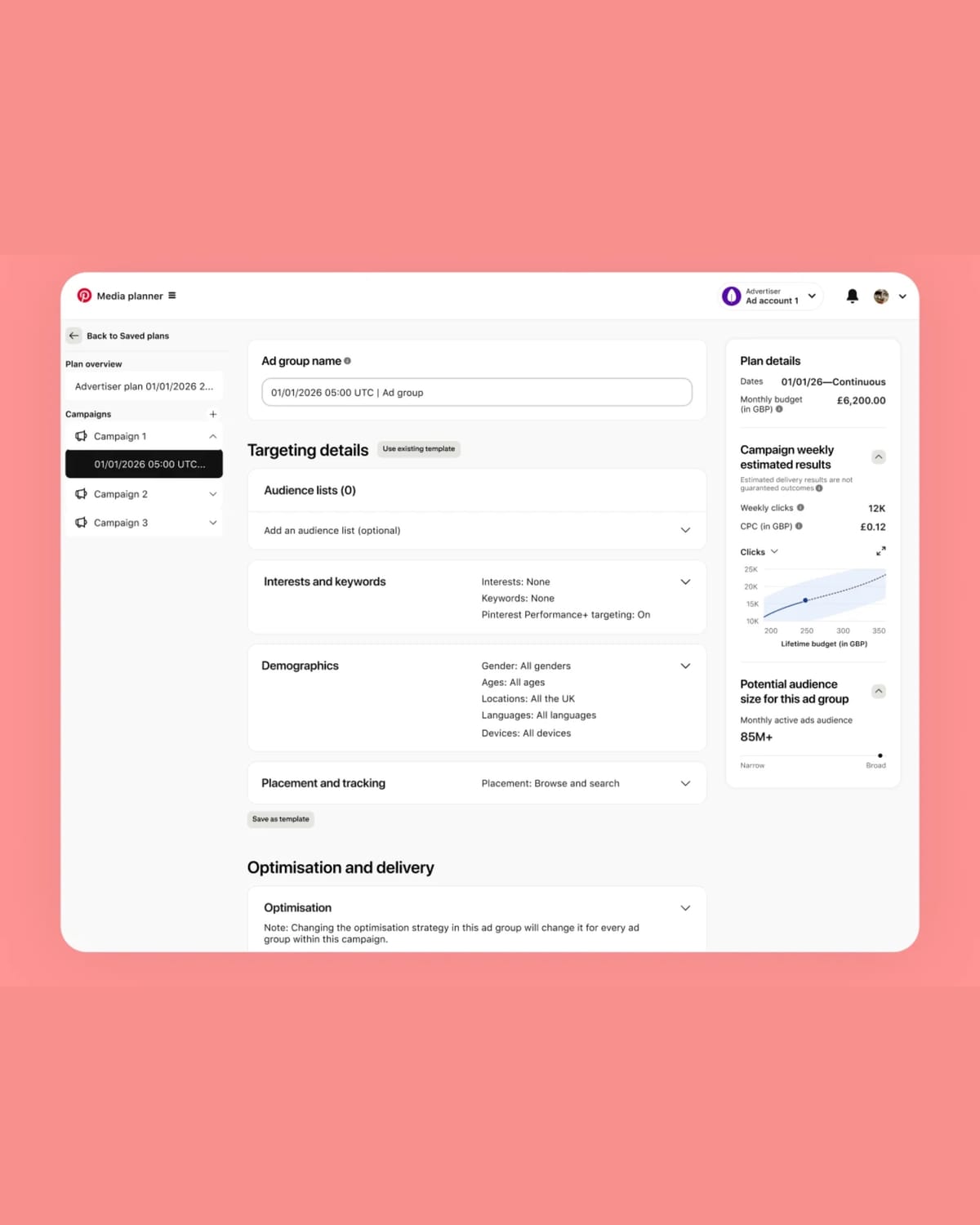
Pinterest this month integrated campaign planning capabilities directly into its Ads Manager, eliminating manual spreadsheet work for brand awareness and consideration campaigns. The Pinterest Media Planner provides audience discovery, budget optimization, and performance forecasting within a unified interface.
According to the announcement published January 23, 2026, the tool addresses friction in upper-funnel marketing workflows by consolidating media planning functions that previously required external tools or manual calculations. Advertisers can now explore audience segments, estimate campaign metrics, and model different scenarios without leaving the Pinterest advertising platform.
The Media Planner operates within three core functions. Audience exploration enables advertisers to discover and size demographic, interest, and keyword affinity segments using Pinterest's internal data. Budget estimation provides projections for key awareness metrics including impressions, reach, frequency, and cost per thousand impressions. The system also generates consideration campaign estimates for clicks and cost per click across specific countries.
Scenario modeling functionality allows advertisers to compare projections across multiple variables. Marketers can test different budget allocations, flight dates, audience configurations, and creative formats before committing resources to live campaigns. The platform generates side-by-side comparisons enabling data-driven decisions on media mix optimization.
Pinterest's approach reflects broader platform consolidation trends where advertising systems integrate planning, execution, and measurement within single environments. LinkedIn introduced its Media Planner tool on March 25, 2025, providing forecasting for reach, impressions, frequency, and cost-per-result metrics. Amazon consolidated its DSP and Ads Console into unified Campaign Manager on December 3, 2025, merging fragmented buying interfaces into single infrastructure.
The tool's emphasis on upper-funnel metrics addresses measurement challenges in brand awareness advertising. Recent research indicates that marketers struggle to determine channel impact despite unprecedented data access, with 86% of in-house marketers unable to evaluate performance across channels according to Funnel's December 2025 study.
Pinterest's media planning integration provides country-specific estimates, acknowledging regional variations in advertising costs and audience availability. This granularity supports global campaigns requiring localized budget allocation and performance expectations across markets with different competitive dynamics.
The collaboration features enable team coordination through shareable plans. Users can distribute planning links to stakeholders or export files for review cycles, addressing workflow requirements in organizations where campaign approval involves multiple decision-makers across marketing, finance, and executive teams.
Technical implementation positions the Media Planner within the Ads Manager navigation structure. Advertisers access the tool through the menu interface, selecting Manage campaigns followed by Media Planner. The placement indicates Pinterest's intent to position planning as integral workflow component rather than separate auxiliary function.
Cost per thousand impression forecasting provides baseline efficiency expectations before campaigns launch. This upfront visibility into CPM rates helps advertisers assess whether Pinterest inventory aligns with budget constraints and performance targets relative to alternative platforms offering similar audience demographics.
Frequency estimation capabilities address a persistent challenge in awareness campaigns where excessive exposure creates diminishing returns while insufficient frequency fails to build recognition. LinkedIn launched frequency cappingon July 2, 2025, allowing 3 to 30 impressions within seven-day periods. Amazon introduced frequency group reporting on December 23, 2024, enabling cross-campaign reach measurement and achieving 6% average increases in unique user reach.
Pinterest's audience insights integrate demographic characteristics with interest patterns and keyword affinities. This combination enables targeting strategies that layer demographic parameters with behavioral signals indicating purchase consideration or lifestyle preferences relevant to advertiser offerings.
The platform's emphasis on consideration campaigns alongside awareness objectives reflects dual funnel positioning. While awareness metrics focus on exposure and recognition, consideration metrics including clicks and cost per click measure deeper engagement indicating movement toward purchase evaluation stages.
Budget scenario testing functionality addresses resource allocation uncertainty in campaign planning. Marketers managing constrained budgets can model performance expectations across different spending levels, identifying optimal investment thresholds where incremental budget increases generate proportional metric improvements.
Flight date variables in scenario modeling account for seasonal patterns and competitive dynamics affecting campaign performance. Quarter-end budgets, holiday shopping periods, and product launch windows create demand fluctuations that influence both audience availability and advertising costs throughout calendar years.
Format selection within planning scenarios acknowledges that creative execution affects performance outcomes independent of targeting or budget decisions. Video, static imagery, carousel formats, and shopping-specific placements generate different engagement patterns requiring distinct performance expectations during planning phases.
Pinterest operates within competitive landscape where Meta, TikTok, and traditional platforms vie for visual discovery and shopping activities. The platform reached 600 million monthly active users in Q3 2025 with revenue climbing 17% year-over-year to $1.049 billion according to November 2025 earnings.
The Media Planner launch follows Pinterest's infrastructure investments throughout 2025. Top of Search ads launched September 25, 2025, achieving 29% higher click-through rates than standard campaigns. AI-powered board upgradesarrived October 27, 2025, introducing personalized tabs and styling tools for content discovery.
Campaign planning efficiency affects marketing team productivity across organizational scales. Small businesses managing limited resources benefit from streamlined workflows eliminating manual calculations. Enterprise teams coordinating multi-market campaigns gain standardized planning frameworks supporting consistent methodology across regional variations.
The integration reflects Pinterest's positioning as planning platform rather than reactive social network. Internal research indicates Pinterest trends last nearly twice as long as trends on other social platforms, driven by user behaviors spanning months rather than days. This extended engagement window creates longer optimization periods for advertising campaign performance.
Measurement precision becomes increasingly critical as advertisers face transparency challenges across programmatic channels. Research shows only 36% of post-transaction programmatic budgets reach valid, viewable, measurable, and non-fraudulent impressions according to Association of National Advertisers data. In-platform planning tools providing upfront performance estimates address uncertainty in campaign delivery.
The tool's arrival coincides with growing pressure on marketing budgets demanding accountability. Industry predictions indicate 2026 marks the year when outcome-based measurement becomes standard practice, with advertisers requiring proof of business impact including sales uplift and customer acquisition rather than proxy metrics.
Pinterest's keyword affinity data within audience exploration provides intent signals beyond demographic characteristics. Users searching specific terms demonstrate consideration for related products or services, enabling targeting strategies that reach audiences during active planning phases when purchase decisions remain fluid but interest has formed.
Historical performance context influences planning accuracy. Platforms lacking robust historical data generate estimates with wider confidence intervals, while systems incorporating extensive campaign history produce projections with tighter variance ranges. Pinterest's estimate methodology likely incorporates aggregated performance data across similar campaigns to inform projections.
The export functionality addresses enterprise workflow requirements where planning documents circulate through approval hierarchies before execution authorization. Finance teams evaluating budget requests and executive stakeholders reviewing marketing strategies require documented assumptions supporting resource allocation decisions.
Cross-campaign scenario comparison within single planning sessions accelerates strategic evaluation. Marketing teams can model Q1 brand awareness campaigns alongside Q2 consideration initiatives, identifying optimal sequencing and budget distribution across temporal phases within annual marketing calendars.
Pinterest's unified planning environment reduces context switching between tools that fragment marketer attention and introduce coordination overhead. Systems requiring manual data transfer between planning spreadsheets, budget allocation tools, and campaign setup interfaces create error opportunities and slow execution velocity.
The Media Planner positions Pinterest within broader industry movement toward consolidated advertising platforms. Google introduced Cross-Media Reach measurement enabling deduplicated reach tracking across video campaigns. Display & Video 360 enhanced frequency cap metrics on August 26, 2025, replacing bid request calculations with media cost methodology.
Country-level granularity in budget estimates acknowledges regulatory environments, competitive landscapes, and economic conditions affecting advertising costs. Markets with concentrated advertiser demand and limited inventory generate higher CPMs than developing markets with expanding inventory and nascent competitive dynamics.
Impression forecasting provides scale expectations informing reach potential across target audiences. Campaigns requiring mass awareness benefit from high impression volumes distributed broadly, while niche targeting prioritizes concentrated exposure among smaller highly-relevant segments.
The scenario modeling architecture supports iterative refinement where planners test assumptions, observe projected outcomes, adjust parameters, and compare results. This exploratory workflow enables discovery of non-obvious optimization opportunities that might not surface through sequential single-scenario analysis.
Pinterest's integration follows platform pattern where functionality development progresses from manual processes through semi-automated workflows toward fully integrated environments. Early Pinterest advertisers built media plans in spreadsheets, requiring manual assumption documentation and performance projection calculations.
Reach estimation capabilities complement impression forecasting by distinguishing between gross exposures and unique audience counts. Campaigns optimizing for broad awareness prioritize reach maximization, while frequency-focused initiatives concentrate impressions among core audiences to build recognition through repeated exposure.
The planning tool architecture positions Pinterest to capture increased planning activity occurring during early campaign development phases. By embedding within advertiser workflows at conceptual stages rather than only execution moments, the platform increases engagement touchpoints and informs strategy formation.
Collaborative features address distributed team structures where campaign development involves marketing strategists, media buyers, creative teams, and analytics specialists operating across geographic locations and organizational divisions. Shared planning links enable asynchronous collaboration without version control complications inherent in file-based workflows.
Pinterest's Media Planner arrives as advertisers seek efficiency improvements across campaign workflows. Research indicates marketing professionals face data overload with 86% unable to determine channel impact despite unprecedented tool access. Consolidated platforms addressing multiple workflow stages within unified interfaces reduce complexity fragmenting attention.
The integration represents infrastructure investment supporting Pinterest's competitive positioning against platforms with established planning capabilities. Advertisers comparing platform options evaluate not only audience characteristics and inventory quality but also workflow efficiency and measurement sophistication supporting informed decision-making.
Who: Pinterest introduced the Media Planner for advertisers managing brand awareness and consideration campaigns on the platform.
What: A campaign planning tool integrated directly into Pinterest Ads Manager that provides audience discovery, budget estimation with metrics including impressions, reach, frequency, CPM, clicks, and CPC, plus scenario modeling comparing different budget allocations, flight dates, audiences, and formats. Users can save and share plans with team members or export files.
When: Pinterest announced the Media Planner on January 23, 2026, following platform infrastructure investments throughout 2025 including Top of Search ads, AI-powered board features, and visual search expansion.
Where: The tool operates within Pinterest Ads Manager, accessible through the Manage campaigns menu. Advertisers can generate country-specific estimates for campaigns targeting different geographic markets.
Why: The Media Planner eliminates manual spreadsheet work and external tools previously required for upper-funnel campaign planning, consolidating audience insights, performance forecasting, and collaborative workflows within unified interface. The integration addresses marketer demands for streamlined planning capabilities supporting data-driven budget allocation and media mix optimization decisions.